Showing posts with label Routine. Show all posts

Tuesday, January 28, 2020

Tuning Slide #5.25- Professional Action

Weekly Reflections on Life and Music

Your vision will become clear only when you look into your heart. Who looks outside, dreams. Who looks inside, awakens.
— Carl Jung

Last week I talked about being a professional or procrastinating? Part of it was based on this article by Mayo Oshin.

There she gave a two-part answer to how to become (and stay) “pro”:

◆ Thou shalt commit to a schedule.
A schedule is simply a pre-commitment to consistently put in your ‘reps’ and hours in your craft. Just like any new habit, your willpower and ability to delay gratification will also affect your consistency levels.

◆ Thou shalt believe that thou art ‘Pro.’
This is why it’s so important to shift your identity. You have the power right now to believe that you’re a professional. [But] To say that you believe you’re a pro isn’t enough because actions speak louder than words. Prove to yourself that you’re really a pro and do the things that a pro would do every day.

I then concluded that I have recently been guilty of procrastination. Being inspired by her directions, I said I needed to answer three final questions from Oshin’s article. So let’s see what happens.

◆ Am I committed to being a professional in any area of my life?
Two old statements I’ve used before came to mind as I worked on this:
  • How you do anything is how you do everything and, from author Annie Dillard,
  • How we spend our days is, of course, how we spend our lives.
What these both mean is simple and two-pronged. First, it isn’t in whether I say I want to be professional at something, it’s whether I am truly committed to it. True commitment means action, it means doing the things that lead to becoming professional. I have worked at that over these past 5-6 years and it has been exciting. I know it can be exciting and rewarding to get beyond my amateur mindset because I have done it in my life in other things, namely my careers and my commitment to a recovery lifestyle. I was not- and am not- just playing with those, I am committed to them. I have taken the time to do the preparatory work beyond just the basics. I have worked at improvement on a weekly, even daily basis. If my preaching after 30 years or my counseling after 25 hasn’t improved, well, I have not become professional. I have not done the deliberate practice.

This also says that I have been willing to commit to what is important to me in these areas, then I can do it in other things. I suppose I could do it in everything, but that would take up far more than the standard 24-hour/168-hour week. Other things can be hobbies, interests, likes- but I can’t spend the time to become “pro” in all of them. But I have become a professional, therefore I can do it. It can be how I spend my life. That means I can honestly answer “yes” to the first question. (By the way, it is always a good idea to take some time to reflect on this question about many things. Am I still committed to this particular professional area? Is it still a driving force of my life? That’s why I am still not 100% retired!)

◆ Is there anything holding me back from going pro?
Ah, now the self-reflection needs to get into deep honesty. There can be all kinds of answers to this, some of which might even indicate that one might need to look at NOT becoming “pro” in that area. That’s back at the commitment level. But having answered that question first, we can look at other things. A few that I have discovered over the years and in the past week include:
✓ Fear of failure
✓ Being overcommitted, i.e. not being able to say “No!” to myself or others
✓ Procrastination
✓ Having too many interests and hobbies
✓ Boredom with the mundane routine of every day
✓ Getting easily distrac… Squirrel
✓ Procrastination
✓ Self-Esteem
✓ Putting off until tomorrow what I should be doing today. (Procrastination!)

When I reach a procrastination point, that does not mean that I am in failure mode. It usually means that in one or more areas I am at a “stuck-point” or a “plateau.” When I move to the next question I can begin to put these in some order of what must be done while the stuck-point or the plateau is happening.

◆ What can I do to create the schedule and identity of a pro?
Now, the whole quote from Annie Dillard hits just as hard as the initial quote we usually hear.
How we spend our days is, of course, how we spend our lives. What we do with this hour, and that one, is what we are doing. A schedule defends from chaos and whim. It is a net for catching days. It is a scaffolding on which a worker can stand and labor with both hands at sections of time. A schedule is a mock-up of reason and order—willed, faked, and so brought into being; it is a peace and a haven set into the wreck of time; it is a lifeboat on which you find yourself, decades later, still living.
So last week I sat down and did the first step of a schedule, I made a list of the different projects and areas of my days (how I live my life!) and listed what needs to be done. That helps focus me, ease my distractability. If it’s written down it is less likely to get missed. I don’t call this a “To-Do” list. It is the raw material that tells me what is ahead, what deadlines I have made for myself, and allows me to do some planning of how much time needs to be spent at it. Once I get this I can now begin to think about how I want to do the schedule. I now see the skeleton of the day coming into being. I can put a timeline on some of them. For example, I need to have the Tuning Slide post done every week by Monday evening, latest. I need to take the time every day to practice trumpet. I have a monthly deadline for a book-writing group that requires writing and research. And so on…

That has helped me move beyond the plateau. I can now put some time frames on these. I know how much time I need and want to spend on my music routine. I know how much time I want to give to my physical fitness routine. I know what my different writing gigs will take. That means it’s time to move on. Stop worrying about the stuck-point or procrastination. I have a hunch I needed this time to put these all together in a new perspective.

As yourself, am I doing my “professional” stuff effectively? Am I putting my action and commitment together? Then make the plans- be deliberate. And, well, just do it.
Tuesday, January 21, 2020

Tuning Slide #5.24- Professional or Procrastination

Weekly Reflections on Life and Music

The difference between an amateur and a professional is in their habits. An amateur has amateur habits. A professional has professional habits. We can never free ourselves from habit. But we can replace bad habits with good ones.
— Steven Pressfield

Little did I realize when I set up my schedule of posts for these months that I would need to hear what I am writing about today. I originally planned this post as another reminder of what the differences are between “amateur” and “professional.” It is not, as I have said before, about getting paid versus not, it is about attitude, perspective, and mindset. It’s in the things like these from Jeff Goins at Medium:

✓ 1. Amateurs wait for clarity. Pros take action.
You have to know what you are before you can figure out what you want to do.
✓ 2. Amateurs want to arrive. Pros want to get better.
You have to become a student long before you get to be a master
✓ 3. Amateurs practice as much as they have to. Pros never stop.
You have to practice even, maybe especially, when it hurts.
✓ 4. Amateurs leap for their dreams. Pros build a bridge.
You have to build a bridge, not take a leap. It’s the daily practice. The amateur is concerned with the big break, whereas the pro is more focused on delaying immediate gratification in exchange for long-term success.

All well and good. Over these last five to six years I have made many changes and improvements. I have learned to take action, to strive for ongoing practice, to build bridges through that practice toward where I am going. It has been an exciting and fulfilling journey. I have finally accepted that being a professional musician is not just about making a living and having a career in music. It is living in those things in all of one’s life. That is how I grew and improved in my careers as a pastor and counselor. It is where I am still going in my life as a musician.

But it is not a straight line of constant improvement. In the past, when I reached certain points of “being stalled” or “plateaued” I just kept moving. The answers usually came. "Don’t stop" may be the best advice at those moments. More is coming.

Well, today I am writing to remind myself of all this in ways far beyond just my music. I noticed this especially when I reviewed the following from behavioral psychology writer Mayo Oshin (link):

▪ 1. Amateurs wait to feel inspired. Professionals stick to a schedule.
Professionals don’t let their feelings dictate their actions. They intentionally create and stick to a schedule come rain or shine.

▪ 2. Amateurs focus on goals. Professionals focus on habits.
Amateurs struggle with ‘resistance’ and procrastination because of their intense focus on the end result. Professionals treat success like a marathon and not a sprint. They focus on developing the habits that will naturally help them to achieve their goals as a by-product.

▪ 3. Amateurs strive to achieve. Professionals strive to improve.
The professional understands that achievement is simply an indication of how much they’ve improved. They are focused on continuous growth and seek to find new ways to improve themselves.

▪ 4. Amateurs stall after failure. Professionals grow after failure.
Amateurs try to avoid failure at all costs. They fear criticism and worry too much about what people would think if they failed. Professionals treat failure and criticism like a scientist—discarding the irrelevant information and using the relevant feedback to become better at what they do.

[Mumble] How did I know that I would be where I am today when I set up this schedule back six weeks ago? [Mumble] There must be some outside force that plans these just to keep me from getting too comfortable. [Grumble] I guess I need to live what I suggest. [Grumble one last time.]

Over the past month or so, I hit one of my walls in much of what I am doing.
~~ My trumpet practice routine got sidetracked by minor surgery. In my frustration, I have struggled with getting centered again.
~~ My workout routine got shifted by travel, though I have managed to keep my weight-loss goal steady, though at a plateau.
~~ My writing of this blog and two other projects started to become a chore, so I would just put it off. Part of this is because I am in a different setting than usual and haven’t gone to “The Office”, i.e. the coffee shops where I do most of my writing. I even thought of putting The Tuning Slide on hiatus for a few weeks. [Horrors!]

It reminds me of the saying I used here several years ago:

◆ How you do anything is how you do everything.

Over these weeks something (it) has shown up in anything and everything.

Okay, it is procrastination.

I need to name it- and the first step is to know that I am procrastinating and I need to do something about it. I need to remind myself that this isn’t an either-or choice. I am by nature one who likes to be inspired, to set goals, to achieve, and to avoid failure. Because I will bring that into my “pro” attitude, I remind myself that:

⁃ Professionals get inspired because of following schedules.
⁃ Professionals have goals as well as habits (which help them reach their goals).
⁃ Professionals achieve because they improve.
⁃ Professionals do get stalled, but they keep moving.

I go back to Mayo Oshin’s post. She gives a two-part answer to becoming (and staying) “pro”:

◆ Thou shalt commit to a schedule.
A schedule is simply a pre-commitment to consistently put in your ‘reps’ and hours in your craft. Just like any new habit, your willpower and ability to delay gratification will also affect your consistency levels.
◆ Thou shalt believe that thou art ‘Pro.’
This is why it’s so important to shift your identity. You have the power right now to believe that you’re a professional. [But] To say that you believe you’re a pro isn’t enough because actions speak louder than words. Prove to yourself that you’re really a pro and do the things that a pro would do every day.

Having been found guilty of procrastination and inspired by these directions, three final questions that I need to answer from Oshin’s article.
  • Am I committed to being a professional in any area of my life?
  • Is there anything holding me back from going pro?
  • What can I do to create the schedule and identity of a pro?
Take some time this week to look at those questions for yourself. I will, and then continue this next week. Be honest, rigorously honest, with yourself. It always helps to do that since we are good at keeping the truth from ourselves, though we usually know it’s BS.

You can never be true to others, if you keep on lying to yourself.
― Gift Gugu Mona

Monday, December 09, 2019

Tuning Slide #5.18- Keeping Chops

Weekly Reflections on Life and Music

Miss one day of practice, I notice;
miss two, the critics notice;
miss three, the audience notices.
— Credited to many from Franz Liszt through Louis Armstrong to Doc Severinsen and beyond.

I have not played my trumpet since last Sunday. I had some minor surgery and was told not to play. The pressure needed to play my horn could cause some problems and the last thing I wanted was to find myself with an even longer period of recuperation. I have obeyed. But I have missed it! When something has become a daily habit of years duration, there is an empty spot. I am not particularly worried about its impact on my chops. My last gig of the year is tonight (Monday) and I have plenty of weeks ahead to get things back in shape.

Sidenote: In the 1940s (though it was probably used for some years before it was recorded) chops began meaning one's ability, skill or competence, and was a jazz musician's figurative reference to one's embouchure, that is the use of one’s mouth and lips (i.e. chops) in playing a wind instrument. The better one was, the better chops one had. (Quora)

In any case that age-old statement quoted above did come to mind. If I had an audience just listening to me play tonight, they might even be able to notice that my chops weren’t where they could be.

Of course, that is a problem that many of us can often face since most of us are not full-time musicians. Sure, when I am healthy and in the midst of a series of different gigs, I may actually play as much as 20 hours/week, which, let’s be honest, is less than three hours/day. Doc warms up for that long before a gig! It can be difficult to have consistent chops with so (relatively) little playing. I may think I am doing an amazing job, but that is only in comparison to where I have been in the past. It obviously takes some special, deliberate action to keep the chops in some sort of shape when we are not full-time.

I came across a post at Rod Herbert Big Sound Music which addresses that. He titled it Getting Some “Chops” and Keeping Them! - Brass and Woodwind Skill Development Ideas For Busy Part-Time Community Band Musicians. He lists and describes a number of techniques he recommends to help. Surprise, there is no great big secret in them. What they are is, in essence, musical calisthenics that can be used in short segments at different times of the day. They can give a form and direction to some of the things that can go wrong. Just, for example, he says that breath control is one of the first things he loses. (He’s a bass trombonist!) He uses what he calls a Caruso-style calisthenics for sound, endurance, register development, and breath capacity. Go to the link to see what he does.

But most importantly, in reality, is to make sure that you play something every day. One of my teachers told me that when I got going on this version of my journey about ten years ago. As usual, he was right. Play. Get the horn on the face every day. Rod Herbert has these ideas [link]:
· Leave your instrument out of its case! Just make sure the kids don’t trips over it or use it for a football! Every time you walk past pick it up and play SOMETHING!

· Get a good practice mute or spend some money on a Yamaha Silent Brass System. Essential for both families and nosey neighbors. [That has given me the freedom to practice when I am traveling and staying in hotels/motels.]

· Lock yourself away for twenty minutes and get some chops! The ultimate “me time”. [Do that in a few random times added to regular practice time can make a huge difference.]
He also mentioned something called “Breathing Gym.” What in the world might that be? Well, “Breathing Gym” is a book and exercise routine for musicians developed by tuba players Sam Pilafian and Patrick Sheridan. From a PDF here is the introduction.

•Breathing Gym is designed to give control and efficiency of breath by developing proper breathing habits. It improves tone, stamina, and all-around performance

•Breathing Gym can be used as part of a warm-up routine or a mid-rehearsal change of pace while addressing specific issues such as dynamics, articulation, and phrasing

•Breathing Gym consists of five types of exercises:
⁃ Stretches
⁃ Flow Studies
⁃ Therapies
⁃ Strength and Flexibility
⁃ Breathing for the Brain

Here is a link to the PDF that gives the background and some general directions.

Will these work? Perhaps, especially if breath control is a concern of yours. Breathing exercises of course don’t need to be that intense. They can be meditation and mindfulness breathing. That can help with tension release, deeper inhalation, and increased awareness of how your body feels when breathing smoothly and with intention. It sets the brain/mind and body/muscle connections into greater sync. That will allow the breathing techniques needed for your instrument can become more intuitive.

Okay, so none of this is earth-shattering. What it does, though, is to bring some of these things closer to consciousness. We can pay more attention to our need for better chops if we pay attention to doing what we need to do for better chops. It can be known as deliberate practice, planned exercises, touching the instrument daily, mindful awareness of what makes me a better musician. It takes me away from being content with what I’m doing and moves me to the next level.

I have found over these years that this is most essential in a couple of specific situations.
✓ When I have reached a plateau of my playing. It can get discouraging to feel that things aren’t progressing. Yet, that is exactly when I need to take the effort. I have learned that my chops are not leaving me. They are ready to move on. Back then to the deliberate practice.

✓ When I do not have any specific gigs coming soon to practice for. When I know that I have to be at my best form for that upcoming concert or performance, I will find the time to practice. I will work on my chops and the music and the basics. When there’s nothing coming soon, well, I can get around to it tomorrow. Maybe that is why this came to me a this time. After tonight, my next concert will be at the beginning of February. That’s a long time from now. But I know I won’t be ready to get ready for that concert in January if I lose my focus today.

It doesn’t matter where any of us happens to be in the improvement and maintenance of our chops. The word itself brought to mind an old statement about finding enlightenment. The original was:
Before enlightenment; chop wood, carry water.
After enlightenment; chop wood, carry water.
— Zen Kōan

For our purposes:
Before you develop your chops, work on them.
After you have developed your chops, work on them.

Keep going, I tell myself. You’re getting closer.

As Rod Herbert said at the end of his post about chops:
DO try this at home!

Monday, November 04, 2019

Tuning Slide 5.14- Acting Like a Pro- Attitude

Weekly Reflections on Life and Music

Discipline is for professionals.
Motivation is for amateurs.
― J.R. Rim

I know I must be a professional musician- I’m not getting paid. (Rim shot.) Okay, just kidding. But I got to thinking one day about one of the most surprising aspects of what I have learned over these past five years of growth and musical development. Professional musicians are often just like non-professionals- just different in how they think. When I first connected with the group of musicians at Shell Lake Big Band Camp and the Trumpet Workshop, I came at playing and practicing trumpet just like I always had. I was, I knew beyond a shadow of a doubt that I was an “amateur” and I would never be anything but an amateur.

1. a person who engages in a pursuit, especially a sport, on an unpaid rather than a professional basis.
2. a person who is incompetent or inept at a particular activity. (Google)

I knew that the first was true, and the second? Well, if I wasn’t inept, I was at least less than many others. I didn’t think about becoming a professional. I just enjoyed playing the trumpet at whatever level I was able to reach and then just try to maintain it. What I discovered in the group at Shell Lake was that there is something different about professional musicians- their mindset. They have a different attitude, they have an outlook on playing music that is far from what I was doing. That quote at the top of the post this week is one of the things I learned. Motivation and discipline produce different results, although motivation can, and does, often lead to discipline and the resulting change of mind. (But that’s a whole other story for a different time. See Daniel Pink’s book, Drive: The Surprising Truth About What Motivates Us.)

For this week I just want to talk about what it is that I have experienced with this change in mindset.

On their website, the magazine Inc. has an article about motivation vs discipline. In it retired pilot David Burke, who spent 23 years as an elite fighter pilot, says that:

"More than any other quality, discipline is what drives a person to succeed when faced with adversity. And that's what the real world is: adversity." Discipline, Burke continues, is what "drives you to do the work you don't enjoy, but is required. Discipline conquers fear. Discipline keeps you going when your curiosity, motivation, and excitement evaporate." (Link)

When I walked away from my first summer at Shell Lake, I was motivated! Man, was I motivated. But I wasn’t yet disciplined. It wasn’t that I didn’t know how to become disciplined, (I've been a professional in other fields for 40 plus years), I just didn’t think it was anything special in this area. After all, I was “only an amateur.” It was after a number of months of increased practicing, discovering a daily routine and the inner joy of just playing music at a higher level, that I ran across the dreaded “boredom.” Long tones! Clarke 1, 2, and 3! Over and over. Day in and day out. I was learning and growing, but the excitement did begin to evaporate. So I switched to willpower. But (and this is also for another day) I knew that willpower is a limited resource. If I had used too much of it just to get through the day, I wasn’t going to have any to pick up the horn.

That’s when discipline began to set in. Back to the article from Inc. Jim Rohn is considered to be America's Foremost Business Philosopher. He says:

"It takes consistent self-discipline to master the art of setting goals, time management, leadership, parenting and relationships. If we don't make consistent self-discipline part of our daily lives, the results we seek will be sporadic and elusive."
"It takes a consistent effort to truly manage our valuable time. Without it, we'll be consistently frustrated. Our time will be eaten up by others whose demands are stronger than our own," writes Rohn.
"It takes discipline to conquer the nagging voices in our minds: the fear of failure, the fear of success, the fear of poverty, the fear of a broken heart. It takes discipline to keep trying when that nagging voice within us brings up the possibility of failure." (Link)

What kept me going was that I had changed my attitude, my mindset. I know that sounds like willpower, but it wasn’t. It was routine and habit. It was not a whim or a “well, let’s try this now” kind of attitude. That is what the professionals really bring to the table and what we can learn from them.

There is one aspect of this that I can’t overlook- I had to believe it was worth the time and effort, or else why would I do it? If all I got out of it was a sense of drudgery, boring long tones and scales, well, that isn’t enough to keep going. I also began to experience what I am sure drives most professionals in any field, including music- the sense of accomplishment. Disciplined and intentional practice began to give better results. I was enjoying the music and the routine. The habit was real- and I began to feel like a musician. Yes, that is motivation producing because my goal became I wanted to continue to improve. I was no longer afraid of succeeding or willing to say that at my age, why try?

Consistency, done daily, with good time management overcomes the fears Rohn mentioned above. It conquers the nagging voice that says, “Yeah, that’s nice, but you’re just an amateur!”

Not any more. No, I am still not getting paid for being a musician. But thanks to that incredible group of trumpet players I engaged with at Shell Lake, I am in the midst of becoming a “pro.”

Find a group of people who challenge and inspire you, spend a lot of time with them, and it will change your life.
— Amy Poehler

Monday, October 14, 2019

Tuning Slide 5.11- Interview a Musician: Yourself

Weekly Reflections on Life and Music

Courage doesn’t happen when you have all the answers. It happens when you are ready to face the questions you have been avoiding your whole life.
― Shannon L. Alder

I came across a post a few weeks ago that was aimed at journalists who were to interview musicians. It was a good list of questions to ask in order to write the story you were assigned. As I looked at it I realized that it was also a good list that could be used by the musician to review where they are and what some goals might be. They might not all apply to you or me in particular, but the idea is good.

First, the list of questions from the post:
▪ What drew you to the music industry?
▪ Who are you inspired by?
▪ Please explain your creative process
▪ What’s an average day like for you?
▪ Is there a hidden meaning in any of your music?
▪ Do you collaborate with others? What is that process?
▪ Please discuss how you interact with and respond to fans
▪ What is your favorite part about this line of work? Your least favorite? Why?
▪ Have you ever dealt with performance anxiety?
▪ Tell me about your favorite performance venues
▪ What advice would you have for someone wanting to follow in your footsteps? (Link)

To the list I would add, for personal reflection:
▪ What area(s) need(s) to be worked on?
▪ Where do I hope to be in the next year?

Me? Well, I’m glad you asked. Here are some of the things I discover by using some of these questions to interview myself.

▪ What drew you to music?
⁃ I don’t remember any time when I was not drawn to music. It almost comes naturally. I like most music and love some even more. It might have been the piano in the den or the old 78 rpm vinyl records in my grandpa’s record cabinet. Sheet music of “Show Me the Way to Go Home” and “Yes, We Have No Bananas” was fun. Records of “Tennessee Waltz” and “Pittsburgh, Pennsylvania” were almost magnetic. I took piano lessons in the 3rd and 4th grades but was kind of bored. Then came the trumpet in 8th grade- and I haven’t looked back!

▪ Who are you inspired by?
Today- My mentor and teacher, Bob Baca; Doc Severinsen who is still going strong at 92-years old and Herb Alpert at 82; John Raymond, friend and up and coming trumpet player! Historically- Al Hirt, Louis Armstrong, Miles Davis, Dave Brubeck, among many.

What’s an average day like for you? (I revise that to What’s My Practice Routine?)
⁃ With very few exceptions, due usually to a way to busy schedule some days, I play the horn every day. Generally, it is in several parts:
⁃ Warm-up time of 30-45 minutes. This usually starts with long tones done mindfully. I have discovered that using my mindfulness training as the foundation of the long tones, I can be far better at centering and locking-in the sounds. It settles me into the music and allows me to hear better. I will talk about this a little more in two weeks. That is usually the first 10 minutes then I move to some form of scales and Arban/Getchell-type exercises done slowly(!) with a sense of flow. After another 10 minutes or so I may work on a few of these with a little more speed and take them up an octave.
⁃ I may then spend time at that time or later on jazz scales and simple improvisation.
⁃ Work on pieces on the playlist for one of the groups I play in. This is usually at a time later in the day and might be anywhere from 20-40 minutes.
⁃ Rehearsing with the groups, usually 3 evenings a week. If not I will work on etudes, Arban exercises, extended jazz improvisation.
⁃ All together on any given day my playing may be from anywhere around 40 minutes minimum to upwards of 2 - 3 hours.

▪ What is your favorite part about this line of work? Your least favorite? Why?
⁃ The favorite is all about the playing. First, it’s the mindfulness/centering that starts my musical day. It focuses me for the day. When I don’t do it in the morning, I feel somewhat disconnected. Second, it’s the sound and the melodies moving through the horn. Third, it’s the opportunity to be part of groups that make music together, which is often a great deal more than the sum of the parts.
⁃ The least favorite is musicians who don’t focus. It can be very difficult to play in a group of any size if those around me aren’t focused. I don’t mean people who haven’t reached a level of ability, yet. Many of these do focus and are working at improving. But whining and not paying attention to what is happening around them is frustrating to those around them! (Not that I’m perfect at that. It is easy to get distracted and unfocused. But I am learning through my mindful playing of long tones that playing music in and of itself can bring that focus.

Let’s bring it to the goals, now. I put all these things together to realize what and who I would like to become, musically.
✓ First, looking at my last section, I probably need to work on some tolerance. Maybe I can start with myself and accept my own shortcomings in a non-judgmental way that allows me to relax about it and toward others.
✓ Second, to improve my practice routine and be a bit more consistent with the mindfulness part. That will continue the “wiring” of my brain in healthy ways to the playing of music. Slowing down and paying better attention to that simple action will help. (Again, I will talk more about this in a post in two weeks.)
✓ Third, in the next year, I want to move my jazz improvisation (and comfort level) beyond the blues or simple jazz changes. I have been moving toward some slightly more complicated changes, thanks to iReal Pro, but I have a ways to go. More consistent and intentional work needs to be done.
✓ Fourth, the flow studies need to be built upon. Slotting into the correct note without all kinds of movement and slipping is one of my current focus points. That, along with the fingering exercises that help that happen, may be the most important technical work I need to work on to move to a new level of musicianship. Altogether, all three of these will improve my “ear” and tone, part of that new level.

How about you? Take some time this week to interview yourself and see what needs you can identify- while all the time remembering what it was, and is, that draws you each day to your music!

Monday, August 26, 2019

Tuning Slide 5.4- Exercise is Important, Too

Weekly Reflections on Life and Music
Take care of your body. It’s the only place you have to live.
– Jim Rohn

Something I have been more than just slightly aware of over the years is the importance of exercise and physical fitness. I have never been great at it and sometimes have had to force myself into complying with my own principles, but I have had the desire and some motivation for many years. It is not a surprise to me that physical fitness can play a part in our musicianship- and perhaps even vice versa. My trainer tells me he doesn’t see many people (my age or not) who can hold a plank as long and as well as I can. When we discussed it, he said that it may have something to do with my trumpet playing. The importance of the abs in playing trumpet is clear- it’s where the power comes from. So maybe they do go together.

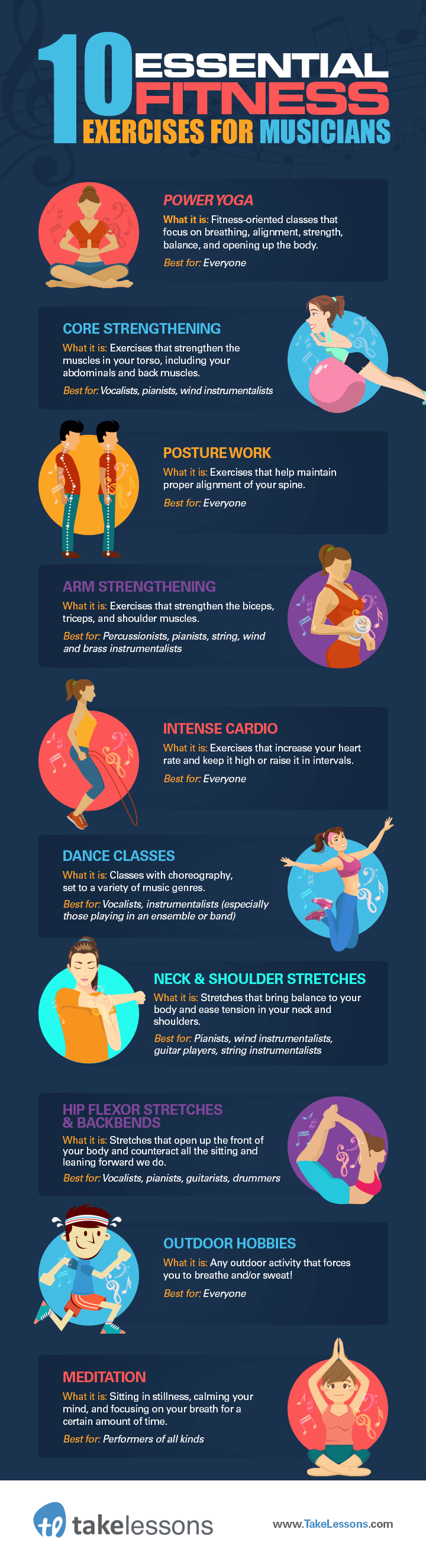
In any case, I came across this graphic at a blog called Take Lessons with 10 exercises and activities for musicians. (Link)


Some of the information from that blog talks about why these are important and can help musicians. Here is an edited version that brings out these advantages.

Power yoga
Learning how to properly and deeply breathe isn’t just important for singers! Taking full breaths is known to reduce stress and improve concentration. Breathing slowly and deeply, especially during challenging yoga poses, will help you to do so during stressful moments, calming both your mind and your body.

Core strengthening
Put simply, you need a strong core to hold yourself upright. It’s not just about having a six-pack; having a weak core can put strain on your back and ultimately cause chronic back pain. Core strength also helps improve your balance and stability — super important for all the sitting and standing we do!

Posture work
Sitting at a computer all day, being hunched over our phones, and slouching in general can wreak havoc on our posture. Over time, our spine begins to morph into the wrong shape — chin jutting forward, shoulders hunched, feet forming a v-shape. Not to mention that a performer with poor posture just doesn’t look as confident or as professional!

Arm strengthening
No matter if you’re a singer or you play an instrument, chances are you’re going to be holding something up, whether it’s your music, your instrument, or your arms. Some instruments may even require using the strength of your arms for certain techniques. Strengthening your arm and shoulder muscles can help prevent injuries, especially to the joints that end up fatigued when they aren’t supported by strong enough muscles.

Intense cardio
Cardiovascular health is important for everyone, but musicians especially can benefit from the mind-over-matter mentality that it takes to push yourself past your limits. And increasing your heart rate during exercise can ease stress, relieve anxiety, and help you sleep better — all of which benefit both your practice and your performance.

Dance classes
Dance classes with choreography require you to stay present and focused, and to memorize moves in the context of the music. These skills come in handy when you need to memorize a piece of music, especially if you are singing or playing with others. They also require coordination and improve your rhythm by forcing your body to feel the beat. Lastly, dance classes can expose you to types of music you might not listen to on your own.

Neck and shoulder stretches
Keeping tension in your neck and shoulders while practicing can cause you to suffer more over time. Especially if you allow your shoulders to come up and forward, this can really weaken your posture and cause back pain, in addition to the neck pain already present. Tension can also inhibit your playing, since many techniques require your muscles to be controlled but in a relaxed way.

Hip flexor stretches & backbends
Tension in the front of your body causes it to be imbalanced and ends up pulling on the back of your body. This takes a toll on your posture and can cause muscle and joint pain. Some say that we carry our stress in our hips, so opening them up would naturally help relieve that stress. Backbending opens your chest and lungs and can help you breathe more deeply.

Outdoor hobbies
In his piece “For Poets”, Al Young advises “Come on out into the sunlight/ Breathe in Trees/…Don’t forget to fly”. The message rings true for all artists — the best inspiration comes from being out in nature and experiencing life. Many musicians spend so much time holed up in studios and practice rooms, so it’s even more important to remind ourselves to get out there and have those one-of-a-kind experiences.

Meditation
Meditation not only reduces stress and anxiety, it also improves focus and memory. And when you have the skills to calm your mind anywhere, anytime, you can handle anything! For performers especially, practicing meditation will connect your mind and body and allow you to keep calm, no matter how many people are in the audience. (Link to Take Lessons)

Of course, be cautious. Don’t get into some exercise class or regimen without checking with a doctor, especially if you have not been active. Plus, take it easy- build into it. It takes time to get into shape, just as it has taken time for any of us to get where we are with our music. We can do great damage to ourselves and our health if we don’t develop balance.

The interplay between fitness and musicianship is clear. It is not to become fitness champions, it’s about doing what you can do to keep yourself in shape. There are plenty of places to take yoga classes, work on the Alexander technique, discover T’ai Chi, get out an hike. I am too geeky to be able to take a dance class, but maybe that will be the right way for you. Yes, it takes planning, work, and discipline to get into a fitness routine. But we already know the importance of being in a good practice routine. Time to apply it.

Monday, August 12, 2019

Tuning Slide 5.2- What I've Learned

Weekly Reflections on Life and Music

Anyone who stops learning is old, whether at twenty or eighty.
—Henry Ford

As I get into the fifth year of The Tuning Slide I took some time to think about what I have experienced and learned since that first August at Shell Lake Trumpet Workshop. I have decided to put it into the form of a letter to Bob Baca, the director of the workshop and my main mentor these past four years. I am not ignoring the other faculty and people at home who have been part of this journey with me. Together they have helped me implement the ideas and more to where I am today!

Hi Bob,

Well, I missed the trumpet week at Shell Lake this year. It was a tough decision, but I have an opportunity to do some different kind of stretching in my musicianship and I’m taking it. As I told you I will be going to an adult concert band camp in Door County in a couple weeks and couldn’t swing both this year. But more on that later in the year. Instead I want to summarize the many things that you (and the others) have helped me achieve.

What I have learned from these past 4 years:

1. Routine!
I remember from these years at Shell Lake that you and the faculty have often said that one plays a high C the same way one plays a low C. At first I didn’t understand, but I believed you and kept waiting for it to happen while doing what I needed to do. The time spent on playing the lead pipe and LONG TONES has paid off. Last year at the Brass Festival in North Carolina I found myself just playing what was on the page- and the notes came out. The answer to that was a routine. A routine that is regular and consistent.

2. The Basics.
I learned that if we don’t continue to work on our skills, develop our tone, practice rhythms and etudes, we can become stale. Over these past four years I have been renewed in my skills, I have practiced and discovered more ways to speak the language of the trumpet and to put more style and tone and life into it. If I am to grow in any way in my abilities I have to practice the basics- which you have taught me to do and then move into greater technical proficiency. All I wanted to do was be a better musician- and it has happened.

Many years ago I was a first-chair, lead trumpet with whatever skills a high school senior could have in1965. I have learned the importance of being a section player and have discovered all kinds of new techniques. I have never stopped playing, but in the past four years I went from “just playing” to “being musical”. I would never have believed it when I left Shell Lake after that first camp in 2015. I have been amazed at what can happen- and yes, as I have said before, even an old dog can learn many, many new tricks.

Perhaps above all else I have discovered the absolute necessity of never leaving the basic behinds. The Bill Adam routine has taught me not to forget or neglect these basics on a daily basis. I play 10-20 minutes of long tones in various forms every day. It is the foundation. I play exercises in all 12 major keys; I go back and use the first Arban exercises regularly; I discovered that if I can hear it, I can play it. My fingers now move more fluidly through muscle memory and my ears hear more through aural memory. I have learned to always have a beginner's mind!

3. Easy does it. Patience, slow down.
Don’t force it; don’t rush it. The secret to playing fast is to play slowly. Sometimes so slowly that you may not even recognize the tune. If it isn’t working, go back to the basics behind it. So simple, yet so powerful.

4. You can skip a day but you’ll never get it back
I have missed very few days over these last four years, mostly when I was recuperating from surgery and wasn’t allowed to play. Once in a while I may take a day off because there was no way around it. More often I will do the basic long-tones and scales for 30 minutes. On most days I play and now I can play a lot.

5. Listen, listen, listen
Pay attention to yourself in your own practice and to those around you in rehearsal. We practice alone to get to now our part. We rehearse with others to know how our part fits in with the others.

6. The Inner Game- trust self 2
The Inner Game ideas have been around a while and they work. I have known them for years; now I know how to better utilize them and to trust me - Self 2- to do what I can do.

7. Play out. Just do it.
Some may think that a “timid trumpet player” is an oxymoron. Put me in a group or public performance and I would become a timid musician. What a waste. It is exciting. That doesn’t mean to over-perform, be over loud or obnoxious. I means what it says- just do it!

8. Stretch outside the box
I know the importance of stretching one’s skills. It is how we grow. What I have learned in these past four years has given me some directions on how to do that. I enjoy it too much now to even think of stopping.

9. It’s at least 90% mental.
The basics of playing and performing music are the easy parts. Just keep practicing. This goes back to- and expands on the inner game. If you don’t think you can do it- you won’t be able to do it. But if you believe you can- you will- even if it takes months and years of practice.

10. Mindfulness
Mindfulness is the basis of a life of hope and growth. Being self-aware and then being aware of all that is around me and living within it- that’s the ability to be mindful. It doesn’t mean lack of growth or being content with just leaving things as they are. It means being attentive and in my musicianship knowing where I can go next.

That’s what I have learned. Here is what I have received:

A. Play like you like it- and you will like playing.
This is perhaps best described in the meme: If you don’t like playing long tones, you probably don’t like playing trumpet. Really? Yep! It is fun to discover something new with different ways of doing long tones each day. I really like playing and it makes a real difference each day.

B. Confidence
Two weeks ago at a community band rehearsal I had to play a solo part that I had never read before since the soloist wasn’t able to be at that rehearsal. Then I had to play some upper register lines. Yep- I did both. Confidence has built. I don’t get panicked when I see some of those notes or at a passage I would have backed off from before. Now, later this week, I will be attending that concert band camp where I have to audition. I am not the least bit afraid. Call out a major key- I can play any of the 12. Give me a sight-reading page- I know the basics. Am I nervous or anxious. Not any more. Now I am excited.

C. Energy and excitement
What can I say? They sum up what I have been given. The other day I was feeling a little under the weather and restless, unable to find something to direct me. My wife looked at me and simply said, “Go play your trumpet. That always works.”

And it did.

Thank you, Bob and the Shell Lake Trumpet Workshop. You have given me one of the greatest boosts of the past 30 years.

Crazy? Yep- crazy good!

Monday, June 03, 2019

Tuning Slide 4.45- Being Free #1

Weekly Reflections on Life and Music


It does not matter how slowly you go as long as you do not stop.

Confucius

Last week I re-told the story of how I got stuck on a Memorial Day 50 some years ago. It held me under its control for nearly 50 years. Every now and then I would break through a little, but only in the past six to eight years have I been able to break out of it and begin ever so slowly to move forward.

This happened in my career as a pastor when I moved from the church where I had started as a “student” pastor to my second congregation and became a “real” pastor. I discovered confidence and my own gifts. It happened again in my early career as a counselor. When I was able to do things more naturally as a counselor, I knew I had moved into a new place.

Why did it take so long with my music? It’s hard to know, but for some reason my trumpet playing always sat there in the background, while I quietly wished I could do something about it. I did not face it, until finally, I did. I never stopped playing, but I didn’t advance. So I recently went digging into how people get past those stuck points. When you reach that kind of plateau or wall, how can one break through?

I came across a website/blog called Planet of Success that calls itself a “ community designed to inspire you to live a successful life full of joy, meaning, and happiness.” I found there a post about ten powerful ways to free yourself when feeling stuck. Steve Mueller, the founder of Planet of Success, tagged the post as “comfort zone” and “limiting beliefs.” Looking at his post I knew he had presented some good insights that showed how I managed to get unstuck in my careers- and then in my music. So in this and the next three weeks, I will look at these 10 ways to get free- and stay that way.

First, so you know where we are going, here are the ten.
1. Face your fears
2. Break your routine
3. Effect change, one step at a time
4. Overcome the perception of impossibilities
5. Be honest with yourself
6. Change your perspective
7. Differentiate between feeling and fact
8. Avoid blaming others
9. Stop comparing yourself to others
10. Stop making excuses
11. Be grateful for what you have
I will look at only the first three this week in my normal way of presenting some of the original ideas and adding my riff to it. My riffs will be in italics.

1. Face your fears
✓ People are unable to move forward because they are afraid.
At some point in life, we simply became afraid of going any further…. We gave in to our fears. We allowed fear to stop our progress in life.
Everyone on this planet, and I mean really everyone, has fears. It’s not something to be ashamed of. … There’s no need to be afraid of failure. Be concerned about not having the courage to try.

In my case, my fear was that I would fail. No, my fear was I knew would fail- I was convinced I wasn’t as good as I used to think I was and people might find that out. I put everything into hiding that. In my careers, I managed to overcome that because I was able to put in all the 10,000 hours needed for expertise. I was afraid of doing that with my trumpet.

2. Break your routine
✓ Feeling stuck in life can be the result of unhealthy and restraining routines.

Developing a routine can be quite beneficial. It helps you to keep moving when the going gets tough…. Moving on in life, however, requires us to break the existing structures from time to time. … Break restricting routines whenever they need to be broken.

Actually, I had no routine to break; it was the lack of one that kept me from growing. In reality, my routine was simply to avoid confronting my personal status quo and to accept my inappropriate self-judgment. My pattern of avoidance was finally overcome only by ending up in a big band and quintet in addition to a regular concert band. It was the first time I was willing to open myself to something different. It was difficult at first. I had to learn the whole new language of actually playing jazz. I also had to move away from my comfort zone and be more visible in a quintet. That became a new routine that eventually led to even more change.

3. Effect change, one step at a time
✓ If you’re feeling stuck in life, it’s important to overcome that which prevents you from moving forward.

It’s better to tackle one problem after another than half-heartedly trying to address everything simultaneously. Not only will the sheer size of the problem overwhelm you, but it could also make you reluctant to truly free yourself.
Just don’t be too hard on yourself. Try to stick to one problem until it is solved. One problem after another. This way you can affect positive changes in your life step-by-step.

At first, I didn’t know what I was changing other than finding new things to play in new ways. Small steps, playing 4th part in the big band, beginning to practice more often with the quintet pieces. I then decided to take some lessons. Simple. Back to basics reminders. One small step that at the same time expanded my horizons.

We will expand on these ideas in the next three weeks. These are the starting points for any change that we hope to be successful in.
Start small:
◦ What is a fear you need to confront?
◦ What in your current routine may be holding you back? (Note that it is not necessarily the routine, but how you perceive it. That’s a hint of what’s to come.)
◦ What can you change in the next week to begin the small, but important change?

Tuesday, September 04, 2018

Tuning Slide 4.8-

Weekly Reflections on Life and Music

The secret of getting ahead is getting started.
— Mark Twain

Summer is over. Yesterday was Labor Day and it’s now time to get back on track. I hope you didn’t take time off from your music for the summer. Summer can be a time of getting things together. There can actually be more time for the music. But regardless of what you did, we often look at the end of summer as a time to get going again. It probably goes back to the dangerous idea that we only have to be learning the nine months of the “school year.” It’s dangerous because it leads us to go the wrong direction and not stay focused on what is in front of us.

As we now mentally get back to whatever it is happens when summer is done, we are heading in the right direction again. We are heading into the future. For me one of the ways I have done this with my music for four years in a row now has been the Shell Lake (WI) Trumpet Workshop. I have an incredible time learning and sharing and growing in those six endurance building (!) days. Some of it is simply (!) remembering the basics that I need to be reminded of. Some of it is getting to play with other musicians or take a lesson. No matter how many things are involved there is often one thing that stands out.

This year for me it was a reminder that at the heart and soul of music is the sound. Not a new insight. Not even all that radical. But with so many trumpet players (myself included) focused on equipment and technique and “how to…”, we can lose sight of the sound and how we get it. We get it by listening to each other. We get it by working with others who have the sound we want and then we work on going that direction. To do that takes concentration and listening. Some of it may be technique, but only to the point of it helping produce the sound.

One specific for me from this year was discovering in my lesson that when doing scales, for example, I would drop the sound just before I went to the next note. That, needless to say, interrupted the sound, weakened it, and got in the way of the musicality. (Thanks, Matt!) I wasn’t playing through the sound, I was playing at the sound, at the note and not through it. How do I change that? By listening and practicing the scales or early Arban and Getchell exercises. But not just going through them to get through them, but intentionally, slowly, mindfully, while listening to the sound. My Self 2 knows what to do and how to do it. I need to relax and play with the sound not against it. That also goes to the breath and style. It is the same whether I am playing a G on the staff or the high C above the staff.

With that example, here is this year’s list of reflections from the students about what they learned from the workshop. I will again deal with a number of these over the next year. They can be a good regular reminder of what making music is all about.
______________________
• Sound
• Know what we want; study it; act on it.
• Tone quality
• Have the mind of a child, i.e. be open and ready to learn.
• The power of ask
• Sight reading
>>> Play everything
>>> Read the sound (pay attention to rhythm)
• Conscious and confident rhythm
• (Slow it down so we) don’t make same mistake twice
• Accomplish something- that’s what makes us happy.
>>> Set goals and meet them.
>>> Setting goals is an essential action but make them achievable
>>> Small victories add up
• Accountability
• Motivation
• Rest as long as you play
• Set a constant routine
• Have different sets of practice each day
>>> Plan what you might do in each set during the day
• Why are the (Bill Adam) routine pieces we learned in that order?
>>> Relaxed breath
>>> Always, always no matter what the part of the routine it’s the breath and sound
• Don’t practice- perform
• Eliminate distractions when you are practicing
• You only see your path of dots looking back
>>> Just make good dots- from a Steve Jobs graduation talk.
• Have continuous energy in your sound
• Record yourself
• Life is about learning and sharing.
>>> Wise ones know what to do when
• Intent with every note
• Play through the sound, not at the sound
• Phrasing consists of tension and release
• Imagination- imagine your best sound - and then play it
• Be solution-oriented
• Non-judgmental practicing
• Principles over emotion
• Listen to music and listen deeply- listen with a musician’s mind.
>>> What is the shaping of the line? (For example)
>>> How can I learn to do it?
• The most successful person sticks with it the longest
>>> Persistence leads to success, therefore…
>>> Be persistent
• Plans- long-term.
>>> Pick something you really want and move toward it
>>> Start with end goal in mind and work backwards to today
• Professional reputation starts today
• Always give 100%
• If you’re on time, you’re late
• Urgent, important, not urgent, not important, etc.
>>> Time management
• Failing forward
>>> Say thank you when you fail
>>> There’s no failure, only feedback
>>> What’s between the two mountains? Valley.
>>> Don’t take yourself too seriously
• It only matters that you are on the journey for today
>>> Journey comes before destination
• Just be yourself- we are constantly evolving
• Inner game- p. 37- the rose. It’s always a rose from the seed to its death.
>>> Petals and thorns. Don’t criticize it for not having the flower.
>>> Grow where you’re planted
• No limits- but be smart
• Solo will never sound good if thinking- look how good I can do
>>> Good soloist is selfless
>>> How it fits with whole.
• Get inspired
• Worst sin is feeling sorry for yourself
>>> Causes many problems
>>> Root of so many issues
>>> It is the sin of pride
>>> Don’t put someone else’s light out to make yours brighter
>>> It’s self centered
• Be engaged with everything you do
>>> Make everything interesting
• Concentration happens in the presence of a quiet mind
>>> Develop mindfulness and focus
• Perception is reality
• Great minds discuss ideas; average minds discuss events; small minds discuss people.
• Reality of dreams comes from naïve idealism
• The way you do anything is the way you do everything
• Put it out there and see what happens. Take risk and do it.
• If you think there’s a ladder of comparison between you and another player, you’re done.
>>> When we compare ourselves to others, it takes away our potential.
• If we have a month to prepare, takes a month,
>>> If we have a week, it takes a week
• The part number doesn’t mean a talent level. It’s NOT: first or your dirt.
• Most difficult thing about practicing 3 hours a day- mental preparation.
• If you do something, you will want to do more. Have to start with something.
• If you want something you’ve never had, you have to do something you’ve never done.

Which ones do you need to focus on this week?

Monday, July 09, 2018

3.52- A Year Ends, a New One Begins

Weekly Reflections on Life and Music


Be not afraid of life. Believe that life is worth living, and your belief will help create the fact.
— William James

Well, I made it another year. This is the last post of year three of the Tuning Slide. Unlike years one and two this one is not being made into a book. The book of those posts was like a diary of an adventure into trumpet playing. Some of it was my reflections on what trumpet playing means and why music and life go so well together.
Link to purchase book in paper or Ebook.

This past year was put together a little differently and took a number of different topics into account each month. This year was built on what I continue to learn about music. The blog is structured around the learning experiences I continue to have at Shell Lake (WI) Arts Center at the annual adult Big Band and Trumpet Workshops. I never fail to discover something new from Bob Baca and the faculty at both workshops.

It is also built what I continue to discover from life itself. I cannot separate them. One always informs the other. The opening quote above from William James captures both. You don’t believe life is worth living- or you are afraid of it? Seek out something new. Which is what I started three years ago when I went to my first Shell Lake workshops. Not that life was dull or depressing. Quite the contrary. But what I found out was that life is always ready to present me with new ideas and new doors opening. Even when I am not looking for them.

In my day job I continue to be a counselor for addiction treatment. One of my missions is to present the idea in many different ways to people caught in addiction that life is amazing and can be made even more amazing. It is what is often called recovery. Well, the other day the group I was leading was talking about building a life of recovery as something you must do every day. If you skip a day thinking that you have enough to get you through, you might not make it to the next day. If a recovering person does not make their recovery THE TOP priority, it can get lost. And if recovery is lost, so is everything else.

I asked the question- “How do you do that?” They began to name things like a community of support, being open to learning new things, discovering new hobbies and activities to keep from being bored. Someone then used the word “routine.” At that point my mind jumped to what I have been doing these past three years. I saw a new connection.

Routine. That is what we often call the regular practice foundation. “Did you do your routine today? What do you do for your routine?” Slowly but surely in the past 36 months I have developed a new way of living as a trumpet player. And it is based on a routine!

For most of these months I have played the same routine in some form or another most days. For the past 15 of these months I have played some variation of it every day. Long tones, thirds, Clarke #1 and/or #2, lip slurs, scales. Day after day after day. Some etude or another, the latest pieces for whatever concert is coming up next.

The Routine!

The result is that I am now a better and more focused musician. Much to my surprise it has not become boring. In fact, on the days I feel like goofing off or too exhausted to go through it, the routine actually energizes me. Within the first ten minutes whatever the mood had been is gone. I am in the moment and the flow of the instrument. That is just the routine. The every day part. That isn’t yet the musical pieces.

The Routine is worth playing. Each time it is the same- but new. Each time it focuses the energy of the horn and the sound in unique ways just for that day. (Remember that sound is a form of energy!)

It is life. Each day may be the same, but it is new. Each day has its energy, focusing on what that day has to bring. Each day is unique- just like every other day. And how we do on each day is what is most important since it is the only one we have.

To live is so startling it leaves little time for anything else.
— Emily Dickinson

So what’s next? I have a couple books I want to bring into focus on the blog in the next year. One is The Mastery of Music: Ten Pathways to True Artistry by Barry Green who wrote the Inner Game of Music. I am finding some excellent insights in that. The other is The Art of Mindful Singing: Notes on Finding Your Voice by Jeremy Dion. The practice of mindfulness can be a valuable tool for growth in life and music. I am not a singer anymore. But music is music and mindfulness is mindfulness. I have a hunch there are some important insights in that little book.

I also already have some notes from the adult Big Band Workshop and I think this next year may see more thoughts on jazz and improvisation along with the different languages of music and how I might be able to become more conversant in these different languages. In a couple weeks I will also be participating in one of those great life events when I join over 100 other brass musicians from the USA, Europe, and South Africa in Winston-Salem, NC for The 3rd International Brass Festival of the Worldwide Moravian Unity. I will certainly be keeping my mindfulness and attention sharp for whatever may be happening.

Then, of course, will be this year’s Shell Lake Trumpet Workshop. The same thing happens every year- but it will be completely different. There will be different participants, different music, and we are all a year different. The experiences of the past year will shape what happens at this year’s workshop.

I can hardly wait. It will be startling. It will set the stage for another year of the Tuning Slide, my music, and, needless to say, life.

What a Wonderful World

Wednesday, January 10, 2018

3.29- The Tuning Slide: The Goal- Making Theory into Reality

Weekly Reflections on Life and Music

If you have built castles in the air, your work need not be lost;
that is where they should be.
Now put the foundations under them.
— Henry David Thoreau

First, here is the note from the board at last year's workshop to start us off:
✓ Taking the theoretical and making it real.

Let me play with these words for a while. I promise you that if it doesn’t work out, you are not reading this. Or whatever. Seriously, I do want to play word doodling here with the whole idea of that quote. What are the steps of moving from theory to reality?

So let’s set the parameter:
  • Theory- an idea that something can be done.
  • Reality- doing it.
It is obvious, then, that there is:
  • Issue #1- what do I want to have happen?
The answer to that is found by asking myself:
What’s important to me?
Where do I want to go?
I may not even have an idea about what the “theory” is that I am going to try to make into reality. It is vague, it is uncertain. One could call it nebulous, which is another way of saying cloudy and indistinct.

At this point it’s all in my head. It is not even truly a dream.

I take myself back to my first Shell Lake trumpet workshop 2 1/2 years ago. I went because I sensed something would be there after meeting Bob Baca at the Adult Big Band Workshop. Was it my 50+ year experience of being a musician and being able to play music? Was it a sense that maybe I can improve? Most likely it was these things based in what has been an unending part of my life: music.

While at Shell Lake I had an experience that told me, in theory, that I can do something with my trumpet playing, even at age 67. I can move beyond the relatively mediocre but somewhat experienced musician I was. The theory was:
At age 67 I can become a better trumpet player.
Visions and dreams are nice, but they remain nothing if we don’t do something about them. So the next stage, though not a particularly clear one for me at that point was what I call:
  • Self-testing in thought experiments.
    • If I do this, what could happen?
    • What are the pros and cons?
    • What are the steps I will need to take?
NEXT is to do some:
  • Research and planning.
The research was right there in front of me at the workshop in Mr. Baca and all the staff. I took crazy notes. I exhausted myself with thoughts and answers. I overwhelmed my thinking processes with new ideas. I listened and asked questions. If I was to find out if the theory was possible, if it could become a reality, I had to have a plan, which was also right in front of me-
  • The Bill Adam Routine!
    • It was a daily plan to get me started. It was the long tones and thirds, the expanding Clarke #1 and Schlossberg #28. It was making a commitment to playing as often as I could, missing as little as possible. Let’s see what happens, was my philosophy. It can’t hurt- and might actually work.
Which led to
  • Action
I did what I said I was going to do.
  • Month 1- Easy: I practiced 87% of the month. I was psyched.
  • Month 2- a lot of travel and I was not ready to figure out how to practice on the road. Only 15 out of 30 days.
  • Month 3- Back in gear. 84% of the month.
  • By the end of December- 90% with an overall average of 3 out of 4 days practicing or playing.
  • Next two months at 78%, then no month since then under 87%.
  • At end of 12 months and returning to Trumpet Workshop: I had practiced and/or played my trumpet on 9 out of 10 days.
Did it work?
Yep. I was getting comments from friends. My wife noticed the improvement. I was building endurance. And Mr. Baca pointed out how much I had changed!

That meant it was time for the next two steps:
  • Reflection
  • Repeat the process with new goals, new theories to work on, new research to do, new plans to make.
Other goals I have worked on include learning the 12 major scales (without using music), expanding range, learning improvisation, being more intentional about my practice planning.

So, as a trumpet player who has visions of Doc and Maynard floating through his head, here is a new theory to explore:
Is it possible for a now 69 year old experienced trumpet player who is no longer quite as mediocre to build upper register range?
I have never had a range above the staff. If I did in high school, over 50 years ago now, I don’t remember it. I avoided high parts. I would break into a nervous sweat if it went above that “G” on top of the staff and only agree to play that piece with that in it early in a performance. Sure, the “A” above that was somewhat reachable, but only when the gods and weather systems worked together.

Do I need to be able to play up there?
Not if I am playing mostly 3rd and 4th with an occasional 2nd here and there. And if I build enough endurance I could probably, in a pinch, get up to the “B”. But if I want to do any 1st parts, or even interesting improvising, I need to at least be comfortable up there. One friend said that, in essence, your “usable range” is actually about a third lower than your upper note. That meant that my “usable range” was that top space “E” and top line “F”.

That was not good enough for me anymore. But is it possible, at my age, to do that? Hence the research, planning, and action model. I found some of my notes from what Mr. Baca had said about playing the high notes the same way you play the lower ones (simplified, I know.) I took a lesson with Bill Bergren at this past year’s workshop and learned how to start all over again. (Yep! Thanks again, Bill, in all sincerity!) I did some Googling on the Internet. And I started working on it.

As of today, my actual range is now “F” to “F” sharp on the ledger lines above the staff!! My effective range is now up to “C” and “D” above the staff. (I’m still not sure what they are officially called.) I finally broke through a barrier/break that I didn’t know was there but hit every time- the “G-A-B” above the staff. It is a real break in playing and takes time. I didn’t know that before doing the research. In finding that out I realized it wasn’t my inability to play it that was the problem. It was an actual physical and mental thing together. Now I go sailing right through it. I think I have found another one (for me anyway) from “D-E-F” above that.

And I am working on it.

In short, without the whole process and being far more intentional (and less intense!) about it, the more fun it has become. The result is that I am a better musician, trumpet player, and human person, as a result of finding these things about myself.

Truly we can take the theoretical and make it real. It doesn’t happen overnight and we all work at our own pace. But it does work. At the 2nd trumpet workshop I said to my friend Jeff as we looked at the music- I don’t think I will ever play up there in that register above the above the staff High “C”.

I had to apologize for lying to him. He laughed and encouraged me to keep at it.

Keep researching, keep planning, keep the actions moving.

Wednesday, January 03, 2018

3.28- The Tuning Slide: Goals for a New Year

Weekly Reflections on Life and Music

What better way to begin a new year of posts than to talk this month about goals. Setting them, working on them, achieving them, revising them. I will let the quote below tell us why.

When I was growing up I always wanted to be someone.
Now I realize I should have been more specific.
— Lily Tomlin

So this month we will get specific. That’s what goals are all about isn’t it? We move and grow, change and develop. We start with who we are, where we are, and then move into what we might want to become. Simply said, goals are ways to help us grow and realize the potential that is within us.

While I have been starting each post with one of the summary statements on the board at the end of last summer’s Workshop. But this week’s is based on a whole paragraph from the groundbreaking book, The Inner Game of Tennis. We talk a great deal about the principles in that amazing book and The Inner Game of Music by Barry Green with Gallwey. The note I wrote down from the summary simply said:

✓ Be yourself at your full potential (Example of the rose, Inner Game of Tennis, p. 37)

I needed to be reminded what that meant so I went digging and easily found it. Here’s the full paragraph:
When we plant a rose seed in the earth, we notice that it is small, but we do not criticize it as "rootless and stemless." We treat it as a seed, giving it the water and nourishment required of a seed. When it first shoots up out of the earth, we don't condemn it as immature and underdeveloped; nor do we criticize the buds for not being open when they appear. We stand in wonder at the process taking place and give the plant the care it needs at each stage of its development. The rose is a rose from the time it is a seed to the time it dies. Within it, at all times, it contains its whole potential. It seems to be constantly in the process of change; yet at each state, at each moment, it is perfectly all right as it is.”
― W. Timothy Gallwey, The Inner Game of Tennis: The Classic Guide to the Mental Side of Peak Performance
Our potential is already present before we start this process; at each moment we are right where we are and that is okay! I can’t help but think of our individual genetic codes when I read that. Inside that double helix of genes and chromosomes is all that is needed to make each of who we are. Period. Nothing else is needed. Each cell in our body is completely us. No, I don’t understand all the ins and outs of it, the processes behind it, etc. But I don’t need to. All that I ever was, all that I have ever become, all that I am yet to be is somehow or another encoded. Yes, I have an impact on how that happens. But the potential is there.

What then do I want to do? Where have I been? What have I learned and experienced already that can help me. So, as I think about 2018 I look at where I am and what has gotten me to this point. Last week I did a list of the experiences of 2017 that have created dots that I have connected in the past 12 months. Here are a few of them. They were:

⁃ Dots of inspiration and humility.
⁃ Dots of learning and staying open to growth.
⁃ Dots of discipline and commitment.
⁃ Dots of patience and improving skill.
⁃ Dots of acceptance of Self Two doing its work.
⁃ Dots of sharing what I have learned so others, too, may learn.

What didn’t happen as fully as I wanted?
  • Exercise and weight loss (I know that's not a direct musical issue. But it does go back to the old "how you do anything is how you do everything" mantra. If I can so easily lose commitment and dedication in that area, it could happen in other ways. Not to mention that being in better shape and weight will help me in many ways, including as a musician.)
What do I want to expand on?
  • Increased endurance and range. (Already a huge jump over a year ago.)
  • Improvising. (Also leaps and bounds ahead.)
Making a plan:
James Blackwell has some ideas and ways to keep track of goals and the path to fulfill them. (http://www.blackwellstrumpetbasics.com/3244-2/)

Here’s my take on it in a mock-up of just part of what James talks about. Mine is set up on a weekly basis instead of monthly. That’s just the way it fits in my mind. My mock-up shows via an Excel spreadsheet what I am doing. I keep the list in my “Basics” notebook so I can follow along.

Barry's Practice Log Su M T W Th F Sa
Daily Routine
Long Tones x x x x x x x
2 Octav Thirds- Circle of 4ths x x x x x x x
Clarke 1 Expanding x x x x x
4-5 days/week
Schlossberg 28 x x x x
Scales- various Exercises from Arban x Ab x Ab x Ab x Ab x Db
Clarke 4 Expanding x x x
Arban Lessons (Examples)
Basics, Lip Slurs, Chromatics, B, C LS C B
Scales, arpeggios A A A A A
Tonguing, Technique x x x x
Rotation
Goldman 1-6 1 2,3 2 5
Clarke 5-6, 7-8 5, 6 5,6 5,6
Arpeggio Scales x x x x
Getchell/Concone x
Other
Etudes
Arban- Characteristic Study
Keel Row/Blue Bells x x
Yankee Doodle/America x
Charlier/Vanettelbosch
Other
Jazz Improv x x x
Current Band Pieces, etc.

That’s a lot, I realize. It would easily take over 2 hours/day to do it all. That isn’t the point, of course. Even my over-active perfectionism knows that. What this is doing is now giving me an overall structure to my daily practice. The Daily Routine is required and can take up to 35 minutes. It is what I have learned keeps me centered and focused on the very basics.

I said earlier that I want to really work on jazz improvisation this year. That may mean that the Jazz Improv line may need to move up on the chart. Even if it doesn’t, I will have a way of noting if I am truly doing what I say I am going to do. For me, that is the real value of this chart and my accompanying notebook/journal. The charting gives me a great visual that can show me at a glance were I might be missing something. Following James Blackwell's thoughts, I will probably keep tweaking this, moving things around, adding and deleting as I work through things and find new areas to improve.

One of the goals for the year is reflected above in the line- Arban's Lessons. I am hoping to get through a significant part of the classic Arban's book in the next 12 months. I am using an excellent resource recommended by one of my teachers. Eric Bolvin has developed a series of lessons that takes you through Arban in a well-organized manner. It is called The Arban Manual and is available at his web site. (https://bolvinmusic.com/product/arban-manual/)

Over the next few months I have more practice time and plan to try at least two 50-60 minute sessions/day. Perhaps more some days? I know it can be done. Can I do it? Will I do it? The goals and planner will hopefully keep me on target.

Remember, for each of us, like with the rose, the seed - our potential is already present. It can always be changing and growing, but it is also always there.

Last week I talked about Steve Jobs' now famous commencement address where we talked about connecting all the dots. He knew any of us can get lazy and stop making good dots, or get distracted, or find ourselves in difficult situations. He ended that address with words placed on the back cover of an early 70s iconic publication, The Whole Earth Catalog. The catalog's farewell was written beneath a picture of an early morning country road. All it said was:
Stay Hungry. Stay Foolish.

Jobs said he wished that for himself and for his listeners. Stay hungry for more adventure and growth. Stay foolish enough to think we can actually do it.

Or as Mr. Baca would put it,
Crazy? Yeah. Crazy Good.

It's going to be a great new year!