Showing posts with label physical. Show all posts

Monday, October 21, 2019

Tuning Slide 5.12- More Fitness for Musicians

Weekly Reflections on Life and Music
To keep the body in good health is a duty - otherwise we shall not be able to keep our mind strong and clear.
— Buddha

A disclaimer that I should make every time I write about fitness and exercising- many times the person I am trying to convince most is myself. Not that I “should” workout and take better care of my fitness. I already know that. I have been a certified group fitness instructor. Over my whole adult life, I have worked hard (every now and then) to get into or stay in shape. Most of the time it has worked without too much pain. But time (i.e. age) does take its toll and over the past fifteen or so years I have had to work more diligently to maintain a tolerable fitness level. I have been a member of a gym or fitness center for all these years and, believe it or not, actually enjoy working out and the endorphins I get from it.

One doesn’t need to be in physical shape to be a musician- unless you are in a marching band or act out onstage like Mick Jagger. But for me, when I am in better physical fitness my playing improves, my attitude toward my music is better, and I have better endurance. I know I am not alone in this. A quick Google search will find all kinds of articles about fitness for musicians.

Bill Plake is a musician and fitness person. He has this to say:
It’s not as if you can’t play well if you’re not physically fit (lots of very unfit virtuosi out there). It’s just that you might do better if you stay fit. … Exercising regularly improves your mood, your memory, learning and processing information…your overall mental acuity.
In my experience as a teacher, I find that students who are physically fit tend to have better concentration, efficiency and endurance in their musical practice as well (again, there are exceptions to this observation). (Link)
He reminds anyone who is new to exercise to make sure you have some kind of medical approval, that you take it easy at first, that you make sure you are doing balanced fitness exercises (see below), and use a trainer, at least to get started. Some of the things I have learned about why this is important.
◦ Utilizing all types of fitness= balanced fitness. Balance is one of the key words of life. If we go to extremes, trying to hard can be just as bad as not trying enough. Balance can help keep us focused.

◦ Working on a variety of fitness areas can do things like helping in holding the instrument longer and with more steadiness or the endurance that can give you the ability to play for longer periods (not counting the embouchure)

◦ Working on the core and strengthening the abs=better support of body- and of air. The abs help keep the back supported, not to mention that diaphragm breathing is important.
Let’s look at the four types of exercise and fitness that the NIH lists on their website and their ideas behind them. (Link)

https://www.nia.nih.gov/sites/default/files/2017-05/infographic_be-fit-4-function.png

Endurance or aerobic, activities increase your breathing and heart rate. They keep your heart, lungs, and circulatory system healthy and improve your overall fitness. Building your endurance makes it easier to carry out many of your everyday activities. Endurance exercises include:
**Brisk walking or jogging
**Yard work (mowing, raking, digging)
**Dancing

For musicians, as I have said, endurance helps sustain you through longer playing times, allows better lung capacity for playing wind instruments, keeps one mentally sharper since exhaustion doesn’t come as quickly.

Strength exercises make your muscles stronger. They may help you stay independent and carry out everyday activities, such as climbing stairs and carrying groceries. These exercises also are called “strength training” or “resistance training.” Strength exercises include:
**Lifting weights
**Using a resistance band
**Using your own body weight

Strength for musicians is the ability to utilize the muscles at a higher level of performance. That supports the ability to increase endurance.

Balance exercises help prevent falls, a common problem in older adults. Many lower-body strength exercises will also improve your balance. Balance exercises include:
**Standing on one foot
**Heel-to-toe walk
**Tai Chi

Balance is my biggest problem. Due to nerve and muscle weakness from some back issues, I work at trying to gain better balance. I’m not sure I could pass a field sobriety test- and I haven’t had any alcohol to drink in over 30 years! It is important for me, and what I think has been happening is that I am finding ways to compensate for the balance issues in the other areas of fitness. Hence the need to have a broad range of fitness exercises!

Flexibility exercises stretch your muscles and can help your body stay limber. Being flexible gives you more freedom of movement for other exercises as well as for your everyday activities, including driving and getting dressed. Flexibility exercises include:
**Shoulder and upper arm stretch
**Calf stretch
**Yoga

Flexibility is also a state of mind. Musicians need to have the flexibility to play different styles, under different circumstances, with different people. The ability to go with the flow is supported by the flexibility of the body.

I guess I would sum this up with the broader idea that hat happens with the body can happen with the mind. Look at the above as mental supports as well as physical.

Take it easy if you are going to start exercising, don’t expect overnight miracles. Find one of the many fitness centers that are all around and find a trainer who will guide you. The changes will show up if we do.
Monday, August 26, 2019

Tuning Slide 5.4- Exercise is Important, Too

Weekly Reflections on Life and Music
Take care of your body. It’s the only place you have to live.
– Jim Rohn

Something I have been more than just slightly aware of over the years is the importance of exercise and physical fitness. I have never been great at it and sometimes have had to force myself into complying with my own principles, but I have had the desire and some motivation for many years. It is not a surprise to me that physical fitness can play a part in our musicianship- and perhaps even vice versa. My trainer tells me he doesn’t see many people (my age or not) who can hold a plank as long and as well as I can. When we discussed it, he said that it may have something to do with my trumpet playing. The importance of the abs in playing trumpet is clear- it’s where the power comes from. So maybe they do go together.

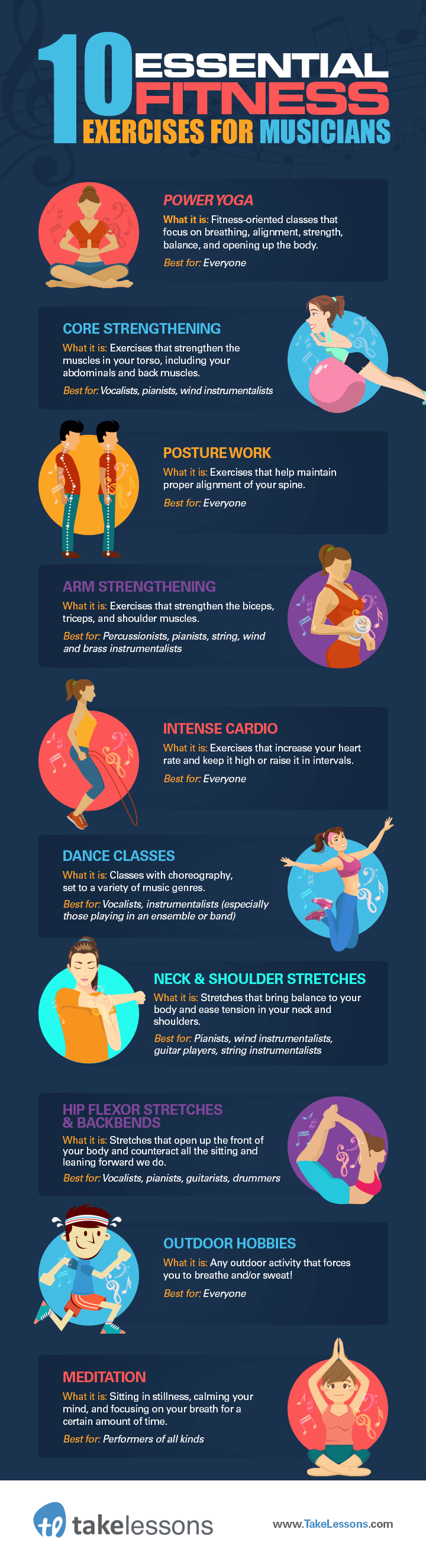
In any case, I came across this graphic at a blog called Take Lessons with 10 exercises and activities for musicians. (Link)


Some of the information from that blog talks about why these are important and can help musicians. Here is an edited version that brings out these advantages.

Power yoga
Learning how to properly and deeply breathe isn’t just important for singers! Taking full breaths is known to reduce stress and improve concentration. Breathing slowly and deeply, especially during challenging yoga poses, will help you to do so during stressful moments, calming both your mind and your body.

Core strengthening
Put simply, you need a strong core to hold yourself upright. It’s not just about having a six-pack; having a weak core can put strain on your back and ultimately cause chronic back pain. Core strength also helps improve your balance and stability — super important for all the sitting and standing we do!

Posture work
Sitting at a computer all day, being hunched over our phones, and slouching in general can wreak havoc on our posture. Over time, our spine begins to morph into the wrong shape — chin jutting forward, shoulders hunched, feet forming a v-shape. Not to mention that a performer with poor posture just doesn’t look as confident or as professional!

Arm strengthening
No matter if you’re a singer or you play an instrument, chances are you’re going to be holding something up, whether it’s your music, your instrument, or your arms. Some instruments may even require using the strength of your arms for certain techniques. Strengthening your arm and shoulder muscles can help prevent injuries, especially to the joints that end up fatigued when they aren’t supported by strong enough muscles.

Intense cardio
Cardiovascular health is important for everyone, but musicians especially can benefit from the mind-over-matter mentality that it takes to push yourself past your limits. And increasing your heart rate during exercise can ease stress, relieve anxiety, and help you sleep better — all of which benefit both your practice and your performance.

Dance classes
Dance classes with choreography require you to stay present and focused, and to memorize moves in the context of the music. These skills come in handy when you need to memorize a piece of music, especially if you are singing or playing with others. They also require coordination and improve your rhythm by forcing your body to feel the beat. Lastly, dance classes can expose you to types of music you might not listen to on your own.

Neck and shoulder stretches
Keeping tension in your neck and shoulders while practicing can cause you to suffer more over time. Especially if you allow your shoulders to come up and forward, this can really weaken your posture and cause back pain, in addition to the neck pain already present. Tension can also inhibit your playing, since many techniques require your muscles to be controlled but in a relaxed way.

Hip flexor stretches & backbends
Tension in the front of your body causes it to be imbalanced and ends up pulling on the back of your body. This takes a toll on your posture and can cause muscle and joint pain. Some say that we carry our stress in our hips, so opening them up would naturally help relieve that stress. Backbending opens your chest and lungs and can help you breathe more deeply.

Outdoor hobbies
In his piece “For Poets”, Al Young advises “Come on out into the sunlight/ Breathe in Trees/…Don’t forget to fly”. The message rings true for all artists — the best inspiration comes from being out in nature and experiencing life. Many musicians spend so much time holed up in studios and practice rooms, so it’s even more important to remind ourselves to get out there and have those one-of-a-kind experiences.

Meditation
Meditation not only reduces stress and anxiety, it also improves focus and memory. And when you have the skills to calm your mind anywhere, anytime, you can handle anything! For performers especially, practicing meditation will connect your mind and body and allow you to keep calm, no matter how many people are in the audience. (Link to Take Lessons)

Of course, be cautious. Don’t get into some exercise class or regimen without checking with a doctor, especially if you have not been active. Plus, take it easy- build into it. It takes time to get into shape, just as it has taken time for any of us to get where we are with our music. We can do great damage to ourselves and our health if we don’t develop balance.

The interplay between fitness and musicianship is clear. It is not to become fitness champions, it’s about doing what you can do to keep yourself in shape. There are plenty of places to take yoga classes, work on the Alexander technique, discover T’ai Chi, get out an hike. I am too geeky to be able to take a dance class, but maybe that will be the right way for you. Yes, it takes planning, work, and discipline to get into a fitness routine. But we already know the importance of being in a good practice routine. Time to apply it.

Monday, October 01, 2018

Tuning Slide 4.12- Don't Ignore the 10%

You have to, take a deep breath. and allow the music to flow through you. Revel in it, allow yourself to awe. When you play allow the music to break your heart with its beauty.
― Kelly White

Here’s where we started last week and then looked at the biggie- mental.

• Trumpet playing is
o 90% mental
o 9% air
o 1% physical

Now it’s time to move to the other two- the physical stuff- our instruments and our bodies.

Ever wonder how some truly excellent trumpet players can always use the same mouthpiece? Or how they can have a completely different tone in different parts of the same piece without changing the mouthpiece?

When I went to trade in my first trumpet my good friend and fellow trumpet player picked it up and played it. His comment was, “How can you play this thing in tune?” which I had been doing for 25 years at that point. “I don’t know,” I said, “it’s the only horn I ever had so I just played it.” Then I got my Bach Strad. Yes, it made an immediate difference! It was “easier” to play, more efficient a horn. I also could build some endurance when playing in a band since I wasn’t always lipping the notes to stay in tune.

Sadly, I didn’t become Doc or Maynard when I started playing it, though. I was a better player and the horn offered me the opportunity to have a better sound and style, but it didn’t turn me into a virtuoso. Let us not forget that in the end it is deliberate, efficient practice that makes us into better musicians. That takes the right attitude, of course, and the proper mental training as well as “equipment” that helps.

So, as I thought about this week’s post I made a list of what does the “physical” entail? Combining “air” and “physical”, what is the 10% that is not directly mental? My non-exhaustive list, in alphabetical order, along with my thoughts on how that may be something to be aware of:

◦ Articulation- These work together to keep us from getting tired as quickly. Efficient articulation styles can certainly help us as we continue to enhance our skills.
⁃ Learning effective tonguing techniques.
⁃ Double and triple tonguing
⁃ Goldman’s exercises and, as always, Arban’s.

◦ Body relaxation- This one takes both the physical and mental into account.
⁃ If I am stressed, I will not be relaxed and my sound will falter.
⁃ Learning how to tense and relax muscles in my arms and upper body will give me a better, brighter, clearer sound.
⁃ Even having tension in my legs and feet will translate into tension in how I play.
⁃ Developing relaxation thoughts and actions is important.
⁃ T’ai Chi and Qigong can be helpful here.

◦ Breath- It’s often all about the breath, the air, and how I use it efficiently.
⁃ Shallow vs. Deep slow breaths.
⁃ Learning to breathe from the depths of the diaphragm
⁃ Keep the air moving through, not at, the sound.
⁃ I have been told that at least an important part of my problems in endurance and sound come from not breathing effectively. It is what I am always working on.

◦ Dexterity- Ease of movement of fingers and lips, builds hand/eye coordination and wires the brain for many different actions. Dexterity- being nimble and agile- is a wonderful skill. You can’t play bebop without it!
⁃ Finger exercises- scales, chromatics, Clarke, Arban’s
⁃ Lip slurs- many ways to do these, but do them.
⁃ Pedal tones- the ability to really play those pedal tones is an important foundation for high register playing, I am told. Slurs and pedals; pedals and slurs.
⁃ Working on balance and agility of movement in the whole body can certainly have a positive impact as well. The movement of energy and oxygen through the whole body system can be quite helpful.

◦ Embouchure- the lips, facial muscles, tongue, and teeth in playing- yep, it is physical.
⁃ Sometimes (too many times?) we get stuck on this as the end-all and be-all of becoming a great trumpet player. It is one part of the physical, but the more I focus on it, the less I end up focusing on playing and getting the sound! I must never forget that the sound is what we are after. Embouchure helps, but it won’t do it alone.

◦ Endurance- All these physical things combine to give us the ability to do what we do for longer and more intense sessions.
⁃ Surprisingly most endurance is built in (relatively) short actions done smoothly and only to about 80% of full effort.
⁃ It is cumulative.
⁃ To build endurance, rest as much as you practice. This is appropriate balance of the physical and mental, for when we push too hard for too long we WILL lose our mental sharpness. It is built on endurance; endurance is not built on extreme will power.

◦ Posture-
⁃ How we sit and stand
⁃ A method called The Alexander Technique is finding an increased number of adherents. It works on posture as well as issues of breath and body relaxation.

There are some of the things I have personally discovered over the past 4 years of growing into a more advanced trumpet player. Most of us will wrestle with these on a regular basis. I for one always want to go one more exercise, one more song, five more minutes, thinking that this will truly push my endurance. Most of the time it won’t. It may only go so far as hurting. I learned this as a group fitness trainer, I learned it the hard way as a musician. Easy, steady, deliberate.

Of course, we can all name many musicians who are not in good physical shape, who don’t take as good a care of their bodies as would be helpful. In fact, that group would probably include most of us. Fortunately we don’t have to be in great physical shape to be great musicians. But I am coming to believe that it does help. As I have worked slowly on my physical conditioning again, I am finding that I do see benefits to my playing. When I have worked on my “core”, I find I can hold notes longer and have better breath control. With the weight/resistance training my arms don’t get as tired as quickly. Yes, these are small, but every little bit helps.

~~~~~~~~~~~~~~~~~~
By the way: Barry Green, author of Inner Game of Music and Mastery of Music also has a third book called Bringing Music to Life. In it he works with these ideas applied to breathing (air), pulse (rhythm), and movement (body). He addresses a number of these topics that fit in with what I have been writing about here. I will be doing some posts based on that book sometime in the new year. It’s an excellent resource!

Sidenote: This past Friday I ended an 18 month and one week stretch of not missing a single day of playing my trumpet! I had to have some minor eye surgery and the doctor said “No trumpet playing for a week.” I am a couple days into that right now- and it’s a bummer. As any (in)sane trumpet player would, I Googled whether it was true that I should not play. Maybe I could just play low notes or do long tones below “C” on the staff. “No!” said everything I read. It isn’t worth it. Ever. It is only a short period of time. Mess it up and I’m off for a longer time.

It’s still a bummer. But there is that part of playing that is physical and I have to respect it and take care of the physical. I will let you know what happens as it develops further in the next couple weeks.