Showing posts with label fitness. Show all posts

Monday, January 13, 2020

Tuning Slide #5.23- Learning from Fitness and Exercise

Weekly Reflections on Life and Music

Fitness needs to be perceived as fun and games or we subconsciously avoid it.
— Alan Thicke

Trumpet playing, making music, like fitness takes discipline. While discipline doesn’t sound like fun and games, I have discovered over these years of music and exercise that it isn’t always in the moment that it feels that way- it is the result when you are done.

Trumpeter Davy DeArmond is both an athlete and trumpet player. He is the trumpet instrumentalist in the United States Naval Academy Band. In this position, he leads the Brass Quintet, performs with the Concert Band, Next Wave Jazz Ensemble, Brass Ensemble, the New Orleans-style brass band Crabtowne Stompers as well as several ceremonial and marching units and has recorded and toured nationally with many of these groups. He is also a member of the International Chamber Orchestra of Washington. As if that isn’t enough he is a competition-level triathlete! A number of years ago the blog Trumpet Journey interviewed Davy about the things he has learned about music from his athletics. It is not a surprise that he had some good things to say. As I have said before, there are many lessons to be learned from music about life- and vice versa.

Here are some of the things that DeArmond reported as important lessons. (As usual, my thoughts in italics…) (Link)

• WARMING-UP
… As a trumpet player you might find yourself saying, “I can do this short gig without a warm-up,” or “I’m just going to go through the motions today.”… If I take off on a track workout without warming up, I’m probably going to pull something—ending my workout early and possibly affecting my bike ride the next day. The same principle goes for trumpet. If you don’t take care of yourself on a daily basis, it will catch up to you and be extremely detrimental.

[I used to be afraid that if I warmed up on my trumpet for too long, I wouldn’t be able to play. So I kept the warm up as short as possible. I learned the importance of warming up from fitness training. In my music, it is just as important. The difference starts in the planning. Hence DeArmond’s next lesson:]

• IMPLEMENT THOUGHTFUL SESSIONS
In school, it is easy to get in six to eight hour practice days. As your time becomes more valuable and you have more responsibilities, it is imperative that you have thoughtful sessions. When I began training … I found that I couldn’t spend more time on fitness, so I realized that I needed to work smarter and more efficiently. … I realized that I needed to do the same thing with my trumpet playing. I don’t have the luxury of practicing six to eight hours anymore, so I need to ensure that the time I do spend is thoughtful and productive.

[When I began to plan what I wanted to do, it all became part of the discipline. My fitness warm-up time on the bike or elliptical is just as important as the weights or machines. It’s all part of the whole. Make plans and carry them out.]

• LISTEN TO AND TAKE CARE OF YOUR BODY
[DeArmond talks about the necessity to take easy days after pushing the body to its limits in a race or competition. He says it is important to not push yourself to a point of getting hurt. He then goes on…]
… My trumpet playing colleagues and I have a phrase we use—that we have to “undo the day before.” What this means is simply that we take care of our chops the day after a big blow. Some days are more punishing than others, so, if you do have a rough playing day, take care of yourself the next day, and “undo” the pounding that you took. It might be an extended easy warm-up with soft articulations or maybe even a day completely off, but make sure those muscles, just like your leg or arm muscles, are not getting overworked.

[I am aware of the danger of days off. They can become habits- bad habits. The trick is in the planning of the “slower” days, and not in the “doing nothing.”]

• SET AND ACCOMPLISH GOALS
If you’ve never run a marathon before, you don’t really know what to expect, so you get a plan and follow it to success. Unfortunately, as trumpet players, we fall into these ruts of practicing or performing. We stick with the same practice patterns we’ve had for years, and we remain good at the trumpet. However, if you take the time to set and accomplish goals, you can improve on your trumpeting skills no matter how accomplished you are. Simply set a goal (recital, audition, etc.), devise a plan (I will work out of the Goldman book for articulations, Schlossberg for flexibility, Top Tones for endurance) and execute the plan. When you are done, you will be better, but it is of utmost importance to….

[Goals are the natural extension of plans and discipline. Set the goals. Learn the new stuff!]

• ASSESS PROGRESS
As musicians, it is easy to become too emotional when assessing our performance or progress. When I’m done with a long race, first and foremost, I am happy for my accomplishment. At that point, I can think about how I could have gone faster, trained harder, slept or ate better, but I am still happy there is a medal around my neck. For a long time, it was hard for me to assess my trumpet playing, because I was worried about missing notes. Now, I assess the two similarly. I have found that I can assess it fairly without falling into the depths of depression if I miss some notes! Was I relaxed? Did I do what I wanted musically? At what point did it start to feel uncomfortable? Why? Once you can ask yourself questions like this without getting too emotional, you can adjust your training plan and get ready for your next performance.

There’s one more that I have learned over the past five years from my fitness work and applying it to my music. After all these things that DeArmond lists,

• MOVE FROM THE COMFORT ZONE
You never get better doing only what you did yesterday. I need to push that extra ten minutes on the bike (sensibly) just as much as I need to take the time to do the Arban characteristic study, the Charlier etude or the slow, methodical work on the basics. I have to keep moving or nothing new will happen.

All progress takes place outside the comfort zone.
— Michael John Bobak, digital artist

Monday, October 21, 2019

Tuning Slide 5.12- More Fitness for Musicians

Weekly Reflections on Life and Music
To keep the body in good health is a duty - otherwise we shall not be able to keep our mind strong and clear.
— Buddha

A disclaimer that I should make every time I write about fitness and exercising- many times the person I am trying to convince most is myself. Not that I “should” workout and take better care of my fitness. I already know that. I have been a certified group fitness instructor. Over my whole adult life, I have worked hard (every now and then) to get into or stay in shape. Most of the time it has worked without too much pain. But time (i.e. age) does take its toll and over the past fifteen or so years I have had to work more diligently to maintain a tolerable fitness level. I have been a member of a gym or fitness center for all these years and, believe it or not, actually enjoy working out and the endorphins I get from it.

One doesn’t need to be in physical shape to be a musician- unless you are in a marching band or act out onstage like Mick Jagger. But for me, when I am in better physical fitness my playing improves, my attitude toward my music is better, and I have better endurance. I know I am not alone in this. A quick Google search will find all kinds of articles about fitness for musicians.

Bill Plake is a musician and fitness person. He has this to say:
It’s not as if you can’t play well if you’re not physically fit (lots of very unfit virtuosi out there). It’s just that you might do better if you stay fit. … Exercising regularly improves your mood, your memory, learning and processing information…your overall mental acuity.
In my experience as a teacher, I find that students who are physically fit tend to have better concentration, efficiency and endurance in their musical practice as well (again, there are exceptions to this observation). (Link)
He reminds anyone who is new to exercise to make sure you have some kind of medical approval, that you take it easy at first, that you make sure you are doing balanced fitness exercises (see below), and use a trainer, at least to get started. Some of the things I have learned about why this is important.
◦ Utilizing all types of fitness= balanced fitness. Balance is one of the key words of life. If we go to extremes, trying to hard can be just as bad as not trying enough. Balance can help keep us focused.

◦ Working on a variety of fitness areas can do things like helping in holding the instrument longer and with more steadiness or the endurance that can give you the ability to play for longer periods (not counting the embouchure)

◦ Working on the core and strengthening the abs=better support of body- and of air. The abs help keep the back supported, not to mention that diaphragm breathing is important.
Let’s look at the four types of exercise and fitness that the NIH lists on their website and their ideas behind them. (Link)

https://www.nia.nih.gov/sites/default/files/2017-05/infographic_be-fit-4-function.png

Endurance or aerobic, activities increase your breathing and heart rate. They keep your heart, lungs, and circulatory system healthy and improve your overall fitness. Building your endurance makes it easier to carry out many of your everyday activities. Endurance exercises include:
**Brisk walking or jogging
**Yard work (mowing, raking, digging)
**Dancing

For musicians, as I have said, endurance helps sustain you through longer playing times, allows better lung capacity for playing wind instruments, keeps one mentally sharper since exhaustion doesn’t come as quickly.

Strength exercises make your muscles stronger. They may help you stay independent and carry out everyday activities, such as climbing stairs and carrying groceries. These exercises also are called “strength training” or “resistance training.” Strength exercises include:
**Lifting weights
**Using a resistance band
**Using your own body weight

Strength for musicians is the ability to utilize the muscles at a higher level of performance. That supports the ability to increase endurance.

Balance exercises help prevent falls, a common problem in older adults. Many lower-body strength exercises will also improve your balance. Balance exercises include:
**Standing on one foot
**Heel-to-toe walk
**Tai Chi

Balance is my biggest problem. Due to nerve and muscle weakness from some back issues, I work at trying to gain better balance. I’m not sure I could pass a field sobriety test- and I haven’t had any alcohol to drink in over 30 years! It is important for me, and what I think has been happening is that I am finding ways to compensate for the balance issues in the other areas of fitness. Hence the need to have a broad range of fitness exercises!

Flexibility exercises stretch your muscles and can help your body stay limber. Being flexible gives you more freedom of movement for other exercises as well as for your everyday activities, including driving and getting dressed. Flexibility exercises include:
**Shoulder and upper arm stretch
**Calf stretch
**Yoga

Flexibility is also a state of mind. Musicians need to have the flexibility to play different styles, under different circumstances, with different people. The ability to go with the flow is supported by the flexibility of the body.

I guess I would sum this up with the broader idea that hat happens with the body can happen with the mind. Look at the above as mental supports as well as physical.

Take it easy if you are going to start exercising, don’t expect overnight miracles. Find one of the many fitness centers that are all around and find a trainer who will guide you. The changes will show up if we do.

Monday, August 26, 2019

Tuning Slide 5.4- Exercise is Important, Too

Weekly Reflections on Life and Music
Take care of your body. It’s the only place you have to live.
– Jim Rohn

Something I have been more than just slightly aware of over the years is the importance of exercise and physical fitness. I have never been great at it and sometimes have had to force myself into complying with my own principles, but I have had the desire and some motivation for many years. It is not a surprise to me that physical fitness can play a part in our musicianship- and perhaps even vice versa. My trainer tells me he doesn’t see many people (my age or not) who can hold a plank as long and as well as I can. When we discussed it, he said that it may have something to do with my trumpet playing. The importance of the abs in playing trumpet is clear- it’s where the power comes from. So maybe they do go together.

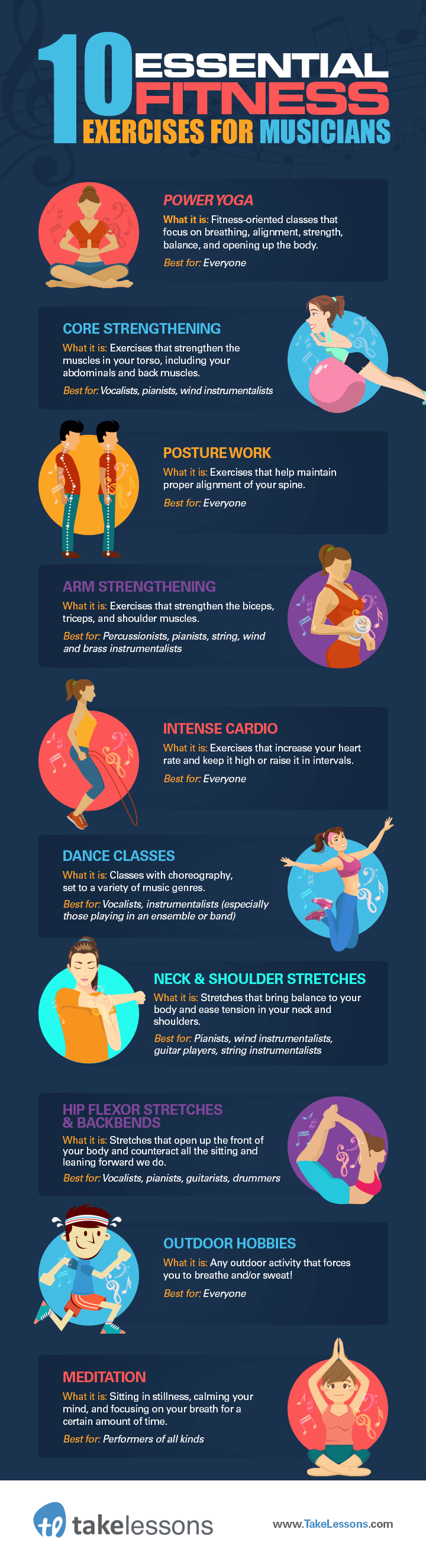
In any case, I came across this graphic at a blog called Take Lessons with 10 exercises and activities for musicians. (Link)


Some of the information from that blog talks about why these are important and can help musicians. Here is an edited version that brings out these advantages.

Power yoga
Learning how to properly and deeply breathe isn’t just important for singers! Taking full breaths is known to reduce stress and improve concentration. Breathing slowly and deeply, especially during challenging yoga poses, will help you to do so during stressful moments, calming both your mind and your body.

Core strengthening
Put simply, you need a strong core to hold yourself upright. It’s not just about having a six-pack; having a weak core can put strain on your back and ultimately cause chronic back pain. Core strength also helps improve your balance and stability — super important for all the sitting and standing we do!

Posture work
Sitting at a computer all day, being hunched over our phones, and slouching in general can wreak havoc on our posture. Over time, our spine begins to morph into the wrong shape — chin jutting forward, shoulders hunched, feet forming a v-shape. Not to mention that a performer with poor posture just doesn’t look as confident or as professional!

Arm strengthening
No matter if you’re a singer or you play an instrument, chances are you’re going to be holding something up, whether it’s your music, your instrument, or your arms. Some instruments may even require using the strength of your arms for certain techniques. Strengthening your arm and shoulder muscles can help prevent injuries, especially to the joints that end up fatigued when they aren’t supported by strong enough muscles.

Intense cardio
Cardiovascular health is important for everyone, but musicians especially can benefit from the mind-over-matter mentality that it takes to push yourself past your limits. And increasing your heart rate during exercise can ease stress, relieve anxiety, and help you sleep better — all of which benefit both your practice and your performance.

Dance classes
Dance classes with choreography require you to stay present and focused, and to memorize moves in the context of the music. These skills come in handy when you need to memorize a piece of music, especially if you are singing or playing with others. They also require coordination and improve your rhythm by forcing your body to feel the beat. Lastly, dance classes can expose you to types of music you might not listen to on your own.

Neck and shoulder stretches
Keeping tension in your neck and shoulders while practicing can cause you to suffer more over time. Especially if you allow your shoulders to come up and forward, this can really weaken your posture and cause back pain, in addition to the neck pain already present. Tension can also inhibit your playing, since many techniques require your muscles to be controlled but in a relaxed way.

Hip flexor stretches & backbends
Tension in the front of your body causes it to be imbalanced and ends up pulling on the back of your body. This takes a toll on your posture and can cause muscle and joint pain. Some say that we carry our stress in our hips, so opening them up would naturally help relieve that stress. Backbending opens your chest and lungs and can help you breathe more deeply.

Outdoor hobbies
In his piece “For Poets”, Al Young advises “Come on out into the sunlight/ Breathe in Trees/…Don’t forget to fly”. The message rings true for all artists — the best inspiration comes from being out in nature and experiencing life. Many musicians spend so much time holed up in studios and practice rooms, so it’s even more important to remind ourselves to get out there and have those one-of-a-kind experiences.

Meditation
Meditation not only reduces stress and anxiety, it also improves focus and memory. And when you have the skills to calm your mind anywhere, anytime, you can handle anything! For performers especially, practicing meditation will connect your mind and body and allow you to keep calm, no matter how many people are in the audience. (Link to Take Lessons)

Of course, be cautious. Don’t get into some exercise class or regimen without checking with a doctor, especially if you have not been active. Plus, take it easy- build into it. It takes time to get into shape, just as it has taken time for any of us to get where we are with our music. We can do great damage to ourselves and our health if we don’t develop balance.

The interplay between fitness and musicianship is clear. It is not to become fitness champions, it’s about doing what you can do to keep yourself in shape. There are plenty of places to take yoga classes, work on the Alexander technique, discover T’ai Chi, get out an hike. I am too geeky to be able to take a dance class, but maybe that will be the right way for you. Yes, it takes planning, work, and discipline to get into a fitness routine. But we already know the importance of being in a good practice routine. Time to apply it.

Thursday, April 24, 2014

I Passed

A month ago I took the training and testing from the Aerobics and Fitness Association (AFAA) to be a certified group fitness instructor. This week I got the good news that I passed!

Hooray for me! Now, what am I going to do with it? Now that's the question.

Sunday, March 23, 2014

Now I Wait

Yesterday was a tense day. It was my day to take the workshop/tests for certification as a Group Fitness Instructor with the Aerobics and Fitness Association of America (AFAA). It was a short story with a long prelude.

Back around a year ago when I was beginning to head toward my semi-retirement I came across a story in a local paper about a fitness instructor at a local center. He was in his early 80s, taught water aerobics (among others) and started in the fitness field when he was in his early 60s.

Over the past 8 years I have slowly but surely worked toward a broader and deeper understanding of fitness. It began when I wanted to do 60 miles of biking for my 60th birthday. For an uncounted time I joined a health club. I was periodic in attendance, but I did keep going. I then moved and joined the healthy living center at my new residence.

That has continued for most of the past 5 years through three surgeries and a few other physical concerns cropping up. As I got into biking and I even commuted to work on my bike. When I read the article on the fitness instructor in town it was like an "Aha!" moment. I have something new to offer, even as I have (now) passed age 65.

So I began to pursue that angle. I took a couple online courses from AFAA on getting ready to be a group fitness instructor and a personal fitness instructor. Yesterday I did the day-long certification workshop ending in the four-part examination. Three of those are "practical," something that AFAA is known for and, I think, is an essential part of becoming a fitness instructor. In this part of the day we had to demonstrate that

1) we knew two strength and one stretching action for each of 10 muscle groups;
2) could do a 3-minute warm-up and five-minute cardio routine; and
3) lead the group in one activity showing beginning, intermediate and advanced options.
There is then a written exam with 100 matching or multiple choice questions. Perhaps the largest single group of questions dealt with the different muscles and muscle groups along with their locations and actions.

I won't know for 4 - 6 weeks how I did. Since no job is hinging on passing the test and getting the certification I am not in any hurry, other than to know.

What will I do with this? At this point I don't know. I would like to be able to help others my age- or approaching my age- to know that age doesn't have to be a reason to get out of shape or even to get back into shape.

I have also discovered Yoga and Tai Chi as important mental supports and mindfulness practices. I don't think I will get special certifications in either of those areas, but you never know how I can use those experiences as well.

In addition all this has a big part to play in addiction/alcoholism recovery. Specialized groups in fitness centers or community programs for recovering people to help their sobriety would be a good move. But at this point, I am not trying to shoehorn this into something. Rather I am trying to be open to whatever directions come.

By the way, the experience yesterday at the workshop was wonderful. I learned a lot and was directed well by the instructor. The field of fitness and exercise is changing rapidly and there are obvious needs for good instructors and trained leaders.

But for now, I wait. Since I am also back to work full-time for a while, it will give me time to think through how this can fit into my semi-retired life.

Monday, November 18, 2013

Milestones Continue to Collect

Last week I passed a milestone for the year. Friday was the 150th day this year that I have ridden a bike- either on the streets/trails or a stationary one at the fitness center. I know I won't be able to get enough in before the end of the year to make it 183 days (or 50% of the year). But that will be the goal for next year.

Mileage for the year so far: 1,340 miles, combination of both types.

Not bad. Not bad at all!

Thursday, November 07, 2013

I'll Take the Compliment

Co-worker 1:

There sure is a lot less of you these days.
Co-worker 2:
Seeing you in that sweater, it's clear how much weight you've lost.
Co-worker 3:
You sure are looking spiffy these days.
All these within the last couple weeks as I hit my latest plateau of weight loss. I am down about 30 pounds- about 15%- since March 15. That was my second goal made and it feels good.

No, not just the compliments, but the actual feeling of being 30 pounds lighter. The other evening I was carrying my big band music bag and my trumpet up the stairs. I guess together they weight in the 30 pound range. As I got to the top and thought about how much more difficult it was carrying that load I was struck by a thought:
I carried that much weight around for a long time.

Wow.
Next goal- another 15 pounds by the end of January. At this point I am still on a plateau within a couple pounds of that 30 pound decrease. It will soon be time to pick it up again and keep the downward trend going to my ultimate goal. Back in March I would never have believed this was possible. Now, I'm excited and looking forward to the next 15 pounds.

Just keep me away from the doughnuts.

Wednesday, July 13, 2011

Three Weeks Gone- Starting on Four

Today begins the Fourth Week of my fitness challenge/program at the local healthy living center. Over these three full weeks I have lost 9+ pounds. That is little changed from last week thanks to several days of no exercise this past week due to some health issues and appointments. But it also means that I maintained the diet part of the challenge.

I actually continued, for the most part, the challenge of the first two weeks to stay away from processed sugar and artificial sweeteners, to eat more fruits and vegetables, to eat out less and eat healthier when I did. I was a huge success at those. Water has actually begun to taste good as has decaf tea without any sweeteners.

In the exercise part I have done some active spinning (cycling) classes (45-50 minutes each), 25 - 45 minute sessions on the elliptical machine and the regular biking workouts. The strength training part has been a little more difficult, finding the time and actually doing it. But I have managed some. That will be my emphasis in the next week or so.

In short, I am feeling quite good about myself and what I have been doing. I will hopefully drop below the 190 lb. level this week for the first time in over a year!

Plus I am feeling good. Who would have thought it?

Thursday, June 23, 2011

It's a Lot Like Work

...and I hope it works.

Ten days ago I posted about some of my physical problems I have been facing again- namely lower back-related issues. My calves are in bad shape, but fortunately it is neither from lack of exercise or vascular issues. It appears to truly be related to my lower back problems which have been around for quite a few years now.

Sidebar Note: I remembered this last week when the news was talking about the 7th anniversary of the
O. J. Simpson slow-speed chase in the white Bronco. I was in Miami for a Mission Conference
when that happened- and in a lot of pain from the first MAJOR flare-up that almost got me a surgery.

Anyway, my calves are still stiff and painful when I walk, but all I do is walk a little more slowly and it takes longer to get places. I don't have a spine clinic appointment until mid-July and I am now beginning to think it may be an acute flare-up and not truly part of the chronic problem.

So I have continued to limp and exercise. Fortunately the calves don't hurt when I am on the elliptical machine or the bike!

But I also mentioned in that post 10 days ago that I had signed up for a fitness/weight-loss/strength program. That started last night.

I survived. Including the strength part in my upper body that is not in all that good a shape. We were introduced to the Mayo Clinic Diet Book which we are using for the weight section of the program. (The real one, not the fake one that has been around the net for a few years.) I know I need to have better nutrition. All those donuts and sugary things I eat are bad, bad, bad. I have a hunch (just a hunch?) that this is why as I work out more, I have continued to gain weight.

The most difficult thing in this whole fitness program, I am convinced, will be the first two weeks when in the Diet they say- No Sugar! None! Nada! If it is one of the first several ingredients on the label, skip it.

Do you realize how many things have some form of sugar as one of the first three ingredients? Yep. Even that healthy low-fat yogurt has that. Or the artificial sweeteners that only increase our desire to eat. My Body Mass Index (BMI) is in the low-obese range- which means I am really just quite short for my weight.

Isn't denial a wonderful thing?

But I actually enjoyed the class last evening and will see how this whole diet thing goes. At least the health issues with my back seem to be manageable.

Now about all that sugar?

Mayo Clinic Diet

Mayo Clinic Diet Blog
Mayo Clinic Healthy Weight Pyramid Tool

Sunday, August 22, 2010

One Week To Go

Duathlon is an athletic event that consists of a running leg, followed by a cycling leg and then another running leg in a format bearing some resemblance to triathlons.

The largest duathlon in the United States is the Minneapolis Duathlon in Minnesota put on by the Team Ortho Foundation. In 2009, its first year, it had more than 1,000 participants. 68% of the participants were new to the sport of duathlon.
--Wikipedia
And the date for the 2010 Minneapolis Duathlon is Sunday, August 29. That is next Sunday morning. And, at age 62, I will be doing my very first ever duathlon. I will be doing the "Fun Course" (but it's all supposed to be fun, isn't it?) That means that it will be shorter and there will be no awards given. Just the satisfaction of having done it.

I have only been specifically training for this for about 8 weeks when I added "running" to be weekly workouts. I am still doing running and walking (4 min. running/1minute walking about 5 - 6 times). That is still well beyond the 1.5 miles of the course next week. And the biking will be only 12 miles, well within my 20-25 mile "easier" capacity.

Overall, I am excited. I ran one race once before in my life- a 5K, I think- in York, PA, about 30 years ago. Now, it is a whole new world for me. The result- mentally and physically- will help me decide whether I will do another one a couple weeks later in Pine Island. One of my co-workers has challenged me to do it with her. That one is 3.5 mile runs and 21 miles biking. THAT would be a stretch but I am told there is no shame in walking- even across the finish line.

I will keep you posted.