Showing posts with label motivation. Show all posts

Monday, November 04, 2019

Tuning Slide 5.14- Acting Like a Pro- Attitude

Weekly Reflections on Life and Music

Discipline is for professionals.
Motivation is for amateurs.
― J.R. Rim

I know I must be a professional musician- I’m not getting paid. (Rim shot.) Okay, just kidding. But I got to thinking one day about one of the most surprising aspects of what I have learned over these past five years of growth and musical development. Professional musicians are often just like non-professionals- just different in how they think. When I first connected with the group of musicians at Shell Lake Big Band Camp and the Trumpet Workshop, I came at playing and practicing trumpet just like I always had. I was, I knew beyond a shadow of a doubt that I was an “amateur” and I would never be anything but an amateur.

1. a person who engages in a pursuit, especially a sport, on an unpaid rather than a professional basis.
2. a person who is incompetent or inept at a particular activity. (Google)

I knew that the first was true, and the second? Well, if I wasn’t inept, I was at least less than many others. I didn’t think about becoming a professional. I just enjoyed playing the trumpet at whatever level I was able to reach and then just try to maintain it. What I discovered in the group at Shell Lake was that there is something different about professional musicians- their mindset. They have a different attitude, they have an outlook on playing music that is far from what I was doing. That quote at the top of the post this week is one of the things I learned. Motivation and discipline produce different results, although motivation can, and does, often lead to discipline and the resulting change of mind. (But that’s a whole other story for a different time. See Daniel Pink’s book, Drive: The Surprising Truth About What Motivates Us.)

For this week I just want to talk about what it is that I have experienced with this change in mindset.

On their website, the magazine Inc. has an article about motivation vs discipline. In it retired pilot David Burke, who spent 23 years as an elite fighter pilot, says that:

"More than any other quality, discipline is what drives a person to succeed when faced with adversity. And that's what the real world is: adversity." Discipline, Burke continues, is what "drives you to do the work you don't enjoy, but is required. Discipline conquers fear. Discipline keeps you going when your curiosity, motivation, and excitement evaporate." (Link)

When I walked away from my first summer at Shell Lake, I was motivated! Man, was I motivated. But I wasn’t yet disciplined. It wasn’t that I didn’t know how to become disciplined, (I've been a professional in other fields for 40 plus years), I just didn’t think it was anything special in this area. After all, I was “only an amateur.” It was after a number of months of increased practicing, discovering a daily routine and the inner joy of just playing music at a higher level, that I ran across the dreaded “boredom.” Long tones! Clarke 1, 2, and 3! Over and over. Day in and day out. I was learning and growing, but the excitement did begin to evaporate. So I switched to willpower. But (and this is also for another day) I knew that willpower is a limited resource. If I had used too much of it just to get through the day, I wasn’t going to have any to pick up the horn.

That’s when discipline began to set in. Back to the article from Inc. Jim Rohn is considered to be America's Foremost Business Philosopher. He says:

"It takes consistent self-discipline to master the art of setting goals, time management, leadership, parenting and relationships. If we don't make consistent self-discipline part of our daily lives, the results we seek will be sporadic and elusive."
"It takes a consistent effort to truly manage our valuable time. Without it, we'll be consistently frustrated. Our time will be eaten up by others whose demands are stronger than our own," writes Rohn.
"It takes discipline to conquer the nagging voices in our minds: the fear of failure, the fear of success, the fear of poverty, the fear of a broken heart. It takes discipline to keep trying when that nagging voice within us brings up the possibility of failure." (Link)

What kept me going was that I had changed my attitude, my mindset. I know that sounds like willpower, but it wasn’t. It was routine and habit. It was not a whim or a “well, let’s try this now” kind of attitude. That is what the professionals really bring to the table and what we can learn from them.

There is one aspect of this that I can’t overlook- I had to believe it was worth the time and effort, or else why would I do it? If all I got out of it was a sense of drudgery, boring long tones and scales, well, that isn’t enough to keep going. I also began to experience what I am sure drives most professionals in any field, including music- the sense of accomplishment. Disciplined and intentional practice began to give better results. I was enjoying the music and the routine. The habit was real- and I began to feel like a musician. Yes, that is motivation producing because my goal became I wanted to continue to improve. I was no longer afraid of succeeding or willing to say that at my age, why try?

Consistency, done daily, with good time management overcomes the fears Rohn mentioned above. It conquers the nagging voice that says, “Yeah, that’s nice, but you’re just an amateur!”

Not any more. No, I am still not getting paid for being a musician. But thanks to that incredible group of trumpet players I engaged with at Shell Lake, I am in the midst of becoming a “pro.”

Find a group of people who challenge and inspire you, spend a lot of time with them, and it will change your life.
— Amy Poehler

Monday, October 21, 2019

Tuning Slide 5.12- More Fitness for Musicians

Weekly Reflections on Life and Music
To keep the body in good health is a duty - otherwise we shall not be able to keep our mind strong and clear.
— Buddha

A disclaimer that I should make every time I write about fitness and exercising- many times the person I am trying to convince most is myself. Not that I “should” workout and take better care of my fitness. I already know that. I have been a certified group fitness instructor. Over my whole adult life, I have worked hard (every now and then) to get into or stay in shape. Most of the time it has worked without too much pain. But time (i.e. age) does take its toll and over the past fifteen or so years I have had to work more diligently to maintain a tolerable fitness level. I have been a member of a gym or fitness center for all these years and, believe it or not, actually enjoy working out and the endorphins I get from it.

One doesn’t need to be in physical shape to be a musician- unless you are in a marching band or act out onstage like Mick Jagger. But for me, when I am in better physical fitness my playing improves, my attitude toward my music is better, and I have better endurance. I know I am not alone in this. A quick Google search will find all kinds of articles about fitness for musicians.

Bill Plake is a musician and fitness person. He has this to say:
It’s not as if you can’t play well if you’re not physically fit (lots of very unfit virtuosi out there). It’s just that you might do better if you stay fit. … Exercising regularly improves your mood, your memory, learning and processing information…your overall mental acuity.
In my experience as a teacher, I find that students who are physically fit tend to have better concentration, efficiency and endurance in their musical practice as well (again, there are exceptions to this observation). (Link)
He reminds anyone who is new to exercise to make sure you have some kind of medical approval, that you take it easy at first, that you make sure you are doing balanced fitness exercises (see below), and use a trainer, at least to get started. Some of the things I have learned about why this is important.
◦ Utilizing all types of fitness= balanced fitness. Balance is one of the key words of life. If we go to extremes, trying to hard can be just as bad as not trying enough. Balance can help keep us focused.

◦ Working on a variety of fitness areas can do things like helping in holding the instrument longer and with more steadiness or the endurance that can give you the ability to play for longer periods (not counting the embouchure)

◦ Working on the core and strengthening the abs=better support of body- and of air. The abs help keep the back supported, not to mention that diaphragm breathing is important.
Let’s look at the four types of exercise and fitness that the NIH lists on their website and their ideas behind them. (Link)

https://www.nia.nih.gov/sites/default/files/2017-05/infographic_be-fit-4-function.png

Endurance or aerobic, activities increase your breathing and heart rate. They keep your heart, lungs, and circulatory system healthy and improve your overall fitness. Building your endurance makes it easier to carry out many of your everyday activities. Endurance exercises include:
**Brisk walking or jogging
**Yard work (mowing, raking, digging)
**Dancing

For musicians, as I have said, endurance helps sustain you through longer playing times, allows better lung capacity for playing wind instruments, keeps one mentally sharper since exhaustion doesn’t come as quickly.

Strength exercises make your muscles stronger. They may help you stay independent and carry out everyday activities, such as climbing stairs and carrying groceries. These exercises also are called “strength training” or “resistance training.” Strength exercises include:
**Lifting weights
**Using a resistance band
**Using your own body weight

Strength for musicians is the ability to utilize the muscles at a higher level of performance. That supports the ability to increase endurance.

Balance exercises help prevent falls, a common problem in older adults. Many lower-body strength exercises will also improve your balance. Balance exercises include:
**Standing on one foot
**Heel-to-toe walk
**Tai Chi

Balance is my biggest problem. Due to nerve and muscle weakness from some back issues, I work at trying to gain better balance. I’m not sure I could pass a field sobriety test- and I haven’t had any alcohol to drink in over 30 years! It is important for me, and what I think has been happening is that I am finding ways to compensate for the balance issues in the other areas of fitness. Hence the need to have a broad range of fitness exercises!

Flexibility exercises stretch your muscles and can help your body stay limber. Being flexible gives you more freedom of movement for other exercises as well as for your everyday activities, including driving and getting dressed. Flexibility exercises include:
**Shoulder and upper arm stretch
**Calf stretch
**Yoga

Flexibility is also a state of mind. Musicians need to have the flexibility to play different styles, under different circumstances, with different people. The ability to go with the flow is supported by the flexibility of the body.

I guess I would sum this up with the broader idea that hat happens with the body can happen with the mind. Look at the above as mental supports as well as physical.

Take it easy if you are going to start exercising, don’t expect overnight miracles. Find one of the many fitness centers that are all around and find a trainer who will guide you. The changes will show up if we do.

Monday, September 30, 2019

Tuning Slide 5.9- Learning from Jazz

Weekly Reflections on Life and Music
You have to take a deep breath and allow the music to flow through you. Revel in it, allow yourself to awe. When you play, allow the music to break your heart with its beauty.
― Kelly White

As any regular reader of this blog knows, I am a huge jazz fan. I was first introduced through Louis Armstrong, Dave Brubeck, and Al Hirt. I expanded with Buddy Rich and Maynard, then later with Miles. I was hooked when the jazz DJ at the college radio station started playing other musicians and then my good friend Glenn opened the whole jazz world to me. It is a musical language I understand at all kinds of levels and has enriched my life in countless ways. (It’s in my earbuds as I write this!)

Over the past 10-12 years I have been working hard at taking that language into playing it in groups. As I was surfing the other week I came across a post on the Piano Power site on how learning jazz can give us musical superpowers. Overall jazz takes us into all kinds of different nuances, styles, and emotions than we are used to. As I looked over the list all I could say was, “Amen! That IS true.” Here's the gist of it, starting with the question:

How will jazz make me a master of my instrument?

The answer to that is so simple as to defy imagination. Improvisation! (I said simple, but far from easy!) Improvisation moved me away from the printed notes into thinking, listening, feeling, and then playing the music. When I attempt to improvise I end up with a far more physical and even spiritual connection with my instrument and what it can do. Which leads me to see what I can begin to do. Like with any language, it takes practice and it can seem like a long road ahead when you start. The easiest way to start working the sounds and chords is through the blues- and then moving up from there. You get it in your head and heart and you become the composer. As a result I have found that I am also better able to hear the sounds of other music and more easily fall into the rhythms and scales. I become a better trumpet player in all styles I am playing.

Lucas Gillan said in the post, “If all you ever do is read notes on a page, you’ll never quite know what your instrument is capable of.” Nor will you discover what you are truly capable of across the whole range of the instrument.

Another post by Austin Consordini on the Making Music site took me into a different area- about the Seven Everyday Tasks That Every Jazz Player Must Do.
1. Clean Your Instrument
2. Practice Scales
3. Play Something by Ear
4. Practice Improvising
5. Listen to Music
6. Increase Your Repertoire
7. Practice Multiple Instruments
I don’t know whether he put these in this order for any particular reason, but I was struck by #1. Only in the past few years have I paid much attention to that one. How does regularly cleaning my horn make me a better musician? Personally, I have found that taking care of my trumpet is an expression of my caring about the music I am making. I don’t know if my sound or style changes with regular cleaning, but my feeling about my playing does. This reminded me of something else I have long observed. When I take my car to the car wash and get it cleaned inside and out, it “feels” like it drives better. I know it is my perception and reaction, but I feel more comfortable driving a clean car. My horn helps me make music! I need to be kind to it and take care of it!

The second item on the list takes me back to the idea of improvisation and knowing music overall. It is one thing- and an important one thing- to do the scale exercises in Arban’s. It is another to do the 12 major scales by doing them without music in front of you. Sometimes I work my way around the Circle of 4ths (C, F, Bb,…); sometimes I start at middle C and work up the notes to the next C and beyond; sometimes I start on G on the staff and expand down and up one note at a time. All this without music in front of me. It is “relatively” easier to do it from a written page, but I think I learn it more deeply when I don’t use the music. BUT, I found I also have to do scales from the written sheet so that when I see a piece of music in one of the scales, I know what I am looking at! It’s a “Both-And” situation.

I still have to do some work on the minor keys, though.

Playing by ear and practicing improvising have been covered earlier but they lead to the next two for me. The more music I listen to with attention and intention the broader becomes my understanding of music overall. That has then led me to the increase of my repertoire. Sometimes I do that through new or different etude books or some of the solo and etudes I have worked on in the past. Pulling out Mozart or Haydn or taking a fake book and working through the melodies can increase what I am discovering about music. A friend recently mentioned an etude book I had never heard of. I borrowed it and played through some of the pieces. I found them significantly different from any of my other etude exercises in ways that changed my listening skills.

In the end Consordini says in his post:
Becoming a jazz master takes living and breathing jazz music every day. You must be willing to dedicate time each day to mastering your instrument and sound. Being able to integrate these 7 steps into your everyday life will help you to be immersed in jazz and be on your way to becoming one of the greats yourself.
I may not become a jazz master, but I am improving as a musician by doing these things. Amazing how that works.

Monday, August 26, 2019

Tuning Slide 5.4- Exercise is Important, Too

Weekly Reflections on Life and Music
Take care of your body. It’s the only place you have to live.
– Jim Rohn

Something I have been more than just slightly aware of over the years is the importance of exercise and physical fitness. I have never been great at it and sometimes have had to force myself into complying with my own principles, but I have had the desire and some motivation for many years. It is not a surprise to me that physical fitness can play a part in our musicianship- and perhaps even vice versa. My trainer tells me he doesn’t see many people (my age or not) who can hold a plank as long and as well as I can. When we discussed it, he said that it may have something to do with my trumpet playing. The importance of the abs in playing trumpet is clear- it’s where the power comes from. So maybe they do go together.

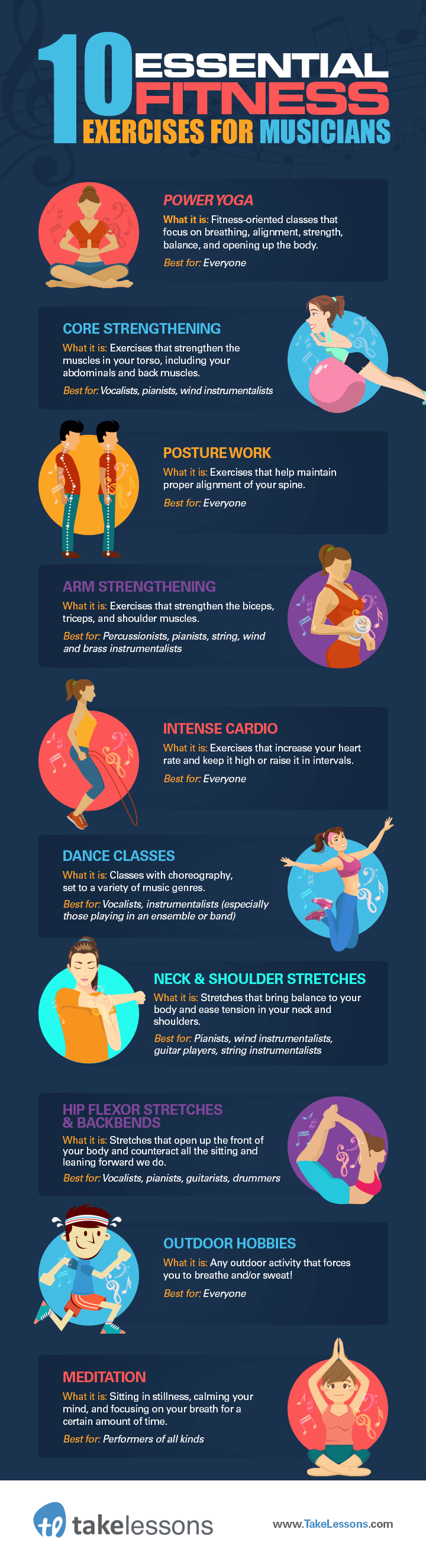
In any case, I came across this graphic at a blog called Take Lessons with 10 exercises and activities for musicians. (Link)


Some of the information from that blog talks about why these are important and can help musicians. Here is an edited version that brings out these advantages.

Power yoga
Learning how to properly and deeply breathe isn’t just important for singers! Taking full breaths is known to reduce stress and improve concentration. Breathing slowly and deeply, especially during challenging yoga poses, will help you to do so during stressful moments, calming both your mind and your body.

Core strengthening
Put simply, you need a strong core to hold yourself upright. It’s not just about having a six-pack; having a weak core can put strain on your back and ultimately cause chronic back pain. Core strength also helps improve your balance and stability — super important for all the sitting and standing we do!

Posture work
Sitting at a computer all day, being hunched over our phones, and slouching in general can wreak havoc on our posture. Over time, our spine begins to morph into the wrong shape — chin jutting forward, shoulders hunched, feet forming a v-shape. Not to mention that a performer with poor posture just doesn’t look as confident or as professional!

Arm strengthening
No matter if you’re a singer or you play an instrument, chances are you’re going to be holding something up, whether it’s your music, your instrument, or your arms. Some instruments may even require using the strength of your arms for certain techniques. Strengthening your arm and shoulder muscles can help prevent injuries, especially to the joints that end up fatigued when they aren’t supported by strong enough muscles.

Intense cardio
Cardiovascular health is important for everyone, but musicians especially can benefit from the mind-over-matter mentality that it takes to push yourself past your limits. And increasing your heart rate during exercise can ease stress, relieve anxiety, and help you sleep better — all of which benefit both your practice and your performance.

Dance classes
Dance classes with choreography require you to stay present and focused, and to memorize moves in the context of the music. These skills come in handy when you need to memorize a piece of music, especially if you are singing or playing with others. They also require coordination and improve your rhythm by forcing your body to feel the beat. Lastly, dance classes can expose you to types of music you might not listen to on your own.

Neck and shoulder stretches
Keeping tension in your neck and shoulders while practicing can cause you to suffer more over time. Especially if you allow your shoulders to come up and forward, this can really weaken your posture and cause back pain, in addition to the neck pain already present. Tension can also inhibit your playing, since many techniques require your muscles to be controlled but in a relaxed way.

Hip flexor stretches & backbends
Tension in the front of your body causes it to be imbalanced and ends up pulling on the back of your body. This takes a toll on your posture and can cause muscle and joint pain. Some say that we carry our stress in our hips, so opening them up would naturally help relieve that stress. Backbending opens your chest and lungs and can help you breathe more deeply.

Outdoor hobbies
In his piece “For Poets”, Al Young advises “Come on out into the sunlight/ Breathe in Trees/…Don’t forget to fly”. The message rings true for all artists — the best inspiration comes from being out in nature and experiencing life. Many musicians spend so much time holed up in studios and practice rooms, so it’s even more important to remind ourselves to get out there and have those one-of-a-kind experiences.

Meditation
Meditation not only reduces stress and anxiety, it also improves focus and memory. And when you have the skills to calm your mind anywhere, anytime, you can handle anything! For performers especially, practicing meditation will connect your mind and body and allow you to keep calm, no matter how many people are in the audience. (Link to Take Lessons)

Of course, be cautious. Don’t get into some exercise class or regimen without checking with a doctor, especially if you have not been active. Plus, take it easy- build into it. It takes time to get into shape, just as it has taken time for any of us to get where we are with our music. We can do great damage to ourselves and our health if we don’t develop balance.

The interplay between fitness and musicianship is clear. It is not to become fitness champions, it’s about doing what you can do to keep yourself in shape. There are plenty of places to take yoga classes, work on the Alexander technique, discover T’ai Chi, get out an hike. I am too geeky to be able to take a dance class, but maybe that will be the right way for you. Yes, it takes planning, work, and discipline to get into a fitness routine. But we already know the importance of being in a good practice routine. Time to apply it.

Monday, August 19, 2019

Tuning Slide 5.3- Advice for a New Season

Weekly Reflections on Life and Music
Don't only practice your art, but force your way into its secrets; art deserves that, for it and knowledge can raise man to the Divine.
— Ludwig van Beethoven

Back in March, I found a post by Melissa Chu titled 25 “No-Nonsense” Lessons on Mastering Your Craft, According to Beethoven. As we all get ready for the post-summer back to basics time, I picked out and edited 7 of the 25 that seemed like good thought starters for this new year of The Tuning Slide. As usual with these types of posts, my reflections are in italics following each idea.

1. Work around your obstacles.
At age 26, Beethoven began experiencing hearing difficulties. Over time, his hearing worsened to the point that he became completely deaf. He was devastated and had suicidal thoughts, since he believed that this meant his music career was over. But later, he changed his mindset and was determined to continue producing music…. Beethoven composed some of his greatest works while he was deaf, including pieces such as Moonlight Sonata and Fur Elise. Everyone faces obstacles at points in their life. Instead of making excuses for why something won’t work, find a way to overcome your challenges.
[Many times the obstacles can actually help us by forcing us to get out of our comfort zone and find new ways to work and live. Most of us won’t be faced with anything as drastic as Beethoven’s deafness, but we can still get stalled. Don’t let that happen.]

2. You are never too good to get help.
Beethoven was acknowledged as a child prodigy by his father…. In his adult years… he was gaining popularity and success, but he still sought the instruction of others for feedback and improvement. The world’s best in any field have coaches and instructors to guide them in becoming even better.
[Find teachers at any age. I love learning and I have discovered that learning from others is one of the best ways. I have met a number of new teachers in the past few years- and the results have been astounding.]

3. Surround yourself with people who will contribute to your successes.
Beethoven moved to Vienna in the hopes of meeting Mozart. In the process, he was introduced to other important people in the process who would act as mentors and financial supporters. He surrounded himself with people who were enthusiastic about his work, enabling him to get motivational and financial support to continue his art. Your environment is one of the most important factors for your growth. By placing yourself somewhere that aligns with your goals, you can reach them much more quickly.
[But it isn’t just teachers who are around us. Don’t overlook your friends as part of your movement and growth. They don’t have to be only musicians, either. The right group of positive and supportive friends is always helpful!]

4. Be willing to wait.
Part of being strategic in releasing content is waiting for the right time. Sometimes choosing to act at a later time is wiser. Although Beethoven’s reputation as a piano virtuoso was rising, he chose to withhold works from publication until they would have a greater impact. Two years later, he had his first public performance. He decided to have his works published then, which proved to be a large financial success.
[Four years ago I thought that within a few months of intentional, regular practice I would be a truly superior trumpet player. I wanted to excel quickly. Well, that never happened. Some of the biggest and most significant changes that I worked for only happened in the past six weeks! I didn’t just sit and wait, though, which leads to the next one…]

5. Expect and plan for failures.
On the road to success, there will be a number of ups and downs. Instead of giving up or stalling, expect and plan for them. Although Beethoven was well-renowned during his life time, there were many times when his works were not well-received and his personal and family struggles made it difficult to make ends meet. Instead of becoming frustrated and giving up, he took a step back and evaluated his work so far. Doing so brought about a change in musical style as he decided to move in a different direction. His move influenced the shift in Classical music at the time.
[Failure isn’t the end. Ups and downs occur; plateaus happen. I came to realize that a plateau usually means I am about to make a move forward. My Inner Game self 2 knows that now and sees that as times of consolidation of resources to move on.]

6. Your tastes and preferences will evolve over time.
Beethoven’s work is divided into three periods: early, middle and late. In each period, he was influenced by different composers and environments. His own personal development and maturity affected his musical style as well. As we get older, our outlook on life and work changes. We might spend time being influenced by different people, or have events occur that change our approach to things.
[For me the change was in my outlook on life and how to move forward. I listened to my teachers, friends, and colleagues. The result was I discovered new things that I would never have expected to like. I continue to deepen my understandings of more contemporary jazz, for example, and have learned new understandings of mood, melody, and musicality as a result.]

7. There is always room to improve.
Even if we think we are good enough, we can always get better at something. This could mean putting in more work to improve our skills, or taking a different direction. Beethoven was quoted as saying:

“I am not satisfied with the work I have done so far. From now on I intend to take a new way.”

Midway through his music career, Beethoven had already composed a number of works. Yet, he still wanted to do even better. And if Beethoven thinks he can do better, then all of us can always strive to get better at what we do.
[That says a lot right there!]

The barriers are not erected which can say to aspiring talents and industry, 'Thus far and no farther.'
— Ludwig van Beethoven

So as I move into this fifth year of The Tuning Slide, I am as excited as I was when I began. These ideas from Beethoven will be woven in and through the posts in the year ahead. More ideas will be in the next couple of posts and then we will dig deeper. I am hoping to be a little more expansive in many posts and move beyond the specifics of the trumpet- but even when I stay with my main instrument, I plan on expanding into more general applications.

As always, if you want me to look into something, email me.

Barry[at]tuningslide[dot]net.

Monday, July 15, 2019

Tuning Slide 4.51- Bloom Where (and Who) You Are (from Year 1)

Weekly Reflections on Life and Music
(I'm taking four weeks off from new posts while I do a number of things, not all related to this blog. On these four weeks I will be posting some from the very first year of The Tuning Slide. Some of it will be to refresh my thoughts, and some of it will just ground what I am doing in the purposes of the blog. This one was post #1.7 on 10/14/2015. It was posted right after I had met Herb Alpert after a local concert.)


Blow your life through your horn.
Arturo Sandoval
One could ask, who else's life could you blow through the horn? Well, sadly, many times we try to be something or someone we are not. We can have role models, but we can't be them. We can wish for other times or places, but we only have what we have in front of us. Here's my "back story" for this post.
~~~~~~~~~~~~~~~~~

Almost 50 years ago I attended my first professional, big-time concert. It was August 1966 and I had just graduated from high school. I had been playing trumpet for almost four years, had achieved first chair status the previous year, and played in a local "garage band" that covered Tijuana Brass music.
That first concert I ever went to was at the Allentown Fair in Allentown, PA, and featured my hero- Herb Alpert and the Tijuana Brass. (Sergio Mendez and Brazil '66 opened for them with their lead singer, Lani Hall.) I was in heaven.
A few months later the TJB came out with their seventh album, S.R.O. and there, on the back was a picture taken at that concert!

Jump ahead by these past 49 years and 2 months. (Now almost 53 years) That 18-year old trumpeter (me) is now a
67- [70] year old trumpeter, probably better than I ever was. The trumpet player on-stage is now an 80-year old trumpet player with a new album just released and in the middle of a concert tour.

Both of us are still playing, Lani Hall, now his wife, is still singing... and I had the pleasure and exciting honor of attending their concert and meeting him two weeks ago at Rochester's Riverside Live! Concert series.

Herb Alpert is also better than ever.

While this is not a review of the show, I will say that it was amazing and far more than would be expected. His ability at the trumpet is outstanding and his sense of music-making is better than ever. He plays jazz in a number of different styles, engages the audience in questions and answers, and is having a great time. He is doing this, I am sure, because he likes it. Music is his life and he needs to share it, on-stage, with others. He doesn't need to do this- he likes doing it.

That's part of the "who" of Herb Alpert. He tips his hat to the music that made him famous with a medley of TJB music, but that's not the highlight of the show. The Tijuana Brass is who he WAS. Many other artists would capitalize on that old music. Alpert is not interested in that. He wants to entertain with who he IS.

He capitalizes on his skill and the ability to do what he does with style and professionalism. He is not a "screaming" trumpet player. He takes the horn and makes the music that he knows he can make with presence and quality. Within that he uses all the notes of the horn in his solid range. At age 80 he utilizes the wisdom he has acquired over decades of making music to enhance his style and move it forward.

Within the solid range of the trumpet he advances the music as both confident soloist and self-assured leader of the quartet. He plays standards then improvises and innovates. He trades fours with the drummer who moves into an extended solo that Alpert returns to as it falls into place.

That is the "where" of Herb Alpert- the here and now. Someone from the audience asked him who he wished he had played with and he commented that he had the opportunity to play with Miles Davis. But he added that he didn't feel it was right. That wasn't who he was. (I would disagree, but then I am a fan of both of them.)

One can listen to Maynard Ferguson and try to be a "screamer." But without the skill and "chops," doing that will become a disaster. One can try to continually repeat what used to be. That, too, wouldn't work.

Being real- being oneself- is what life is really all about. It shows up on the trumpet, but it also shows up at home in our families and at work with colleagues as well as in whatever we try to do on a daily basis. If I try to be someone I cannot be- or someone I once was- it will not be real.
Who am I?

Where am I in my life's growth?

How can I use my here and now skills and resources to keep moving forward into whatever comes next?
Answer those questions- every day. Seek to build on where you were yesterday, moving into where you want to be tomorrow, by doing what you can do today!

I sat in humility watching and listening to Alpert, but he also encouraged me by still doing what he does better than ever.

We do not stop innovating because we have gotten older. We do not stop improving what we can do because we don't have the same skills as someone else. We can each find our place regardless of age, skill, or time.

If you are young, take heart that youhaven't reach the pinnacle of what you can be. Keep at it. What does Herb Alpert do when he is not on a concert tour or on days he performs? He does scales. The simple, basic building blogs of all that we do. Scales. (I am sure he does a lot of other things, too, but he builds that on the basics.)

So, Herb Alpert, thank you for growing and still performing, clearly enjoying life and taking time to greet me and remind me what life is all about.

Monday, June 17, 2019

Tuning Slide 4.47- Being Free #3

Weekly Reflections on Life and Music
If you really want to do something, you’ll find a way.
If you don’t, you’ll find an excuse.

Jim Rohn

Two weeks ago I started a series based on a blog post at Planet of Success by Steve Mueller. It is about 10 powerful ways to free yourself if you are stuck. I took the concepts and riffed on them from my own experiences in the last 8-10 years to overcome self-defeating attitudes that kept me from changing and growing in my trumpet playing. Here are the themes of the previous two weeks:

1. Face your fears
2. Break your routine
3. Effect change, one step at a time
4. Overcome the perception of impossibilities
5. Be honest with yourself
6. Change your perspective

This week we will look at four more. And as always, my thoughts are in italics.

7. Differentiate between feeling and fact
✓ The inability to get unstuck may feel very real, but in the end, it’s just a feeling. And this very feeling creates our perception of the situation. For this reason, it’s important to remind yourself that feelings are not facts.

Try to look at your situation more objectively. Emotional responses might cloud your perception of reality.
Feelings… or facts? Most of the time we are willing to base our “facts” on “feelings”, even if we think they are really, truly, honestly, facts. Since I have been using my Memorial Day experience from high school as the basis of my “facts” it was hard to say that I was going on feelings. It was a clearly obvious “fact” that first, I am not as good a trumpet player as I like to think I am, and second, that I am bad at auditions. Just look at the visible signs of that on that Memorial Day and then when I didn’t get into the college marching band after a poor audition.

But the facts were different. I was not a less skilled trumpet player because I had problems with Taps on that holiday. It may be that I was careless, or just plain human and capable of error, but skill? No way. Blowing the audition surely showed I let things go downhill when faced with pressure. Never mind that they most likely had enough trumpets and didn’t need a freshman- I was simply not good enough I told me. The fact was I could do it, in both situations, but for the next few decades, you couldn’t have convinced me- until I found some facts and began to move forward. Unstuck.
8. Avoid blaming others
✓ It’s relatively easy to blame others when we feel stuck. While this is a great strategy to maintain peace of mind, it will contribute nothing to the solution of your problem.

Even though you’d like to find an external cause for your situation, try to seek that cause within yourself first. Try to take control over your life by not seeking the fault for your problems in others.
I didn’t face this issue in my situation with my music. I knew it was all my fault and therefore I couldn’t do it. But it is a difficult issue to face. We can always find someone else to blame. I could have blamed the tiredness of having marched to the cemetery for my error; I could have said that the person doing my audition was too intimidating; I could have said they didn’t know what they were doing. That might have prevented some of the attitudes I developed, but they would have kept me stuck because once it happens, it will happen again. The next time it will be because they did it. No matter how you look at it, getting stuck is still getting stuck.
9. Stop comparing yourself to others
✓ While we think we compare ourselves in an objective manner, quite the contrary is the case…. In most situations, we take our weakest spots and compared these with people who are above-average in this area.

If you’re feeling stuck in life, try not to measure your life’s worth based on other people’s accomplishments. Measure your life based upon your own standards. Don’t just mindlessly adopt society’s definition of success, find your very own.
You can always find someone who has different, more, or even greater skills than you do. If I always compare myself to Maynard, Miles, or Doc, I will always fall short. Therefore I am not good enough. It’s an old saying that the only person to compare yourself to is you- yesterday. Have you improved since yesterday? If you haven’t, then do something different- the whole gist of this series on getting unstuck. These ways of getting unstuck are really just ways to change our perspective and find the new ways to see what you or I have done and can do. If playing as good as Doc or Miles is the measure of success, forget it. None of us would ever be successful. But stop- what if Miles had said, I can’t be as good as Satchmo? How much poorer the music world would be.
10. Stop making excuses
✓ Excuses keep us from moving forward in life.
Don’t focus on all the different reasons that keep you stuck. Shift your attention to what needs to be done to effect positive change.
That pretty much sums it up! Make the change.

Mueller then completes the 10 steps with the call to do it yourself:
In the end, the only one that is holding you back is yourself. Do not fall prey to the mistake of focusing all your attention on lousy excuses. Look for the steps you can take that will get you out of your situation.
Get past the excuses this week. Take one more step and make a move. It’s not as hard as it feels- or we make it out to be.

Monday, February 25, 2019

Tuning Slide 4.32- Beyond the Plateau

Weekly Reflections on Life and Music
Plateaus are a manifestation of the law of diminishing returns, and when we reach one it simply means that it is time to adjust our methods.
― Chris Matakas, The Tao of Jiu Jitsu

Last week I talked some about the perennial problem of getting stuck in our movement forward as musicians- or in life, for that matter. I mentioned four of the main reasons that I have discovered for my “stuckness.” They were:

• Boredom
• Fear
• Exhaustion
• Lack of direction

Discovering some of these reasons behind my getting stuck may help find a way around them and into the next stage of growth. In order to do that I have to be willing and able to confront my plateaus and discover what to do next. Often what I am really facing is a decision point. In the musical world that question goes back to making a decision whether I am willing to settle for where I am. I have a hunch that any of us can always grow beyond where we are. Here is a famous quote from the great cellist Pablo Casals:

He was asked one day why he continued to practice four and five hours a day. Casals answered, “Because I think I am making progress.”
— Leonard Lyons

Who am I to disagree? So first I have to change my language to have a better, more positive way of describing the moment. Instead of being “stuck” I remind myself that I am at a “plateau.” I remember that in my past every musical or life-changing growth has been preceded by the plateau. A plateau is better than a stuck place- think flat land vs. a swamp or quicksand. Given a choice, I’ll take the flat plain. A plain or plateau tells me there is movement possible, even if for the moment it is at the same “level.” I am still moving, hopefully toward my goal.

My wife and I discussed this last week. She has been on an exercise development program following a period of medical concerns. At this point her goal was simply to walk a mile four times/week. Two days in a row she had some difficulties and I could sense she was on the edge of giving up. She was at a stuck point. I didn’t say anything specific, I just encouraged her to try it one more time. As it turns out the next time we went, she had made a step toward a better place. She was pleased and energized. She had been at the point I described last week as the “darkest before the dawn” point. She has continued to move forward.

I doing research on this topic, I found many websites that give thoughts and directions. One, the Every Day Power blog has five game-changing strategies for when you’re feeling stuck in life from Erika Boissiere. (https://everydaypowerblog.com/strategies-feeling-stuck-life/) They were:

◆ Challenge your assumptions- every last one of them!
She says that we may believe we have explored all the things that are happening. If we are still on the plateau of stuck, we probably haven’t. She suggests brainstorming more ideas, even crazy ideas. The goal is to come up with as many things as you can find. She adds, “Stop ruminating on the ideas you’ve already come up with!”

◆ Talk yourself through your worst-case scenario
Boissiere continues then to look at the worst-case options. What if this is as good as it gets? Could you continue? What might happen if you did continue? Could you survive? “If the answer is YES, you will un-tether yourself from fear of the worst case happening – and move forward.”

◆ Learn about courage
Sometimes it might take a bit of courage to move on. If fear is one of the main reasons behind this plateau, this one becomes especially important. Courage is the ability to do the next right thing, the next important thing, even if it is challenging or uncomfortable. Chances are that in my musical life, this will not kill me, that I can survive the next step and move forward anyway. For me that continues to be those solos that can trip me up. That I why I continue to play in the quintet and work on it. I am more exposed and my errors could be more devastating than playing fourth in a big band or being a section player in the concert band. Again from Boissiere, “Allow yourself to be scared. If you fall flat on your face, believe that you will pick yourself up again.”

◆ Use your village
Our individual “villages” are those people around us who we trust, who have our best interests in mind, and know something about what we are doing. So go ask them. Trust them. This what my wife did the other week when she was stuck. She trusted me and continued on her journey. It might mean finding a mentor or teacher and taking a lesson or two. Broissiere tells us to “[g]o to your strongest allies, and get their input.”

◆ Create your vision
At this point it usually comes back to what I talked about last week, make some goals, give myself some new direction. It might be learning a new piece, working on a specific technique, getting back to some basics and building on them. Broissiere remind us that “[y]ou must look beyond your short-term anxieties and create a vision for yourself.” It is, as she says, looking at the horizon instead of down at your feet. Where am I going?

I have been taking my winter season to work on these things. A few weeks ago I talked about my work on improving my precision and sound. As I said then it has been working, although there have been plateaus. That in and of itself is one of the best motivators to keep moving forward. I have also been working on my jazz language skills. I am building my vocabulary of jazz and learning how to be more free-flowing in improvising. While this may sound like it’s at odds with the “precision” goal, at this point they are beginning to merge, much to my surprise. Because I worked on my sound and attack, I feel more comfortable to working with chord changes and trusting the sound I am hearing in my mind. It all begins to meld into something new and different. My two goals are working together. They give me a direction.

Life is not a bunch of disconnected boxes. Life and music are all the things that I am and all that I can learn. I have a hunch that it is still an endless and growing path in front of me.

Monday, February 18, 2019

Tuning Slide 4.31- On Getting Stuck

Weekly Reflections on Life and Music
We must be willing to let go of the life we have planned, so as to have the life that is waiting for us.
E.M. Forster

In the past couple posts or so I have been talking about being a student, how to improve what we can do, some ways I am working on a particular direction, i.e. more precise playing. It is always exciting when I get started on something new or different. I can hardly wait to pick up my horn and do that day’s exercise and routine. That goes along well for awhile until I reach a point where I get stuck. There are two things that can happen. First, I stop progressing. While I have been doing well, hearing and feeling the changes and growth, one day it seems to just stop. Over a period of a few days I notice that there is no more change. It’s all still good and I am doing better than when I started on the new goal, but it hasn’t improved any more. My natural response to that I simple. “Well, I guess I’ve gone as far as I can go on this one. That’s it.”

Which leads almost naturally into the second thing that can happen- I feel like I’m going backwards. The sound isn’t as good as it was last week; the endurance has decreased; my range has suffered. I then become more self-critical and less motivated. I cut corners on the particular routine that I was working on and I get stuck. So I start looking around at the music in my books, the routines I have available, the etudes and lessons that I have worked on- and start practicing without a goal. It will keep my endurance up, my embouchure in shape, but it won’t necessarily improve what I’m looking to improve. I become complacent, satisfied with the status quo. While that status quo is light years from where I was even four years ago, I stop growing.

It is all in my head, sort of. Attitude and self-defeating thoughts can do a lot of damage to our growth and movement. Self 1 has taken over and is telling Self 2 that we’ve reached the end of the journey. We can’t go any further down the road. Just sit back and take it easy.

In the end, when you feel like you have gotten stuck, just move on. In order to move on I usually do the following:
◆ I remind myself why I am playing trumpet in the first place- and why I have continued to play and to find ways to grow in these 57 years since I got my first trumpet. It’s all about the music!
◆ I remember the line if you don’t like playing long tones, you don’t like playing the trumpet for its own sake. If it’s all about the music, it’s also all about the sound!
◆ I then remind myself of something that I wrote about way back in the earlier days of this blog- that one often reaches a plateau or even a step backwards just as one is about to make the next move forward. I call that darkest before the dawn theory of growth. Just when you think you can’t continue- you can. With deliberate practice and direction.

The “Aha!” moment has been reached and I can take a look at what has happened, what I have accomplished, and where I can go. It’s at that point I discover a number of things about myself and my growth. I get stuck when one or more of the following things get in the way
◆ Boredom
Playing those long tones and scales can get very dull. Boredom is actually the inability to find the new that is right in front of you. Boredom is unmet expectations telling you that this is crazy. That’s why, if I do nothing else with my horn on a given day, I play those long tones - and I try to play them with as much life and soul as I can. Soulful long tones? Yep. It’s all in my head and how I hear them.
◆ Fear
The fear is the one mentioned above- what if I am at the end of my ability? What if I can’t get those intervals down right or that lick to fall into place under my fingers? Maybe at my age I should just be satisfied with all that I have done in the past few years and be satisfied. I am afraid to fail, afraid to lose, afraid to not be able to grow and improve. So why try? I can recognize the craziness in that statement the minute I say it or write it. Yes, there may very well come the day when I am at the end, but a quick look at Herb Alpert (age 83) and Doc Servinsen (age 92) will quickly remind me that if I keep going I will grow!
◆ Exhaustion
This is a flip side of boredom which is a form of mental exhaustion. It comes because I have been working and working and getting nowhere. It is also possible to overwork your willpower which can lead to both mental and physical exhaustion. This leads, I think, to some of the leveling off of improvement or even the steps backward we take before making an growth jump. This means I have to take a look at how I’m practicing and how I may be over doing some aspect of it.
◆ Lack of direction
These all lead to this fourth reason for getting stuck- I don’t know for sure where I am going. I’ve lost my way, gotten off the path, been distracted. It is time to look at my goals and what I want to get out of- and give back to- my music. It is a two way street and I need to develop my self-awareness, mindfulness, and goal-setting.
These are not just specific to music. I mentioned in a previous post that I have difficulty at times in my physical exercise routine. When that happens I can look at these same four things to discover a possible underlying issue with my exercise, or my writing routine. Fortunately there are ways to deal with them after we have taken a look at ourselves and what we are in the midst of experiencing. I will deal with that next week.

Until then, find out where you may be stuck and what have been happening. It may be one of those four things above, or it may be something very specific to your situation. Don’t be afraid of it- none of us can grow unless we look at what may be holding us back. No matter what, keep moving; don’t stop. Go back to the basics until you discover what you need at this moment in time.

Monday, February 04, 2019

Tuning Slide 4.29- Getting Technical Beyond Will

Weekly Reflections on Life and Music
Be stubborn about your goals and flexible about your methods.
–Unknown

One of the great fallacies of human endeavor is the idea of “willpower.” We often will hear that all something takes is enough willpower and we can do whatever we want. I did a quick Google-search on willpower and found many quotes that will tell you that willpower is what makes the difference between success and failure. Well, sadly, this is a myth, misconception, and almost surefire road to failure in the long run.

Willpower alone won’t do it.
No one has enough of it to get everything done.

Yes, you need the “will” to do something; you have to have the drive and desire to do what needs to be done. But just depending on willpower alone won’t cut it. Researchers in a number of fields with different experiments have shown that willpower is a limited quantity. If you spend your whole day exercising willpower to make sure you can get everything done, you will get home at night exhausted- your willpower will be shot, gone, depleted. It is actually more like a muscle than some hidden secret strength.

If I want to ride thirty miles on my bike, it will take more than exerting my “willpower” to complete it. I will not have the stamina, the physical strength, or the mental endurance to accomplish it. At least not without training.

Which is what my musical practice routine is- training to accomplish more. But there’s the catch of finite amounts of “willpower.”

Over the past month I have been focused on my physical exercise. I am working hard to losing weight and improving my overall health. I have been exerting more “willpower” to motivate myself to get to the gym and do my routine. During that time I was having a more difficult time getting beyond my basic daily trumpet routine. In fact, to be honest, I missed some days on the trumpet- often the days when I had to exert more “willpower” to get to the gym. It also impacted the time I have spent writing- the third of my personal trinity of self-growth.

Sometimes we have to suck it in and Just Do It!

Which is what I finally managed to do last week. First, I sat down and just played the horn with iReal Pro to get my creativity going again. Second, I pulled out the computer and just started writing. Third, I got in enough exercise to boost the energy. But I still need some work on how to fit all these together- the balance.

It seems to me that “willpower” is not one thing; it is several.
◆ Desire- the “want-to-do-it”;
◆ Discipline- the “plan-to-do-it”;
◆ Habit- the “do-it-every-day” pattern;
It is the combination of the three, as well as others, I am sure, that make what we call “willpower” successful.

Josiah Boornazian, one of the regular contributors at Learn Jazz Standards (https://www.learnjazzstandards.com/), had a post two weeks ago that explained why the habit part of “willpower” is important. The post is about what he calls Three Pivotal Exercises that can help one’s jazz technique. These three exercises are learning how to utilize technical studies of intervals, chords, and arpeggios in jazz. He makes sure to point out that there are many good and very useful technical studies that one can use, of course. (Link)

First, though, he gives his philosophy of using technical studies and urging people to think on three levels. While he is talking from the jazz genre, it applies just as well to any kind of skill we want to get better at.
#1: Firstly, we want to develop muscle memory and sharpen our physical intelligence. I call this “thinking with our fingers.”

#2: Secondly, we want to improve our ability to recognize chords and melodies by ear. I call this “thinking with our ears.”

#3: Thirdly, we want to sharpen our understanding of jazz theory, especially scale/chord theory, because it is so helpful for learning how to improvise fluently. I call this “thinking with our (theory) brains,” “thinking with our intellect,” or “thinking using concepts.”
I like his phrase “physical intelligence” to describe what we often call “muscle memory.” I have often been amazed at how practicing some of the basic technical studies like he recommends can apply so quickly and easily in so many different settings. It happened again recently in the community band I play in for the winter. We are playing the Carmina Burana suite which I surprisingly have never played before. In the 3rd movement there is a four measure run of tongued and slurred quarter notes in the basic G major scale. My brain with Self 2 recognized it immediately, although not consciously. My fingers responded with little hesitation and got it right the first time through. That is muscle memory, developed from jazz and technical studies.

The technical studies in the back of Getchell’s First Book of Practical Studies give a way of training for the physical, but also with the intervals to recognize the chord structures. I have been amazed at times how working these allows me to know what a piece of music is going to do- or at least be prepared for it. Whether it is a standard wind band piece or some comping behind a solo in a big band, that “aural” intelligence and awareness is invaluable.

That easily leads to Josiah’s third level, theory. We practice the technical studies, hear, and then experience the theory. Somewhere in our Self 2 we go- “Oh yeah! I know what that means” which gives Self 1 no reason to jump in and get worried.

One more thought related to the technical studies and their importance is to make sure we play them conscious of their sound and their musicality. It is difficult at times to get beyond simply playing it technically correct but with dull sound or poor musicality. Without looking at the sound and music, we will get bored. But with that awareness, we will develop the ability to play musically, no matter what the study!

It is always the music; always the sound. But more on that another time!

Monday, January 14, 2019

4.27 Tuning Slide- More Time In the Zone

Weekly Reflections on Life and Music
When the zone calls, you must listen. You never know how long being in the zone lasts. It is a cardinal rule - you must take advantage of every second that you are in the zone.
― John Passaro

There is a family story that my wife has enjoyed telling since, well, for a long time. It goes back to right after we were married. It was a wondrous Sunday afternoon and we were doing nothing. We were both in the living room. I was reading and she was doing something. I was aware she was talking to me. I would make a sound of assent and keep reading. Suddenly she stopped and was laughing.

“Did you hear what I just said?” she asked.

“Uh….[pause] [guiltily] No, what?”

“I said that the pink elephants are coming down the street trampling on all the flowers.”

Which I had said “Uh, huh” to without hearing.

I didn’t know about “flow” at that time. But I was in a state of flow in my reading. A few months ago I talked about flow as part of Barry Green’s music mastery pathway of “concentration.” He called it the “spirit of the zone. In that post I wrote:

Psychologist Mihaly Csikszentmihalyi named the concept of “flow in 1975 and been widely referred to in any different fields. It is also known as “being in the zone.” Flow
is the mental state of operation in which a person performing an activity is fully immersed in a feeling of energized focus, full involvement, and enjoyment in the process of the activity. In essence, flow is characterized by complete absorption in what one does, and a resulting loss in one's sense of space and time. (Link)
Requirements for flow can be:
◆ Intense and focused concentration on the present moment
◆ Merging of action and awareness
◆ A loss of reflective self-consciousness
◆ A sense of personal control or agency over the situation or activity
◆ A distortion of temporal experience, one's subjective experience of time is altered
◆ Experience of the activity as intrinsically rewarding

Very clearly I was in some kind of zone, or even state of flow as I was reading. I still experience that feeling when involved in a book- I am hyper-focused, I am not all that aware of what is happening around me, time is lost, and it is intrinsically rewarding. You can begin to see why this can apply to playing or listening to music, I am sure.

Digging a little deeper in that Wikipedia article I came across Owen Schaffer’s list (he studied under Csikszentmihalyi.) In 2013 he proposed 7 conditions for flow that summarize the above list:
◆ Knowing what to do
◆ Knowing how to do it
◆ Knowing how well you are doing
◆ Knowing where to go
◆ High perceived challenges
◆ High perceived skills
◆ Freedom from distractions
(Link)

Again the connections with music are hopefully clear. One thing it means is that to get into flow is not just something that happens on its own. It is not some magical, mysterious event that occurs when Self 2 gets in charge. Even the best Self 2 cannot get in the zone playing trumpet if it doesn’t know anything about the trumpet, music, or whatever. The Inner Game doesn’t just happens, it is planned for, developed, and, of course, the result of deliberate, focused practice.
Flow can come from, as the list indicates:
◦ Knowledge from learning (being taught), experience, and time. (What to do and how to do it.)
◦ Self-awareness and trust in Self 2 as you have grown and improved. (How well you are doing and where to go next.)
◦ Moving beyond the basics and pushing yourself to new heights that you know you can achieve. (High challenge and perception of your skills.)
◦ Focus, focus, focus, or mindfulness, mindfulness, mindfulness. (Freedom from distractions.)
When these conditions occur whether in the practice room, rehearsal hall, or on stage, the possibility for flow increases. Of course you still have to pay attention. We cannot forget in a performance that we are not observers. I remember a concert a few years ago when the band was playing an incredibly wonderful piece. I had a long passage of rests, probably at least 32 if not 64 measures. I fell into a listening zone (as opposed to a performance zone)- and almost missed my entry. But, as a result of working hard at knowing the piece and some of the above conditions, I heard the music moving to where I was to come it. It was intuitive as I picked up the horn and played. (But it was close!)

The Inner Game and Flow both show that “attitude” in an important piece of moving in the right direction. Attitude and action go together. Most of the time before we get into flow it is the actions that propel us forward. The old saying is that it is easier to act your way into a new way of thinking than think your way into a new way of acting. That can be called developing a habit, or experiencing the joys of what you want, rewiring the brain, or just plain grit. Attitude must come. If you continue to think you can’t- you won’t.

I found the following list on the Website “Play in the Zone” that we can take into the practice room and rehearsal hall to get us ready for Self 2 to work us into the zone.
9 Attitude Tweaks That Hold the Secret to Playing Your Best
1) Play freely. Don’t play to “not play badly”
2) Love the challenges
3) Accept what happens rather than getting frustrated or upset
4) Don’t care too much
5) Trust in yourself
6) Hear each note clearly before you play it
7) Be decisive, and commit fully to every phrase
8) Be relaxed about nerves
9) Focus on process, not outcome
(Link)
Three of those stand out for me this week.
• Play freely Don’t play to “not play badly.”
⁃ What a way for me to undermine and sabotage my goals, my practice, and especially my sound. I can only play as good as I can today, of course, but I have to play as good as I can today. It is not healthy to say “Well, as long as I don’t suck too badly…” I can’t go there. It won’t work. I will always suck.

• Love the challenges!
⁃ Sometimes the challenge is playing the Arban’s single tonguing exercises as well as I can play them, good sound, clarity, etc. Sometimes it is playing Arban’s Characteristic study #1 better than I did last time. Both are challenges. If I don’t take the challenge of the beginning of the Arban’s Book (or Clarke, Goldman, Getchell, etc.) I will never get to the challenges later in the books.

• Focus on process, not outcome!
⁃ Process does not mean doing it mechanically. It always means playing musically with good sound. Those are assumed. But how do I improve my skills if I don’t have a plan and a direction to what I am doing. Process, the steps and stages from here to there?

Which of the above are things that are important for you? These are all the marks of being a good student of your instrument. I will look at more of that next week and do some expanding on this.

Until then- build your attitude and enjoy what you are doing.

Monday, November 12, 2018

4.18 Tuning Slide- Mastery of Music #7: Concentration

Weekly Reflections on Life and Music

If you are interested in something, you will focus on it, and if you focus attention on anything, it is likely that you will become interested in it. Many of the things we find interesting are not so by nature, but because we took the trouble of paying attention to them.
― Mihaly Csikszentmihalyi

Pathway seven in Barry Green’s Mastery of Music is one we have talked about in many forms in a number of posts. Whether we are talking about mindfulness or the Inner Game we end up discussing

Concentration: The Spirit of the Zone.

Green describes zone as that point when a musician, artist, or athlete finds themselves moving through their tasks with an
assurance and presence, a sensitivity and precision beyond normalcy…. The focus shifts into a fluid awareness which seems able to tap effortlessly into the highest levels of artistry. The brain is the key to this state of peak performance, in music and in life.
One of the musicians Green interviewed said it is when the “performer is completely absorbed in the act of making music.” He goes on to point out that in spite of what we often think, concentrating on more than one task at a time just doesn’t work.
This of course is at the heart of Green’s writing on the Inner Game. When we can allow Self 2 to do its thing and not be distracted by the technicalities and criticisms of Self 1, we can enter into the flow.

Psychologist Mihaly Csikszentmihalyi named the concept of “flow in 1975 and has been widely referred to in any different fields. It is also known as “being in the zone.” Flow
is the mental state of operation in which a person performing an activity is fully immersed in a feeling of energized focus, full involvement, and enjoyment in the process of the activity. In essence, flow is characterized by complete absorption in what one does, and a resulting loss in one's sense of space and time. (Link)
Requirements for flow can be:

◆ Intense and focused concentration on the present moment
◆ Merging of action and awareness
◆ A loss of reflective self-consciousness
◆ A sense of personal control or agency over the situation or activity
◆ A distortion of temporal experience, one's subjective experience of time is altered
◆ Experience of the activity as intrinsically rewarding

Owen Schaffer in 2013 proposed 7 conditions for flow that summarize the above list:

◆ Knowing what to do
◆ Knowing how to do it
◆ Knowing how well you are doing
◆ Knowing where to go
◆ High perceived challenges
◆ High perceived skills
◆ Freedom from distractions
(Link)

Just exactly what Barry Green and Timothy Gallwey have been saying about the Inner Game. There is an intuitiveness about flow, or perhaps better, a falling into a comfortable place where the tensions and issues around us fall away and we just do what we know how to do.

Some of the challenges to staying in flow include states of

◦ Apathy
⁃ Challenges are low and one's skill level is low producing a general lack of interest in the task at hand.

◦ Boredom
⁃ Challenges are low, but one's skill level exceeds those challenges causing one to seek higher challenges.

◦ Anxiety
⁃ Challenges are so high that they exceed one's perceived skill level causing one great distress and uneasiness.
These states in general differ from being in a state of flow in that flow occurs when challenges match one's skill level. Consequently, Csíkszentmihályi has said, "If challenges are too low, one gets back to flow by increasing them. If challenges are too great, one can return to the flow state by learning new skills.”
(Link)
Sadly, most of us do not get into “flow” as often or for as long as we would like. I have had it happen in concerts when we are playing some great work that I know well- like Holst’s Second Suite. I just “flow” into it with little thought to what I am doing. I put the trumpet to my face and blow with joy!

Most recently I was pleasantly surprised in a gig with one of the big bands I play in. I have a solo in one song that I have never been able to play well. I get lost, I lose concentration, I start judging myself. That often leads to a disaster. In the recent gig the piece came up and, a few songs before I could feel the tension rising. (Overly focused on Self 1) Then there was a change in the music order and I wasn’t sure when it would happen. (Lack of control took over!) I stopped wondering and just played the stuff in front of me. I was enjoying myself. I was as close to flow as I could get. Then my solo piece came up. No time to think. No time to get nervous. Put the horn to my lips and play like it was Holst or “When the Saints Go Marching In.”

It worked! I flowed through the piece. When I got lost, I still knew what I was doing. Skills have increased as did the ability to keep Self 2 out of the picture. I enjoyed it. Immensely. Was it a great solo? Well, greatness is relative. Compared to Wynton, no. Compared to that other me, well maybe it was at least good. And as we all know, in jazz there are no wrong notes- some just sound better than others!

How then do we get to the place where “flow” can happen? Well, working on my general principle of how we do anything is how we do everything, it is important to build opportunities for flow into all of our lives. No matter what it is, if we build it into our lives it won’t matter if we are playing music or digging post holes in the backyard. We can be in flow.

I think it is important to expect flow to come. That’s where deliberate practice comes in. That’s where intention and self awareness come into play. All the things we talk about here are put into action. Following what we said above- Increase skill and/or increase the challenges. We can avoid apathy, boredom, and anxiety.

More than that, develop a personal practice that involves some kind of mindfulness or meditation help. If we learn those type of things, they will work their way into your musicianship as much as the rest of your live. Acceptance, staying in the moment, living one-day-at-a-time kind of approach, will also build a reservoir of skill in this. Like Barry Green, I have also found that Tai Chi/Qigong are ways to build this attitude of flow. Yoga can be a more active way, as can riding a bike or running, to build experiences of flow.

And let’s not forget putting the earbuds in and enjoying good music.

[Note: Thought I would at least give an update on my return to playing after that 8-day hiatus last month. It took just about four weeks to get back to the basic level of range and endurance I had before the surgery. Admittedly I didn’t push it to get back more quickly. After all this is supposed to be fun, right?]

Monday, November 05, 2018

4.17- Tuning Slide: Mistakes or Not

Weekly Reflections on Life and Music

Success does not consist in never making mistakes but in never making the same one a second time.
— George Bernard Shaw

Scanning some notes and articles on the Internet I came across an article that referenced some research. It was in Wired magazine and burst the bubble that we “learn from our mistakes.” There are many motivational quotes that would have us believe just the opposite. Or so I thought. I went looking and found that this idea about mistakes being learning is a short-cut in thinking. What many of the quotes really say is that mistakes are to be expected as we are learning. If we haven’t made any mistakes, we haven’t done anything. Einstein, Teddy Roosevelt, and Meister Eckhart, among others, lead us to understand that.

In essence though what mistakes teach us is what NOT to do. If we continue to do the same things and keep getting the same mistakes, we are not learning and growing in our musicianship. If we don’t do anything to correct the mistake, all we are doing is reinforcing the mistake. One I had to learn the hard way was missing accidentals or even key changes. I was adamant that as a good musician I should be able to learn what key I am playing in and not miss that F# or Eb. Yet time after time I would miss it. Or I would hit the F# when it wasn’t. What I wasn’t doing was marking the note I was regularly missing. You know, circle it or some other notation.

I was being stubborn- and perhaps not wanting my colleague on the left or right to know I had to (God forbid) mark a note that I should be playing correctly. (Even though they clearly heard every wrong note I played!) Instead of improving as a musician, I was stubbornly getting stuck where I was. Once I was willing to use a pencil correctly, things began to change. I also developed a series of notations that I use to remind myself of certain things that I have tended to get wrong or struggle with. I see that notation and I know what I need to do.

To say that mistakes are our friends and tell us what not to do can be a dangerous path- mistakes are not good things when we could have done something differently. Mistakes are not what we want to have happen in a performance. We will make mistakes, of course; notes will slip, something will be out of time or out of tune. Those mistakes will not improve our playing. The mistakes we learn from are the ones that we make in our practice rooms, or lessons- where they can be caught and corrected.

But there are other mistakes that we regularly fall into. These are more insidious that the missed accidental. They can go to the heart of who we are as performers. So here is a far from complete list of:

Mistakes musicians make that we can change:
Poor sound- We can’t truly hear ourselves when we are playing unless we are on stage and a monitor is giving us an idea. There are a number of reasons for this- we are on the wrong side of the horn, we get some of the sound through our facial bones and not from the air, we hear part of the sound in our imagination which “auto-tunes” the sound we are getting from the horn. In order to deal with these we can practice in places where there is a strong echo and we can record ourselves. The mistake we make is not finding out how we truly sound.

Lack of rhythm- timing and tempo are essential to good music. Some of it can be corrected by working with a metronome, but that will never give us rhythm. A metronome has no feeling, no rhythm. It is only tempo. Feeling the music is important, no essential. We will talk more about this next week when I talk a little about “flow.” Our big mistake in this area is to ignore how the music makes us feel and then translating that into the performing of the music.

Believing we can’t do it- actually, this is worse than a mistake. This is a killer of quality and creativity, a sure-fire way to fall into a hole we dig for ourselves. I know I may never be as good as Doc or Maynard, but that doesn’t mean I can’t continue to be better than I was last month. In order to get there, I must be pushing the limits in healthy, organized ways.

Not planning- if we don’t know where we want to go, we won’t get anywhere. That doesn’t mean we have to map out our whole musical journey. It does mean we have to have an idea where we need to go and where we want to go. This is where the errors we make or the recording we hear can guide us. When I discovered how poor my tone was, I knew what I had to work on. When I found my endurance decreasing, I went looking for ways to improve what I was doing.

Getting stuck on hardware- heavy caps and the latest version mouthpiece won’t correct what is wrong with our sound. For most of us we are no where near the best sound the instrument we own can make. A new instrument may be a good thing- and the right thing- for some of us. But it will still take practice, practice, and even more practice to continue to evolve as a musician.

Fearing mistakes so much that we don’t try- the ultimate mistake! Just do it. Move forward. Challenge yourself. Take lessons and get feedback. Record yourself and listen critically. Be ready to grow!

Don’t plan for mistakes; don’t build them into your practice. But listen for them; prepare for them; and when they happen discover what they can teach you about a better, more effective, more musical way.

I hope that in this year to come, you make mistakes. Because if you are making mistakes, then you are making new things, trying new things, learning, living, pushing yourself, changing yourself, changing your world. You're doing things you've never done before, and more importantly, you're doing something.
— Neil Gaiman