Showing posts with label long tones. Show all posts

Monday, August 12, 2019

Tuning Slide 5.2- What I've Learned

Weekly Reflections on Life and Music

Anyone who stops learning is old, whether at twenty or eighty.
—Henry Ford

As I get into the fifth year of The Tuning Slide I took some time to think about what I have experienced and learned since that first August at Shell Lake Trumpet Workshop. I have decided to put it into the form of a letter to Bob Baca, the director of the workshop and my main mentor these past four years. I am not ignoring the other faculty and people at home who have been part of this journey with me. Together they have helped me implement the ideas and more to where I am today!

Hi Bob,

Well, I missed the trumpet week at Shell Lake this year. It was a tough decision, but I have an opportunity to do some different kind of stretching in my musicianship and I’m taking it. As I told you I will be going to an adult concert band camp in Door County in a couple weeks and couldn’t swing both this year. But more on that later in the year. Instead I want to summarize the many things that you (and the others) have helped me achieve.

What I have learned from these past 4 years:

1. Routine!
I remember from these years at Shell Lake that you and the faculty have often said that one plays a high C the same way one plays a low C. At first I didn’t understand, but I believed you and kept waiting for it to happen while doing what I needed to do. The time spent on playing the lead pipe and LONG TONES has paid off. Last year at the Brass Festival in North Carolina I found myself just playing what was on the page- and the notes came out. The answer to that was a routine. A routine that is regular and consistent.

2. The Basics.
I learned that if we don’t continue to work on our skills, develop our tone, practice rhythms and etudes, we can become stale. Over these past four years I have been renewed in my skills, I have practiced and discovered more ways to speak the language of the trumpet and to put more style and tone and life into it. If I am to grow in any way in my abilities I have to practice the basics- which you have taught me to do and then move into greater technical proficiency. All I wanted to do was be a better musician- and it has happened.

Many years ago I was a first-chair, lead trumpet with whatever skills a high school senior could have in1965. I have learned the importance of being a section player and have discovered all kinds of new techniques. I have never stopped playing, but in the past four years I went from “just playing” to “being musical”. I would never have believed it when I left Shell Lake after that first camp in 2015. I have been amazed at what can happen- and yes, as I have said before, even an old dog can learn many, many new tricks.

Perhaps above all else I have discovered the absolute necessity of never leaving the basic behinds. The Bill Adam routine has taught me not to forget or neglect these basics on a daily basis. I play 10-20 minutes of long tones in various forms every day. It is the foundation. I play exercises in all 12 major keys; I go back and use the first Arban exercises regularly; I discovered that if I can hear it, I can play it. My fingers now move more fluidly through muscle memory and my ears hear more through aural memory. I have learned to always have a beginner's mind!

3. Easy does it. Patience, slow down.
Don’t force it; don’t rush it. The secret to playing fast is to play slowly. Sometimes so slowly that you may not even recognize the tune. If it isn’t working, go back to the basics behind it. So simple, yet so powerful.

4. You can skip a day but you’ll never get it back
I have missed very few days over these last four years, mostly when I was recuperating from surgery and wasn’t allowed to play. Once in a while I may take a day off because there was no way around it. More often I will do the basic long-tones and scales for 30 minutes. On most days I play and now I can play a lot.

5. Listen, listen, listen
Pay attention to yourself in your own practice and to those around you in rehearsal. We practice alone to get to now our part. We rehearse with others to know how our part fits in with the others.

6. The Inner Game- trust self 2
The Inner Game ideas have been around a while and they work. I have known them for years; now I know how to better utilize them and to trust me - Self 2- to do what I can do.

7. Play out. Just do it.
Some may think that a “timid trumpet player” is an oxymoron. Put me in a group or public performance and I would become a timid musician. What a waste. It is exciting. That doesn’t mean to over-perform, be over loud or obnoxious. I means what it says- just do it!

8. Stretch outside the box
I know the importance of stretching one’s skills. It is how we grow. What I have learned in these past four years has given me some directions on how to do that. I enjoy it too much now to even think of stopping.

9. It’s at least 90% mental.
The basics of playing and performing music are the easy parts. Just keep practicing. This goes back to- and expands on the inner game. If you don’t think you can do it- you won’t be able to do it. But if you believe you can- you will- even if it takes months and years of practice.

10. Mindfulness
Mindfulness is the basis of a life of hope and growth. Being self-aware and then being aware of all that is around me and living within it- that’s the ability to be mindful. It doesn’t mean lack of growth or being content with just leaving things as they are. It means being attentive and in my musicianship knowing where I can go next.

That’s what I have learned. Here is what I have received:

A. Play like you like it- and you will like playing.
This is perhaps best described in the meme: If you don’t like playing long tones, you probably don’t like playing trumpet. Really? Yep! It is fun to discover something new with different ways of doing long tones each day. I really like playing and it makes a real difference each day.

B. Confidence
Two weeks ago at a community band rehearsal I had to play a solo part that I had never read before since the soloist wasn’t able to be at that rehearsal. Then I had to play some upper register lines. Yep- I did both. Confidence has built. I don’t get panicked when I see some of those notes or at a passage I would have backed off from before. Now, later this week, I will be attending that concert band camp where I have to audition. I am not the least bit afraid. Call out a major key- I can play any of the 12. Give me a sight-reading page- I know the basics. Am I nervous or anxious. Not any more. Now I am excited.

C. Energy and excitement
What can I say? They sum up what I have been given. The other day I was feeling a little under the weather and restless, unable to find something to direct me. My wife looked at me and simply said, “Go play your trumpet. That always works.”

And it did.

Thank you, Bob and the Shell Lake Trumpet Workshop. You have given me one of the greatest boosts of the past 30 years.

Crazy? Yep- crazy good!

Monday, February 18, 2019

Tuning Slide 4.31- On Getting Stuck

Weekly Reflections on Life and Music
We must be willing to let go of the life we have planned, so as to have the life that is waiting for us.
E.M. Forster

In the past couple posts or so I have been talking about being a student, how to improve what we can do, some ways I am working on a particular direction, i.e. more precise playing. It is always exciting when I get started on something new or different. I can hardly wait to pick up my horn and do that day’s exercise and routine. That goes along well for awhile until I reach a point where I get stuck. There are two things that can happen. First, I stop progressing. While I have been doing well, hearing and feeling the changes and growth, one day it seems to just stop. Over a period of a few days I notice that there is no more change. It’s all still good and I am doing better than when I started on the new goal, but it hasn’t improved any more. My natural response to that I simple. “Well, I guess I’ve gone as far as I can go on this one. That’s it.”

Which leads almost naturally into the second thing that can happen- I feel like I’m going backwards. The sound isn’t as good as it was last week; the endurance has decreased; my range has suffered. I then become more self-critical and less motivated. I cut corners on the particular routine that I was working on and I get stuck. So I start looking around at the music in my books, the routines I have available, the etudes and lessons that I have worked on- and start practicing without a goal. It will keep my endurance up, my embouchure in shape, but it won’t necessarily improve what I’m looking to improve. I become complacent, satisfied with the status quo. While that status quo is light years from where I was even four years ago, I stop growing.

It is all in my head, sort of. Attitude and self-defeating thoughts can do a lot of damage to our growth and movement. Self 1 has taken over and is telling Self 2 that we’ve reached the end of the journey. We can’t go any further down the road. Just sit back and take it easy.

In the end, when you feel like you have gotten stuck, just move on. In order to move on I usually do the following:
◆ I remind myself why I am playing trumpet in the first place- and why I have continued to play and to find ways to grow in these 57 years since I got my first trumpet. It’s all about the music!
◆ I remember the line if you don’t like playing long tones, you don’t like playing the trumpet for its own sake. If it’s all about the music, it’s also all about the sound!
◆ I then remind myself of something that I wrote about way back in the earlier days of this blog- that one often reaches a plateau or even a step backwards just as one is about to make the next move forward. I call that darkest before the dawn theory of growth. Just when you think you can’t continue- you can. With deliberate practice and direction.

The “Aha!” moment has been reached and I can take a look at what has happened, what I have accomplished, and where I can go. It’s at that point I discover a number of things about myself and my growth. I get stuck when one or more of the following things get in the way
◆ Boredom
Playing those long tones and scales can get very dull. Boredom is actually the inability to find the new that is right in front of you. Boredom is unmet expectations telling you that this is crazy. That’s why, if I do nothing else with my horn on a given day, I play those long tones - and I try to play them with as much life and soul as I can. Soulful long tones? Yep. It’s all in my head and how I hear them.
◆ Fear
The fear is the one mentioned above- what if I am at the end of my ability? What if I can’t get those intervals down right or that lick to fall into place under my fingers? Maybe at my age I should just be satisfied with all that I have done in the past few years and be satisfied. I am afraid to fail, afraid to lose, afraid to not be able to grow and improve. So why try? I can recognize the craziness in that statement the minute I say it or write it. Yes, there may very well come the day when I am at the end, but a quick look at Herb Alpert (age 83) and Doc Servinsen (age 92) will quickly remind me that if I keep going I will grow!
◆ Exhaustion
This is a flip side of boredom which is a form of mental exhaustion. It comes because I have been working and working and getting nowhere. It is also possible to overwork your willpower which can lead to both mental and physical exhaustion. This leads, I think, to some of the leveling off of improvement or even the steps backward we take before making an growth jump. This means I have to take a look at how I’m practicing and how I may be over doing some aspect of it.
◆ Lack of direction
These all lead to this fourth reason for getting stuck- I don’t know for sure where I am going. I’ve lost my way, gotten off the path, been distracted. It is time to look at my goals and what I want to get out of- and give back to- my music. It is a two way street and I need to develop my self-awareness, mindfulness, and goal-setting.
These are not just specific to music. I mentioned in a previous post that I have difficulty at times in my physical exercise routine. When that happens I can look at these same four things to discover a possible underlying issue with my exercise, or my writing routine. Fortunately there are ways to deal with them after we have taken a look at ourselves and what we are in the midst of experiencing. I will deal with that next week.

Until then, find out where you may be stuck and what have been happening. It may be one of those four things above, or it may be something very specific to your situation. Don’t be afraid of it- none of us can grow unless we look at what may be holding us back. No matter what, keep moving; don’t stop. Go back to the basics until you discover what you need at this moment in time.

Monday, August 20, 2018

Tuning Slide 4.6- Learning from LIstening

Weekly Reflections on Life and Music

If there is a behavior you are trying to change, be it large or small, listen to what you are saying to yourself as you work on it. You could be the only person/voice standing in your own way.
— Samantha Smithstein Psy.D.

Last week I talked about the importance of recording oneself for learning and improvement as a musician. I didn’t talk about two things, what I discovered and am doing about it and what does this all have to to do with every day living.

Let’s start with the trumpet stuff. I am not an expert, but have managed to pick up a great deal of insight from the great faculty at the Shell Lake Trumpet Workshop. I hear their voices and suggestions whenever I seek to play better. It is always, they will say, about the sound! What do you hear? Are you listening? It’s also about the breath. How are you breathing? Is it relaxed?

Listen to yourself. Listen, listen, listen.

Well, when I listened to myself on the recording I liked what I heard in general, but was really aware of what needed work. Let’s be honest. We can be our own worst critics, hearing everything that’s wrong even when it’s only a brief slip here or there. I was needing to be my own best critic- that means I needed to be a constructive critic of my playing. I needed to listen musically as if it were someone else.

I know how to do that. I have listened to live music and heard things that I knew were needing improvement. Ever since my first experience of hearing my tired, blah sound those six or so years ago, I have been more aware of it when I hear it. It is because I know what it sounds like- and that it can be dealt with- that allowed me to take the leap of faith unto the recording a few weeks ago. I knew I could trust both my Self 1 and its “great” analytical powers and my Self 2 and its love of music to lead me in the right direction when I wanted to change and grow.

What I learned in more depth than I ever realized it was that I tend to be a sloppy player. I had at times a very sloppy sound. Not always. I noticed that the songs I knew best in the set were usually much, much better than some of the newer or more complicated pieces. There were several songs that we have been playing as a group for most of the ten years I have been with the group. Those I heard my sound clearly and with a musicality that I could appreciate. (Pat on the back, Barry. See, you can do it!)

What does a sloppy sound mean? That was my question to myself as I listened more closely. It was not enough just to say that it was sloppy. That was an immediate reaction which could be discouraging. Go deeper, I told myself. What is sloppy? I was aware of four things, listed from the most basic and obvious to those I have learned from my mentors:

1. Not hitting notes cleanly. That meant I would either slip to a higher note or stick on a lower note. It also meant that old bugaboo of mine- the dull, non-energetic tone. I also learned this past few months that this is also a sign that I am not centering the air and holding its strength as it plays through the music. This happened way too often, even on the songs I knew well. That meant another problem that I talk about later.

2. Articulation issues. Part of that was the air from above. But it was also inefficient use of valve changes and careless movement of my fingers from note to note. I was not being as precise in my fingering as I could- and the result was that at times it sounded like I was simply playing a series of notes and not a melody line. Again, the older songs, even those that were more complicated, didn’t have this as much as the newer ones.

3. Distraction. Since it is me listening to me playing, I know the musician quite intimately. One thing I know is that I can be on the edge of ADD way too often. (Squirrel!) My mind can easily move off its own center line. I know from hard experience in my practice room that when that happens I can easily get lost even when playing a simple C major scale. I could hear that in my playing. Some of those flubs were just silly moments when my mind went somewhere other than the music or its sound.

4. Finally, playing at the music, instead of through it. This is a deeper discussion of what I mentioned in the first one above. Let it flow, move the air in a steady stream and keep the tongue from getting in the way.

What then is there for me to do? Thanks to my teachers and mentors I have set up a few things to handle these.

First, I am paying attention to the basics of the long tones. (Oh, not them again!) I have been doing them every day for a year and a half, but there is always something new they have to teach me. I am discovering that they are my best friends. (If you don’t like playing long tones, you don’t really like playing trumpet I have been told.) I do a set of them in whisper (very, very soft) tones. I am listening, carefully, trying to keep the sound centered and what it feels like.

Second, I am doing it slowly. Most mistakes come from trying too fast. Slow on the long tones, slow on the exercises from the beginning of the Arban’s book, slow from Getchell- so I can listen while still moving the valves deliberately.

And third, go for a lesson! Which is scheduled for later this week and then I am planning one a month through December when it can be arranged.

For life, then, in this whole discussion about recording oneself and listening:

• Focus. Unless we learn ways to maintain focus in life, we will get sloppy. We will miss important things that are around us and in front of us. And the best teacher of focus can be-
• Mindfulness. The non-judgmental action of bringing one’s attention to the present moment without putting values on them is an invaluable skill. This gets us in touch with our feelings and reactions. We miss so much of our daily lives by losing focus and mindfulness. We ignore important things and settle for the trivial because we don’t see what’s around us. But for it to work we have to have-
• Teachability- honesty, open-mindedness, and willingness. There will be countless times each day when the opportunity to learn something new will be in front of us. Watch for the teachers, listen for the mentors. Then move forward.

Thursday, March 08, 2018

Tuning Slide: 3.37- Summarizing and Moving On

Weekly Reflections on Life and Music
In the past three months (December through February) I reviewed a good number of the summary statements we put together at the closing session of last summer’s Shell Lake Trumpet Workshop. Directly or indirectly here they are, alphabetically arranged, to jog your memory.

• Always have a relaxed breath. Warm, moist air
• Always play with your best sound
• Animals can’t change emotion- we can.
• Be comfortable being uncomfortable [Expect the unexpected]
• Be yourself at your full potential- Example of the rose, Inner Game of Tennis, p. 37
• Best way to go 1000 miles is to take first step
• Can’t do it alone
• Circle of influence is important
• Have to schedule the not urgent/important or it gets lost
• Hear it, study it, make it become natural
• If you panic you will die
• Just have fun! It will happen faster.
• Keep a journal/log
• Listen to your body.
• Negativity is exhausting. You will be negative about others if you are negative about your self.
• Never give up
• Never put out someone else’s light to make your light shine brighter
• Obstacles appear if we take our minds away from the goal.
• Only see our path of dots going backward
• Power of ask
• Setting goals (short, intermediate, long term) for practicing etc.
• Shoot high- don’t sell yourself short
• Taking the theoretical and making it real.
• The way we do anything is the way we do everything
• Therefore make good dots
• There’s always time to practice
• Trumpet’s a skill, but it impacts everything.
• When given opportunity to share- do it.
• Worst sin is feeling sorry for yourself- because it’s all about me
• Your best trumpet playing hasn’t happened yet
• Your best trumpet playing is only a thought away

An impressive list of ideas and thoughts that can keep us all busy for years. Take a look at it again and see where you might need some prodding- then do it.

Oh- this year’s Shell Lake Trumpet Workshop is less than five months away! I’m already registered and excited.

<><><><><><><><>

This month’s series I am calling
Myths, Misconceptions and Holy Truths.

It is easy to live under many misconceptions and myths. They are often based on seeming common sense or just plain old personality quirks. Over the past three years of digging into trumpet playing in many ways that are completely new to me, I have faced a few of these. Each Wednesday this month I will start with a myth or misconception I or others around me have had, talk about it, work with it, then summarize it in what I am calling a “Holy Truth.” You’ll get the picture.

My mind is made up. Don’t confuse me with the facts.
-Various sources

A few trumpet players were having a discussion. As is often the case it turned to mouthpieces, perhaps the single most common area of discussion among us. We all have had experiences and all have our opinions. Opinions are, of course based on our subjective look at what has happened to us.

The question became, “What mouthpiece do you use?” The usual answers were there: Bach 3C, Bach Megatone, Schilke 14A4a. Discussions then wandered around to “cheater” mouthpieces, that is those that give an advantage for use when high register lead playing is a necessity. Again, we shared experiences.

“I just never felt comfortable with….”
“I liked it but my lip seemed to collapse with…”
“I got better range and endurance for the first time with…”
“Did you know that so-and-so has only ever used…”

Just for the fun of it I looked up Schilke’s list of standard trumpet/cornet mouthpieces. There are 53(!) and 11 heavyweight mouthpieces! That’s just one manufacturer!

Mind boggling and probably confusing as hell to anyone trying to figure it out. But we all have our opinions and they are, of course, right. Until we change our mind because we think there must be something better out there.

Looking for the better mouthpiece may be the #1 task.

But what really got me thinking was a very simple question. One of the trumpet players wondered if getting a mouthpiece that improves your upper register would hurt your mid-register playing, up to the G at the top of the staff, for example.

Well, I guess it could if you used one of the really upper-register-type mouthpieces for all your playing, but on a more general level, I am not sure why it should. Here’s why…If we are truly working on our overall sound and musicality, the equipment we use will not be the most important thing. It will be the practice and the sound.

Which brings me around to the misconception or myth this week:
the exaggerated importance we put into equipment as the magic bullet that will turn any one of us into the next Doc or Maynard.
In our pursuit of being a better musician, however each of us defines it, we may at any given time think that a different horn, a different mouthpiece, a different lead pipe could push us that one bit closer to Doc or Miles. Yes, a better horn or mouthpiece can make a difference in our playing. An old clunker horn that has too much (or too little) back pressure or valves that are poorly made will not sound as good as a good horn. Yes, a different mouthpiece may work better for you. I am even told that a model of a horn by the same manufacturer can even be different depending on the year it was built.

It can also degrade our playing if we think that all we have to do is get a new (fill in the blank) and all will be great.

The Holy Truth for the week then is simple:
  • Equipment is not the answer.
Okay, let’s amend that, equipment alone is not the answer because it can make a difference. But at the heart of it is the sound we make and the practice we put into it.

The question about a mouthpiece that improves upper register hurting middle register is a good example. A year ago I bought a new mouthpiece that has definitely increased my range and endurance. I am, as I said in last week’s post, hitting upper register notes I would never have thought possible with greater endurance. It also has a brighter and better projected sound. My wife, a non-musician, noticed that right away. I like it. AND, it has not caused any problem with my middle range because I made sure it didn’t.
  • I did not concentrate on the upper register. I continued to do my routine of expanding long tones starting at G on the staff. I kept going higher while maintaining the lower end. I made sure that I did not sacrifice that middle range.
  • I also concentrated on the sound I was producing in that range. I was letting the mouthpiece and the horn work together. When I am playing they have to be a single unit. Together they produce the sound.
  • Finally, I also worked on pedal tones. Guess what- I am also playing pedal tones better than I ever have. I realized that unless I was truly using a “cheater” mouthpiece to get to the upper range, the whole sound has to be there. Pedal tones are one of the “secrets” of high register playing because they help with the flexibility of the embouchure. Makes sense.
I will admit that I continue to look at mouthpieces as ways of improving my sound. After all, I am a trumpet geek. But it is going to have to be significant for me to spend the money on it, after all, again, the Holy Truth is

Equipment is not the answer.

Wednesday, January 10, 2018

3.29- The Tuning Slide: The Goal- Making Theory into Reality

Weekly Reflections on Life and Music

If you have built castles in the air, your work need not be lost;
that is where they should be.
Now put the foundations under them.
— Henry David Thoreau

First, here is the note from the board at last year's workshop to start us off:
✓ Taking the theoretical and making it real.

Let me play with these words for a while. I promise you that if it doesn’t work out, you are not reading this. Or whatever. Seriously, I do want to play word doodling here with the whole idea of that quote. What are the steps of moving from theory to reality?

So let’s set the parameter:
  • Theory- an idea that something can be done.
  • Reality- doing it.
It is obvious, then, that there is:
  • Issue #1- what do I want to have happen?
The answer to that is found by asking myself:
What’s important to me?
Where do I want to go?
I may not even have an idea about what the “theory” is that I am going to try to make into reality. It is vague, it is uncertain. One could call it nebulous, which is another way of saying cloudy and indistinct.

At this point it’s all in my head. It is not even truly a dream.

I take myself back to my first Shell Lake trumpet workshop 2 1/2 years ago. I went because I sensed something would be there after meeting Bob Baca at the Adult Big Band Workshop. Was it my 50+ year experience of being a musician and being able to play music? Was it a sense that maybe I can improve? Most likely it was these things based in what has been an unending part of my life: music.

While at Shell Lake I had an experience that told me, in theory, that I can do something with my trumpet playing, even at age 67. I can move beyond the relatively mediocre but somewhat experienced musician I was. The theory was:
At age 67 I can become a better trumpet player.
Visions and dreams are nice, but they remain nothing if we don’t do something about them. So the next stage, though not a particularly clear one for me at that point was what I call:
  • Self-testing in thought experiments.
    • If I do this, what could happen?
    • What are the pros and cons?
    • What are the steps I will need to take?
NEXT is to do some:
  • Research and planning.
The research was right there in front of me at the workshop in Mr. Baca and all the staff. I took crazy notes. I exhausted myself with thoughts and answers. I overwhelmed my thinking processes with new ideas. I listened and asked questions. If I was to find out if the theory was possible, if it could become a reality, I had to have a plan, which was also right in front of me-
  • The Bill Adam Routine!
    • It was a daily plan to get me started. It was the long tones and thirds, the expanding Clarke #1 and Schlossberg #28. It was making a commitment to playing as often as I could, missing as little as possible. Let’s see what happens, was my philosophy. It can’t hurt- and might actually work.
Which led to
  • Action
I did what I said I was going to do.
  • Month 1- Easy: I practiced 87% of the month. I was psyched.
  • Month 2- a lot of travel and I was not ready to figure out how to practice on the road. Only 15 out of 30 days.
  • Month 3- Back in gear. 84% of the month.
  • By the end of December- 90% with an overall average of 3 out of 4 days practicing or playing.
  • Next two months at 78%, then no month since then under 87%.
  • At end of 12 months and returning to Trumpet Workshop: I had practiced and/or played my trumpet on 9 out of 10 days.
Did it work?
Yep. I was getting comments from friends. My wife noticed the improvement. I was building endurance. And Mr. Baca pointed out how much I had changed!

That meant it was time for the next two steps:
  • Reflection
  • Repeat the process with new goals, new theories to work on, new research to do, new plans to make.
Other goals I have worked on include learning the 12 major scales (without using music), expanding range, learning improvisation, being more intentional about my practice planning.

So, as a trumpet player who has visions of Doc and Maynard floating through his head, here is a new theory to explore:
Is it possible for a now 69 year old experienced trumpet player who is no longer quite as mediocre to build upper register range?
I have never had a range above the staff. If I did in high school, over 50 years ago now, I don’t remember it. I avoided high parts. I would break into a nervous sweat if it went above that “G” on top of the staff and only agree to play that piece with that in it early in a performance. Sure, the “A” above that was somewhat reachable, but only when the gods and weather systems worked together.

Do I need to be able to play up there?
Not if I am playing mostly 3rd and 4th with an occasional 2nd here and there. And if I build enough endurance I could probably, in a pinch, get up to the “B”. But if I want to do any 1st parts, or even interesting improvising, I need to at least be comfortable up there. One friend said that, in essence, your “usable range” is actually about a third lower than your upper note. That meant that my “usable range” was that top space “E” and top line “F”.

That was not good enough for me anymore. But is it possible, at my age, to do that? Hence the research, planning, and action model. I found some of my notes from what Mr. Baca had said about playing the high notes the same way you play the lower ones (simplified, I know.) I took a lesson with Bill Bergren at this past year’s workshop and learned how to start all over again. (Yep! Thanks again, Bill, in all sincerity!) I did some Googling on the Internet. And I started working on it.

As of today, my actual range is now “F” to “F” sharp on the ledger lines above the staff!! My effective range is now up to “C” and “D” above the staff. (I’m still not sure what they are officially called.) I finally broke through a barrier/break that I didn’t know was there but hit every time- the “G-A-B” above the staff. It is a real break in playing and takes time. I didn’t know that before doing the research. In finding that out I realized it wasn’t my inability to play it that was the problem. It was an actual physical and mental thing together. Now I go sailing right through it. I think I have found another one (for me anyway) from “D-E-F” above that.

And I am working on it.

In short, without the whole process and being far more intentional (and less intense!) about it, the more fun it has become. The result is that I am a better musician, trumpet player, and human person, as a result of finding these things about myself.

Truly we can take the theoretical and make it real. It doesn’t happen overnight and we all work at our own pace. But it does work. At the 2nd trumpet workshop I said to my friend Jeff as we looked at the music- I don’t think I will ever play up there in that register above the above the staff High “C”.

I had to apologize for lying to him. He laughed and encouraged me to keep at it.

Keep researching, keep planning, keep the actions moving.

Wednesday, October 05, 2016

The Tuning Slide: 2.5- Finding the Center


Weekly Reflections on Life and Music
How is it that this bunch of metal can make music? Whether I’m working on a Bach piece for the quintet or listening to Doc soar skyward from the very lowest G to far higher than I can go, this comes out of the same basic physics and metallurgy of the instrument we share in common. This is just as true for any instrument, but those of us who play wind instruments depend on some special properties of tubes. (Yes, that’s really all a trumpet or sax or clarinet is- a long tube.) So to understand some of the basics of our instrument, let’s look at some physics. Don’t worry, I’m not a physicist so it won’t get too technical.

As with all brass instruments, sound is produced by blowing air through closed lips, producing a "buzzing" sound into the mouthpiece and starting a standing wave vibration in the air column inside the trumpet. The player can select the pitch from a range of overtones or harmonics by changing the lip aperture and tension (known as the embouchure).  (Wikipedia)

638px-crest_trough-svg (Link)
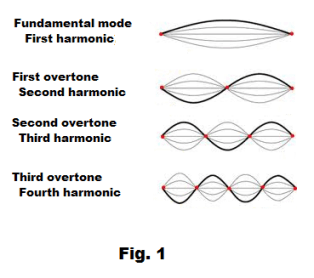
Standing waves are produced. Waves have frequencies. They have “sound” when they are in a frequency range we can hear. Our famous western tuning note of A440 means that the frequency (distance from crest to crest) of the standing wave is 440 Hz, or 440 cycles/second. Fortunately the way sound waves work in a tube, for example, produces more than just the base frequency or wave. Otherwise the sound would be dull and lacking in a lot of character. It also produces
waveovertone(Link)
Overtones, simply put, are various multiples of the original fundamental frequency of the wave. The higher the note, the fewer the overtones and the closer the next note. That’s why we have 7 different fingering positions between middle C and G on the staff (open, 123, 13, 23,12,1,2,) and only 4 different fingering positions (open, 12,1,2,open,1,2) repeated between the next C and G above the staff. (Overly simplified, I know. Don’t worry about the specifics of the physics. If it works, we don’t have to know how.)

But let’s keep going. There’s one more bit of acoustics that explains the sound of our instruments.

resonance1(Link)
Resonance is when one object vibrating at the same natural frequency of a second object forces that second object into vibrational motion. (Link)

Which is what happens within the folds and valves of the trumpet. It is the ability of the sound to be reinforced or prolonged by reflection from the inner surfaces and setting them into their own vibrations. The result is that they is a deeper, fuller sound. It is how many overtones we are playing at a single moment. Lower notes tend to have greater resonance than higher notes because of the overtones, frequencies, tube length, etc. As we learn to play higher notes, we strengthen the resonance. That’s why someone like Doc can hit those high notes and he still produces resonance where mine sounds like a screeching baby bird being strangled.

Hold on, I’m just about through with the physics. It will all make sense even if you don’t understand the full science.

One of the reasons that Doc or Maynard (or whoever your favorite trumpet player is) can have a resonance in their higher register- as well as in their whole range- is that they have learned to keep the sound centered. You see the center of the horn, the center of that lead pipe or tuning slide, is where the sound is most effectively and efficiently produced. It allows the standing wave to go right down the middle and its overtones to be centered with it.

Yes, this is a long way to get to the point but let’s boil it down to this simple explanation:

The center of the horn is where the resonance is. Therefore, in order to get the rich, full sound, all you have to do is find the center and play into it. Center the tone; center the air; you will improve your sound.

How do you learn to do that? In looking at this basic explanation of trumpet acoustics, we have reached the very basics of trumpet practice and development- finding ways to center our sound. Since it is basic, it should come as no surprise that it is…

Long tones!

Yep, those boring exercises in holding a note for an “extended” period of time are probably the most important thing we will ever learn about being a trumpet player. It looks like, from an acoustics and metallurgical standpoint, everything else builds on top of that. You don’t have to know the science, but it helps me visualize what is important when I am doing long tones. And in visualization, we are actually helping ourselves to do what we are wanting to do.

When you play those long tones, it may be helpful to picture in your mind the sound wave moving down the lead pipe. As it does make sure it stays in the center in your mind’s eye. Through the wonders of the nerves and workings of our brain that actually helps us to guide the air that way in the world of the trumpet itself. We often overlook the mind-body connections and the power of visualization and thought.

Well, how long should we play a given long tone. There are all kinds of advice on the Internet abut how long, in time, “long” is. Some say hold it for as long as you can keep it centered and steady. Others talk about a flowing series of long tones. (Look up Schlossberg #6 at Greg Wing Trumpet for a really helpful exercise of long tones.)

In general though here are four definitions of what is long enough:

•    Long enough to keep it centered
When we are first warming up the sound will not be as centered as it can be. For those of us who are less advanced, such centeredness comes with time. But you will hear the difference.
•    Long enough to hold it steady
Once we hear it getting centered the next step is to keep it steady there. That means the force behind the breath and the abdominal support.
•    Long enough to hold the dynamics.
Pick a dynamic and hold it. Many recommendations are to play it soft, then next time softer, holding it at the pianissimo level for the duration.
•    Long enough to listen! Really listen!
Can you hear it? No? Then do it again. Hold and listen. Keep the breath and dynamic steady.

One very useful way to get started is just playing the “tube” - the lead pipe. Take the tuning slide out and play 2nd line “G”. Listen for the centeredness, the steadiness. Listen again. Do it regularly at the start of your practice and you will be ready for the notes that come next.

Long tones can be a good 10 minute warm-up. Not strenuous, but solid. As perfect a way to get your session going as any.

Bruce Chidester on The Trumpet Blog has a list of 10 reasons to do long tones. Here are four of them:
  • Long tones give you the opportunity to listen to your sound- by listening to your sound; there is a natural tendency to improve on what you are listening to.
  • Long tones help you analyze what is going on within your air stream. Opening and closing the channel which encompasses the passage of air will dictate the timbre of your tone.
  • Long tones train your arms and hands to support the instrument more steadily for any shaking in these areas will telegraph into a shaky tone.
  • Long tones are the direct opposite of fast, highly technical passages and thus need to be implemented to balance your technical playing.
    Bruce Chidester
But there’s another piece of being centered. It fits in with the principle that the way you do anything has an impact on the way you do everything. Being “centered” in ourselves may be the most important thing we can do for our health and daily living. It gives us a place to go to within ourselves when stress gets overwhelming. It gives us a way to gather our thoughts and focus ourselves. What we are talking about above with “centering” the sound is a form of focusing the sound. It increases our ability at mindful attention to what is happening. It trains our brains to control our body to produce the sound we want. Apply that now to who you are.

You- the musician- need to be able to be centered in yourself. You need to sense and enhance the resonance that happens around you and within you. That rich, vibrant sense of life alive can enhance all that you do.

That means attention to breathing. That means attention to how we are feeling and reacting to our surroundings. That means being aware of the physical tensions and tightness that so easily derails us. That is one important piece of my own personal work. I have learned a lot of that mindfulness and breathing in so many areas of my life. Now I am applying it to my trumpet playing. My performance anxiety, for example, can be eased with self-centering. My listening for the centering of my sound in long tones teaches me what being centered feels like. It relaxes my muscles and I find I am playing with a more relaxed tone. If we do not play “centered” we can find ourselves playing “tight”, constricting the sound. Playing tight also tires me out more quickly because my breath isn’t centered or easily flowing. It is a wondrous cycle of the flow of our lives.

Seek the resonance within you- and in your music.

End note: Gavin Brehm is one who does know the science of physics and acoustics. He has designed mutes, started Brehm Mutes, LLC and knows something about trumpets. Instead of putting his comments into comments, I place them here in the post itself as he has some good expansion and ideas. Thanks, Gavin!
Interesting take on this topic! I think that this definition of resonance brings up an interesting distinction between being “forced” into sympathetic vibration (which would be an oxymoron) and simply sympathetically vibrating. This definition encourages saying that a resonant player is able to “make” the horn resonate (again oxymoronic), while the physics dictates that it is actually the horn that allows the players lips to resonate to their full potential by reflecting waves in series back to them. To me, this distinction is often missed in colloquial English because of its subtlety. Yet, since only objects which share modes of vibration can send each other into resonance, then the horn and the players lips must already have equal oscillatory tendencies. This reinforces the idea that a relaxed player will achieve greater resonance than would a player with undue tension, since resonance is not something that the player can force.

Wednesday, April 27, 2016

Tuning Slide: The World in a Note

Weekly Reflections on Life and Music

The more you get into music, the more you discover that
a whole note becomes the whole world.
- Trumpet Camp 2015

The Music Lesson is a wonderful musical philosophy book by bassist Victor Wooten. Early in the book Victor's "mentor" Michael asks him if he remembers the Dr. Seuss book, Horton Hears a Who. "Do you remember what the poor elephant found inside the little speck of dust?"

"There was a whole civilization living inside it."
"Exactly," [Michael] said, pointing at me. "Notes are the same. If you listen closely, you can find a whole world living inside each one. Notes are alive, and like you and me, they need to breathe. The song will dictate how much air is needed."
At the end of trumpet camp last year we heard the same thing in our closing session as quoted above.

Months ago, as I put together the themes for this blog year, I sent Mr. Baca an email asking for an explanation, a line or two that I could riff on. He was always too busy.

Actually, I think he was doing me a favor. He was letting me figure it out on my own. I would schedule a post on the subject, then push it back. A few weeks ahead, I would say,

"Nope, Mr. Baca hasn't answered me yet."

I would push it back again. It seems I needed to discover the world in a note for myself.

To understand how the world exists in a single note is not something that can be clearly taught. It is one of those things that makes sense only when you have your "Aha!" moment. Sure I've been given clues and ideas about what it means, but, hey, I can be a little slow. The answer was right in front of me all the time. It was shown over and over on web sites and articles. It showed up every day I picked up my horn to practice.

A couple weeks ago it came to me. Clear as the bell on my trumpet. It came together when watching a video of Wynton Marsalis on the website- Arban Method. (Video at bottom of post.)

Long tones. The boring, bane of every trumpet player.

I remembered Mr. Baca at Big Band Camp telling me to take the tuning slide off and just play that single tone, basically, "G" on the staff.
  • Play it; 
  • listen to the sound;
  • center it; 
  • hold it; 
  • just let the air go through; 
  • listen to the sound;
  • keep it centered;
  • Now do it again.
In that note is the whole world of trumpet music. In that note will be every note you play.

Now, put the slide back in and do it with "G". It's still there. THAT note hasn't changed. The trumpet does the work.

Play up the scale. Every note is still that single buzzing tone- the single note of the world. Play down the scale. The same thing is happening.

With every long tone, you play that same single tone. It is, in essence, the foundation of every note on the horn. As long as you keep that in mind, and the physics and philosophy of the buzz note, you will have the whole scale.

How simple.

One of our local PBS stations is currently rerunning the Ken Burns series Jazz. It's amazing how much different the series is 16 years after first aired. I am hearing and seeing things that were irrelevant to me when I first saw it. In last week's episode one of the commentators was discussing the revolutionary genius of Louis Armstrong. (An understatement!) He was describing how Armstrong took "pop" songs and interpreted them for his jazz bands. No one else was doing that. They played them straight. Armstrong, the commentator said, went to the very essence of the songs. He would often distill it all to one note (!) playing the tempo and swinging the groove. One note! The whole song in that single note.

When I started this trumpet journey last summer I thought the purpose of doing long tones was to build chops. If I did long tones on a regular basis I would improve the embouchure, increase my range, build endurance, develop breath, and learn to center each note. All of which is true. But now I have a hunch these are the important results of finding the whole world in the single note on the horn.

Most instrumentalists face the same task. We can't make chords on our instruments like a pianist or guitarist (or even banjo player) can. We have one note at a time to work with. At first we learn the notes. We discover the ways to play each individual note. It has its place on the scale and we play it. We do our version of "chords" when we move to intervals, playing thirds and arpeggios. But it is still only one note at a time. (Ignore overtones for this discussion.)

Somewhere along the line we begin to hear differently. We begin to discover the world in our trumpet, the voice we talked about in an earlier post that is uniquely ours.

And it's all in that single note we can only play one at a time.

Let's move away from music for a moment and get philosophical. My goal in this blog is as much to "tune" our individual lives as it is to "tune" our musical chops. This is as true for who we are and what we hope to do or be each and every day.  That single, buzzing "G" is our individual core. It is our personality, our skills, our hopes and dreams. If we try to focus too much on these and seek all the answers we will quickly become unfocused. Our lives simply responding to the next "thing" or next "crisis" or even next "dream."

But what is your "G" tone? What is your world in a single note at the center of your soul? What's in your heart? How does that define what you can do and how you do it? Take the time to center on that. Meditate on it. Learn to live it and let it guide you no matter what is happening.