Showing posts with label physics. Show all posts

Wednesday, October 05, 2016

The Tuning Slide: 2.5- Finding the Center


Weekly Reflections on Life and Music
How is it that this bunch of metal can make music? Whether I’m working on a Bach piece for the quintet or listening to Doc soar skyward from the very lowest G to far higher than I can go, this comes out of the same basic physics and metallurgy of the instrument we share in common. This is just as true for any instrument, but those of us who play wind instruments depend on some special properties of tubes. (Yes, that’s really all a trumpet or sax or clarinet is- a long tube.) So to understand some of the basics of our instrument, let’s look at some physics. Don’t worry, I’m not a physicist so it won’t get too technical.

As with all brass instruments, sound is produced by blowing air through closed lips, producing a "buzzing" sound into the mouthpiece and starting a standing wave vibration in the air column inside the trumpet. The player can select the pitch from a range of overtones or harmonics by changing the lip aperture and tension (known as the embouchure).  (Wikipedia)

638px-crest_trough-svg (Link)
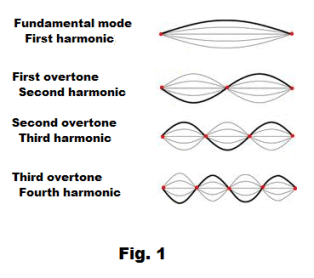
Standing waves are produced. Waves have frequencies. They have “sound” when they are in a frequency range we can hear. Our famous western tuning note of A440 means that the frequency (distance from crest to crest) of the standing wave is 440 Hz, or 440 cycles/second. Fortunately the way sound waves work in a tube, for example, produces more than just the base frequency or wave. Otherwise the sound would be dull and lacking in a lot of character. It also produces
waveovertone(Link)
Overtones, simply put, are various multiples of the original fundamental frequency of the wave. The higher the note, the fewer the overtones and the closer the next note. That’s why we have 7 different fingering positions between middle C and G on the staff (open, 123, 13, 23,12,1,2,) and only 4 different fingering positions (open, 12,1,2,open,1,2) repeated between the next C and G above the staff. (Overly simplified, I know. Don’t worry about the specifics of the physics. If it works, we don’t have to know how.)

But let’s keep going. There’s one more bit of acoustics that explains the sound of our instruments.

resonance1(Link)
Resonance is when one object vibrating at the same natural frequency of a second object forces that second object into vibrational motion. (Link)

Which is what happens within the folds and valves of the trumpet. It is the ability of the sound to be reinforced or prolonged by reflection from the inner surfaces and setting them into their own vibrations. The result is that they is a deeper, fuller sound. It is how many overtones we are playing at a single moment. Lower notes tend to have greater resonance than higher notes because of the overtones, frequencies, tube length, etc. As we learn to play higher notes, we strengthen the resonance. That’s why someone like Doc can hit those high notes and he still produces resonance where mine sounds like a screeching baby bird being strangled.

Hold on, I’m just about through with the physics. It will all make sense even if you don’t understand the full science.

One of the reasons that Doc or Maynard (or whoever your favorite trumpet player is) can have a resonance in their higher register- as well as in their whole range- is that they have learned to keep the sound centered. You see the center of the horn, the center of that lead pipe or tuning slide, is where the sound is most effectively and efficiently produced. It allows the standing wave to go right down the middle and its overtones to be centered with it.

Yes, this is a long way to get to the point but let’s boil it down to this simple explanation:

The center of the horn is where the resonance is. Therefore, in order to get the rich, full sound, all you have to do is find the center and play into it. Center the tone; center the air; you will improve your sound.

How do you learn to do that? In looking at this basic explanation of trumpet acoustics, we have reached the very basics of trumpet practice and development- finding ways to center our sound. Since it is basic, it should come as no surprise that it is…

Long tones!

Yep, those boring exercises in holding a note for an “extended” period of time are probably the most important thing we will ever learn about being a trumpet player. It looks like, from an acoustics and metallurgical standpoint, everything else builds on top of that. You don’t have to know the science, but it helps me visualize what is important when I am doing long tones. And in visualization, we are actually helping ourselves to do what we are wanting to do.

When you play those long tones, it may be helpful to picture in your mind the sound wave moving down the lead pipe. As it does make sure it stays in the center in your mind’s eye. Through the wonders of the nerves and workings of our brain that actually helps us to guide the air that way in the world of the trumpet itself. We often overlook the mind-body connections and the power of visualization and thought.

Well, how long should we play a given long tone. There are all kinds of advice on the Internet abut how long, in time, “long” is. Some say hold it for as long as you can keep it centered and steady. Others talk about a flowing series of long tones. (Look up Schlossberg #6 at Greg Wing Trumpet for a really helpful exercise of long tones.)

In general though here are four definitions of what is long enough:

•    Long enough to keep it centered
When we are first warming up the sound will not be as centered as it can be. For those of us who are less advanced, such centeredness comes with time. But you will hear the difference.
•    Long enough to hold it steady
Once we hear it getting centered the next step is to keep it steady there. That means the force behind the breath and the abdominal support.
•    Long enough to hold the dynamics.
Pick a dynamic and hold it. Many recommendations are to play it soft, then next time softer, holding it at the pianissimo level for the duration.
•    Long enough to listen! Really listen!
Can you hear it? No? Then do it again. Hold and listen. Keep the breath and dynamic steady.

One very useful way to get started is just playing the “tube” - the lead pipe. Take the tuning slide out and play 2nd line “G”. Listen for the centeredness, the steadiness. Listen again. Do it regularly at the start of your practice and you will be ready for the notes that come next.

Long tones can be a good 10 minute warm-up. Not strenuous, but solid. As perfect a way to get your session going as any.

Bruce Chidester on The Trumpet Blog has a list of 10 reasons to do long tones. Here are four of them:
  • Long tones give you the opportunity to listen to your sound- by listening to your sound; there is a natural tendency to improve on what you are listening to.
  • Long tones help you analyze what is going on within your air stream. Opening and closing the channel which encompasses the passage of air will dictate the timbre of your tone.
  • Long tones train your arms and hands to support the instrument more steadily for any shaking in these areas will telegraph into a shaky tone.
  • Long tones are the direct opposite of fast, highly technical passages and thus need to be implemented to balance your technical playing.
    Bruce Chidester
But there’s another piece of being centered. It fits in with the principle that the way you do anything has an impact on the way you do everything. Being “centered” in ourselves may be the most important thing we can do for our health and daily living. It gives us a place to go to within ourselves when stress gets overwhelming. It gives us a way to gather our thoughts and focus ourselves. What we are talking about above with “centering” the sound is a form of focusing the sound. It increases our ability at mindful attention to what is happening. It trains our brains to control our body to produce the sound we want. Apply that now to who you are.

You- the musician- need to be able to be centered in yourself. You need to sense and enhance the resonance that happens around you and within you. That rich, vibrant sense of life alive can enhance all that you do.

That means attention to breathing. That means attention to how we are feeling and reacting to our surroundings. That means being aware of the physical tensions and tightness that so easily derails us. That is one important piece of my own personal work. I have learned a lot of that mindfulness and breathing in so many areas of my life. Now I am applying it to my trumpet playing. My performance anxiety, for example, can be eased with self-centering. My listening for the centering of my sound in long tones teaches me what being centered feels like. It relaxes my muscles and I find I am playing with a more relaxed tone. If we do not play “centered” we can find ourselves playing “tight”, constricting the sound. Playing tight also tires me out more quickly because my breath isn’t centered or easily flowing. It is a wondrous cycle of the flow of our lives.

Seek the resonance within you- and in your music.

End note: Gavin Brehm is one who does know the science of physics and acoustics. He has designed mutes, started Brehm Mutes, LLC and knows something about trumpets. Instead of putting his comments into comments, I place them here in the post itself as he has some good expansion and ideas. Thanks, Gavin!
Interesting take on this topic! I think that this definition of resonance brings up an interesting distinction between being “forced” into sympathetic vibration (which would be an oxymoron) and simply sympathetically vibrating. This definition encourages saying that a resonant player is able to “make” the horn resonate (again oxymoronic), while the physics dictates that it is actually the horn that allows the players lips to resonate to their full potential by reflecting waves in series back to them. To me, this distinction is often missed in colloquial English because of its subtlety. Yet, since only objects which share modes of vibration can send each other into resonance, then the horn and the players lips must already have equal oscillatory tendencies. This reinforces the idea that a relaxed player will achieve greater resonance than would a player with undue tension, since resonance is not something that the player can force.

Monday, October 03, 2016

Why Does Synchronicity Happen?

Synchronicity is a concept, first explained by psychiatrist Carl Jung, which holds that events are "meaningful coincidences" if they occur with no causal relationship, yet seem to be meaningfully related. -- Wikipedia
That word came to mind recently when reading the wonderful book Bach- Music in the Castle of Heaven by John Eliot Gardiner. He referred to the three musicians born in 1685 as The Class of '85.
In 1685, within a period of eight months, three master composers were born: Scarlatti, Handel and Bach. Although each was extremely influential, they worked in very different ways because of the contrasting demands of their surroundings. --NPR
Three other amazing composers were born around the same time, Gardiner reports. The French composer, Jean-Philippe Rameau was born in 1683 and Johann Mattheson and Georg Philipp Telemann, were born in 1681. In other words, the extended Class of '85 produced, in a four year period six remarkable, significant, and in many ways music-changing individuals.

Synchronicity: Meaningful coincidences.

Why? What happened in that time frame that brought about the start of some incredible musical changes by six men born within the same small window of time?

Coincidence? Sure, I can accept that. It doesn't have to be in any way related. Things happen. Kind of like enough monkeys "typing" on enough computer keyboards (had to update the image) could produce the works of Shakespeare. Except I am not sure that is reality. When things fall into "lucky" place like that, one does wonder why at that point in time and in that place those things happen.

I remember thinking of that about the rise of the major religions of the world as they have become in a relatively small time frame over the turn of the "eras" B.C. (B.C.E) and A.D. (C.E). It has made me wonder what was happening in the Western Hemisphere native peoples at the same time in the development of their religious life? If we could dig deeply enough, a "coincidence" would not surprise me.

Synchronicity: Meaningful coincidences.

I could cite others that I have considered but none of that would answer the question about why do coincidences like that happen? Perhaps even more broadly, why do coincidences happen in every day lives? Yes, many of them are false constructs, I realize. Correlation does not equal causation or even connection for that matter. The connection is in OUR minds and point-of-view; there is no actual connection in most instances.

And yet....

As I was pondering this question while reading Gardiner's book a thought did come to me. It comes out of the reading I have been doing on Quantum physics and waves and resonating frequencies. It is based on the thought that I had in an earlier post on The Physics of the Universe. At that time I wrote that the universe, creation and all of us...
...are energy vibrating, perhaps at our own unique wavelengths. Who knows but that we are finely tuned instruments who respond at our quantum level to the music and vibrations, the energy and pulsing rhythm always surrounding us.
I got this image of wavelengths of sound and energy flowing through the universe or, less grandly, in the vibration of lives and events around the world. As these vibrations propagate from life and the stuff of which this world is made, they interact with each other. They are like the waves from a pebble tossed into a lake interacting with waves from other pebbles, the wake from a passing motor boat, or the moving water kicked up by a fish's fin. It is basic physics that these waves move together or against each other.
In physics, interference is a phenomenon in which two waves superpose to form a resultant wave of greater, lower, or the same amplitude.
--Wikipedia

Like in this picture of waves in water.

At times these waves can produce interesting patterns. Sometimes they come together at points that bring about significant movement or other events.

So, as I pondered the Class of 1685 and the coincidence of time and place I wondered
What if these synchronistic events are a time and place where some of these waves, vibrations, overtones, and resonance come together in a unique way? In so doing they allow for things that have never happened before and in various places, the nodes of these interactions become the sits of coincidence.
Synchronicity: Meaningful coincidences.

Synchronicity: Resonance created by the constructive interference of vibrations and waves of events, people, and even quantum level overtones resulting in similar events that don't appear to have any causal connection, yet seem to be meaningful related.

Just thinking out loud.

Friday, September 09, 2016

The Physics of the Universe

I have always had a strong interest in science and its relationship to life. When I started college some decades (!) ago, I started out as an engineer. In the mid-1960s any student who showed any aptitude at all was directed that way. Well, it didn't work out so well for me, but I never lost my interest in science. In these past 50 years the world of science- and particularly physics- has exploded in all kinds of directions and insights that are nothing more than mind-twisting. Quantum physics and everything related to in has made the universe so much more complicated and interesting.

Sometimes things come together to pique my interest even more.

  1. This particular tweaking of my thoughts started about a month ago when I came across the book, The Jazz of Physics by Stephon Alexander. I had just finished the "biography" of physicist extraordinaire, Richard Feynman by James Gleick. When you begin combine jazz and physics I knew it had to be interesting, even if it did look a little more in-depth than I could begin to understand at times.
  2. I hadn't had a chance to start it when I was visiting with an old friend. We were talking about all kinds of topics, including religion when he said, "Try this one on for size. What if Einstein's theory of relativity was a way of describing creation?" I no direct answer and kind of filed it away since supper was ready anyway. (Eating and heavy thinking don't often go together. Something about doing two important things at once.) With this question in mind, I picked up the Jazz of Physics book that evening where I found out that Alexander was using jazz as an analogy for physics as a way of coming to an understanding of how the structure of our universe was created. Alexander wrote:
    It had never occurred to me, he wrote, that galaxies and superclusters of galaxies were organized structures, let alone that they could tell us something profound about the nature of the universe, including what it is made of and how it came into being.
  3. Next came the fun day in New York City last week with a young friend we have known since he was a young child. One of the things he is working on in his own mind has to do with music, physics, and how humans have "musical sounds." Which is exactly what Alexander does in his book.
Such a confluence of events and thoughts amazes me. Call it serendipity, synchronicity, or plain old coincidence, it usually gets my attention. I have now worked my way through the rest of Alexander's book, often scratching my head at the physics, but understanding the basics he was trying to describe in both physics and jazz. I would describe it in my own very non-technical and
very unscientific way like this:
We are all made of music! And music made us all.
Way back at the beginning of creation when all was infinitely small and of an infinite mass it was the very quantum vibrations of the smallest of particles and anti-particles that began the movement into the universe beginning. Sound, music, is simply vibrations and that early vibrating energy had a tone, a type of "music." Photons and electrons and positrons and whatever else I don't understand, kept the vibrations moving at that quantum level. Somehow or other the building blocks of modern physics including Einstein's work on relativity and Heisenberg's Uncertainty play into this.

Beyond that, I am lost. In fact all I wrote in and of itself is probably so wrong as to be an embarrassment to anyone who knows physics. But that's okay for me. I'm just learning. I may take some time to do some digging into the physics Alexander writes about. In some mystical and marvelous way this relates to improvisation and an understanding of how knowing your next note in a line opens up the possibility for ALL notes.

Underneath it all for me is the idea that we are music. We are energy vibrating, perhaps at our own unique wavelengths. Who knows but that we are finely tuned instruments who respond at our quantum level to the music and vibrations, the energy and pulsing rhythm always surrounding us.

Or, I may be all wet. But I feel the music, I hear the sounds, and something in me responds. Whatever it is, I am grateful.