Showing posts with label meditation. Show all posts

Monday, August 26, 2019

Tuning Slide 5.4- Exercise is Important, Too

Weekly Reflections on Life and Music
Take care of your body. It’s the only place you have to live.
– Jim Rohn

Something I have been more than just slightly aware of over the years is the importance of exercise and physical fitness. I have never been great at it and sometimes have had to force myself into complying with my own principles, but I have had the desire and some motivation for many years. It is not a surprise to me that physical fitness can play a part in our musicianship- and perhaps even vice versa. My trainer tells me he doesn’t see many people (my age or not) who can hold a plank as long and as well as I can. When we discussed it, he said that it may have something to do with my trumpet playing. The importance of the abs in playing trumpet is clear- it’s where the power comes from. So maybe they do go together.

In any case, I came across this graphic at a blog called Take Lessons with 10 exercises and activities for musicians. (Link)
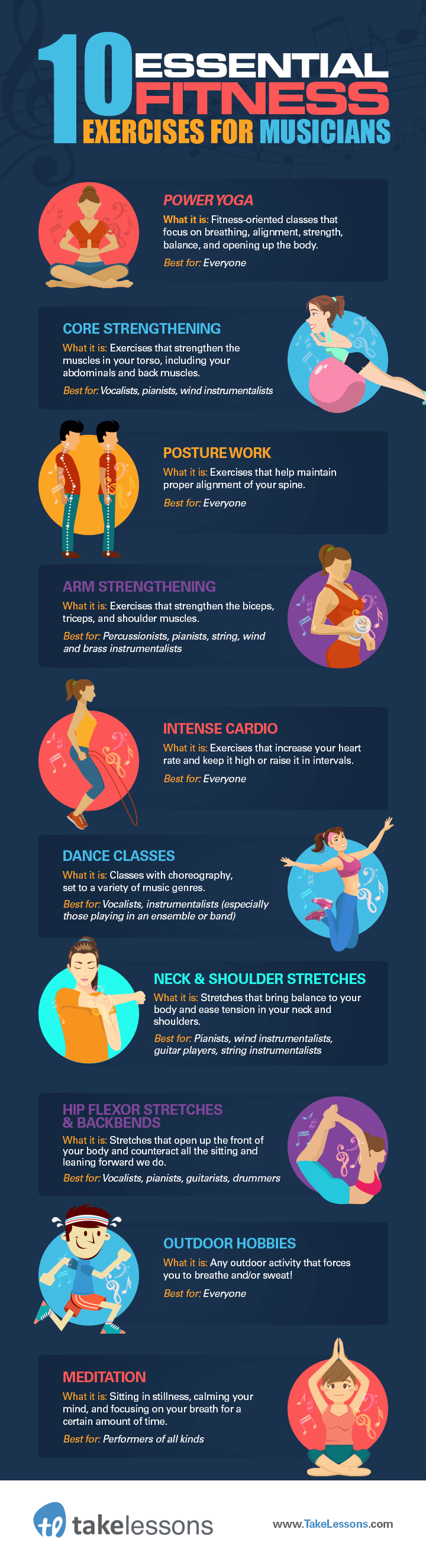

Some of the information from that blog talks about why these are important and can help musicians. Here is an edited version that brings out these advantages.

Power yoga
Learning how to properly and deeply breathe isn’t just important for singers! Taking full breaths is known to reduce stress and improve concentration. Breathing slowly and deeply, especially during challenging yoga poses, will help you to do so during stressful moments, calming both your mind and your body.

Core strengthening
Put simply, you need a strong core to hold yourself upright. It’s not just about having a six-pack; having a weak core can put strain on your back and ultimately cause chronic back pain. Core strength also helps improve your balance and stability — super important for all the sitting and standing we do!

Posture work
Sitting at a computer all day, being hunched over our phones, and slouching in general can wreak havoc on our posture. Over time, our spine begins to morph into the wrong shape — chin jutting forward, shoulders hunched, feet forming a v-shape. Not to mention that a performer with poor posture just doesn’t look as confident or as professional!

Arm strengthening
No matter if you’re a singer or you play an instrument, chances are you’re going to be holding something up, whether it’s your music, your instrument, or your arms. Some instruments may even require using the strength of your arms for certain techniques. Strengthening your arm and shoulder muscles can help prevent injuries, especially to the joints that end up fatigued when they aren’t supported by strong enough muscles.

Intense cardio
Cardiovascular health is important for everyone, but musicians especially can benefit from the mind-over-matter mentality that it takes to push yourself past your limits. And increasing your heart rate during exercise can ease stress, relieve anxiety, and help you sleep better — all of which benefit both your practice and your performance.

Dance classes
Dance classes with choreography require you to stay present and focused, and to memorize moves in the context of the music. These skills come in handy when you need to memorize a piece of music, especially if you are singing or playing with others. They also require coordination and improve your rhythm by forcing your body to feel the beat. Lastly, dance classes can expose you to types of music you might not listen to on your own.

Neck and shoulder stretches
Keeping tension in your neck and shoulders while practicing can cause you to suffer more over time. Especially if you allow your shoulders to come up and forward, this can really weaken your posture and cause back pain, in addition to the neck pain already present. Tension can also inhibit your playing, since many techniques require your muscles to be controlled but in a relaxed way.

Hip flexor stretches & backbends
Tension in the front of your body causes it to be imbalanced and ends up pulling on the back of your body. This takes a toll on your posture and can cause muscle and joint pain. Some say that we carry our stress in our hips, so opening them up would naturally help relieve that stress. Backbending opens your chest and lungs and can help you breathe more deeply.

Outdoor hobbies
In his piece “For Poets”, Al Young advises “Come on out into the sunlight/ Breathe in Trees/…Don’t forget to fly”. The message rings true for all artists — the best inspiration comes from being out in nature and experiencing life. Many musicians spend so much time holed up in studios and practice rooms, so it’s even more important to remind ourselves to get out there and have those one-of-a-kind experiences.

Meditation
Meditation not only reduces stress and anxiety, it also improves focus and memory. And when you have the skills to calm your mind anywhere, anytime, you can handle anything! For performers especially, practicing meditation will connect your mind and body and allow you to keep calm, no matter how many people are in the audience. (Link to Take Lessons)

Of course, be cautious. Don’t get into some exercise class or regimen without checking with a doctor, especially if you have not been active. Plus, take it easy- build into it. It takes time to get into shape, just as it has taken time for any of us to get where we are with our music. We can do great damage to ourselves and our health if we don’t develop balance.

The interplay between fitness and musicianship is clear. It is not to become fitness champions, it’s about doing what you can do to keep yourself in shape. There are plenty of places to take yoga classes, work on the Alexander technique, discover T’ai Chi, get out an hike. I am too geeky to be able to take a dance class, but maybe that will be the right way for you. Yes, it takes planning, work, and discipline to get into a fitness routine. But we already know the importance of being in a good practice routine. Time to apply it.

Monday, September 24, 2018

Tuning Slide 4.11- It's (Mostly) All in Your Head

Weekly Reflections on Life and Music

• Trumpet playing is
o 90% mental
o 9% air
o 1% physical
— Attributed to a number of people, most often Bill Adam

When it comes right down to it, this is what the Inner Game of Music is truly all about. It is the mental side of playing music. It attitude. It is mindfulness. It is how we think and act out what we are thinking- or not thinking. I am not sure I like that idea. It means that things like building endurance or a perfect embouchure, the right mouthpiece or instrument, or heavy caps aren’t as important as we like to think they are. They are attempts at short-circuiting the process of becoming a musician.

Not to disregard the physical side. (More on that next week.) That is real and does impact the way we play. But it is the more effective use of our energy through the mental that in the long run as the most positive impact on what we are doing. Why might that be? Here’s a thought:

The brain consumes energy at 10 times the rate of the rest of the body per gram of tissue. The average power consumption of a typical adult is 100 Watts and the brain consumes 20% of this [energy].

We also know a great deal about the many ways the brain can impact our actions, our physical health, how our bodies function. While much of it is a mystery, the effects have been seen in many studies.

This also shows why that sometimes the tiredness we feel after a period of playing is perhaps even more mentally caused than physical. That’s a lot of energy going out when we are playing. For example, here are some things that are regular actions of the “mental” that impact what we do:

◆ How we practice- we have to think about that as we do it.
⁃ Slow, fast, articulation, slurs, etc

◆ Hearing the music and notes in our head as we play.
⁃ I am fairly sure that the best way to learn to play is to hear the notes in your head before you play. This is especially true of the upper register, but applies equally to the whole staff.

◆ What we think of our abilities and how far we believe we can go
⁃ I know I can’t play that run. I am unable to memorize. I am crappy.

◆ Self 1 criticizing or Self 2 wanting to just do it
⁃ This goes beyond the previous one. This happens in the middle of a performance and we get distracted. “I just missed the note! OMG! I’ll never get it,” Meanwhile I didn’t get the next three measures because I got lost. Self-fulfilling prophecy.

◆ Memorization
⁃ It takes concentration and mental effort to memorize. I have not been willing to spent the time or take the effort. And that does impact my playing. (I also tell myself I can’t do it.)

◆ Listening to ourselves and others.
⁃ I have to pay attention when listening. Engage the brain!

All that takes mental activity. The more difficult it is, the more we are distracted and the harder we have to work- and playing becomes more difficult. Part of it is what is the story we are telling ourselves about ourselves? What is it we believe about our abilities? But it is also about being intentional about taking care of our brains- the mental activities that can strengthen what we do with the trumpet. So I Googled (always a good place to start) “How do we train the brain to be more efficient?” and I got some interesting thoughts from an article on Entrepreneur.com. Here are their eight ways to improve brain power (the ideas are from the article. The thoughts about them are mine) (Link):

1. Exercise.
⁃ The work of endorphins and other neurotransmitters is essential. Exercise helps generate them and regenerate cell activity. Most of us (pointing at myself as well) do not get enough physical exercise. It really doesn’t take a lot- average about 30 minutes of walking a day and it will enhance brain power! That and the oxygen boosts efficiency, too.

2. Drink coffee.
⁃ It’s a stimulant and helps in learning. It is only a short-term solution, but what you learn helps build the brain connections.

3. Get some sunlight.
⁃ Yes, get outside. It is actually more than the sun- it is the vitamin D, I am told. But to me it is also the ability to take-in fresh air, see and experience the world, and discover new things all around you.

4. Build strong connections.
⁃ We are not meant to be lonely. We have been created as social creatures. Some have even theorized that what we call “spirituality” is the need to have connections with the world and others. When we are isolated unhealthy things can begin to happen to our bodies and brains. Get out, be social.

5. Meditate.
⁃ Mindfulness/meditation has become the “In-thing.” For very good reasons. Not the least of which is that it works. Ten minutes a day can make a big difference. I don’t just mean “sitting meditation. I would add T’ai Chi and Qigong or walking meditation to a meditation regimen. The increased inner balance gets us more “in tune” with ourselves and what we are doing. Maybe do some yoga as part of a weekly exercise program as well.

6. Sleep well.
⁃ I know the old dictum we have heard from some- “You can sleep when you’re dead” as a way to get us off our lazy couches and do something. But to ignore healthy sleep habits can potentially get in the way of health itself. Sleep hygiene can be a big help, even if you sometimes have to struggle to get enough. Look into it.

7. Eat well.
⁃ I read that and said, “Yep, I will love to eat a lot.” I don’t think that is what it means. To eat well is to eat healthy, to not subsist only on junk food, or high sugar content drinks. Feeding your body healthy fuel will certainly help the brain!

8. Play Tetris.
⁃ For some reason, Tetris is considered by some researchers to be one of the better video games. It works on spatial recognition (an aid to balance), hand-eye coordination (like translating all those black marks on the page into music?), and keeps brain matter alive and working. Why Tetris? I have no idea. But I remember when I played it on the old Gameboy. It was fun and probably helped. (Maybe I'll download it on the iPhone.)

I would add a couple other things:
◆ Take time for relaxation and hobbies.
◆ Journaling can be a great way to get in touch and keep in touch with what is going on in your own head.
◆ Read more than you watch TV.
◆ Listen to music more than you watch TV.

If I want to be a better trumpet player, I guess I need to take care of the mental. Losing my mental sharpness will not have a good result in my music.

Wednesday, January 31, 2018

3.32- The Tuning Slide

Weekly Reflections on Life and Music

The heavens, whose aspect makes our minds as still
As they themselves appear to be,
Innumerable voices fill
With everlasting harmony;
The towering headlands, crowned with mist,
Their feet among the billows, know
That Ocean is a mighty harmonist;
Thy pinions, universal Air,
Ever waving to and fro,
Are delegates of harmony, and bear
Strains that support the Seasons in their round…
-William Wordsworth, On the Power of Sound

One of the joys of our winter stay on the Gulf Coast in Alabama is the ability to practice on the balcony overlooking the beach and water. I put my silent mute in and do my daily routine whenever it is warm and sunny enough, which is at least 75% of my time there. One day recently I finished my 30-40 minutes of playing and then sat and meditated for another 15-20 minutes. The result was the following reflection on both the practice and how music itself pulls us in and we become part of something greater than any one of us could ever be.


The surf is the constant background. It is a rhythm without a pattern, or better yet, a rhythm and pattern combining into breath. Its constancy is a heartbeat, a watery drum keeping all in motion. There are days it is as soft as a baby’s sleeping breath. This is, after all the Gulf of Mexico, not the expansive ocean. Even at fifty yards it can easily be overpowered by my muted horn.

But it is never lost. It is a pianissimo of my inner heartbeat, a drum cadence. It allows, even invites, movement. My long tones follow in order. They fall in sync with the surf. Then I play scales and it becomes a counterpoint. Play the chromatics too fast and I can lose the rhythm, the pattern under it all.
Slow down, the surf calls.
Follow me, the rhythm beckons.
In my time frame the surf is infinite, perpetual. Any time of day or night I can walk out on the balcony and it will be there. When it isn’t, life itself will have come to an end. This surf, formed by the world-wide waters, has been the breeding source of life itself. It shapes and reshapes the shorelines, constantly changing and challenging what even human grandiosity thinks is permanent. It will destroy and remold what we- and it- have built.

Then come the louder days. Gale force winds whip the tops off large swells. Though it is still the Gulf, its power is beyond what we can know. Most such days I am forced back inside, unable to compete in sound or comfort to the surf. In between the extremes, though, after a storm has moved through, shifted the winds, and roiled the surf, I can take the routine back to the balcony. Now the sound and pattern of my playing shifts. I get a little more aggressive, a little more stubborn in my insistence that I be heard, even by me.

I never win, humbling for a trumpet player to admit. Perhaps if I removed the mute my sound would carry a little further but I don’t want to disturb neighbors- or the surf itself. I must be in tune and time with the surf. Chromatics, Clarke #1, have to fall into the proper places, not just the silence but the ebb and flow of sound. The exercise on thirds must find the note solid in the right place of the surf’s rhythm. Amazing how many things it takes to make music. But with time and experience they do fall into an intuitive second nature. Harmony.

At times I realize I am also hearing and seeing other parts merging in this chamber composition. The birds in the tree below, the silent hopping of the sparrows on the edge of the balcony, the gulls laughing, pelicans soaring and diving. Whom am I to intrude, to insist on the importance of my part over theirs? That’s the harmony. I am not here to force my will on that of the world. I must not or the music will be more than dissonant, it will be destructive.

In between exercises and runs I pause. One is to rest as much as one plays, is the old adage. Here, on the balcony, that is a pleasure. As I stop the surf remains. It brings a moment of refreshment before I pick up the horn again. The others instruments continue their own song, unaware that I am listening. The call and chatter of the gulls, Laughing Gulls, in fact, challenging my hubris that I of all creatures can think I can accompany the greater symphony. Or they just do what they are supposed to do simply because their melody is needed to fill out the sound.

I take an extra 15 minutes at the end of the routine to just improvise over different chords, working on my favorite tunes I want to play at jams- Amazing Grace, This Land is Your Land, and Horace Silver’s The Preacher. They are now my contributions to uniqueness, more than just routine, foundation, they are different every time, influenced I am sure by the mood of the Gulf and the melody playing around me.

I am both humbled (kept in my proper place)
And empowered (given the direction to do what I can do)
By these practice times on the balcony.
  • Humbled at how little power I truly have;
  • Humbled that I am allowed to accompany such beauty;
  • Humbled that the surf and sand, birds and beach could care less!
Yet,
  • Empowered because I, too, am part of this symphony simply by being here in this moment;
  • Empowered to play and seek ongoing harmony with nature’s music;
  • Empowered by the inner and outer beats of the Eternal Heart.
Music is a gift of God!

Wednesday, October 25, 2017

The Tuning Slide 3.18- Ways to FInd Balance

Weekly Reflections on Life and Music

Life is like riding a bicycle.
To keep your balance, you must keep moving.
-Albert Einstein

Remember- how you do anything is how you do everything. If our lives as musicians are “out of balance” that means that many things we do are also out of balance. There is also the reverse way of thinking about this. If we begin to find balance in some different ways, the balance will begin to move into other areas as well. Balance is a physical as well as emotional factor. Our “sense of balance” comes from the inner ear, as many of us learned in high school health or biology. As a counselor who loves metaphors, I think the awareness of balance connected to the “inner ear” is a great metaphor well beyond the physical facts of human anatomy.

The “inner ear” is also be about that part of who we are that listens to how we are feeling, inwardly. The “inner ear” listens to the signals and feelings from within. The “inner ear” can “hear” discomfort and internal pain, it can feel “out of balance” and knock us out of whack as much as an inner ear infection can cause us to be dizzy and unable to maintain physical balance. (Yeah, I’ve had that happen!)

In this month’s posts I have been talking about the ways we can be “compleat” musicians. One of the things that seems to jump out of all that I have written is balance. That came to mind on Sunday at the Pops Orchestra concert. As the 4th trumpet I was only needed for the first number. I went out into the audience to enjoy the rest of the show. At intermission I went backstage and told the director how good it was sounding in the auditorium. His only question:

Was it balanced?

Yes, it was. Which was why it sounded good. Of course the question was more than just about whether the oboe could be heard appropriately with the violins. It was also about blend and how everyone was playing. If one trumpet is playing the section staccato and another is playing the same passage legato, it will stand out. So balance is more than just weighing two or more things against the others. It is the overall sound and tone, the style and dynamics. As always:

It’s all about the music

There are different things that I have found that can help me find balance so that I can translate it into my music. Perhaps the most valuable and effective are the movements and disciplines surrounding the ancient arts of yoga, T’ai Chi and Qigong. While yoga has kind of morphed into a wide range of exercise options, at its heart is the ability to move and stretch into a more balanced life. If you want it for aerobic or extreme exercise classes are available all over the place. I am not going to talk much about yoga. I highly recommend it for learning how to move and stretch, to grow into a more flexible and physically fit musician.

For me, the T’ai Chi and Qigong (pronounced chee-gung) based disciplines have become a key part of my own journey into better balance. I have been working on these two disciplines at various levels for four or more years. I am in no way an expert at these. I am a mere beginner who has discovered a way that has helped me in many, many ways. As I did some digging recently I found that a number of music schools, including Berklee and Vanderbilt have T’ai Chi courses for musicians. From Berklee’s catalog:
Tai Chi Chuan, or "Grand Ultimate Fist," is a moving meditation/exercise/martial art that can complement and energize your studies, music, and all the activities of your busy day. ... It is also a constantly evolving art/science that promotes physical, mental, and emotional balance, and is a useful tool for identifying playing-related tension patterns and opening constricted channels of the body. Tai Chi Chuan is a slow, flowing, no-sweat exercise with excellent health benefits that requires no uniforms or equipment, a moderate amount of floor space to perform, and no opponent to compete against except yourself. -Link
For their Qigong class, "Playing in the Key of Qi" Berklee says:
These exercises promote emotional balance, mental clarity, and an optimum physical state. Students will learn about the unique physiological benefits as well as how to apply these exercises to their instrument, daily activities, and creative endeavors. In addition, students will learn how qigong can act as a catalyst for healing or preventing an overuse injury and other health maladies. By the end of the course, students will be more able to conduct the inner orchestra of their mind, body, heart, and spirit through a state of relaxed awareness. -Link
The Harvard Medical School Guide to T’ai Chi (Harvard, 2013) lists ingredients that are the framework for T’ai Chi. Five that have particular impact for musicians:
  • Awareness
  • Intention
  • Active relaxation
  • Strengthening and flexibility
  • Natural freer breathing
In that same book, there is a chapter on enhancing creativity with T’ai Chi. Artists and musicians make comments like:
If you like music, you will probably like T’ai Chi. You can learn to tune into your body and know what that means. (Harvard Guide, p. 254)

T’ai Chi is about getting flow to happen, from inside to outside, side to side, and top to bottom. This is the same as creativity. (Harvard Guide, p. 252)

The experience [of T’ai Chi] felt so similar to playing music. Movement, rhythm, themes, and even vibrations, all come into play in both activities. When you play music, you have to play in tune, balance with your fellow players, and know where you are without thinking about it. Practicing T’ai Chi teaches you to tune in to the mind-body, the sense of balance, of being in the moment, and nowhere else.Doing the T’ai Chi form is a lot like playing chamber music. (Harvard Guide, p. 253)
Okay, I know this is sounding like an infomercial on T’ai Chi and Qigong. I guess what I am trying to say is that this is one way I have discovered to build balance into my own practice. The meditation in motion enhances my awareness and mindfulness. The discipline of easy breathing is an aid to relaxation before or after practice or performance. (Sometimes even during a performance.) Playing music is for many of us far more than just the notes on the page. It is deep movement, it is the breathing, it is the experience of doing something with others that is moving and entertaining. Above all, it is also a gift to ourselves allowing us to find the melody and the balance in tune with ourselves and the world around us.

There are more places offering T’ai Chi or Qigong than in the past. Google it for your area or check with a local community education program or healthy living center. Do some exploring for yourself. The best way is to learn with a teacher, but there are some good videos that can help you discover what it means. Here are links to three videos that I have personally found helpful:

Don Fiore T’ai Chi
Qigong at Spark People
T’ai Chi Chih

Mindful Musician
Tai Chi Health Products

With these we come to the end of this month's tips on being a "compleat" musician. In the end, self-care in all its forms allows us to grow and develop our skills. We can learn to be better balanced in music as well as the daily lives that surround our music. Or perhaps the music surrounds our lives to give us greater harmony and joy in life.

Next month we will jump back into ideas about practice, reminding us of the effective, efficient, and deliberate ways that we can use on a regular basis. See you then.


Wednesday, October 18, 2017

The Tuning Slide 3.17

Weekly Reflections on Life and Music

True enjoyment comes from
activity of the mind and exercise of the body;
the two are ever united.
-Wilhelm von Humboldt

We have been talking about how to become a musician this month- at least in behaviors, actions, and attitudes. At the heart of it is always that priority list:
1. The music
2. Our colleagues
3. The audience
4. Ourselves

Unfortunately, since it puts "ourselves" last, people often use that as an excuse NOT to take care of themselves. We end up pushing ourselves beyond our limits into wearing down of our energy, skills, and careers. The issue of balancing extremes that I talked about last week in relation to our actual playing is just as important when it comes to taking care of ourselves. It can be so easy to mess up our lives by not paying attention to what’s important in how we look after ourselves. We ignore warning signs of extreme fatigue, we think that we will always be able to do everything we have always done, we will not take care of our body, mind, and spirit. Many of us will actually take better care of our instrument than we will of ourselves.

In reality if we don’t take care of ourselves we can easily get into deep trouble physically and emotionally. In the end the music we produce will suffer, the relationships with other musicians will deteriorate, and we might not have an audience to play for. Taking care of ourselves, I am convinced, is the same as cleaning, caring for, and tuning an instrument.

Last summer I explained to Bill Bergren at the workshop what I was hoping to get out of an individual lesson. He took my horn from me, pulled out the tuning slide and looked down the lead pipe.

“When was the last time you cleaned this?” He looked in my mouthpiece, handed the trumpet back to me and just shook his head.

I cleaned it that night- and there was way more of the ugly green gunk than I wanted to see. That green gunk is a metaphor for what happens to me when I don’t take care of me!

So I did some surfing around the Internet and found many good bits of advice as I got ready to write this week’s post. They sum up the different areas of our lives that need self-monitoring on a regular basis. That is the “mindfulness” that I talk about so often. The better we pay attention to ourselves and what is going on around us, the better we will learn to take care of ourselves.

I put the things I found into a series of categories:
✓ Balance
Avoiding extremes
✓ Breathing/Relaxation
Developing tension releasing activities
✓ Commitment
Making self-care non-negotiable. (It has to be part of the daily routine!)
✓ Exercise
Keeping the instrument of self physically tuned
✓ Gratitude
Developing an attitude of humility and grace
✓ Mindfulness
Learning to be self-aware both inwardly and outwardly

First, on the Musician’s Way website, (https://www.musiciansway.com/blog/2009/11/the-12-habits-of-healthy-musicians/) Gerald Klickstein had twelve habits of a healthy musician. Here are the ones I felt fit best with this post:

• Manage your workload (Balance)
• Heed warning signs (Mindfulness)
• Minimize tension (Breathing/Relaxation)
• Take charge of anxiety (Breathing/Relaxation)
• Keep fit and strong (Exercise)

On the website Psych Central (https://psychcentral.com/lib/how-clinicians-practice-self-care-9-tips-for-readers/) there was an article about how medical clinicians and counselors learn to take care of themselves. Here are some of the tips from there that seems most appropriate.

• Remember that self-care is non-negotiable. (Commitment)
• Put it on your calendar — in ink! (Commitment)
• Know when to say no. (Balance)
• Identify what activities help you feel your best. (Balance)
• Take care of yourself physically. (Exercise)
• Surround yourself with great people. (Mindfulness)
• Meditation (Mindfulness)
• Check in with yourself regularly (Mindfulness)

To be a healthy musician, then, let's put these together:
  • Mindfulness:
    • Check in with yourself regularly
    • Heed warning signs
    • Meditation
  • Gratitude:
    • Surround yourself with great people
  • Balance:
    • Know when to say no
    • Manage your workload
    • Identify the activities for relaxation and renewal that can help you feel your best
  • Commitment:
    • Put your self-care activities on your calendar in ink
    • Remember they need to be non-negotiable
  • Breathing/Relaxation:
    • Minimize sources of tension
    • Take charge of anxiety
  • Exercise:
    • Take care of yourself physically
    • Keep fit and strong
As to that last one, I have been a wannabe exerciser for years. I manage to keep at it for a while, then something changes and I get lazy or off-track. (I have been a certified group trainer, as well.) Yet I have always known and experienced that when I am taking care of myself physically through exercise and better eating, I am better overall, and I am a better musician. There are many places to find ideas about exercise for musicians. I came across one set that was really helpful. The site is Take Lessons (https://takelessons.com/blog/fitness-exercises-for-musicians) and they had a wonderful bit of information for musicians. They also had a number of links to helpful videos. Here are seven of their ten ideas, chosen more by my own experience to share:
  • Yoga- Stretching and movement with balance and intention is a great metaphor for musicians. We can learn it well through yoga. The website talked about “power” yoga. Not a necessity in my opinion. Yoga will do it without all the extras added.
  • Core Exercises- The core, the abs, are the supporting foundation for all good health. They provide a way for musicians to be more focused and relaxed because they are well supported. The benefits of a strong core I don’t think can be overstated! Pilates is an excellent way to build this.
  • Posture- We have all heard that having good posture does a lot- we just ignore it. Yet a good posture will support better music. It also has a lot to do with breathing. And efficient use of breath is essential to those of us who are wind musicians!
    (http://brassmusician.com/posture-and-breathing-by-mike-white/)
  • Arm Strength (biceps, triceps, shoulders)- Think about holding the instrument! Need I say more?
  • Cardio- A healthy heart will help get that air moving and increase endurance.
  • Neck & Shoulder stretches
    (http://www.musicnotes.com/blog/2014/06/17/stretches-for-musicians/)
  • Meditation- Yes, this can be an important part of exercise. Next week I will talk more about this in relation to T’ai Chi and Qigong.
I hope I am preaching to the choir in this post. I am a strong supporter of self-care. It is not being selfish. It is taking care of yourself as a way of helping others. It is in line with the instructions you hear on an airplane. If the oxygen mask drops down, put yours on FIRST before helping even a little child put their on. You can’t help if you aren’t safe yourself.

Take care of you. It’s the only you that you will have.

Wednesday, July 26, 2017

The Tuning Slide: 3.5- Spirituality and the Musician

Music is the mediator between the spiritual and the sensual life.
-Ludwig van Beethoven

The past two weeks I have been looking at music and the spiritual. I defined spiritual as:
a. Awareness of power and existence greater than one's self.
b. There is meaning, purpose, and direction in this greater scheme of things.
c. Positive, healthy connections with other people as part of a greater community.
This week I want to look at the spiritual and us as musicians. The first quote below that I talk about is, like the quotes the past two weeks, from this website ( http://www.thescavenger.net/health-personal-development/self-growth/226-spiritual-significance-of-music-92345.html )
What we believe, perceive, and respect in life will shine forth in our music and spirituality. For some, spirituality is a scary word reflecting religious thinking masquerading as truth. It does not have to be some esoteric message about magic and mysticism. … Spirituality reflects our faith and values. It represents our response to reality. It is the rippling undercurrent beneath our actions, firmly built on the foundational cornerstone of belief…
There’s a lot in that one paragraph. First it says that who we are will be reflected in our music. That includes our beliefs and perceptions of the world around us as well as what we value. Sometimes those things shine through in spite of us. The whole history of musicians and substance abuse, suicide, and personal difficulties did not completely silence the messages that some of these have had to share with us. In fact for many of them their music was a way of trying to figure it all out, their search for meaning and hope and life itself cries out from their music. At times that becomes very dark and dismal, and at times filled with a bright light of hope, even if they themselves never found it.

Which brings me to the questions that many of us need to wrestle with in our music…

What feeds your spirit? What is it that gives meaning and hope to our lives? Where is our personal search taking us? How does my music reflect the beliefs and reality I live with each day?

Most of us don’t deal with these consciously when we go into our practice rooms or even performances. But the more in touch we are with those questions, the more likely our music will be impacted and transformed. Most musicians know of those times and places where all these come together and we are moved in different ways in the midst of a performance. One of my friends described that in one of his group’s performances with the word- “boomerang.” They were performing at a conference and the audience started to sing along with them turning the moment into one of high emotion and spiritual uplift. Everyone, including the musicians, were surrounded by something greater than themselves. No one left that performance unmoved! It happened because the musicians were very much in touch with their own spiritual lives and it was included in their music.

How then do we feed our spirit.

There are many ways, perhaps starting with your own spiritual history or tradition. In the book Spirits Rejoice!: Jazz and American Religion, Jason Bivins discusses the spirituality of a number of Jazz musicians over the decades. He almost always begins with their upbringing and its possible influence on who they became and the expressions of their music. Most did not stay in those initial traditions alone, but the influence is real and powerful no matter how far the style may have strayed. It is also why Gospel music is part of the deep heritage of Jazz itself. But it is found in all types of music. So be attentive to what moves you musically and what that says about your own spiritual roots.

But then you must maintain your own mindful awareness of yourself. Mindfulness is the non-judgmental attentiveness to your feelings and the events around you. Mindful meditations a way that many people begin to discover some of these depths. Later this year I am also going to talk a little about things like Yoga, Tai Chi, and Qigong as spiritual disciplines for musicians. They can bring together body, mind, and soul in an expression of your own creativity and energy.

Which brings me to a quote that I think applies to our lives as musicians and our spirituality:

Play the music, not the instrument.
-Author Unknown

To get in touch with the spiritual in our own music we have to become comfortable with our instrument. We can easily get sidetracked by the technical aspects of playing our instrument. We can get bogged down by trying to remember the fingerings for the key we are playing in. We can lose sight of the music when we are just playing the notes on the page. The spiritual depth of our playing, our even just the plain musicality of it, gets interrupted by the logical side and we lose the intuitive.

One of my MAJOR pet peeves is when I get a piece of music and find that a previous musician as gone through and written the fingerings for all the notes in a particular section. My mind cannot process the written numbers and the note at the same time. I lose the intuitive knowledge that a G# on the staff is 2nd and 3rd. Numbers don’t represent anything and I wonder what that 2 and 3 mean. Sure, it’s a quirk of mine, but I have spent a long time becoming as comfortable with my instrument as I can be at this moment. Don’t confuse me with data that is unneeded.

Right now I am doing something I have never consciously done in my 55+ years of playing. I am working on changing my embouchure. (No need for details at this point.) That means I must for the moment be playing the instrument first. I am trying to relearn how to play with a good sound. I am developing new muscle memory in my lips and breathing patterns. I am working toward the natural feel the change in embouchure will have when it is settled in. Until then, I am not finding the spiritual as easily as I did before. One of these days I will be back to the music.

To live is to be musical, starting with the blood dancing in your veins.
Everything living has a rhythm.
Do you feel your music?
-Michael Jackson

As I am writing this, I am listening to some music. I am typing and the music is flowing. It is an instrumental Jazz duet and it is working in both the conscious and sub-conscious. Every now and then I am aware that my body is moving side to side in time with the music. Then my feet start tapping. I am in a public place so I am not about to get up and start dancing. But the rhythm is dancing in me. Do I feel that when I play? That is my goal.

That is spiritual. Let it flow.

One of the best examples of spirituality in music is the incredible Jazz saxophonist John Coltrane. He is famous for his spiritual wanderings, wrestlings, and depth. Last week, on the anniversary of his death, National Public Radio posted on Facebook an older piece they did on him in 2012. McCoy Tyner, a member of his band, remembered Coltrane saying:

"I respond to what's around me."

Tyner adds,

"That's the way it should be, you know?”

Coltrane on NPR.
(http://www.npr.org/2000/10/23/148148986/a-love-supreme?utm_source=facebook.com&utm_medium=social&utm_campaign=nprmusic&utm_term=music&utm_content=20170717)

Here’s a video of Coltrane’s “Dear Lord.” With the title in mind, hear spirit blowing through the horn!


And if you haven’t ever done it, go find “A Love Supreme.” Take the time to let it fill you.

~~~~~~~~~~~~~~~~~~~~~~~~~~~~~~~~~
A special note:


This year's Shell Lake Arts Center Trumpet Workshop begins Sunday, July 30. I have the boxes of my book ready to go. They will again be free to the students! In order to help me defray the cost I have a Go Fund Me page where those who would like to can make a donation. Thanks!

Here is the link:

Go Fund Me for Tuning Slide books for students

Wednesday, July 19, 2017

The Tuning Slide: 3.4- Depths of Spirituality

Weekly Reflections on Life and Music

Music, once admitted to the soul,
becomes a sort of spirit, and never dies.
― Edward Bulwer-Lytton

Last week I started a series of three posts on music and spirituality. I don’t want to get too out in left-field, New Age-y or whatever. That easily happens since spirituality is such a slippery subject, like trying to catch the wind. To attempt to keep my post from the dangers of such a discussion, I found a few quotes on a website (http://www.thescavenger.net/health-personal-development/self-growth/226-spiritual-significance-of-music-92345.html ) that I will use to keep me a little focused. The original quotes are bold; my thoughts on it are in normal type.

Many who study and discuss spirituality believe that we are innately spiritual; it is part of the human make-up and serves the evolutionary purpose of helping us form communities of meaning and support, helping ourselves and others when in times of need, and focusing on the broader picture of our world so that we can work together for mutual benefit. At the same time music and song are found in one form or another in most if not all cultures. Music becomes a way, perhaps, to form the bonds of community and support. It can express who we are by telling our stories in ways easier to remember. It may even serve to help form the neural networks in people of the same culture or offer a way for newcomers to join the culture.

Yes, that’s a heavy paragraph. Let me lighten it. Music can emerge from:
… personal education, environment, and experience. It can be inspiring, practical, and form the foundations for enjoying everyday life. When we listen to the secret language of the song, we only begin to understand that music is from a spiritual source.
The “secret language of song.” A few weeks ago I shared a post on my Facebook page about hymns we should stop singing in churches. The reasons were varied but they were usually because the song was simplistic, contained poor theology, or was just too sickly sweet. It sure hit a nerve. Some people thought I was a heretic (exaggeration, I hope!) or was treading on things that were given directly from the very hand of God. For many, the hymns mentioned contained a “secret language” that made sense to them. The post seemed to be attacking that. Yes, the music may be saccharine, the theology poor, the words silly- but for many of us these songs have come from a spiritual source. They don’t make sense- they make soul.
Spirituality is like a seed planted in the soul; when cherished by the heart, nourished by the mind, and savored by the spirit, it can and will give good fruit in due season. Spirituality is central to our life journey.…Spirituality is pivotal to how we interact with the world around us when pursued with authenticity, integrity, and sincerity.
I can’t but think of John Coltrane when I read that quote. His whole life was a quest to find the seed, nourish it, savor it, and discover its fruit. Following his recovery from addiction he jumped headlong into one of the great spiritual journeys found in music. His music expressed what he found in his soul. Many listeners, which is what this post is about, were at first surprised, turned away, finding the music too far from what they were used to. Others heard a connection that literally struck a familiar internal chord. Their lives began to resonated in tune with it.

I found that in a number of places for myself. One is the immortal Jazz standard, Summertime. It doesn’t matter if it’s Janis Joplin’s soulful wailing (which I was fortunate to have heard in person), Coltrane’s spiritual flights, or Louis Armstrong and Ella Fitzgerald sweaty southern interpretation (among many)- the song contains the authenticity, integrity, and sincerity of the soul. Blues can often do that- and can bring people of different backgrounds and history together. It is expressing variations on each of our life journeys.
[Spirituality] can be born out of a desire to connect with a deeper meaning and purpose in life. Musician and listener share a spiritual connection in the space between silence and sound.
Why do some key signatures sound happy and others, sad ? Why do we want to get up and dance to some and so in the corner and cry with others? Why do some songs connect us with each others pain, take us to heights of joy, or silence us in awe? It happens when the musician touches us with her sound. It happens when we are open to new things, or in need of an uplift. It happens when we move into sync with what it around us and some level of sound vibration. The spaces of silence lead us to moments of introspection that we may not even know we are having. In those connections we may even find that there is more to our own lives- and the world- than meets the eye.
Sound is spiritual. Every action and word has a sound that resonates and vibrates through life that is positive, negative, or neutral.
But be cautious, is also an important reminder. Did the Rolling Stones singing “Sympathy for the Devil” at Altamonte in 1969 have some spiritual impact that ended in violence and chaos, a beating death, and three accidental deaths? Probably not, but the spiritual tone of anything can be changed by music- for better or worse. Some have condemned heavy metal and death metal, rap, or even good old rock and roll for many bad things.
Deep down in the depths of the human soul we are all searching for significance reflecting a desire to discover something greater than ourselves. Every person has asked the timeless question of the meaning, purpose, and significance of life. Music is used as an expression of the deep desire to discover more.
At some level it does feel like I (and others) have been putting a great deal of baggage on music, making it of great significance. After all, it’s only music, only entertainment.

But it isn’t that. It is far more than something to pass the time. We all saw the outpouring on the death of the rock superstar Prince last year. That was not because he entertained a lot of people- it was because he touched people at important times in their lives. He moved them, inspired them, got them through tough times and helped them celebrate happy times. We resonate with the music that moves us- and music that moves us means we are in tune, in sync with it.

Sometimes it’s the rhythm or the groove; sometimes it’s the chord progressions; sometimes it’s the melody and words moving together. The great music comes from somewhere both deep within us and from the transcendent beyond us. Together they bind us to others and help us find ourselves.

How do we musicians develop our own “spirituality” or soul in order to make music? Next week I will look at it from the point of the musicians.

I have to end this week’s post with a wonderful quote credited to Christian Reformer Martin Luther. Never known as one who minced words, his earthiness was often evident in his statements about others who didn’t agree with him. To Luther, music was divine; but don’t disagree with him. I don’t!

A person who...does not regard music as a marvelous creation of God, must be a clodhopper indeed and does not deserve to be called a human being; he should be permitted to hear nothing but the braying of asses and the grunting of hogs.
[Foreword to Georg Rhau's Collection Symphoniae iucundae, 1538]”
― Martin Luther

Saturday, April 29, 2017

Lenten Journey- Ash Wednesday- Interrupted By God

We must be ready to allow ourselves to be interrupted by God.
God will be constantly crossing our paths and
canceling our plans by
sending us people with claims and petitions.
We may pass them by,
preoccupied with our more important tasks…
When we do that we pass by
the visible sign of the Cross,
raised athwart our path to show us,
not our way,
but God’s way
must be done.
Dietrich Bonhoeffer- Life Together

Bonhoeffer. He has been much in my thoughts over the past few months. He is one of the heroes of the faith that early on had an incredible impact on me. It was 1971. I was at my first ever church camp. I was a counselor, invited by a friend, to help him lead a course on the church and war. The program leader first introduced the camp to Bonhoeffer in one of his morning lectures. Bonhoeffer was a theologian and pastor in Germany in the 1930s and 40s. He died 26 years before in 1945 in the waning days of World War II- imprisoned and executed by Hitler’s SS as the result of his participation in an attempt to assassinate Hitler. He had been a major opponent of the German Lutheran Church’s support of Hitler and the Nazi policies. He was a founding leader of what came to be known as The Confessing Church.

He has become one of the guiding theologians on wrestling with grace and discipleship, the church and our role in the world. The Cost of Discipleship remains a relevant classic; Life Together may be one of the single best theologies of church life; Letters and Papers From Prison shows his ongoing pastoral concerns. A giant of a man.

Over the past two months I have been writing a series of nine posts related to dealing with impressions, reactions, and concerns that have arisen for many people since the election in November. Many have described their reaction as a “Dark Night of the Soul.” I explored the Dark Night as an essential experience to getting closer to union with our Higher Power. It doesn’t matter what political or non-political situation starts the journey through the dark night. I believe many on both sides of the political spectrum have experienced this in many different ways over the past years- not to mention centuries. What is important is opening ourselves to the ways that we may be being led. I am not an active pastor any more. I am writing as a person on a spiritual journey, giving voice to my own concerns and yearnings for peace in my soul and in my land. I speak for no one but myself. (Link to the posts.)

The question comes down to a very simple (though not easy) one for me:
How does one live the spiritual life in the midst of cultural, social, and religious unrest?
The answer for me started in allowing the dark night to open me up to surrender to the ways and will of my Higher Power, whom I call God as revealed in the life, teachings, death, and resurrection of Jesus. Please note: I am writing personally as a Christian. I will talk about “God” and “Jesus Christ as Lord” and the “Holy Spirit” in this series. Lent is a Christian journey with Jesus to His death and resurrection. These, and the Jewish underpinnings of the Christian faith, are who I am. They are the language that speaks to me. But I believe the spiritual journey of the soul knows no denominational or specific faith tradition.

The second question builds on the first:
How does one live in the world when one has journeyed what may be called the mystical path into some form of greater union with God knowing that the ultimate union must wait until after this life?
As I came to the end of the previous series I realized I needed to dig more deeply into those questions. I also realized that Lent is the perfect Christian season to do so! At the same time I came across a post on Facebook by “The Contemplative Monk” who described the journey of Lent:

Lent is the church season we die to ourselves, lament our loss, fast, and pray, to be enabled to live a resurrected incarnational ‘Christ in us’ life. No one lives a resurrected life without dying daily. 

With that in mind here’s what I hope to do in the weeks until Easter.

I will be posting a series called “Interrupted by God” which is a phrase from the quote above. I have found 12-14 of the most commonly noted quotes from Bonhoeffer and will deal with one each Sunday of Lent and each day during Holy Week until Easter. I will be looking for direction on how to live in difficult times or even times when things seem to be going downhill far too quickly.

In so doing I will be seeking words of
  • grace and peace, 
  • conviction and repentance, 
  • atonement and forgiveness. 
  • I will be looking for the ways that, as a follower of God, I can seek God’s will and the power to live it.
It begins with today’s quote at the top of this post. Here is what that quote said to me as I begin Lent, 2017.
  • We need to be ready to be interrupted by God.
It is way too easy to be busy. In my busyness, which even includes my plans on being spiritual (!), I can easily overlook the presence of God in my life. This is not a new insight. Rather it is one that has been one of those human failings that so many of us have. We can be so busy with what we think is God’s work (or not) that we don’t see the work in front of us.
  • God will be constantly crossing our paths and canceling our plans
In my experience God does not suddenly grab me by the back of the neck and pull me Godward. Nor does God hit me with a  2x4. At least not very often. God more often just walks in front of me, crossing the path where I had been going, and getting my attention with more subtlety than we may expect.
  • Sending us people with claims and petitions.
The subtlety is because God uses other people. For me, in my experience, these people are often those we have so easily “labeled” as the “least, and lonely, and lost.” Nice categories but what happens when the person in my path is not a least, a lost, or a lonely person, at least on the outside? What happens if it is a person with “privilege” fighting her own struggles? What if it is a person I don’t feel comfortable around? There is where this interruption by God becomes meddlesome.
  • We may pass them by, preoccupied with our more important tasks…
We do have choice, “Free Will!” We can say no. We can continue on our way. “Yes, I see you,” we may say, “but what I’m doing is so important. I have hungry to feed, sick to visit, strangers to welcome.” These are good things, even important things. But sometimes the person right there in my path needs something from me, or perhaps even more likely, is a way for God to get my attention. But I can move on.
  • When we do that we pass by the visible sign of the Cross,
There's always - BUT! The visible sign of the cross is what I am ignoring. The visible sign of the cross- the sign of God’s action in Jesus- calls me to live and love as Jesus did. Isn’t that what the inner journey of the dark night was supposed to teach me? But in my free will, forget it. Oh how blind we can be when we choose not to see.
  • raised athwart our path to show us, not our way, but God’s way must be done,
Not my will but God’s be done. Amen.

But how then do I bring this into my life? How do I discover God’s way? I must ask myself some questions. Perhaps even each day- and often each day...
  1. What is interrupting my life right now? Might that be a call from God to move in that direction?
  2. How can I learn to more clearly see the “visible signs of the cross” when I am moving through my day?
  3. Am I willing to follow the directions of my Higher Power, praying only for God’s will for me and the power to carry it out?
As I write this I realize how big a task is in front of me this Lent.

May I be willing to stop and see the cross-
and the ever present promise of life!

Thursday, April 27, 2017

Lenten Journey- Sunday 2- In Denial

If my sinfulness appears to me in any way smaller or less detestable
in comparison with the sins of others, 
I am still not recognizing my sinfulness at all.
Dietrich Bonhoeffer- Life Together

“Thank goodness I’m not as bad as that guy over there!” These are words that clearly indicate I am in denial and most certainly on the wrong path. I am making one of the most common of hypocritical statements. Even if I try to modify it in a way that admits, that well, maybe I am sinful, that is usually just a way of allowing me to point out the sins in the other person without guilt.

As Jesus sat down next to the woman caught in adultery he started doodling in the sand. He looked around at the men (almost certainly no woman would have been allowed in such a place) and made one of the most powerful condemnations of human judgmentalism- “Whoever is without sin may throw the first stone” and he went back to doodling. I imagine the crowd quietly slipping away.

In the Twelve Step programs of recovery and self-help five of the steps have the person look at themselves and find out what they have been doing wrong. Many balk at what seems to be an extreme self-examination. Yet recovery and growth depend on it.
  • Steps four and five are a personal moral inventory; 
  • Steps eight and nine recommend that the person go and make amends to all they may have harmed, not looking for forgiveness, but honesty; 
  • Step ten says continue to take personal stock of one’s life and promptly admit when we are wrong.
Rigorous honesty is deeply embedded in the Twelve Steps, not honesty at telling someone else what they have done wrong but honestly admitting to oneself and others what we have done wrong.

That is one of the major points of Lent. This is a time to take inventory of ourselves. This is not a wallowing in how bad we are. It is not a time of self-flagellation over how we have been so sinful it is hard to believe God can even get close to wanting to give us grace. Those have been part of Lent in many times and places- and still are for many. But that can be counter-productive to living the grace of forgiveness.

As I have often understood it, it is important to realize that I am in just as much need of grace as anyone I may meet. I got into a discussion with a colleague one time about hoping that someone even as bad as Hitler or Charles Manson could be given the grace that allows them into heaven. My summation was simply that if God’s grace is THAT big, then there is also room for me. I wasn’t trying to say there is universal salvation. I’m not sure the Hitlers, Stalins, or Mansons of the world would want to be in heaven. I was talking about the oversized, one size fits all grace of God. (Please- no theological dissertations here. It was not a statement of doctrine!)


If I am to know grace and forgiveness- and share it with others- then I have to see my human condition. Which brings me to the Lenten questions to ask myself this week in light of Bonhoeffer’s quote.
  • How do I participate in the sinfulness I am condemning?
This is perhaps the most difficult thing to do. It is one of those psychological insights that we often rant the loudest and with the most anger at the things we are afraid of in ourselves. "Methinks she doth protest too much!" to misquote Shakespeare, is often used to indicate just that. I must look at the ways i benefit from or encourage the things I am finding sinful.
  • How can I discover when my own defects of character are getting out of control?
If we take the time to pray and meditate in whatever ways we find helpful, the answers to this question will be quite clear. When I'm lying awake night replaying issues; when I'm filled with anxiety about something I said or did; when I am afraid to face a situation because it hurts emotionally- those could be indications that my shortcomings are our of control.
  • When have I not treated my neighbor with the love and respect I want- and need?
Is it the way of God- if I only treat my neighbor well only when they earn it, but not at all times; or when they stop doing what I don’t like? How about even when I am upset at them? I need to regularly take THAT inventory. 
  • When have I judged others, casting the first stone, so to speak, instead of recognizing my own shortcomings?
It is almost a cycle, since this question takes me back to the first one and back through the list again. Such a Lenten discipline can bear incredible fruit in peace and a sense of spiritual direction. These questions can even be the start of finding our what my God's will for me is.

Does all this mean that I cannot speak out when I see evil being done or when people are being taken advantage of or when situations and individuals are acting in ways contrary to the ways of God? Absolutely not. Part of the witness of Dietrich Bonhoeffer was his selfless stands challenging the Nazis and the powers that be in the church in Germany. He did not mince words or soft-pedal the condemnations he was seeing. To look at oneself first is not to ignore the evil that may be happening around us. But we cannot do such challenge from a self-righteous position of being better or holier than the others. Only when we see our own self- honestly and in depth- can we begin to see the ways we are called to speak out from humility.

But that will come later in Lent. For this week, I continue to dig around in my own soul, learning how to be more in touch with the will and work of my higher power.

Tuesday, February 28, 2017

6. The Dark Night of the Soul- Through and Beyond

Many of us might be saying as we move through these dark night times:

  • This is impossible.
  • I can’t do anything about what’s happening yet it keeps me awake at night.
  • How can I have a good dialogue with others?
  • I don’t have the energy to do what can be done.
  • I can’t find a reason to hope somedays.

This does look and feel that way. A local church has had a statement on its outside sign for over a month now…
Hope in an apocalyptic world.
Says it all. Everything is falling apart. The end is near.

And yet, an apocalypse, in Christian tradition, is not just a cataclysmic destruction- it is a prophetic revelation of what God is going to be doing. And that brings us back to the Dark Night of the Soul and the journey with God.

Here are the ultimate questions, for me at least, in this series of the Dark Night:
How then does one live after the Dark Night? What is the result of this journey when we get through it?
John Drury in an essay titled The Spiritual Theology of St. John  of the Cross says:
The dark night of sense not only overcomes evil but also infuses good into the soul.  It gives knowledge of self and one’s misery.  This makes it possible for the proficient to have courteous communication with God.  The gift of knowledge extends beyond oneself to God’s grandeur and majesty.  Knowledge of human lowliness and divine greatness produces genuine spiritual humility, from which stems love of neighbor. 
The fruits of this journey are humility, knowledge, virtue, and love for God and others. -Link 
Beyond that, John of the Cross doesn’t give us much of an answer. One of the more common criticisms of him is that he doesn’t deal with the every day life of a person who has experienced the union with God. Part of the reason for that is simply that such a union does not fully occur in this life. The contemplative life, one built in prayer and meditation is powerful and may even feel good. But if it doesn’t have an impact on how we live and what we do in this life, does that mean, then, that the life after the dark night is one of simply waiting around to get to heaven?

I don’t think so. One of the reasons I don’t believe that is true is simply from my experience and the experience of others in dark night situations. I return to the spiritual journey and tools that have led me and many others- the Twelve Steps of Alcoholics Anonymous and their basic text, often referred to as the “Big Book.” In chapter 5, “How It Works”, the paragraph following the listing of the Twelve Steps says:
Many of us exclaimed, "What an order! I can't go through with it." Do not be discouraged. No one among us has been able to maintain anything like perfect adherence to these principles. We are not saints. The point is, that we are willing to grow along spiritual lines. The principles we have set down are guides to progress. We claim spiritual progress rather than spiritual perfection.
How then do we maintain the spiritual journey once the dark night has shown us our powerlessness and our need for a “higher power”? After we have cleansed our souls, made it right with others, and taken responsibility for our own actions, then what? When we recognize our own imperfection and perhaps even knowing or unknowing participation in the darkness, what can we do?

Step 11 says that we continually seek awareness of our higher power’s will- and ask for the power to do it. We do this through regular practices of prayer and meditation. There are some principles behind that, of course.
Honesty
Open-mindedness
Willingness
With these come humility and acceptance of life on life’s terms.

In order to do that there are some practices that we can develop.
Dr. Amit Sood of the Mayo Clinic who was one of my mentors a few years ago, says that we need to develop spiritual practices that help keep our lives as stress free as possible. The more stress, the more likely we are to veer away from the better ways of the spiritual life. It always starts with working on ourselves- the only person we can truly change. On his blog, Dr. Sood lists some practices that help in our daily self-inventory and discovery of acceptance.
Pick one of the practices noted below for today, or create one of your own.
    •    Today, I will consider that most people around me have good intentions.
    •    Today, I will try to gain a complete perspective before making any conclusions.
    •    Today, I will try my best to look at well-meaning intent in a previous situation where I got hurt.
    •    Today, I will keep good intentions all day long.
    •    Today, I will forgive myself for a previous unhealthy thought.
    •    Other: (create your own)
Another idea from Dr. Sood is to get in the habit of picking a “theme” for each day. Start the day with an awareness of the theme and then look for ways to live that throughout the day. He lists the following:
Monday- Gratitude
Tuesday- Compassion
Wednesday- Acceptance
Thursday- Higher Meaning
Friday- Forgiveness
Saturday- Celebration
Sunday- Reflection
This kind of discipline can help keep us grounded in our spiritual lives. It can remind us on a daily basis that we can make a difference by how we live and treat others. What the Dark Night leads spiritual people to is a position of witness. Perhaps at times these witnesses are in the form of being the source of repentance for ourselves and our nations.

I come now to some of the ways we can apply these to our current situation- the one that triggered this dark night in the first place. Many are still struggling with the election and its real life consequences on many people. What is interesting to me is that many of those who are feeling this way are doing so out of a real concern for others.
  • We see issues of racism and intolerance- dangerous and toxic ideas that seriously undermine who we are as a nation. 
  • We see issues of people possibly losing health care or much needed Medicare or Social Security benefits. For a nation that says it cares, this is a disaster. 
  • We see the wealthy 2% getting breaks while the potential for fewer benefits for those who can least afford it is real. For a people who claim democracy and equality, this is a witness against us. 
  • We see refugees and immigrants lumped into religious-based prejudice from people who can’t tell the difference between Muslims, Sikhs, or Hindus. 
  • The press is being unmercifully attacked as an enemy, voter suppression is a real possibility- and this from those who claim to uphold the Constitution.
No wonder many are confused and scared.So let me start by calling us to our own living out of compassion. We need to be cautious that we do not succumb to hateful or mean reactions. We need to maintain our own integrity. We need to be able to listen to what the other side is saying. If we are truly all Americans, we need to find ways to work together. In so doing we also need to find ways to counter the prevailing “party line” of Mr. Trump, Mr. Bannon, and their associates.

Unfortunately we are in an uphill battle. You may have discovered, as I have, that logic does not tend to win any arguments in this or similar situations. No matter what the issue, no matter what side we are on, we all tend to follow our own biases. If it confirms our point of view, we believe it, even when it is downright impossible to believe. The NRA used the “Obama is going to take away your guns” meme so powerfully that many believed it- because they believed it. We will also see in Mr. Trump the confirmation of our fears. When we do so, we need to be careful we do not fall into the same hysteria that we have seen from others. This has been difficult and I am failing at it regularly. But I keep trying.

Underneath this we need to maintain non-violence. The lives of Dr. King and Gandhi are beacons to us. Believe it or not, there are actually studies (admittedly cautionary) that seem to show that non-violent resistance has been more successful at bringing about hopeful change than violence in many places in the world. We must not allow violence to take center stage. We must find ways to maintain the peaceful way even when others- often a very small minority- get the headlines for violent behavior.

In the research and reading for this series, I came across this quote from Shane Claiborne in the book Common Prayer: A Liturgy for Ordinary Radicals:
Peacemaking doesn’t mean passivity. It is the act of interrupting injustice without mirroring injustice, the act of disarming evil without destroying the evildoer, the act of finding a third way that is neither fight nor flight but the careful, arduous pursuit of reconciliation and justice. It is about a revolution of love that is big enough to set both the oppressed and the oppressors free.
I also live with the question, “What if things do continue to get worse? What if the actions of the administration continue to undermine democratic activity, increase racism and intolerance, and even lead to violent confrontations? What if even a small part of the worst of our fears comes true?

We must maintain our stand. We must stay informed. And I don’t mean by watching either left- or right-wing media. Take the time to follow a variety of reputable news sources that probably lean either one way or the other. New York Times and the Wall Street Journal, Forbes, National Review and The Guardian can give a wide view point. You don’t have to agree with all that they say, but most of the time they do tend to be a little more balanced than (in my opinion) any of the TV news outlets of any stripe.

After that, there are three things that those who have had some experience of union with a Higher Power through a dark night journey can and should do.
  •     Protect your soul and spirit.
    • Maintain your own spiritual disciplines of prayer, meditation, yoga or Tai Chi, worship, communion.
    • Don't let the negativity, hatred, or anger subvert your growing awareness of your spiritual life .
    • Find ways to put your feelings into healthy words so others may be better able to understand why you feel the way you do.
  •     Help others protect their soul and spirit.
    • Be a good listener to people on all sides of the issues.
    • Listen to the cries of all who feel least and lost on both sides, remembering that perception is felt as reality
    • Don't attack others in vengeful ways but hear the pain and fear that has led them to their position.
    • Know that we are all in this together and that we all have our biases that can get in the way.
    • Be as forgiving of them as you would want others to be to you. You are the one who can change your reaction.
  •     Bear witness
    • Some are calling this a time of resistance. Resistance is a way of bearing non-violent witness. 
    • Be cautious and loving in your witness. Just the very act of resistance can feel like a provocation to those being challenged. Maintain the peace! 
    • Speak up for the least and the lost, the stranger and the hungry, the sick and lonely. Those of us who are in some space of privilege need to find healthy ways to use that privileged place to improve the world.
In doing this wrestling over the past months has reminded me that the spiritual life and union with our Higher Power is for this life! It is NOT a pie in the sky for someday we will be in heaven kind of message. The dark night occurs because we have experienced a significant spiritual and cognitive dissonance. This is not who we are nor is it who we want to be seen. What can this mean?

It means contemplation AND action. It means affirming life and peace. It means resistance with compassion.

This of course is but a small step. We can only think and act locally in our own lives. Over this time I have felt drawn to the words of Dietrich Bonhoeffer many times. I am going to do a series for Lent here on the blog called Interrupted by God, a phrase taken from one of his quotes. Yes, there are certain issues with Bonhoeffer and I hope to dig through those.

I will start this tomorrow- Ash Wednesday and continue every Sunday of Lent and through all of Holy Week. I have picked a quote for each day and I hope to be able to read more on Bonhoeffer through Lent.

I invite you to join with me on this and continue our individual journeys to our ongoing spiritual awakening and practicing these spiritual principles in all we do.

Blessings and grace!

Wednesday, January 25, 2017

The Tuning Slide: 2.21- Growing Mindfulness

Weekly Reflections on Life and Music

As you begin to realize that every different type of music, everybody's individual music, has its own rhythm, life, language and heritage, you realize how life changes, and you learn how to be more open and adaptive to what is around us.
-Yo-Yo Ma

Becoming open and adaptive the what is around us is a goal for every musician. A good word for it is mindfulness. In the ongoing spirit of this blog where tuning ourselves helps us be in tune with our music- and vice versa, I am going to step away from music for most of this post and talk about being mindful. Don’t forget- how you do anything is how you do everything. Therefore if you do anything with mindfulness, you will learn to do everything with mindfulness. The result will be that you are a better musician and a better person.

Let’s start with a reminder of what mindfulness is. The person who has introduced mindfulness to millions is Jon Kabat-Zinn. His classic definition is simple and to the point.
Mindfulness is awareness that arises through
⁃ Paying attention,
⁃ On purpose,
⁃ In the present moment,
⁃ Non-judgementally. It’s about knowing what is on your mind.
How can we learn this? I found a web site called Zen Habits that lists some possible “rituals” that can help develop mindfulness. Here are a few of them that can be important for our developing musician mindfulness.

It’s good to start the day being mindful. Zen Habits suggests two mindful actions. (Original comments in italics; mine within brackets.):
Sit in the morning. When you wake up, in the quiet of the morning, perhaps as your coffee is brewing, get a small cushion and sit on the floor. I will often use this opportunity to stretch, as I am very inflexible. I feel every muscle in my body, and it is like I am slowly awakening to the day. I’ll also just sit, and focus on my breathing going in and out. [I’ll have more on breathing and mindfulness meditation again in a future post.]

Brush your teeth. I assume we all brush our teeth, but often we do it while thinking of other things. Try fully concentrating on the action of brushing, on each stroke of each tooth, going from one side of the mouth to the other. You end up doing a better job, and it helps you realize how much we do on autopilot. [Here is a good example of how we do anything can impact everything. Just being mindful of brushing can train us to focus the mind.]
As you go through your day, take time for these:
Walk slowly. I like to take breaks from work, and go outside for a little walk. Walk slowly, each step a practice in awareness. Pay attention to your breathing, to everything around you, to the sounds and light and texture of objects. [Slow walking is great for feeling the body in motion. It can help us begin to “feel” what our body “feels” like. That is an important part of playing music- knowing what how our body is feeling and responding.]

Read in silence. Find a quiet time (mornings or evenings are great for me), and a quiet spot, and read a good novel. Have no television or computers on nearby, and just immerse yourself in the world of the novel. It might seem contradictory to let your mind move from the present into the time of the novel, but it’s a great practice in focus. [Just an “Amen!” to that! Note, though, that this isn’t studying or reading to learn- it is for enjoyment.]
As you think about your day, Zen Habits suggests practicing your ability to focus. This one might be helpful if you have a significant concert or performance coming and you need to get the feel of it.
Work with focus. Start your workday by choosing one task that will make a big difference in your work, and clearing everything else away. Just do that one task, and don’t switch to other tasks. [Then apply this to your music practice. Simple, yes, but it takes practice.]
Dr. Amit Sood, one of my mentors from Mayo Clinic suggests that we should have a specific “theme” for each day of the week and stay focused on that through the day. His weekly list is
Monday: Gratitude
Tuesday: Compassion
Wednesday: Acceptance
Thursday: Higher Meaning
Friday: Forgiveness
Saturday: Celebration
Sunday: Reflection
If you start each day aware of the theme and learn to work on that for the day, in a few weeks all of the themes will be woven into the fabric of each day. It’s just like highlighting one part for each day. Then, with another few weeks practice you will know which of these is needed on any given day or even part of the day.

The goal of all this is that non-judgmental awareness- mindfulness.

As you develop these skills they will have a positive impact on your musicianship. Your musicality will be more even and not as dependent on “getting in the right mood” since you will have more awareness of how to focus on what is in front of you. It won’t be pulled down by other people as acceptance and compassion will be there. You will find yourself more balanced as you discover the greater meaning in your day and your music, celebrating with gratitude what you are given the chance to do. Reflection on your life and music will help you be more forgiving of others- and most importantly of yourself.

There is a comfort, peace and joy in deepening the ability to mindful. It gives each moment the possibility of new discoveries. It keeps us focused on what is in front of us, and it allows us to build today what will be good for us tomorrow. No judgement. Just start with what is and move from there.