Showing posts with label Life. Show all posts

Saturday, October 27, 2018

In the Face of Death: More Light. More Life.

Another day of death. This one a sabbath.

Eleven people are dead at a synagogue in Pittsburgh,
killed in a crime of hate.

This but a few days after pipe bombs were mailed,
but did not explode. That would have been more death.

The synagogue was called
The Tree of Life.

More light. More life.
These are the words borne on the emblem of the Tree of Life * Or L’Simcha Congregation in Pittsburgh, PA. They stand for that Jewish community’s daily mission and work, mode of worship, hope for the world, and rallying cry. (Museum of Jewish Heritage)
Earlier this week a man of peace and grace I have gotten to know died after a short illness. Tonight I learned of the death of a friend of many, many years. It sounds trite but any death can strike us hard. One may bring anger or fear. Another good memories and sadness. There may be relief at some deaths, surprise at others. A violent death or deaths can overwhelm us with uncertainty and confusion. A quiet, unexpected death can shock us into private grief.

In the Jewish tradition there is the Mourner's Kaddish, a prayer to be said in a time of death and for 11 months after. But it is a prayer that does not mention death. It begins in confidence and humility:
Exalted and hallowed be His great Name. 
It continues later:
 May His great Name be blessed forever and to all eternity. Blessed and praised, glorified, exalted and extolled, honored, adored and lauded be the Name of the Holy One, blessed be He. 
Blessed be He. Even on a Sabbath of death.

Especially on a Sabbath of death.

May we join together to proclaim
More light. More life
In the name of the Holy One, blessed be he,

Let all say,

Amen.

Friday, February 17, 2017

Life: It Is!

Yes, life just is. Put about any word that fits for you right now and it will be right.

Life is.

  • A friend's wife has cancer.
  • A retired friend, an iconic person in my years in ministry, is in hospice care.
  • A college friend, who later was a colleague of mine in a clinical practice, died suddenly only months after retirement.
Life is.

For this week, then, is a reminder that life is precious and fragile. Perhaps the fragility is part of what makes it precious. This is not a surprise. I have dealt with death since my parents died when I was a teenager. As a pastor I have officiated at funerals of an 8-year old and a nearly 100 year old.

Life is precious, fragile, and unpredictable. Of the three things this week, only the hospice care is less of a surprise. The other two- unexpected, out of the blue, a break in the fabric of my life, if only for a moment.

Yet a reminder that the break in my fabric of life will also happen one day. It is not an easy thing to think about when you feel happy, healthy, and younger than the calendar tells you. It is not easy, even when you are now older than just about anybody you knew in your immediate family. The mask of immortality that we all wear gets a little ragged around the edges on a week like this.

Which is good. We need that balance between mortality and immortality. We need to maintain that awareness of the shortness of life, yet without allowing that to infect us with defeatism- or fear. What is, is. What will be, will be.

So this week I am also grateful for what my life has contained- more than I can even make a dent in recounting.
  • Family! 
  • Friends! 
  • Career! 
  • Fun! 
  • Meaning! 
  • Joy! 
  • Health! 
  • I have been granted the opportunity to continue the best of both my personal and career worlds in retirement. 
  • I have had the chance to become the musician I have always dreamed of wanting to be. 
  • I work in a job that is rewarding, challenging, and never dull- but 
  • I am also "retired" so I can balance that work with my other passions.
That is only the surface.

For today, I am filled with these words attributed originally to a Confederate soldier, but as real today as they were a century and a half ago.

Most Richly Blessed
by an Unknown Civil War Soldier 

I asked God for strength, that I might achieve.
I was made weak, that I might learn humbly to obey.
I asked for health, that I might do great things.
I was given infirmity, that I might do better things.
I asked for riches, that I might be happy.
I was given poverty, that I might become wise.
I asked for power, that I might have the praise of men.
I was given weakness, that I might feel the need for God.
I asked for all things, that I might enjoy life.
I was given Life, that I might enjoy all things.
I got nothing that I asked for, but everything I had hoped for.
Almost despite myself, my unspoken prayers and true needs were fulfilled.
I am, among all men, most richly blessed.


Wednesday, August 05, 2015

Charming, Challenging, Moving

Those three words in the title describe two books I recently read. Rachel Joyce started an amazing storyline in The Unlikely Pilgrimage of Harold Fry. In it she tells of Harold who received a letter from an old friend, Queenie Hennessy, that informs him she is dying and in hospice care. He decides to walk the length of England to see her and, in so doing, help her to live longer. As any regulars here know, I am a sucker for the idea of "pilgrimage," so I jumper right on it when a friend highly recommended I read it.

He was right. It is quite a commentary on all kinds of things of every day life- work, relationships, renewal, retirement, hope, dying, fame in 380+ pages. There were a number of places where Joyce could have taken an easier, more Hollywood-type approach, but she didn't. She kept the story moving at a pace that matched Harold's journey and his wife's musings. We hear much about Harold's past and see how his becoming mindful of his journey changes just about everything.

I loved the flow of the book and the way the characters kept interacting through Joyce's narrative. It's kind of like life- which I know is a pilgrimage of daily discovery. It was a bestseller and longlisted for the Man Booker Prize.

The second book is Joyce's parallel story of Queenie Hennessy as she relates her story while Harold is making his pilgrimage, The Love Song of Miss Queenie Hennessy. It is a deeper telling of the events from Harold's life from a person involved in them in ways Harold never knew. Queenie starts writing this letter after she informs Harold of her terminal illness. She describes life in the hospice, how they respond to Harold's pilgrimage and their own mortality that you can never escape in a hospice. In the midst of that Queenie also tells her back story of her time working with Harold and the 20-years since she last saw him.

Harold's pilgrimage is a physical one, transforming his inner life and world-view. Queenie's is internal, remembering and reacting, finding new ways of bringing life to a closure. Her's is truly a love song about finding and losing love while internalizing it, building it in different ways, and finally giving it a voice.

Since we already know one side of most of the events Queenie relates, it is intriguing to put the two together for a larger and more profound picture. It reminded me that we don't often know either how much impact we have on others, or how they are interacting with our lives. While that sounds trite and cliched, Joyce is an accomplished storyteller who keeps us wondering, "What next?" even as we know the end.

That is what this pilgrimage of life is like, though. We all know the end. It is the ultimate equality And yet, it is how we walk that pilgrimage, how we respond to our events that makes each life unique. Hope, transformation, grace- they are all just around the corner at each moment.

Tuesday, April 28, 2015

A Starting (and Startling) Insight

Susan Sontag, Illness As Metaphor (1978), foreword, p. 3, Farrar, Straus and Giroux

Illness is the night-side of life, a more onerous citizenship. Everyone who is born holds dual citizenship, in the kingdom of the well and in the kingdom of the sick. Although we all prefer to use only the good passport, sooner or later each of us is obliged, at least for a spell, to identify ourselves as citizens of that other place.
~~~~~~~~~~~~~~~~~~~~~~~~~~~~

A few weeks ago I found out about a good, important and long-time friend who is wrestling with "end-of-life" issues. That, of course, is a fancy way of saying he is in the advanced stages of a life-threatening, terminal illness. We've talked on the phone a few times and I have spent a great deal of time reflecting on the issues he is facing- and which we will all deal with some day. Being in the second half of my sixties it is obvious that I am closer to that than I am to birth. I have also been through many times of people dying in my life. Grandparents and parents, aunts and uncles, cousins and a nephew, best friends, a college roommate and hundreds of church members have all "passed on" during my life. In the past couple years one of my best friends learned of a genetic disease which places him at risk; another has been through some real medical difficulties emphasizing his health concerns; now the person who was there at the beginning of my adulthood, helping me discover what it means to be me.

Last week at work one of our doctors gave a talk that included the above passage from Susan Sontag. The phrases- "kingdom of the well" and "kingdom of the ill" resonated as did the thought that one day we all will exchange our "passports" from one kingdom to the other. I remembered the essay, but needed a refresher so I read the book. It is an "easy" read as Sontag gives us a history of the use of metaphor to describe first tuberculosis and then cancer. (Note: She later updated this to include AIDS.) The book was written in 1978, more than 35 years ago and may be at least partly responsible for the changes that I could sense in the specific metaphors she was dealing with.

Here, from Wikipedia is a summation:
[S]he challenged the "blame the victim" mentality behind the language society often uses to describe diseases and those who suffer from them.

Drawing out the similarities between public perspectives on cancer (the paradigmatic disease of the 20th century before the appearance of AIDS), and tuberculosis (the symbolic illness of the 19th century), Sontag shows that both diseases were associated with personal psychological traits. In particular, she says that the metaphors and terms used to describe both syndromes lead to an association between repressed passion and the physical disease itself. She notes the peculiar reversal that "With the modern diseases (once TB, now cancer), the romantic idea that the disease expresses the character is invariably extended to assert that the character causes the disease–because it has not expressed itself. Passion moves inward, striking and blighting the deepest cellular recesses."
-Link
Sontag was reacting to some of the then "alternative" therapies such as the use of psychotherapy, that ended up causing many people with illnesses to see it as their fault. When AIDS came along a few years later, this "blaming the victim" became even more prevalent. AIDS was, at times, presented as God's judgement on Gay people, for example.

I actually remember sometime during this early- to mid-1970s period reflecting back ten years on my mother's death from colon cancer. I recall wondering what she had repressed in her life that she died at age 48? What fears or anger or resentments was she holding in that ate away at her?

That was real, progressive, alternative thinking in 1975. Does that sound crazy in 2015? Not to some people. Every now and then you may still hear someone speak of a person who has a "cancer personality." Or when some research seems to indicate that a virus may be involved in some cancers, people don't believe it. When there is a vaccine, for example, some people discourage its use since it will "encourage" bad behavior which, of course causes cancer.

In some ways, thought, what all this can be is a difficulty accepting our individual powerlessness in the face of illness and death. To be able to blame it on some flaw or fault in our personality that we could have done something about, gives us a sense of lost power, yes, it's an awareness "too late" to do anything about it; but at least we are not powerless. We caused it. It is our fault. (I'll come back to that...)

First a bit more from Wikipedia about where this all goes:
Sontag says that the clearest and most truthful way of thinking about diseases is without recourse to metaphor. The tone of her treatise was angry and combative, and she makes sweeping claims that, while perhaps true to a first approximation, may go too far (Donoghue, 1978).

She believed that wrapping disease in metaphors discouraged, silenced, and shamed patients. Other writers have disagreed with her, saying that metaphors and other symbolic language help affected people form meaning out of their experiences (Clow, 2001).
-Link

Finding meaning in dying?

The current way of expressing that can be seen in obituaries where they will say that the person "fought a courageous battle" against the disease that took their life. I have at times reflected on that passage and realize that this still fits within the metaphor image.

My mother died of cancer before this phrase was used. As a 13-year old boy I wouldn't have said that I saw courage. I saw a disease taking her. She was powerless. And that scared the crap out of me. Was there meaning in that for her? For my Dad? For me? I don't think so. The meaning of dying is simple- "I am done. Time to move on."

Finding meaning in dying? Isn't that a little late to find meaning?

Or, as I have been asking it for about 25 years now,
What is the meaning of life if it ends in death?
That is something that we should not be ignoring at any time in our lives. The clearest and most truthful way IS, as Sontag says, to leave the metaphors aside, at least as we come to grips with our own mortality. It is to recognize that we do have citizenship in what appears to be two kingdoms. It also means seeing that these two kingdoms are not as far apart as we like them to be. It may even be that they are night and day of the same reality. Not flip sides, but part of a continuum.

As I have listened to my two friends wrestling with their end-of-life awareness I have been reminded of my own mortality. I have been reminded, as a radiologist said to one of the friends,
Life is a terminal illness.
But that is insufficient as well. While it places living and dying into the same plane, it also keeps the illness metaphor. Yet let's be real- we may not be able to speak of the unknown in any way other than metaphor. We use metaphorical language all the time to speak of God, in spite of what many fundamentalist literalists like to think.

So, then, where has that led me in these weeks as I have again come face-to-face with the human experience of this life/death citizenship? First,
  • The meaning of life may be found in living in spite of dying.
  • The meaning of death may be found in how we lived.
  • And, I believe, it is in those "meanings" that we find the courage to continue in spite of illness or impending death.
At that point, as I always have to do, I return to the Twelve Steps of AA and the recovery world. As I learned early on from a spiritual guide, it is only when we come to the acceptance of our dying- the last step of death, dying and grief- that we have reached the First Step of Alcoholics Anonymous.
I am powerless and my life is unmanageable.
Leading me to Step Two
Do I believe there is some "high power" that can move me forward in sanity in spite of that?
If so, then there is Step Three
Let that higher power be my guide and source of power.
Everything else is how we do it. Simple? Sure.  Simplistic? No, not the way I have seen it. It is a daily walk in hope and meaning. The things I learn today at 66 are far different than the things I was learning 25 years ago when I first discovered these steps.

This is NOT, I repeat NOT, giving up. Powerlessness is NOT giving in to dying!! Notice again that it is only when we accept our powerlessness that we can seek the power to move on. It is only when we recognize the reality of what we face that we can look for the answers, decisions, directions and options that may impact who we are and what we do.

Illness itself may be the wrong metaphor in the end since it has a negative connotation. Can we accept "illness" as a given, part of our humanity? Can we accept that it will happen? In doing so can we also be ready to continue to affirm and uphold life when it does?

That may be a way that allows for more honesty, hope, and support.That is where courage comes in. That is where the courageous battle against an illness is not a denial of the illness but rather a willingness to seek support, care, treatment. It is a reminder that, yes, we all will die, but until that happens, we are still in the "kingdom" of the living!

Friday, April 04, 2014

A Maze or a Beauty?


We must be willing to get rid of the life we've planned so as to have the life that is waiting for us.
--Joseph Campbell
La Alhambra
Granada, Spain
April 2002

Sunday, August 04, 2013

An August Video #4

Today's the day.

I am officially "old."

Medicare- here I am.

Social Security- you must wait- but I'm heading your way.

I'm rolling on through.  What fun.

And to all of you who I love- let me tell you again-

I love you!


Monday, July 08, 2013

Watching Grass (and other things) Grow

Listen to the heartbeat of the soil and plants in this riveting video.


Awesome!

Sunday, June 23, 2013

A Day for Resurrection

So here is something to reflect on. It comes from an interesting and challenging book, My Bright Abyss: Meditation of a Modern Believer by Christian Wiman. First, the quote:

Christ is not an answer to existence, but a means of existing. (p. 91)
Not knowing where it came from, it can seem like one of those bumper sticker theological statements.
(Note: I am not opposed to short, pithy statements of theology. It's just that many times people use them to make something simplistic, rather than concise. This one is concise.)
It is concise because it comes from one who was an agnostic, perhaps even an atheist, for many years. What's more he is a poet who does not use words unwisely. He chooses his statements with reality in mind. His reality, he has come to see is that there's more to Christ than making him an answer (like bumper stickers try to do.) There is no question to which Christ is the answer other than, for a Christian, this one:
How then does one exist?
And there is the answer- Christ.

Note he doesn't say Jesus. This is a statement of resurrection, life here and forever. This is the Christ, not the wandering Rabbi and miracle worker. Or at least, not JUST the wandering Jesus. In life after Easter, Jesus is not the answer. Christ leads us elsewhere, deeper, to far more profound place than we even know to ask about.

Listen to more of Wiman:
Instead of a resurrection that frees us from this-world thinking... Contemporary Christianity all too often preaches an idea of a resurrection that is little more than a means of projecting our paltry selves ad infinitum, and the result is a grinning, self-aggrandizing, ironclad kind of happiness that has no truth in it. (p. 167)
That knocked more than my socks off and knocked me into a different way of seeing my faith. The resurrection that we  I often have preached, lacks the test of real truth. It was only when Jesus left them that they began to see. That's not just an extension of life here-and-now. That is a new existence.

How then, on this Lord's Day, the weekly Day of Resurrection, did Christ become my way of existing? How did The Christ move me into His existence and out of mine? Maybe I need to meditate on that thought this week. Perhaps I need to allow Christ's existence to show me how to exist.

Thanks be to God!

Wednesday, April 10, 2013

Laugh With Him at His Nightmare!

Shane Burcaw is a remarkable young man from a remarkable family.

He uses humor to make the bad stuff less bad, not to avoid the bad. His blog, Laughing at My Nightmare is a great place to go. Here's his basic bio....

Hello, I'm Shane Burcaw. I'm 20 years old and I have a disease called Spinal Muscular Atrophy that will eventually kill me. I have been in a wheelchair since I was two. I love to laugh and my life is pretty funny. ...


I recently started a nonprofit to spread positivity and raise money for muscular dystrophy research! To learn more and to support us visit laughingatmynightmare.com

Also, I am a Junior at Moravian College in Bethlehem, PA, studying English.

I have been honored to know some of his family for many, many years and his views on life are no surprise. He is someone whose story will change how you look at your life.


More: Here's a video, Happiness is Always an Option, from Shane's non-profit:


And his first inspirational video, The Choice is Yours, from a year ago.


I am humbled and in awe of what this young man and his life have accomplished!

Keep laughing, Shane. It's contagious.

Wednesday, April 03, 2013

In Memory


Friday, March 22, 2013

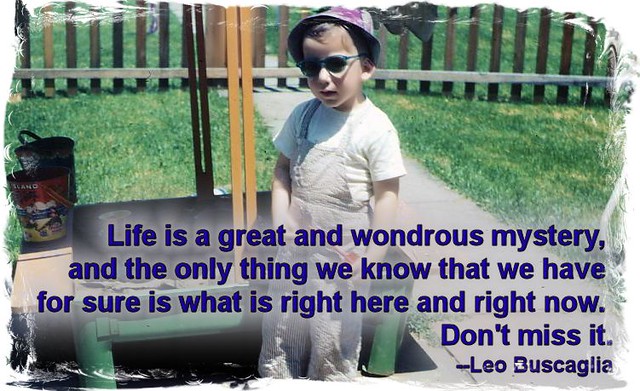
A Sure Thing

Life is


Life is a great and wondrous mystery, and the only thing we know that we have for sure is what is right here and right now. Don't miss it.
--Leo Buscaglia

Friday, March 01, 2013

Wonder and Adventure

Gulf Shores, AL   2/24/13


I wish I knew what people mean when they say they find “emptiness” in this wonderful adventure of living…. I’m afraid I’m an incorrigible life-lover and life-wonderer and adventurer.

—Edith Wharton

Monday, February 18, 2013

A Week About Meaning

We are now at the fourth week of the seven meditating on the daily themes of the Attention and Interpretation program I have been doing with Dr. Amit Sood at Mayo Clinic. Week four is meaning. (Week 1 was gratitude, 2 was compassion, 3 was acceptance.) I just realized as I looked at that list is that what we are doing is building a life. Life that is meaningful has to be built on those first three blocks. We then can move to seeing what it all means.

As usual, a quote starts the week. This one is from American mythologist, writer and lecturer, Joseph Campbell best known for his work in comparative mythology and comparative religion. The quote is simple and lays out for us a direction- but not a meaning.

Life is without meaning. You bring the meaning to it.
The meaning of life is whatever you ascribe it to be.
Being alive is the meaning.

Wednesday, February 06, 2013

The Passing of Time

Last July, I wrote a post entitled When Your Mentors Are Gone. In it I reflected on the fact of aging and the ongoing fact of people who have been important to you dying. In it I wrote about hearing of the deaths of mentors. I wrote in part of it:

The great cloud of witnesses is loaded with witnesses I have known and who have helped me become who I am.

But now they are almost all gone. Few are left, now in their 80s and 90s. None of them to go to for advice but in memory.

Such is the pain and pleasure of aging, the pain of loss, the pleasure of memories, and above all the gratitude of the day in and day out gifts they have left behind in so many lives.
It has happened again this week. Two emails from our church offices that one of those mentors has died at age 99 and another is moving to a nursing care facility. I paused again to ponder the movement of time, of aging, of gratitude for the support and care received. I thought again of special moments.

I sat in the break room of the Church-owned nursing home in a far away city that was about to become my hometown. The Bishop filling me in on the church I was meeting with, the history of the place I was sitting in, the opportunities for ministry that lay ahead of me. He was older that day than I am today, yet full of excitement and energy. We talked and he paved the way in my mind for the ministry I didn't even know I was capable of.

There was also the day that I had to go to him and tell him that I was about to enter treatment in Milwaukee for a "problem" with alcohol. He didn't judge, he didn't scold, he didn't ask how a pastor could be an alcoholic. Instead he prayed and kept contact while I was gone with both myself and my wife and for many years after. He wasn't sure that I could return to the same church as pastor after treatment, but he didn't say I couldn't. He let it work itself out and never got in the way as I spent another 11 years as the pastor there.

Over that time I spent many an hour with him later as his pastor and he as a wise soul both listening and giving, sharing and receiving. After 15 years as the pastor we moved to a different town, but that place is still home- and he continued to be an inspiration and a challenge. Never "old and stodgy," always looking for the cutting edge of ministry, I only wish I can be half as interested and interesting 30 years from now.

There are probably thousands of people that he touched. I was blessed to be one of them.

Such is the power of that great could of witnesses.

Life can be a burden- or it can be a joy. It is a burden if you long to be somewhere else and feel trapped. It can become a joy when you discover who it is you are becoming and what God's will is for you in that moment. We learn the joy from wise mentors. We can share it if we are willing to be mentors to others. Death does not come as such a devastation at nearly a century old. When we can live and grow in the memories and share them with others, it can become the seeds of eternal life.

To the Bishop my deepest gratitude today for who you were and for the seeds you have planted in so many!

Monday, February 04, 2013

A Week for Compassion

Last week I started a seven-week journey through the daily themes of the Attention and Interpretation Therapy program I am doing this winter/spring. The first week was dedicated to a few posts about gratitude, the daily theme for Mondays. This week I am taking the second theme, compassion.

As last week, simply a quote to set the tone for the week. This one from the spiritually profound Thomas Merton:

The whole idea of

compassion

is based on a keen awareness of the interdependence of all these living beings,
which are all part of one another,
and all involved in one another.

Look around for the interdependence of all things around you today-
and your interdependence on them.

Sunday, August 12, 2012

Two To Think for Today

I'm glad Jesus didn't Tweet:

Blessed are the poor in spirit for theirs is the kingdom of heaven. Blessed are those who mourn for they will be comforted. Blessed are t
(The Tweet on the Mount)
--Kim Fabricius
On a more deeply profound turn, consider this from Ben Myers, also at Faith and Theology:
I went to see a doctor and he gave it to me straight. It is my heart, that's what he told me. Apparently I have a condition that makes my heart wear out after the first seven or eight decades of my life. Subtract from that a few years for every unhealthy lifestyle choice I've ever made along the way: smoking, drinking, not jogging, using real butter instead of margarine, too much salt, too much sugar, too much of the wrong sort of fat, not enough of the right sort of fat, too many of the wrong kinds of drugs, not enough of the right kinds, too much sitting in front of the television, not enough rest, not enough vegetables, too many non-organic vegetables with all those nasty carcinogens sprayed all over them, all subtracting year after year after year from an already perilously short life. Taking everything together, I'll be lucky if I get another forty years out of this heart. Less than thirty if my grandfathers' lousy tickers are anything to go by. Bloody genes, can't live with them, can't live without them.
--Ben Myers, As I Sit Dying
When one comes to terms with what Ben is talking about, and accepts it as a reality to be lived with, you are at the First Step.

Much is possible after that point; more than you ever imagined.

Friday, August 10, 2012

Quoting


It is never too late to be what you might have been.
---George Eliot

HT to Life Hack

Wednesday, July 25, 2012

Different And Connected


from Wishful Thinking: A Theological ABC by Frederick Buechner:

Sacrament:A sacrament is when something holy happens. It is transparent time, time which you can see through to something deep inside time. If we weren't blind as bats, we might see that life itself is sacramental.

Ritual:A ritual is the performance of an intuition, the rehearsal of a dream, the playing of a game.
A sacrament is the breaking through of the sacred into the profane; a ritual is the ceremonial acting out of the profane in order to show forth its sacredness.A sacrament is God offering his holiness to [humanity]; a ritual is humans raising up the holiness of their humanity to God.


Very few can bring theology down to earth like Buechner can. How simple, yet profoundly sensitive can you get?

It bears repeating, here, and everyday we roll out of our beds into the world...
If we weren't blind as bats, we might see that life itself is sacramental.

Tuesday, July 10, 2012

Been Thinking A Lot About This

It has been on our minds for a while.

downsize:
reduce, cut down, cut back, trim, trim down, trim back, cut, bring down
It actually began years ago when we had to clean out my father-in-law's house after he died. It was not a huge house, but it was filled with lots of stuff. He wasn't a hoarder like on TV "reality" shows, but he did gather "stuff." At the time we talked about the issue and said we sure don't want to have our daughter go through with that.

picture from moving in 2007
We moved into an apartment a little less than 5 years ago and had our first experience of downsizing. At the time I said this on these virtual pages:
The apartment had ...the ability to "unburden" ourselves from some of the physical baggage we have been toting around. It actually feels good to think in those terms. It is time to help make life a little less cluttered. Why do we keep all those papers from seminary or college? What about those books that have some sentimental value but I know I will never read them again? (Jack Newfield's biography of Robert Kennedy for example. How old is that book anyway?)
We sort of unburdened but kept a lot (like that Jack Newfield book.) Lots of stuff went, but lots of stuff stayed in boxes in one closet or another. And then there's all those books on all those bookshelves.

Well, we are becoming more aware of it again. With my wife's retirement at the end of last year and my turning 64 next month, things like downsizing, uncluttering one's life, unburdening, all become reality tests. Which brings me face to face with my own style of hoarding, based loosely on an obsessive-compulsive soul, probably afraid of losing something important even though I haven't even been aware of its existence for at least 4 of the last 5 years.

I know, if you haven't used it in the past year (some say 6 months), get rid of it.

Easy for you to say.

But it also brings me face to face with aging, closures, moving on, leaving behind. Not easy topics.

I want to say to myself, "Just move on, will ya!" But it doesn't work. Or it hasn't yet. What if I get rid of that "treasured" memento from 1970? Will I even know it's gone? Will anyone even care? Will it mean that I have lost a connection with something or someone or someplace that I haven't had a connection with for 40 years anyway?

But this IS the time to seriously get on it and start doing it. No better time than the present I have always been told. I have my health and strength and time. Don't put it off, it will only get worse.

So I need to go to get ideas from places like Fly Lady's page. And right there she says this that gets my attention:
Clutter has been our security blanket for a very long time. It protected us from people, hard times and having to face ourselves....

If you are having anxiety attacks about releasing some of this clutter in your home; stop and think about what you are afraid of.

1. Is it the security of have 3 of an item, in case one breaks?
2. How about the memories that the item evokes when you see it?
3. And there is always the “Aunt Mary gave us this when we married.”
4. I spent a lot of money on this. I can’t possibly give it away.
5. Oh, I can fix this, but it has been in the basement for 15 years waiting to be fixed.

I want you to think about these reasons and look deep into the heart of them.
--flylady.net
I get the picture, big and little. Now all I have to do is, well, just do it.

Wish me luck.

Sunday, July 08, 2012

When Your Mentors Are Gone

In a small denomination like the one I have belonged to, it is truly one extended community. From your early days in that church you know who to turn to. You know who has the wisdom, who has the Spirit. Many of these become the leaders, officially or de facto. They become role models and mentors. Because of the extended community you don't always have to agree, you just watch and learn from them. You discover how to be true to your beliefs and your God. You learn what to do in tough situations and what not to do. The values, spoken, written and assumed, are shared as much by what one does and what one says.

Then one day you get an official announcement, email, or read it in the paper. Another of those unique people has died. Another mentor lost. Then, before too long another is gone and perhaps even one of the last passes.

It may be the professor who excited your view of the Bible or the President who held the church together in the 60s and 70s. Maybe it was the Bishop who embraced you as a young pastor or the one who fought for his views that you disagreed with but whose life was a humble witness to the power of prayer. How about another professor who used the proverbial 2x4 to open the pastoral-counselor opportunities that have guided you for 40 years?

Then they are gone. Wasn't it just yesterday- 28 years of yesterdays- when you sat in his office accepting a call halfway across the country to the place that would forever on be home?

Wasn't it just a few weeks ago- 23 years of weeks ago- when another sat in your office expressing support and concerns for a newly recovering you? One ordains you, a second baptizes your child, a third ordains your wife.

The great cloud of witnesses is loaded with witnesses I have known and who have helped me become who I am.

But now they are almost all gone. Few are left, now in their 80s and 90s. None of them to go to for advice but in memory.

Such is the pain and pleasure of aging, the pain of loss, the pleasure of memories, and above all the gratitude of the day in and day out gifts they have left behind in so many lives.

The great hymn says it well:

Ten thousand times ten thousand in sparkling raiment bright,
The armies of the ransomed saints throng up the steeps of light;
’Tis finished, all is finished, their fight with death and sin;
Fling open wide the golden gates, and let the victors in.