Showing posts with label Christianity. Show all posts

Friday, March 10, 2017

Reflections on Bonhoeffer

For the writing I have been doing on the Dietrich Bonhoeffer quotes for Lenten Sundays, I have been reading the biography of him by Eric Metaxas. I am learning stuff I never knew about the 1930s in Germany and re-learning things I had long ago forgotten. Three issues have struck me.

1. Size of Germany- and how quickly Hitler took over. Literally a few months and he already had his storm troopers (SA and SS) ready to take over for the regular army. He was elected on January 31. Less than a month later, February 27 the Reichstag (Parliament) was destroyed in a fire, most likely instigated by the Nazis, though blamed on the communists. Within months of his election Hitler had managed to intimidate, legislate, and coerce the end of democracy in Germany with little to no opposition. We forget that Germany is about the size of our states of Montana or New Mexico. Consolidation of power was easier than say it would be in a country as spread out and diverse as the United States. Fortunately!

2. Taking over the church was part of the plan. It was already a state church when Hitler came to power. He hated the church and religion and was determined to co-opt and destroy it. The Deutsche Kristens (German Christians) movement sought to make it a Reichskirche, a Nazi religion. The almost succeeded but the Nazis were too open about their "theology" and its Nazi ideology. Instead, the overall German Evangelical Church (Lutheran) continued as the state church and was marginalized.

3. The ineffectiveness of the church in being the church. As a Christian, former pastor, religious individual, this was one more bit of data to add to what I have often seen. In general, the church as we know it has very little effect against such powerful odds. One reason is that it is easy to co-opt the church. One does not have to live in Nazi Germany to see this. Church historian Martin Marty named it "Civil Religion" in the United States. We see it every time we say or believe that we as a nation have a special place in God's favor. It is a mixing of patriotism, nationalism, and Christianity. It easily divides Christians along political and ideological lines and shoehorns theology into whatever we want it to say.

People like Bonhoeffer and Martin Niemoeller worked at resistance and changing the way things were going. They did not succeed. They were steamrollered out of the way, co-opted by the Nazis and their supporters in the church. They became the "heretics" while those who were twisting Christian theology into Nazi propaganda were the official guardians of "correct theology." They were marginalized by laws making it illegal to be anything but a member of the official state church.

I am glad we have never had a state church in the United States. The general term "Christian" has often been seen unofficially as that. Evangelicals and Fundamentalists have acted that way. I hope we can manage to keep from allowing religion and state to become mixed up.

But there will be more thoughts on that in some of the upcoming Lenten Sunday posts. Back to my reading. I'll keep you informed.

Saturday, March 07, 2015

Yes, This Can Be Persecution

We hear it regularly on the conservative news and religious shows. Christians in the US are being persecuted. Things like the War on Christmas prove it. I have often said that we are cheapening the real suffering of Christians who are being persecuted around the world when we liken what is often called persecution here with what they are going through. Freedom of religion is not persecution, it is allowing each religion to stand on its own.

Well, I came across an article the other day that puts it from the liberal Christian perspective, arguing that the persecution is really against the liberal or progressive Christian viewpoint. (Link.) Here is what I call the "money quote" explaining the situation.

there are two different types of Christianity. One is a movement of people who want to live and be like Jesus. The other (and far more common, far more powerful) is a civil and political religion that is simply named Christianity.
--link
I don't know whether persecution is the word for what he is describing, but it sure is a reflection on reality. The idea of a "civil religion" is not new. Theologian and historian Martin Marty has been describing this for years. Dietrich Bonhoeffer called at least part of it "cheap grace" during World War II.We might call it the "marriage of church and state" or "Imperial Christianity."

Whatever it is, it boils down to the reduction of Christian discipleship to being a "Good and Patriotic Citizen." It happens when we equate any human nation with God's Kingdom. (Even Israel! Don't forget that the prophets could be as critical of their nation as anyone!) Civil religion is not comfortable with dissent although democracy allows for it. Civil religion often demonizes the opposition since only demonic forces would dare to dissent from God's way, (i.e. "my" way!)

I believe as firmly today as I did 40 years ago (probably more so) that the People of God will never be comfortable to any human state. We will often if not always challenge the nation to be more faithful knowing that the nation-state is not God. We will always be calling ourselves, our fellow Christians, our country and all people to be followers of the Prince of Peace.

Saturday, February 28, 2015

When the Religion Ruled the Land

Sitting and pondering ideas the other day I came across one of those intriguing trivial items. On on HistoryOrb's This date page for February 28, I saw this:

1646 - Roger Scott was tried in Mass for sleeping in church
Needless to say that piqued my imagination so I went digging and found an article, Colonial Crimes and Punishment at History.org that looks at some of the colonial era laws. To think of this as early democracy is an interesting exercise in stretching ones imagination.
The English-American colonies were autocratic and theocratic, with a patriarchal system of justice: magistrates and religious leaders, sometimes one and the same, made the laws, and the burden of obeying them fell on the less exalted—the tradesmen, soldiers, farmers, servants, slaves, and the young. That burden could be weighty.
Sometimes, as we look at our American history through the rose-colored glasses of the ideals of the revolutionary era leaders, we forget that democracy is not as we think it was. The early settlers for the most part were not looking to set up freedom for all. They just wanted THEIR freedom and limiting other people who disagreed with them. Many of the laws were theologically based- and often discriminatory and harsh, especially on those of the lower classes.
In the Puritan north a religious message leaps out from almost every page of the early criminal codes. Sin, of course, existed in the eyes of the beholders, and the eyes were everywhere—as you might expect in small, inbred communities. Consider the scrutiny given to observance of the Sabbath. The law usually required churchgoing, and someone was always checking attendance. In early Virginia, every minister was entitled to appoint four men in his fort or settlement to inform on religious scofflaws.
I caught that little phrase above about "small, inbred communities." We forget that these early colonial towns and villages were closed. What we call the great American ideals were not even part of the picture. This was a primitive civilization living on the frontier. That's where the following can happen:
In the early seventeenth century, Boston's Roger Scott was picked up for "repeated sleeping on the Lord's Day" and sentenced to be severely whipped for "striking the person who waked him from his godless slumber."

Colonial strictures on deportment in the pews long applied, even to children, such as in 1758 when young Abiel Wood of Plymouth was hauled before the court for "irreverently behaving himself by chalking the back of one Hezekiah Purrington, Jr., with Chalk, playing and recreating himself in the time of publick worship."

In l668 in Salem, Massachusetts, John Smith and the wife of John Kitchin were fined "for frequent absenting themselves from the public worship of God on the Lord's days." In l682 in Maine it cost Andrew Searle five shillings merely for "wandering from place to place" instead of "frequenting the publique worship of god."
Oh, for the good old days.

Not.

The churches would be filled on Sunday, but I'm not sure we would be any more faithful to the ways of God. We would just learn how to put on the masks more completely.

Friday, December 12, 2014

I Get Angry - Very Angry

If this law is enacted in Michigan, it will be another step backwards in the fight against discrimination. It would allow doctors and EMTs to refuse care, repeat REFUSE CARE to people whose lifestyles they disagree with.

If it wasn't from a local CBS newsfeed in Detroit I would have thought it was a headline from The Onion.

It says something very unhealthy about American politics when a bill like this is even considered as a possibility. It goes against every ethical standard of every health care license issued. It contradicts every basic human value and every bit of Christian faith. It is a perfect opportunity to dig into a) The Parable of the Good Samaritan and b) The story of the woman caught in adultery - let those without sin cast the first stone.

What kind of nation are we becoming when we justify torture because someone else attacked us so we can respond with revenge and anger? What kind of human and humane value systems are we discarding in the name of an abusive understanding of religion? It is a good thing these politicians were not in charge in the civil rights era.

Oh, wait a minute, they were. And they were proven to be on the wrong side of history, faith, and ethics.

If we allow that kind of thing it is no different from the radical Islamist sects who want to impose sharia law. It lowers us to a least, and pretty damn low common denominator.

Friday, October 10, 2014

Always Old- Always New

A recent discovery in Spain gives us another image of Christ.

This is a portion of a communion platter (paten) uncovered by archaeologists in Spain. What struck many people was the fact that this image, thought to be one of the oldest ever discovered, shows him with no beard and short hair.

It was found in southern Spain and the archaeologists estimate it to be from the 4th Century. In terms of Christian history it raises a question on the traditional date that Christianity came to Spain which has been thought to be the 5th Century. But more interesting to many is the beardless, close-cropped hair of the Savior. All of the previously discovered images of Christ from the 4th Century have depicted him with beard and long hair. This picture more closely resembles images from the Catacombs in Rome.


The recovered plate is in remarkably good condition. The researchers have managed to piece together 81% of the original. This picture shows a drawing of it with the missing pieces in white.


The other two people in the image are thought to be Peter and Paul and is to be an image in the afterlife.


What strikes me is not those specifics, although they are interesting, but rather the long line of continuity that these represent. We are talking 17 centuries of history having occurred between then and now. Yet, we still have some of the understandings and practices from that time. We have changed them significantly, of course. We have different understandings of the world (and the Word!). But we share a basic common faith in Jesus Christ. No modern Christian would mistake who is at the center of the picture.

Friday, September 19, 2014

Being Pilgrims- As It Should Be

Since the title of this blog is the Wanderings of a postModern Pilgrim, and pilgrimage is a key image for me, I was struck by the title of a book I came across at our local library: Strangers and Pilgrims Once More: Being Disciples of Jesus in a Post-Christendom World by Addison Hodges Hart. (Note: Whoever finds books to pick for our local library does an amazing job of finding diverse and broad-based ones. If you ever read this: Thanks!)

In this book, Hart is setting up the idea that we are in the midst of a very significant shift in the Church's life and history. The world we live in, Hart says, is a post-Christendom world, the end of a world that began when Constantine followed the cross and Christianity became a state religion. It is now time for the focus to become Christianity, not the state-supported version(s) that have existed for 1800 years.

After an introduction to the ideas of Christendom and state religion, etc. he sets up five ideas, the first four of which he compares and contrasts with the world that Christendom has fostered.

  • dogma, creed and orthodoxy, not dogmatism that divides and confuses;
  • the Bible, not anti-intellectual biblical literalism;
  • evangelism, not polemics, arguments and controversy;
  • sacramental unity in baptism and communion, not disunity through abuse and misinterpretation;
  • and always stays focused on the centrality of Jesus.
Hart is an amazingly eclectic person, although I am not sure he would agree with that about his theology. I get the feeling that he has a very strong and deep understanding of what being a Christian, a follower of Jesus, means and how that often differs significantly from the Christendom model where issues take on a more legalistic (my word) direction. He sees how through the past 1800 years the church- and therefore the message of Christ- has been co-opted by merging it with nationalism, patriotism and state control melding with church control. He is a strong critic of many policies of governments that many in the United States (the religious right) have made hallmarks of faith.

At the same time Hart seems to miss the stricter understanding of Christian morals and values that a Christendom model supports. In the early explanations he says that many of the failures of morals and values in our world today is a sign that the Christendom model has lost its power. Which, as I see it, leads to his view that Christians who follow the morals and values of Christ are going to be strangers and pilgrims in the world again. The believer will be outside the political and cultural mainstream now that the mainstream is no longer based on traditional Christian values.

I have to admit I was pleasantly surprised- and frustrated- by the book. Hart appears to be quite consistent in his understandings and explanations. There is a sense, though, that his moral stances may very well be the Achilles heel of his thesis. In some ways his arguments do not leave open the possibility of continuing revelation of understanding in a vastly different world from the one the Church began in. He is clearly not a fundamentalist or right-wing Christian. Maybe he is right, though, that we have such difficulty with "morals and values" because we have accepted the ways of the world in order to be good citizens.

It is an excellent book, however, and caused me to take steps back and think about what it might mean to be a stranger and pilgrim in this different landscape.

Tuesday, September 09, 2014

Here's One To Make You Think

Looking for another quote I remembered from Frank Schaeffer, I came across this one. It struck me as on target, so I wanted to share it.

“Jesus certainly was not a “Bible believer,” as we use that term in the post Billy Graham era of American fundamentalist religiosity that’s used as a trade-marked product to sell religion. Jesus didn’t take the Jewish scriptures at face value. In fundamentalist terms, Jesus was a rule-breaking relativist who wasn’t even “saved,” according to evangelical standards. Evangelicals insist that you have to believe very specific interpretations of the Bible to be saved. Jesus didn’t. He undercut the scriptures.”
― Frank Schaeffer, Why I am an Atheist Who Believes in God: How to give love, create beauty and find peace

Friday, June 27, 2014

Why I Still Use "Jesus Language"

This thought came to mind while I sat in worship the other week:

Why does the "Jesus language" of the Church still move me like it does?
It may sound like a strange question to raise while sitting in a Christian worship service, especially a highly liturgical Episcopal Church, many light-years distant from my original Christian home of an independent fundamentalist-type Baptist Church. But I am no longer that almost 16-year old who was baptized 50 years ago. I no longer have the narrow vision of "getting to heaven" as the goal of the Christian life nor the understanding that only people like "me" will get in. My understanding of the love and GRACE of God has brought me to a whole different place as to what I think church and God and faith are all about.

I could go even further and ask:
Why does Christian iconography, Eucharistic liturgy and many hymns still make chills run up my spine and even tears form gently at the edge of my eyes?
I have over the years discovered depth of spirituality in many ways, times and places far beyond the Christian "way." Yoga, Tai Chi, Buddhist meditation, the presence of the Spirit in many places (and people.) Saying the great Jewish affirmation in Hebrew:
Shema Yisrael, Adonai elohenu, Adonai echad
moves me as much as the Lord's Prayer though in different ways. Singing a "Kyrie" in Latin touches places in my soul that the the English (which connects with my cognitive brain) cannot. The Doxology or the Gloria in English come forth with a sense of transcendence that words don't convey.

Today I believe more firmly in the existence of an eternal and infinite God, Creator of all, who I believe is named in many more ways than we humans are even capable of imagining. Hence every time I think I have come to a good understanding of God- that all is figured out- I catch myself and step back. If little old me in the 21st Century can understand God's infinite ways, that is not God. Time to move on- and keep it simple. God is God- I am not. Nothing else says it nearly as clearly as that.

So I ask the above questions. They come to mind because the Jesus language of the church has so often been used as exclusiveness instead of openness. It has been used to badger, harass and even kill people "in Jesus' Name." Some might ask, if I am not as narrow in my understanding, why do I keep using the language?

Well, the first answer to my questions is relatively easy. It's a hard-wired part of my brain and soul. After 50 years as a practicing Christian, it touches my life and soul and spirit because it accesses deep portions of my unconscious. These places were planted in those formative years of middle-adolescence and young adulthood. The neurochemicals of my brain respond when these external rituals and actions occur. I also know that these "Christian" ceremonies and endeavors on my part connect with something beyond me- a power greater than myself.

Even as I know that these are not the only ways to make those same connections, they have been part of my spiritual life for 50 years. Yes, then, they DO provide a foundation that in many ways still works, doing what I have needed it to do all these years.

There are, of course things that don't work in the same ways. They were important, but today aren't as effective. I think that comes simply from changes in time, place and age. I have learned to go deeper. For me that has been essential. For that I am also grateful.

The second answer to my question builds on the first. Being secure in the foundation allows me to continue to grow and explore the infinite ways God works. That means some of the words I use today have a different meaning to me today than they used to. Call it "syncretism" but the other ways to God have changed the idea behind the words. Some of that is made more real by seeing the similarities as well as the differences between the paths to, from, and with God. Which ones work for me and my personality? Which don't- but certainly can for others?

This has been one of the more difficult areas. Having originally become Christian in a more exclusive, narrow understanding of Christianity's place in the world (the ONLY way!) I still wrestle from time to time with the inevitable "What if it IS the only way?" question. As I have delved more deeply into spirituality, though, I have found that many spiritual practices are universal. Others are more culturally-based. Others are even based on political/ideological understandings. Therefore, I listen to the spirit as the Spirit has been mediated to humanity in the infinite ways throughout history. I find I am in good company.

The third answer to my questions is, believe it or not, the Church itself. Not any particular church but the Church Historic, the Church Universal, and the Church Triumphant. The Church today is in no way shape or form anything like the Church of my youth, let alone of the 16th or 1st Centuries. Much of what we now believe is THE way to interpret Scripture and History, has not been so for most of Church history. The Church, as a human institution, is continuing to evolve and grow- mature.

In fact over the past few years the "progressive" side of Christianity has certainly moved many ways away from what would even have been "liberal" those 50 years ago. Questions are being asked in new ways, theology is being worked on from new perspectives.  Churches are taking healthier stances on issues, being more inclusive and compassionate in new ways.

Continuing to be part of that movement is exciting. As I have gotten older, I have found comfort in things old AND new. It would be very sad if the church (or The Church) of 2014 was just the same as the one of 1948 or 1727, Luther or Hus, Augustine or Paul. If it were, I am not sure I would be able to be there. Sure, some of the rituals and language are similar to other periods. But in these familiar words and actions is where we, the Church, and the Holy Spirit together see the Scripture come alive:
Behold, I am making all things new.

Sunday, June 15, 2014

A Sunday for Theology

Trinity Sunday

The day set aside to discuss Christian doctrine.

Jesus Christ, God's Son, Savior.

Yet the Trinity is one of those doctrines that resists explanation. The use of Celtic knots does a far better job. There's the triangle knot, in this case also looking like three fish intertwined. The fish (Ichthus) symbol being one of those ancient symbols of the faith. - Ichthus. As always the circle of the completeness of God holding it all together in one.

As does an M. C. Escher-ish triangle. No end, no beginning, no one side or the other. Just when you think you have it figured out, you look again and it doesn't quite meet our expectations. Just like God. Every time I think I have God figured out, everything shifts. Up is down, right is left, what I thought was light is dark and darkness is overcome.


This one also says it well for me. Another Celtic knot-type design with the triangle interweaving with itself, winding around and around in a way that is unsolvable. Holding it all in one is the circle, the completeness of God.


But you don't have to understand it. You don't have to be a theologian with advanced degrees. We experience God in these three-

Father
Son
Holy Spirit

Creator
Redeemer
Sustainer

God.
One God.
Forever and ever.

What more is there?

Sunday, June 08, 2014

Pentecost 2014


An icon of the Christian Pentecost, in the Greek Orthodox tradition. This is the Icon of the Descent of the Holy Spirit on the Apostles. At the bottom is an allegorical figure, called Kosmos, which symbolizes the world.
-Wikipedia

Wednesday, April 16, 2014

Passion Week Pondering

I know we more frequently call this week Holy Week, but I am still partial to the power of calling it Passion Week. It gets to the depth of the mystery of the week.

One other thing that has happened in recent years is combining Palm Sunday with the Passion. So last Sunday I sat in church and participated in the Gospel for the week. A few of the things I pondered.

  • At the start was the parade. All glory laud and honor to thee redeemer King. The service started in the parish hall with the Palm Sunday reading. The brass accompanied the hymn as the congregation moved (processed, paraded) into the sanctuary, led by the cross, where the Cross above the altar was covered in red. We were not just observers, we were there, singing praise and honor.
  • Then for the Gospel we heard a narrative reading of the Passion story. Voices called out to free Barabbas and the crucifixion of Jesus. A stark reminder. Again, we were not just observers, we were there, standing helplessly by as the story unfolded.
  • There was no sermon. None was needed; none was called for. The Gospel said it all and the only thing left for us was to think on those things, pondering and keeping them in our hearts for the week ahead. I know that the response in many a Protestant church would have been dissatisfaction that the preacher didn't preach. But there is not much to say at that point. Nothing to do but pray. We were not just observers, we needed to be there.
  • Then we came to the table. Bread of heaven, cup of salvation. The reality of the Passion incarnate. We are not observers, we are there. No, He is here.
  • As the postlude played us into the world I remembered that this year is 50 years that I have been a Christian. It is 40 years as an ordained clergy. It is another Palm Sunday. Another Passion week. I realized I have even less understanding of what all this means than I did 10 years ago let alone 40 or 50 years. I have no idea about the meaning, no logical, reasonable explanation for this Passion Week.


But I am even more convinced than I was then,
of its importance 
in my faith and life.

After all, I am not just an observer. 
He is here. 
So am I.

Wednesday, January 15, 2014

Wrestling On

Over the last month of being “semi-retired” and not being as immersed in the daily work, I have found myself wrestling with religious issues as if I were back in the pulpit again. I have been blind-sided by this movement in my life. Not that I left it behind over the past 10 years of working outside the church. The posts of this blog often had that religious direction to them.

But here I am spending a lot of time talking to myself in these words about what it means to be the church, to be part of the church.

So why am I still preaching? At least, still preaching in my writing? Why am I still working on being part of the church? Why can’t I quit you?

Yes, it is that kind of a relationship. It is one I am stuck in and with because I am unable to leave it behind.

Now that is scary. That is what I hear all the time from my patients and others who are still stuck in addiction. It is why I described the movie that line is from as about love addiction- co-dependence.

Perhaps some of it has to do with the fact that I spent 30 years of my adult life serving the institution- and I want to make sure it was for the right reasons. On one hand I know it was for many good and wonderful things came out of it. People were touched, loved, brought into deeper relations with the Creator of the Universe.

But the church is an imperfect organization that hurts people as much as it helps them. Not necessarily a given congregation, but the Church. The human institution is very capable of doing evil. A scan of religious news of the past several decades would easily give enough examples to fill many books.

Many people have been abused and misused by other church people. Judgmentalism, self-righteousness, anger clothed as “holiness”, violence in order to protect God’s good name have not been missing from the day in and day out life of many churches. People have been cheated, lied to, accused of wrong doing by leaders they thought they could trust. Even when the truth comes out, the abused and misused have been sure they were wrong and their leaders had to be right.

The institution itself perpetuates its own myths. We think of ourselves more highly than we deserve to be thought of, yet are often truly humble and willing to reach out to the least and lost around us. Most positive social change has started in one way or another in the halls of faith as a response to living out the call of God. Abolition of slavery, civil rights, building homes with the poor, feeding the street people are but small pieces of the work of the churches.

Yet these were just as often opposed by church people using the same Bible to keep the status quo in place and the poor and oppressed in their place. The KKK found a fiery cross for its symbol and Hitler easily co-opted a country of deep religious history into buying his Final Solution.

There is always a “Yes, but…” in the discussion about the church. There is always another side, the opposite side sometimes good, sometimes evil, but clearly able to be seen. The church slowly makes its snail-like progress through the centuries, often stuck in an image and understanding one generation behind.

Hence the eternal need for prophets in the church. When the institution becomes too secular it is challenged to go deeper into its faith. When the church becomes too comfortable in serving itself the prophetic challenges it to step outside the box. When it throws out tradition because it doesn’t seem to be “relevant” the voices remind it that tradition can be solid ground in difficult times. Or when tradition is the end-all and be-all a prophetic vision breathes new life into the seemingly dead bones.

In short, the church is always in the process of dying- and always having the holy wind of God’s resurrection pushing at its stone-guarded doors.

This is what I am wrestling with today. We will see where it goes, of course. I seem to say that about many different things, but then again, I am always this work-in-progress. I seek each day to be led by my Higher Power. Step Eleven of the Twelve-Step programs is very clear and what I try to do each and every day. I try to seek

through prayer and meditation to improve my conscious contact with God, asking only for knowledge of God’s will for me and the power to carry it out.
Feedback?

Sunday, June 23, 2013

A Day for Resurrection

So here is something to reflect on. It comes from an interesting and challenging book, My Bright Abyss: Meditation of a Modern Believer by Christian Wiman. First, the quote:

Christ is not an answer to existence, but a means of existing. (p. 91)
Not knowing where it came from, it can seem like one of those bumper sticker theological statements.
(Note: I am not opposed to short, pithy statements of theology. It's just that many times people use them to make something simplistic, rather than concise. This one is concise.)
It is concise because it comes from one who was an agnostic, perhaps even an atheist, for many years. What's more he is a poet who does not use words unwisely. He chooses his statements with reality in mind. His reality, he has come to see is that there's more to Christ than making him an answer (like bumper stickers try to do.) There is no question to which Christ is the answer other than, for a Christian, this one:
How then does one exist?
And there is the answer- Christ.

Note he doesn't say Jesus. This is a statement of resurrection, life here and forever. This is the Christ, not the wandering Rabbi and miracle worker. Or at least, not JUST the wandering Jesus. In life after Easter, Jesus is not the answer. Christ leads us elsewhere, deeper, to far more profound place than we even know to ask about.

Listen to more of Wiman:
Instead of a resurrection that frees us from this-world thinking... Contemporary Christianity all too often preaches an idea of a resurrection that is little more than a means of projecting our paltry selves ad infinitum, and the result is a grinning, self-aggrandizing, ironclad kind of happiness that has no truth in it. (p. 167)
That knocked more than my socks off and knocked me into a different way of seeing my faith. The resurrection that we  I often have preached, lacks the test of real truth. It was only when Jesus left them that they began to see. That's not just an extension of life here-and-now. That is a new existence.

How then, on this Lord's Day, the weekly Day of Resurrection, did Christ become my way of existing? How did The Christ move me into His existence and out of mine? Maybe I need to meditate on that thought this week. Perhaps I need to allow Christ's existence to show me how to exist.

Thanks be to God!

Sunday, June 02, 2013

Looking for News In All the Wrong Places?

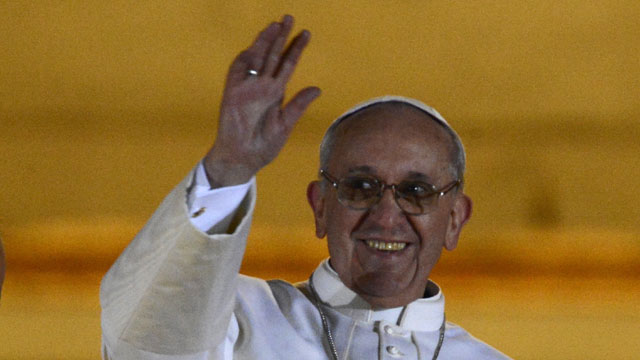
I went looking for "religious" news on Yahoo! this morning. There were a lot of little things about what Pope Francis did or said. There were some analysis pieces about the waning impact of the Catholic Church in state legislatures on the issue of gay marriage.

I decided to do some more surfing and was able to find the average and the not so average. I discovered that the news is pretty much the same in religion as  in politics. The stories can be irrelevant outside of a small circle of friends or potentially dramatic. Sometimes it may even be in the same story.

Over at the Huffington Post there were some opinion pieces and such. One headline was both a surprise and an "Of Course!"

Muslim and Jewish Leaders Unite to Combat Hatred
Religion New Service had it's headline story:
Cancer diagnosis gives second life to Carman’s music career
(RNS)-Once one of the biggest names in Christian music, Carman had been rejected by every Christian music label in the last 12 or 13 years. It was only after he went public about his terminal illness that the 57-year-old singer-songwriter discovered he still had an audience.
Worldwide Religious News had the following headline links on their homepage. They are perhaps the best example of the important, the disturbing and the "who cares!":
  • Americans see religion in decline yet want more of it. What's up with that?
  • Southern Baptists Move To Cut Ties With Boy Scouts Of America Over Inclusion Of Gay Scouts
  • Myanmar Mosque, Muslim Orphanage Burned After Alleged Immolation Of Buddhist Woman
  • 'Japanese Jesus' Legend: Christ Escaped Jerusalem, Lived In Japan With Family As Rice Farmer
  • Italian professor says has found world’s oldest complete Torah in Bologna
A number of places, of course, had the news of author Fr. Andrew Greeley's death.

But arguably the biggest piece I found anywhere was this one:
LOS ANGELES (AP) — The Evangelical Lutheran Church of America [ELCA] elected its first openly gay bishop to a six-year term on Friday at an annual assembly in Southern California, officials said.

The election of Rev. Dr. R. Guy Erwin comes after the church's controversial rule change in 2009 that allowed gays and lesbians to be ordained in the nation's largest Lutheran denomination.
From a very basic, cultural perspective this barely ranks a note when compared to state legislatures (Way to go, Minnesota!) and their advancement of Gay marriage. It will be ten years next week since the Episcopal Church elected Bishop Gene Robinson in New Hampshire. As most religion news headlines show, the "news" of religion is not all that high on the exciting scale. This one seems like news that only the family would care about.

While I don't think it is earth-shattering, I do believe it shows the direction of our society toward more openness and a shift among at least some religiously-inclined individuals in the same direction.

My small denomination is wrestling with the ordination of gay individuals prior to the next national meetings in a year. The connection with this story is also that my denomination has "full communion" with both the Episcopal Church and the ELCA. So for our leadership the question is on the agenda: What if a "legally" ordained gay person from either of these other churches wanted to become a pastor in our denomination?

[Side note disclaimer: In retirement my wife and I are now members of an Episcopal Church.]

No, that is not tsunami-generating movement, either. But I think it illustrates how some of these issues move forward like they do- a little bit at a time- with a lot more connections than we realize. In the great scheme of the Christian timeline the approval of the ordination of women is more like a few moments ago- the early- to mid-70s in the mainline denominations. I graduated with, and was ordained only a few months before our first ordained woman pastor. Forty years is only 2% of Christian history. Yet it was in that movement that the movement to accept and ordain Gay individuals took root.

Each start as small movements. Not the kind that at first make news. But that is how change works. While there re the "black swans" that shatter all preconceptions and make us shift, long-term social change works much more slowly than that. Christianity itself was not a legal religion for 300 years. That's 15% of its history. But it was the slow movement, the incrementally small changes that brought about significant, cultural shifts.

That's why it is important not to be blinded by the big stories. They may tell us a lot about where we are, but it isn't very often they can tell us with any certainty about where we are going.

Wednesday, March 13, 2013

Hope From (and For) Francis


I am not a Roman Catholic, but I am praying that what has happened today in Rome will be the start of some spiritual engagements in our world. The first Latin American elected to be Pope who took the name Francis. Francis the First since no one has ever done that. Perhaps because to commit to the lifestyle of Francis is more difficult than being the Pope.


From what I am hearing in these brief hours, Francis I does seem to be one who has taken up the cause of the poor. He has been as humble as his namesake in many ways. He asks for silence in prayer from the people to him. A nice beginning.

What next? Well, we have a long way to got o find the answer to that, of course. He is 76 years old and is not a young man. He has a strong conservative doctrine (which may not play well in some American quarters.) Yet he is a man of the people and a strong advocate for social justice, I have heard. That will be a good and interesting mixture. Can he be strong in light of the incredibly complex and difficult issues facing our modern world- and his own church? Can his witness be such that other churches and the wide diversity of Christianity can find some common grounds in caring for the poor?

May be have the strength needed to be the kind of Pope the world needs! Amen.

Saturday, February 09, 2013

You Can't be Both?

I vaguely remember seeing this bumper sticker before, but today, for some reason, it struck a chord:

You Can't Be Both Christian and pro-Choice.
I beg to differ, of course, or I wouldn't be writing about it. I am not sure that the bumper sticker represents a good, solid biblical view.

So, first with tongue in cheek, I will think about some of the things that the Bible would tell us we can't be (or have) and still be followers of Jesus. How about:
You can't be both Christian and
  • have tattoos
  • wear cotton/wool/polyester blends
  • swear falsely
  • want what others have
  • play/watch sports on the Sabbath
  • work on Saturday (the real Sabbath)
  • be a women with your head uncovered in church
  • be divorced

Or perhaps a cultural one from some branches of the Lutheran Church and others,
  • You can't be a Christian and worship with others who are not Christian or are not the same brand of Christian as you are.

But instead of being only snarky in this post how about some of the ideas I would add to the list from my reading of the Bible:

You can't be a Christian and
  • be for capital punishment
  • think war is a good idea
  • be willing to let children live in poverty
  • ignore your neighbor in need
  • believe the rich deserve special treatment
  • believe the poor don't deserve special treatment.

Well, obviously many Christians (and other religious people) can and do believe these things, even the ones I listed that are MY beliefs. For any one branch of Christianity to believe that they have THE answer is a hubris beyond imagination and a grandiosity that begs for forgiveness. None of us has the answers. Yes, being a Christian is about a lifestyle and not a set of doctrines. As far as I can tell it in my own imperfect way, the only thing we can probably truly say with any human certainty is
You can't be a Christian and NOT believe that Jesus is Lord.
All else is interpretation.

Friday, December 07, 2012

A Day Late.

Yesterday, December 6, was St. Nicholas Day.

Sustainable Traditions has a good post on this Jesus Radical. My kind of saint. They close the post with this:
This Christmas season, let us remember Nicholas‘ example and pursue, as he did, a radical devotion to Jesus and the power of embodying GOD’s kingdom in simplicity and, even sometimes hidden, exploits of faith.

Saturday, July 07, 2012

My Yoke is Easy ???

About a year or so ago I was sitting in a small restaurant waiting for some friends for lunch. As i sat there three people came in and sat about 6 or 7 feet away from me in the otherwise empty restaurant. They seemed to enjoy their time together and, as they finished their lunch, one of the gentlemen turned to the other man and that man's wife (I assume.) It turns out the first man was a preacher of some type and he was meeting these people to talk about faith and life. It was hard not to eavesdrop since he wasn't exactly speaking quietly.

Here are a few of the quotes that struck me- and were representative of the whole conversation:

This [being part of church] is supposed to be hard and costly.

It will take away your peace.

It is service and service isn't supposed to be fun.

I'm not here to make people happy.
When I made a note about this on my smartphone, I then added this initial thought:
I sure wouldn't want him to be my pastor. Of course, maybe I wouldn't want Jesus either, I suppose. But there is something about what he was saying that makes me uncomfortable and that just doesn't sound like what I have understood the Christian life to be.

I affirm that none of the things this pastor said is something I can agree with.

What happened to Jesus' promise that the burden is light and the yoke easy?

Or His words of Peace be with you?

Why can't serving others be fun- fulfilling and joyous?

And while a pastor may be called to preach difficult words, I can't but believe that when one follows the God of Creation (and in my life, the Father of Jesus Christ), happiness will be more than fulfilling. It will be at a never-ending surplus.

Of course I could be wrong, but I think I'' take my chances with a God of grace any day.

Tuesday, May 29, 2012

Things A Christian Shouldn't Say

Pastor Tim at Reluctant Xtian had a thought-provoking post last week with the title of this post. There are things worse than cursing, he says. Things, I would agree, that misrepresent the faith and take us into difficult territory. For my money, his #1 is pretty close to #1:

“It’s all in God’s plan…”
Say what?

Which is just a first cousin to my #1:
"God doesn't give us more than we can handle."
Both make some tough to uphold presumptions and place God in a really difficult light.

In the same ballpark is to tell a child (or even an adult) that someone died:
"...because God needed them in heaven."
Even the Biblical story of Job tosses away all these. Yes, God's voice from the whirlwind doesn't give much comfort...
"After all, I Am God. You weren't there when I created the world, so just be quiet and accept it."
...but it comes a lot closer to the trust and truth of the matter.

With Christians spouting some of these vacuous platitudes, is it any wonder that atheists and agnostics have such a difficult time accepting what we have to say? Why do we think we have to have easy answers to these questions? Why do we even think we have to be able to figure out the answers?

Perhaps the greatest comfort may be to know that even when we don't have answers, that somehow in the great ways of God what we are going through can be redeemed. Even when explanations fail- and they almost always will- we can simply accept that this is the way it is. Sure, that is easy for me to say today. I have been through those other times, when like Job iw as ready to yell through clenched teeth. And maybe those days will come again.

But somewhere in the depth of the awesome love of God I can find that answers are not The Answer. As Robert Kennedy quoted the Greek poet Aeschylus:
‘Even in our sleep, pain which cannot forget falls drop by drop upon the heart, until, in our own despair, against our will, comes wisdom through the awful grace of God.’

Sunday, April 08, 2012

Easter Sunday Video meditation

It's never been said any better than this.
Step by Step (Sometimes by Step)
Rich Mullins