Showing posts with label psychology. Show all posts

Monday, October 28, 2019

Tuning Slide 5.13- The Tools of Mindfulness

Weekly Reflections on Life and Music

“What day is it?” asked Pooh.
“It’s today,” squeaked Piglet.
“My favorite day,” said Pooh.
— A. A. Milne

Last week a friend and I were emailing back and forth about “playing the lead pipe” of the trumpet. He was trying some different practice techniques and was sharing what he found with me.

He had just experienced the fundamental foundation of the teaching of Bill Adam- playing the lead pipe to get started each day. (No, I admit, I don’t do that on a regular basis.) Its purpose is to get the player to listen. The goal is not to play the lead pipe in tune. Each lead pipe plays a slightly different note based on length, etc. The goal is to hear the rich, full sound of the proper airflow into the mouthpiece and lead pipe. There is no tuner use with this- we tune the instrument with the tuning slide which compensates for the different tunings of different lead pipes, horns, etc. Play the lead pipe, I was told, and listen for the sound to center and become more full. Some claim to even hear a sound like an old phone ringing when you reach that point. The rest of the goal is to remember that we play every note on the horn that same way. The lead pipe sound and airflow are the foundation. From his experience, my friend had just reinforced for me the insights that Mr. Adam and his students have built over all these years.

[Side note: here is another take on this:]

As I was responding to my friend I realized that some of the reasons this works as it does are because it tunes the ear to listen as well as the lips to form the right shape, the breath to flow smoothly, the arms to hold the trumpet in the right position, and the brain to get in sync with what we’re doing.

In short, it develops mindfulness. And as one moves deeper into what one is paying attention to through mindfulness, it rewires the brain to play the music. It is both muscle memory and aural, hearing memory being developed. I have talked many times over the years about mindfulness. It is a basic, and for me, essential daily skill. Jon Kabat-Zinn, one of the most famous modern proponents of mindfulness, defines it as “awareness that arises through paying attention, on purpose, in the present moment, non-judgementally…”

When I talk about being more consistent with the mindfulness portion of my routine, I mean I need to slow down and pay deeper attention to what I’m doing. I need to continue the ongoing re-wiring of my brain that improves my musicianship. I am talking about the times I do long tones and flow studies and building awareness through lead pipe playing.

There are mental tools that can be used to strengthen our mindfulness. Wikibooks has a series of articles about what are called “Core Mindfulness Skills.” In that, they present three WHAT tools and three HOW tools.

The WHAT tools
◦ Observe: is simply experiencing, with awareness, your feelings, your thoughts, and sensations directly without the use of words. (Link)
◦ Describe is putting words on experience and experience into words. (Link)
◦ Participate is the skill of throwing yourself into your objectives whole-heartedly without self-consciousness. (Link)

For example, when playing long tones or flow studies, I start by just observing, listening to what I am playing. I (try to) make no judgment, just listen and pay attention to what it sounds like and what it feels like. As I listen, I try to describe what I am hearing or feeling. I will then be participating in the experience. The sounds are with me and come through me. It is at these points that I begin to notice differences as I play. It is at this point that I begin to use the HOW tools.

The HOW tools
◦ Take a nonjudgmental stance. See, but don’t evaluate. Just the facts. Focus on the “what,” not the “good” or “bad,” the “terrible” or “wonderful,” the “should” or “should not.” (Link)
◦ One-mindfully is sustained attention on the present moment which develops concentration. (Link)
◦ Effectively- Focus on what works. Do what needs to be done in each situation. (Link)

This is where you begin to develop the insight into playing and are allowing the sounds to adapt and deepen. Notice I am not saying that the sounds “get better” or that the sound is “bad.” This is not to be a judgment on our part as we listen. It is about the sound and what the sound is like. We do this with a focus that is important. We need that focus or we lose the sound. We notice that and maintain the concentration in the present moment. In this time we then learn what works and what doesn’t. We discover what and when the sound falls into place, becomes richer, closer to what we are listening for and how it just sounds centered.

This can work in other ways when playing in a group of some kind. We are often told to listen to the group. Next time begin by listening, non-judgmentally and with a focus on the person next to you and try to play with them. One of the directors at the Birch Creek camp this past summer suggested we do that. I was amazed at what it did to my awareness of the music- and then my own playing. It is the same thing- mindfulness, in the present moment.

The result, among other things, will be what those working in this call Wise Mind.

◦ Wise Mind is the integration of emotion and reason, where the two overlap.
◦ Wise Mind is a state of mind in which you experience yourself as being calm, centered, and in control of your emotions.
◦ In Wise Mind, you act in accordance with your beliefs, principles, and values which deepen feelings of coherence and integrity.

Again, this is to be non-judgmental. It is based on more than dichotomies of good/bad. It is based on what is working to make music. It is based on the merging of reason and feeling, thinking and emotion and allowing our music to flow from that intersection.
Wednesday, August 02, 2017

The Tuning Slide: 3.6- Bits and Pieces

Weekly Reflections on Life and Music

With this year’s Shell Lake Trumpet Workshop in full swing this week, I put together a couple different bits and pieces that have been rumbling around in my life and music over the past few months.

The first bit is from a conversation I had with another trumpet player during a band rehearsal. One week I mentioned my basic routine of practicing between 90 minutes and two hours a day. The next week they came up to me at a break and said they had thought about me during the week and had thought about my routine. Then they asked, “But how do you play two to three sessions of that length? What do you find to play?” I realized that this is a question I might have asked a few years ago. But I have been fortunate since the summer of 2015 to have been introduced to some amazing trumpet instructors who have helped me make playing trumpet a full-time job (without pay, of course.) They have shown me the value of deliberate practice and how the investment in playing the basics every day makes a difference.
So here is what I described to my friend.

My first session of the day, usually up to an hour, is just the basics.
  • 10-15 minutes of long tones, including now some specific exercises on my upper register which moves into the second section.
  • 10-15 minutes of scale exercises of various types. Sometimes it’s just playing each major scale around the Circle of Fourths
  • 15-20 minutes of very basic exercises from Arban’s
  • 15-20 minutes of Clarke exercises and etudes, usually from # 3,4, or 5.
My second session also up to an hour is when I work on
  • Band, quintet and other performance pieces
  • Jazz improvisation
  • Charlier, Vannetelbosch, and Arban’s etudes and studies
  • Concone etudes can be a great way to come down and relax at the end
That’s it. If I only have time for one session, it is always a variation on the first one. As Matt Stock, one of the Shell Lake Trumpet Workshop faculty said one day in a post, record yourself playing one of the basic Arban’s exercises and you will see how much more work you can still do. By having a deliberate routine- and then adjusting, revising, and developing it will give you the chance to see your growth and improvement as well as what you need to be working on. It also reminds you that every piece of great music and every great performance is based on these basics.

My second “Bit” is another question I ran across somewhere recently. It deals with the famous admonition for practicing that we should rest as much as we play.
Why rest while you are practicing?
Let me start off by saying that I don’t always follow that advice. When I know I have 60 minutes to play, to take 30 minutes to sit around seems like a waste. I admit that it is better when I do; but I get impatient with sitting between each exercise. Boredom sets in and squirrels keep distracting me. That is one of the reasons why it is often suggested that we practice with another person so we have to rest while they play what we just played, or vice versa. But I do try to take 15 minutes out of every hour to rest. I have found two reasons for that- physical and psychological.

First the physical is just like when I am at the gym working out. It works far better if, for example I wait between repetitions on any given exercise. It has to do with how muscles and our body work. The short rest period relaxes them and begins the rebound and rebuilding process. It helps build muscle mass and muscle flexibility. If you keep it tight for an hour you are definitely more likely to do some damage that could prevent you from doing what you want to do.

As to the psychological, if you are learning something new or stretching your boundaries, there will be some tension and stress beyond the muscles ad physical.Your brain gets tired, too. Relax. Take a moment to get up and walk around. Go get a drink of water. Stretch some muscles.

One thing I am thinking about is taking a few minutes during the hour to do some stretching or even some Tai Chi/Qigong movements. It doesn’t need to be anything intense, just loosen the arms and shoulders, get the butt off the chair and let some blood flow. This is one of the ideas I want to explore some in the next year here on The Tuning Slide. I have a hunch it will have some positive impact.

The next two bits and pieces are in my notebook from this past April’s Eau Claire Jazz Fest. First is from one of the clinics. It was about improvisation, but is easily applied to practicing and performing in general. One of the best ways, we were told, was to cut out the perfectionism. Yes, we will make mistakes. Accept it. It’s the way life is. The advantage of that statement is that is can frees us from being uptight. Much of our fear and stress comes from not wanting to make mistakes and holding back from what we can truly accomplish. It slows us down. It keeps us away from our potential success. In essence it is permission to be human.

But, the leader said, that does not give us the okay to be sloppy. To know we will make mistakes is not the same as not trying to get better.

The last of my “bits” for this week is from Greg Keel, director of Shell Lake Arts Center’s jazz camps and an accomplished instructor and performer. He was one of the adjudicators in the room I was acting as host for. One of his clinician-type questions he asked every band was simple, What do you listen to?
Why do you listen?
Many reasons of course, and many are good.
  • Relaxation
  • Inspiration
  • Motivation
  • Being rooted in tradition
It will clearly have an impact on your own playing. Take the time often to listen. Listen to what you want to sound like. Listen to stuff that challenges you. (I am working on some modern-style jazz, trying to get into its style and feel. Listen, listen, listen!) Listen to all genres and figure out what makes it good. Your life will thank you.

Summing it up:
  • Be deliberate in working toward what you want to accomplish. Plan ahead and make goals
  • Be balanced in what you do- rest and relax.
  • Accept your humanity and imperfections
  • Listen to what’s around you- your own traditions and your own ideas. They meld together.
Notice that all of these aren’t just about trumpet. If you want to be a success in your life as much as in your music
  • Plan ahead and have goals.
  • Keep your daily balance
  • Know it won’t always go the way you want it to and adjust
  • Pay attention.
Much more on all of these in the coming year. I am finishing this post at this year’s trumpet workshop. As the week has been going on the spark is being reignited. So much more in growing in trumpet playing, music- and, of course, life!

Wednesday, October 07, 2015

The Tuning Slide- Hear the Inner Music

Weekly Reflections on Life and Music

Music is the language of the spirit.
It opens the secret of life bringing peace,
abolishing strife.
― Kahlil Gibran

More than once on this blog you will find me writing about the "Inner Game." This is based originally on the work of Timothy Gallwey's 1972 classic, The Inner Game of Tennis.

Where I want to start in this post is to talk about what is there, inside, where we do the work of the Inner Game. What we find there, I am convinced is the soul, the spirit, that we all have in common but which is expressed in unique ways in each of us. In the midst of that spirit is music, the language of the soul. A large part of what a musician does is get in touch with that inner language and then use the tools of the Inner Game to move that language outward.

We can easily lose this when we think about the music too much. If we try to read it, analyze it, dissect it as if it were a science experiment, we won't hear the music.

When we begin music it is like learning any language. Whether it was as infants picking up our native tongue or learning a second- or third-language as we got older, we start first with listening and then the basics of the language- notes, time, etc.

Surprisingly (or not) with the language of music it is actually a short jump from "This is a note." to "This is a measure." and on to phrases, songs, and beyond. I watched an instructor take a complete non-trumpet player from nothing to playing a simple song in less than 30 minutes. That included learning how to make the sound.

I'm not going into detail on that at this time, but it was fun to watch. The volunteer was doing this in front of a room full of trumpet players and was somewhat nervous. But in the end it worked. And we all learned something.

One of the things that I think makes this happen is simply that there is music within us. Our minds, bodies, spirits all respond to music in one way or another. We have an inner rhythm (our heartbeat, for instance) and an awareness of the music around us.

The fact is that at any level of playing music, we have to, in one way or another, hear the inner music. With some songs it is easier than others. There is a hook, or phrase that gets our attention. A local composer has written a few marches for our community band. One run through and I found myself humming the tune. I don't know what it is, but he has a way to connect with my inner music, and I guess the inner music of others.

Then as you work on a musical piece you can be freed to move within the music and no longer be an observer of it. That's the part of the inner music- singing it to yourself, reading it as music, not notes on a staff. The desire to "figure it out" through logic or tricks doesn't allow the music to flow.

We aren't used to learning music through the inner music. Brandyn said to me:
If you think about the next passage instead of just hearing it you'll create obstacles and that's bad. Just keeping that mindset of singing everything and letting go of everything else is by far the hardest thing and most unfamiliar thing for me to work on.
But when we learn how to do it, it will amaze us. The music we will be able to make will increase drastically each time.

That is where we will look in later periodic posts at the inner game of music. How do we free up this inner music? How does part of us (called Self 1) keep us from doing it and how can we free Self 2 to allow it to happen? It works in all of our lives. The result is musical.

Wednesday, April 08, 2015

Living in Dissonance

Cognitive dissonance is that sense of disconnect that happens when you are looking at something and feeling something the opposite. Wikipedia describes it more officially as

In psychology, cognitive dissonance is the mental stress or discomfort experienced by an individual who holds two or more contradictory beliefs, ideas, or values at the same time, or is confronted by new information that conflicts with existing beliefs, ideas, or values.
--Link
I'm not an expert on how it can be used in positive ways, although much of what a counselor does can be enhanced by developing cognitive dissonance in a client. That can help them see the changes that need to be made.

I am reminded of cognitive dissonance every time I see a pharmaceutical commercial on TV. Whether it's Viagra or a diabetes medication the visuals of the ad or enticing. There is often a sexual component (even if it isn't Viagra) and a sense of the natural world- the fresh out-of-doors. You are given a feeling of relaxation and excitement (with Viagra, anyway) at the same time. All these wonderful images flow across the screen.

Meanwhile the voice over, which they are required to give but hope you ignore, tells you all the awful side-effects that could occur which would mean you better get immediate medical attention- and the four-hour erection is the least of these problems.

I am sure they know the cognitive dissonance that occurs in every one of these ads. Whether it's the desire for feeling better which would lead you to want or need the medication clashing with the side-effects or even just the reminder of medical concerns in the middle of a TV show, cognitive dissonance can get in the way of the consumer buying the product.

Perhaps the one that most clearly battles this problem is the ad for the stop-smoking aid, Chantix. At one point in advertising history and perhaps even until now, the Chantix commercials ran a full two-minutes. That is a lot of ad time. Over half of that was the listing of the side-effects- and there are many.

Chantix (varenicline) is an effective medication. It is used successfully by millions as are most of the medications we see advertised. The issue isn't that they don't work, the issue is there are possible side-effects for some people. The public has the right to know of the possible problems, but it is interesting to watch the pharmaceutical companies do everything they can to keep us from being discouraged.

Wednesday, February 20, 2013

Our Search for Meaning

It is impossible, I believe, to talk about meaning without talking about the work of Viktor Frankl. Frankl (1905-1997)

was an Austrian neurologist and psychiatrist as well as a Holocaust survivor. He was the founder of logotherapy, which is a form of existential analysis. His best-selling book Man's Search for Meaning chronicles his experiences as a concentration camp inmate which led him to discover the importance of finding meaning in all forms of existence, even the most sordid ones, and thus a reason to continue living. (Wikipedia)
I first read the book in college and have done more study of it since. His was referred to as the third Viennese school of psychotherapy. The reason, I think, is that he delves into the dark side of human existence and finds that it is not as hopeless as it may seem. After surviving the Holocaust, he wondered why some survived and others, all other things being equal, did not. It was in the finding of meaning that he found his answer. Even in the midst of such unspeakable suffering, meaning is possible.
According to Frankl, "We can discover this meaning in life in three different ways: (1) by creating a work or doing a deed; (2) by experiencing something or encountering someone; and (3) by the attitude we take toward unavoidable suffering" and that "everything can be taken from a man but one thing: the last of the human freedoms – to choose one's attitude in any given set of circumstances".

Frankl emphasized that realizing the value of suffering is meaningful only [emphasis added] when the first two creative possibilities are not available (for example, in a concentration camp) and only when such suffering is inevitable – he was not proposing that people suffer unnecessarily.
The truth in that seems obvious, at least to me. It is why, I believe, finding deeper meaning in life is so important to our health and well-being. Life cannot be meaningful only when things are going well. We must be able to access meaning at other times as well.
If there is meaning in life at all, then there must be meaning in suffering.
Viktor E. Frankl
The suffering itself may not be meaningful. In fact it may be nothing short of evil, as in the Holocaust or hundreds of other examples of the last half-century in many corners of the globe. Neither is it the suffering that gives meaning. Meaning can be found, somehow or another, in the depths of our lives, no matter what. Yes, that is incredible. That is beyond most of our experiences in our everyday lives. Only someone like Frankl, who discovered this in one of the most evil actions of bringing suffering unimagineable, can bring us to consider this idea.

It is also not some general idea or ideal that Frankl talks about. It is unique and connected to each of our lives at any given moment.
For the meaning of life differs from man to man, from day to day and from hour to hour. What matters, therefore, is not the meaning of life in general but rather the specific meaning of a person's life at a given moment.
Viktor E. Frankl
My own personal search for deeper meaning, all of our individualized expressions of meaning are a living, evolving, and growing part of who we are. We look within, and around, to see what it is we may do or be today.

That is exciting.

In this week when I think about the deeper meaning of life, I pause and meditate on Viktor Frankl's great contribution to human thought.


Saturday, November 03, 2012

Sandy and Maslow's Hierarchy

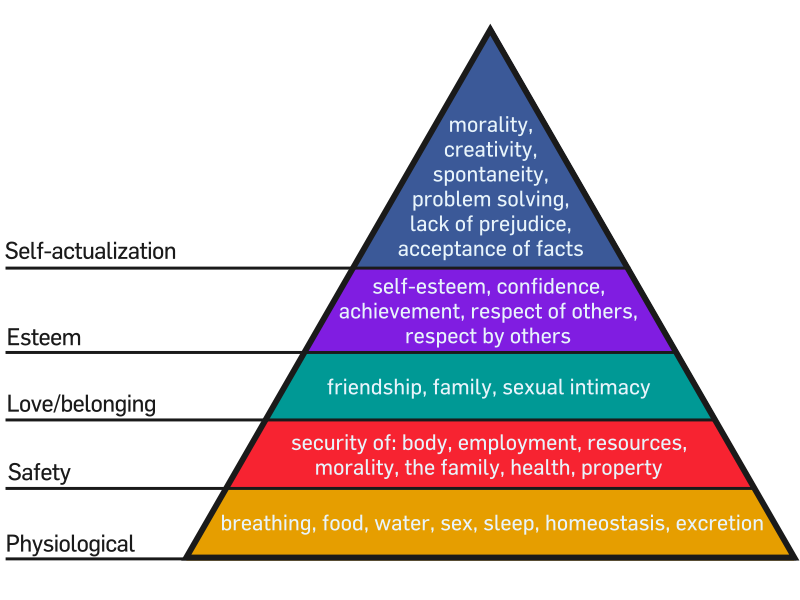
For years I have known, studied, and taught about Maslow's Hierarchy of Needs as an intuitively true and useful description. For those of you not familiar with it, the traditional pyramid is on the left.

....................................
From Wikipedia:
Maslow's hierarchy of needs is a theory in psychology proposed by Abraham Maslow in his 1943 paper "A Theory of Human Motivation". Maslow subsequently extended the idea to include his observations of humans' innate curiosity. His theories parallel many other theories of human developmental psychology, some of which focus on describing the stages of growth in humans. Maslow used the terms Physiological, Safety, Belongingness and Love, Esteem, and Self-Actualization needs to describe the pattern that human motivations generally move through.

Maslow's hierarchy of needs is often portrayed in the shape of a pyramid with the largest, most fundamental levels of needs at the bottom and the need for self-actualization at the top.

The most fundamental and basic four layers of the pyramid contain what Maslow called "deficiency needs" or "d-needs": esteem, friendship and love, security, and physical needs. If these "deficiency needs" are not met - with the exception of the most fundamental (physiological) need - there may not be a physical indication, but the individual will feel anxious and tense. Maslow's theory suggests that the most basic level of needs must be met before the individual will strongly desire (or focus motivation upon) the secondary or higher level needs.
....................................
Well, a few evenings ago while watching the evening news I realized I was seeing Maslow's theory in action. It didn't take much to translate the visions on the TV into the falling apart of their hierarchy of needs. Here are some of my observations:

  1. The overwhelming sense of powerlessness in the face of such devastation can only lead to a falling apart of all sense of safety and security.For many the structures of western civilization which give us security- police, fire, seawalls- are not working. The protections we come to assume will be there are not. After two or three days, it gets scary.
  2. The loss of homes and cars, clothes and even family members will tear at the fabric of the most fundamental needs- our physiological needs- food, (drinkable) water, shelter. It doesn't take long for the sense of terror to eat away at how we feel about ourselves and the world around us.
  3. With these bottom two foundations shattered, or badly damaged, the social structure begins to crumble as well. Tempers rise, blame begins to be put on others or government or whoever is handy. This helps mitigate that sense of powerlessness. We can't be at the whim of natural forces. We would have been able to face it down- IF THEY had been more prepared.
  4. As this sense of loss becomes more real, grief sets in and the process of grieving continues to eat away at our sense of hope and direction. Anger, depression, bargaining interweave with the weakening hierarchy of needs. Denial had already been at work before Sandy as people had difficulty believing that it could really happen.
These aren't new observation, of course. They have been utilized in many an apocalyptic book or movie for years and years. How quickly civilization can fall apart is frightening. A little bit of additional stress on an over-stressed social system can bring it crumbling to the ground.

When these things are affecting millions of people at the same time, chaos can ensue. Symbolic actions do little to alleviate the situation, as Mayor Bloomberg found out in relation to the NYC Marathon. New York winning the World Series after 9/11 had a great deal of positive meaning. It helped New York and the nation get a sense of resolve. But that was 6 weeks after the event and people weren't running through the midst of Ground Zero.


Caution and hope must now go together. Caution to counteract the fear that must still be present in those facing more cold nights or emergency shelter days. Fear is a powerful emotion driven by the brain's survival mechanisms. Hope, in real and concrete ways, must be seen.

Fortunately there are many stories circulating of the ways that civilization is still intact in New York and New Jersey. These remind us that while we may be facing some insecurity and even great loss, the human side of civilization, the possibility of relationships, support, friendship - Maslow's "love and belonging" are still present. These have not been fatally wounded  by Sandy.

Perhaps the cautionary tale of all this is how fragile civilization can be and how at the mercy of events beyond our control we can be. To build our support systems- personal, interpersonal, societal- is not something to be overlooked or taken lightly. This is not the last time we will face such chaos and catastrophe.

As we come to the end of a very divisive and contentious election cycle, I hope that we learn from Sandy the need to work together may be far more important than ideological purity.

Wednesday, August 18, 2010

We Are Not As Logical As We Think We Are

I have talked about this in various posts before, but it is one of those topics that I for one need to be reminded of on a regular basis. We do not think only logically. In fact, behavioral and cognitive scientists among others have discovered a whole slew of biases that regularly stump and stymie us. They are usually placed into four areas:

  • Social biases,
  • memory biases,
  • decision-making biases, and
  • possibility/belief biases.
Scribd. has posted a slide show that has information on these biases as taken from Wikipedia. According to Wikipedia:
A cognitive bias is the human tendency to make systematic errors in certain circumstances based on cognitive factors rather than evidence. Such biases can result from information-processing shortcuts called heuristics. They include errors in statistical judgment, social attribution, and memory. Cognitive biases are a common outcome of human thought, and often drastically skew the reliability of anecdotal and legal evidence.
I have had two interesting examples of this recently. One was a personal experience. I was having a conversation with several people about some of the Academy Award-winning movies and we got around to One Flew Over the Cuckoo's Nest. I commented that I really liked the film and it coincided with my clinical experience at a state mental hospital in Pennsylvania in 1974. The problem is, the movie wasn't released until 15 months after I had finished my clinical training. What I think has happened is that I read the book at around the time I was doing my work at the state hospital and my mind put the book, the movie, and the experience together.

The other experience was in another conversation when an acquaintance was remembering a very specific event in his life. He says it happened when he was 13 and the KC Chiefs had just won the Super Bowl. There were a number of problems with his memory:
  • The Chiefs were in the first Super Bowl in January, 1967. They lost (to the Packers).
  • They were next in the Super Bowl in January, 1970. They won (against the Vikings.)
  • My acquaintance was 13 in 1965.
He gave me a stunned look and just sat there.

These can be found in various forms among the 104 cognitive biases that regularly lead us astray. Does that mean we shouldn't trust our memory? Well, partly. But it does mean that we should be careful when we think we are so right that we can't in any way, shape, or form, be wrong. Chances are, I might very well be wrong and basing my life-or-death decisions on incorrect information.

Cognitive Biases - A Visual Study Guide