Showing posts with label trains. Show all posts

Saturday, May 10, 2008

National Train Day

On May 10, 1869, in Promontory Summit, Utah, the “golden spike” was driven into the final tie that joined 1,776 miles of the Central Pacific and Union Pacific railways, ceremonially creating the nation’s first transcontinental railroad. And America was transformed.
--National Train Day website
Yes, in many ways it is a shameless promotion from Amtrak. But if it works to get more people on trains, I'm all for it!

So thank a train today. Even if it's old and just used for a bunch of tourists.

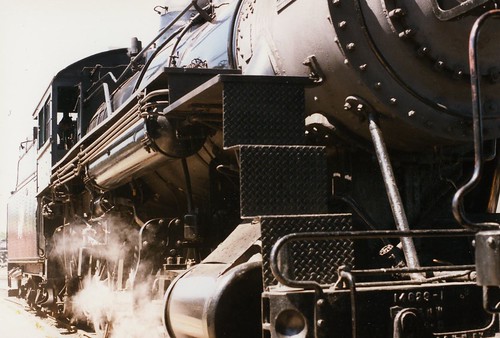
Train- originalpmPilgrim photo

Monday, May 21, 2007

On Greed and Reverse Thinking
Time to catch up with some of my thinking from some of my current reading.

This one is from a book I mentioned the other week. In The Men Who Loved Trains Rush Loving, Jr. gives a very interesting and insightful report on the change in the Northeast Railroad scene from the Pennsylvania (PRR)-New York Central (NYC) merger, through Conrail and into the current post-Conrail era. One of the old understandings on a business level of it all was that companies like the PRR and NYC and their demise was that they had a too narrow understanding of themselves. They saw themselves as railroads and not transportation companies. They were stuck in their old ways.

That showed up in a couple of ways. One was the grandiosity I mentioned before that the PRR was THE RAILROAD of all railroads and it was never going to change. The world would have to change first. That was bad enough, but that got all wrapped up in a level of deceit and lying and accounting criminality that was perhaps equaled (but arguably not surpassed) by the Enron and WorldComm scandals of a few years ago. Government support (taxpayer money), bank money (investor money) and several truly great companies were ransacked, misappropriated, and just thrown away in order to prop up a few men who couldn't believe the world wasn't theirs to do with as they wanted. Scary.

But just as scary in some ways was what even "good people" later in the story showed. There was a conservative thought process at work in some who came in to rebuild things at Conrail. There were those who believed that one of these days things will once again be like they used to be. One example was that they often refused to give up extra sets of rails because someday we will need them again. Someday the railroads will be just like they used to be. There was an inability to believe that things had to change for a different world. There was an unwillingness to see that even the greatest of institutions and corporations is not eternal. As airlines and trucking companies were taking so much business, some believed that with the right circumstances these would disappear as competitors and things would be just like they used to be.

Both of these lessons of these railroads should not be lost. Sadly I have a hunch that they have been before and will be again. Nothing changed until three decades after Penn Central, Enron and WorldComm hit the headlines for doing essentially the same things. They seem to have changed now, but I'll hold my bets on that as I have great faith that human greed will become the mother of new creativity in financing and bookkeeping to lead to whoever the next implosion will hit.

The most dangerous may be the extreme conservative viewpoint that

  • refuses to see change
  • believes that change can be reversed to some past "golden age" or
  • reinterprets the past to make it better than it was.
I can think of many examples of this, of course, from the current situation in Iraq to what happens in many of our local communities as new people move in and the community changes. (Interestingly, it doesn't matter whether the change is from a lowering of economic status, a raise in economic status, new immigrants, or the loss of old farms. The effect is generally the same.) One of the most common is the way many of us in churches have a difficult time believing that what we did in the 50s and 60s isn't working today. We are all potential victims of this conservative thinking.

Perhaps the best solution is to try to focus on what we value about the past- what made it good- while admitting to the shortcomings that it had. Then, with deep humility, figuring out what we can do differently today that, while upholding the things that we value (if they are worth valuing!), meet the new and different needs and circumstances today. We are often fighting old battles that are irrelevant or, at best, not a problem any more. We are often riding on lines that should be abandoned and taken into new territory.

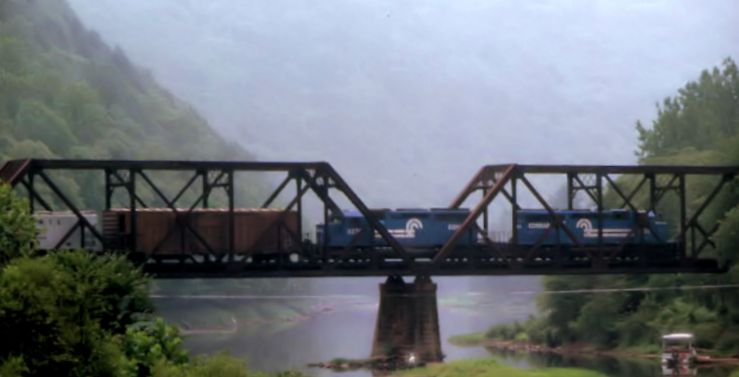
I miss the old railroads. I really do. I loved the sound of the engines heading up the Pine Creek Gorge back in Pennsylvania. When I realized that the rails were gone and are now a bike and hiking trail, I was saddened. I would never have one of my great dreams realized- to ride the head-end of a Conrail freight up through the incredible beauty of the Gorge. Never again would I hear that whistle echoing up and down the sides of the towering mountains.

Then I realized that I don't want it back. Something else had happened. Pine Creek was safer for animals and even people now. The old line up the Creek wasn't needed anymore and now the Gorge could become a wild and scenic river. It can flourish. And so can the railroads since they don't have to maintain that track anymore. I may have loved the sound of steam engines, but the incredible soot and dirt and pollution they produced can easily be left behind. Nostalgia is never a good thing to build a world on. It is always reverse thinking.

Monday, May 07, 2007

More Reading
So many books, so little time. But I keep on reading. I am truly hooked on books. I always have been. There's so many wonderful worlds there to explore in both fiction and non-fiction. Here's some of what I've been working on.

Make It Stick is a book about why some messages and bits of information stick- continue to catch our attention. Chip and Dan Heath start with an example of some of those famous spam urban legends that never go away and move on to many excellent examples of the message sticking. They say there are the following six elements that make a message sticky:

Simple
Unexpected
Concrete
Credible
Emotional
Stories
s
As a result I am looking differently at each week of the treatment curriculum we use to see how I can help make it "stickier". But it is hard, thanks to one thing the brothers highlight- the Curse of Knowledge. That simply is the fact that once we have learned something, it is hard to remember what it was like NOT to know it. We thus assume that whoever we are teaching, training, etc. already knows as much as we do. This is one of the biggest obstacles of developing messages that stick.

For anyone in advertising, teaching, training, blogging, or any other kind of attempts at communication, this is a must read. It is also interesting.

The Men Who Loved Trains is a eulogy to the great railroads of the east coast and how they were wrecked by greed and grandiosity. There are good guys and bad guys in Rush Loving's storytelling. The bad guys had no concept of railroads as anything other than a business. And they had no good concept of what that business could be or do. They were in it for themselves. Some of them were no better than the classic railroad robber barons of the late 19th Century.

The good guys in the story are the ones who loved trains as trains and worked hard to make them work for the good of all. It is a sad story from the Pennsylvania and New York Central Railroads through Conrail into the Norfolk and Western days of now. It is basically a business book, but it is a story of love of the companies that have been lost. (Note: I am a grandson of a New York Central railroader and the nephew of an Erie Lackawanna railroad man. Check your history books for these storied roads.)

Something In the Air kicked in the nostalgia. Big Time! Alan Freed. Johnny Lujak, Dick Biondi, Cousin Brucie, Murray the K, Dan Ingram, Jean Shepherd. Names and voices of radio in the 50s and 60s. THE names and voices of radio for millions- a generation. Marc Fisher's book is the story of a revolution spinning through air across the invisible waves of radio. I was going to write more about it here, but it has struck so many chords in this former DJ, college radio nerd, and lover of all things radio that I am working on a few other posts about it. Watch for them in the coming weeks.