Showing posts with label memoir. Show all posts

Tuesday, April 05, 2016

What Hunter S. Thompson Missed in My Hometown

Back in January I had a post about the connection between my hometown, Jersey Shore, PA, and the original Gonzo Journalist, Hunter S. Thompson. He spent three weeks there in 1957 as a sports editor- his first job out of the Navy. To say he hated it would be an understatement, referring to them as a "nightmare people." (I was nine years old when Thompson lived a couple blocks up the street from my grandfather and worked at the newspaper office across the street from my Dad's pharmacy.) In a letter to a friend he had commented on many differences between Fort Walton, FL, and Jersey Shore, PA. One of these was:

There were innumerable bars in Fort Walton: there are two in Jersey Shore.
I am sure there were far more than two bars in my hometown in the late 1950s, especially if you counted the “hotel”, The Legion, the VFW, and the Elks and Moose clubs. Alcohol was not forbidden in Jersey Shore. It played a part in the area history as much as the Susquehanna River or the logging of Pine Creek. A local hero from the Prohibition Era was one Prince Farrington, arguably the greatest of American bootleggers. (Info from Lock Haven Express, 5/3/08)

Farrington, who died a year before Hunter S. Thompson arrived in town, was, to many, the Robin Hood of Central Pennsylvania. He purchased shoes and food for poor children, a roof for a local church and helped with mortgages for local families in danger of losing their homes. He is said to have hired every farmer within 50 miles of Williamsport to provide his supplies. He bought grain above market price, and then paid them more to store and hide the barrels. It’s said milkmen delivered jugs of Farrington’s product on their standard milk routes; most of the area’s law enforcement, regulatory and judicial staff were on his payroll. (LHE)

Originally from North Carolina he heard about the wonders of Central Pennsylvania from a fellow inmate during one of his youthful incarcerations. He was told of the clear and wonderful water in that part of the country. A perfect place to brew whiskey. It didn’t take long for Farrington and his family to move to the area. Loganton, in Clinton County, became home. His whiskey was considered better than the “big names” of the business. The story went that film star Roy Rogers once had a trainload of Farrington whiskey sent to Los Angeles for a Hollywood party, the barrel taps dipped in root beer to disguise the odor. It was so good that he continued to brew his own well into the early 1950s, long after Prohibition ended. After all, moonshine whiskey had no taxes on it.

The “last raid” on his stills came in 1946, but after posting bail he fled the state. He was eventually caught in Florida, served two years and released due to failing health. His daughter brought him back to Central Pennsylvania where he died in 1956. The family, it is reported, continued to make bootleg whiskey into the 1960s. (LHE) I guess Hunter S. Thompson didn’t hang around long enough to find them.

A few years later I could have helped. One of my teachers in high school was a relative of the Prince- and no one hid the fact. The legends of Prince Farrington, which was his real name, were never lost. It may even be that they have grown with time. His homestead is now an Inn along Main Street. In the 2008 article in the Lock Haven Express the good and bad of the story was recalled.
While Tammy Farrington [Prince’s great-niece] is proud of her family history, and the rogues that populate it, she says some of her relatives are a bit embarrassed by their association with one of the world’s most famous bootleggers.

And, she admits readily, there is a dark side to the family legend: Many of the Farrington clan developed serious drinking problems. In fact, she had her own past battles with alcohol.

But if the Prince Farrington legend lives on in the local imagination, it’s largely because of the folk hero’s genuine altruism, which kept food in the mouths and roofs over the heads of so many families.

One story that bears repeating involves his donation of $400 to replace the roof of a church in Sugar Valley. When parishioners finished the project at a cost of only $200, they tried to return the balance to Prince. He refused to take it, advising them to give the money to the church reverend.

The good reverend mulled over the offer from the millionaire bootlegger and finally decided to accept his largesse, saying, “God needs it more than Prince Farrington does.”
The Susquehanna Valley may have been too narrow for gonzo journalism, but it was a perfect place for bootlegging to thrive.

This was rural Pennsylvania in my formative years.

Thursday, January 14, 2016

Before He Was Famous

Hunter S. Thompson was one of the off-beat characters of the late-20th Century. He started- and personified "Gonzo Journalism."

Gonzo journalism is a style of journalism that is written without claims of objectivity, often including the reporter as part of the story via a first-person narrative. The word "gonzo" is believed to have been first used in 1970 to describe an article by Hunter S. Thompson, who later popularized the style. It is an energetic first-person participatory writing style in which the author is a protagonist, and it draws its power from a combination of social critique and self-satire.
--Wikipedia
Over the past few years I came across some information that linked Thompson to my small, north central Pennsylvania home town. Last year when doing some research on some memoirs I discovered even more about that. Here is what I wrote at the time.

* * * * * * * * * * *
The world of the 1950s and early 1960s was, in small town America still the “old world”. The soldiers had come home, America was prosperous and lots of babies were being born. Jersey Shore, Pennsylvania, was as typical of that world as any other place. If you were looking for excitement and change, challenge and movement, this was not the place. The world of Central Pennsylvania was still as it had been for decades.

Perhaps no one expressed that better than future Gonzo journalist Hunter S. Thompson. In 1957, fresh out of the Air Force and looking to become a professional, Thompson found a job working as sports editor for the Jersey Shore Herald, a daily newspaper whose office was across the street from Lehman Pharmacy. He was 20 years old with no college degree. His resume said he had worked for the Command Courier, the newspaper of Eglin Air Force Base at Fort Walton Beach, Florida. He moved into an apartment four blocks from my grandfather’s house.

Jersey Shore, he discovered was not the (New) Jersey shore, as he had originally thought. He wrote a letter to a friend that clearly explained his no fear but a lot of loathing of Jersey Shore.
So you think Iceland is bad: ha! Let me tell you about north-central Pennsylvania.

There were three red lights in metropolitan Fort Walton: there are two in Jersey Shore, Pennsylvania. There were four laundry and dry cleaning establishments in Fort Walton: there are NONE in Jersey Shore. There were innumerable bars in Fort Walton: there are two in Jersey Shore. There were at least four good eating establishments in Fort Walton: there are but three small grills in Jersey Shore. There were women (whores, lesbians, and divorcees, if you must) in Fort Walton: the only women under forty in Jersey Shore go to high school. There were beaches and water and sand dunes and sea gulls and boats and bays in Fort Walton: there are mountains of coal dust, dirty old people, ancient wrecks of houses, and "True Confessions" magazines in Jersey Shore.

And now you're going to ask just what in the hell I'm doing in Jersey Shore, Pa. I know... and I'm ready with a quick answer I'm having a nightmare.
To say he was unhappy would be an understatement. But it’s not that he was unwelcome. On the Internet I found a scan of his press pass signed by the Chief of Police who I knew. Thompson even explains in his letter about what the people of the town thought.
These nightmare people think I’m a “nice young man” who’s come to settle in their community and make it a home. They call me “Mr. Thompson” and “sir” and insist that I attend the Lions’ Club meetings, become an Elk, and join a bowling team. They invite me to their homes for dinner and tell me that the only thing wrong with America is the fact that we’ve given all our money to foreigners.
He went on to briefly describe his work as sports editor. “Half of one entire page has to be local bowling scores – a goddamn list of people’s names…If a man really wanted to bury himself, I can think of no better place to do it than in Jersey Shore.”

Obviously the rural, small town America was not for Thompson. Staying in Jersey Shore was not an option. But the Hunter S. Thompson that Johnny Depp would one day portray on screen was at work. He left Jersey Shore after a few weeks, but only in a Hunter S. Thompson way. Here is a description from an online blog.
He had taken out a colleague’s daughter; the father was kind enough to allow the young couple access to his '49 Chevy. Sure enough Hunter got the man's prized possession stuck in the riverbed. The next day, the angry co-worker drove the car into work and Thompson said, “I knew heavy trouble was coming …I just got up, took my coat off the rack and went out the front door. Didn’t even collect my pay. Went straight to the apartment, loaded the car and drove to New York.
These “nightmare people” were, of course my relatives, neighbors and friends. “They” included me. During the time Thompson was in town the only thing I worried about was the tonsillectomy I had that November just before Thanksgiving. I want to defend my “nightmare people” but I am at a disadvantage. I knew nothing else but Jersey Shore and its seemingly ideal life. It was probably as quiet and dull as Thompson reports. At least on the surface. Later, the joke would be that the bus drivers on the intercity bus called Jersey Shore, "Jersey Whore". That or "The Peyton Place of the Susquehanna." Of that I have no personal knowledge.

Source of italicized information:
Outta the Way Blog
* * * * * * * * * * *

As always, I guess things depend on your own experiences and history.

Tuesday, March 31, 2015

A Comedian With a Heart

We just finished listening to Martin Short's moving memoir, I Must Say: My Life As a Humble Comedy Legend, on our trip home. I am glad, first of all, that we did the audio book version with Short himself doing the reading. That way we got the "real deal" of Short's characters and own way of presenting his story.

Two things stand out in my mind about the book. First, it gives a down-to-earth view of celebrities that we see often- Tom Hanks, Steve Martin, Paul Shaffer, Bill Murray, Kurt Russell and Goldie Hawn and Short himself. As Short tells his story and these friends of his show up, we find that they are just every-day people in their own world. While they may be in a whole different culture than most of us, within their culture and relationships they do the same things as we do. They sit on balconies and look at the ocean, on the porch of a cabin and watch the water on the lake. They go to the doctors and have fun times together. They call each other up on the phone and go shopping.

They also have the pains of life that we all have. Which is the second outstanding element of Short's memoir- he lays bear the pain of his life. His brother's sudden death while Short was a teenager, the death of his mother, the father who was like so many other fathers of the 50s and 60s and finally, the death of his wife of 36 years in 2010. His reflections on these events go deep into the ins and outs of being human and coping with life. They speak of the heart- and to the heart. He doesn't sugar-coat them not give glib answers. You can tell that through a lifetime of deaths in his life, he has wrestled with what the meanings are- for him.

As we were driving listening to the last sections of the book about his wife's death, my wife and I found ourselves crying. He doesn't play the emotions, he simply tells the story and his reactions. We could not stay dry-eyed. Short is of our generation, of course, and we are soon to celebrate 43 years together. The deep loss of the death of a spouse is not something to avoid. As Short presents it, when it happens, it will hurt, deeply and forever, but these difficult times are difficult because we have had a good life together.

While not one to regularly listen to audio books, I highly recommend this one instead of just reading it. You will get Martin Short at his best and most human.

Friday, November 28, 2014

I Would Agree

This came across NPR the other day:

Language Heard During Infancy, Then Lost, Leaves ‘Ghost’ Imprint on the Brain

MRI scans revealed that the adoptees showed the same brain activity as native speakers, despite no longer being able to understand and speak anything in the language.
Anecdotally I would agree in some minor way. I grew up in North Central Pennsylvania with a mother from Brooklyn who spoke Yiddish quite fluently, as did her family. I remember hearing a story that she didn't know English when she started school, although I am not sure that would be the case since she was the youngest of three children who, by the time she went to elementary school would have already been in 3rd and 4th grades.

In any case I know my mother and her family were fluent and, when we went to Brooklyn for visits, the language was freely used. I never was taught it or even given any hints about what any of the words meant. I have a hunch that this gave them the leg up on these two young kids with big ears. I do remember the phrasing and style of the words with that unique Brooklyn/Jewish lilt to it. I can still fall into that dialect quite easily. It is almost natural. That's the first bit of anecdotal evidence.

My mom died not long after I turned 13 and contact with the Brooklyn side of the family was lost. No more Yiddish.

When I was in high school I took German, which, as you may know is quite similar to Yiddish- Yiddish being a Germanic language of Eastern Europe that utilizes Hebrew letters. I did okay but never really studied like I should when I got to college. No anecdote here.

But somewhere around 10 years ago I was surfing around the Internet and came across a site that had some talks given by a Hasidic Rabbi in Yiddish. Just for the fun of it I clicked on it knowing I wouldn't know what he was saying, I just wondered. Hence, anecdote 2.

Well, it was clear it wasn't German, but I could have heard it anywhere and would have known it was Yiddish. No mistake. It had the accents and feel of the Yiddish that is buried somewhere in my most early memories. I have a hunch that my brain cells would have been lighting up like a Christmas tree (or Hanukkah candles, might be more appropriate!)

I know this doesn't prove anything. But it was such a deep moment transporting me back over five and a half decades to a time and place long gone.

The human brain is a truly remarkable organ. 

Monday, June 16, 2014

Father's Day After

Over the past years I have been working on a memoir. With Father's Day yesterday, I thought some more about my Dad, in many ways a mystery to me. He died when I was still in High School. As I have worked on the memoir, I have been digging in my own mind for the myths of family I have absorbed. But I have also been doing some research and have been discovering that the myths may be fact. Here, then, a day late, but just as relevant, some thoughts from the memoir in progress about Dad.

High School Class Picture, 1924. Harold on left side holding banner.
College Yearbook, 1928

Harold. Known to his friends as “Red”, “Buddy” to his mother. He was the youngest of three children. Bill and Beulah, his parents, were from neighboring homesteads in the woods on the edge of the Allegheny Plateau near Jersey Shore, PA. Bill was one of 15 children, the second oldest to survive infancy. Like many in his family, Bill was a railroad man, a brakeman on the New York Central with a couple fingers on one hand shortened by getting them caught in the couplings of a freight. I never got the sense that the Lehmans were a close family. All kinds of aunt-this or uncle-that were tossed around. By the mid-1950s their numbers were legion with more branches and leaves on the tree than I ever understood. I never met most of them. Even when they lived nearby. I didn't even know until this past year that many of their graves are in the cemetery in town.

My dad, as the myth goes, ran away from home in his mid-30s, leaving his father behind to run the pharmacy without his son, the pharmacist. He went to Maryland where, in late 1940 he was drafted and entered the U S Army in January 1941, 11 months before Pearl Harbor. He was almost too old which may explain why his registration papers and military ID give his birth year as one year later than it really was.

There is not a lot of information I was ever given about the next several years. There is a picture from his training in 1941 in Florida, some type of medical corps.

Recently I started looking through my Grandmother’s diaries that I have from the years 1940 – 45. They are revealing, but hide far more than they reveal. They do show that myths are based on reality and explain- or muddy- the truth. In July 1940 Buddy was mad about something and left the house at dinner saying he “wasn’t coming back.” He didn’t for months. Grandma notes the one-month date of his leaving, then in September he “sends for his clothes.” A month later she ends up in the hospital with a never explained illness. Buddy is sent a telegram by his sister and comes home for a week. A short time later Grandma notes simply that he “registered yesterday.”

He appears again in 1943, seemingly living at home. Grandma didn’t say much in any of her entries. Simple things like getting up, feeling tired, who she wrote to or got a letter from. Names pop up here and there. Which led me to another of the myths- that my dad had a very steady girlfriend. There she is in the diary visiting Beulah, and later, when he’s back for a short period, going out with him. She was the girlfriend who, according to legend, had her tires slashed by an angry Red when he thought she was going out with someone else. Was that what led him to run away in 1940 at age 34 and the owner of a pharmacy? No hint is to be found. Then what Grandma called an “awful shock” when Buddy calls from Augusta, Georgia, in May 1944 to say he’s married.

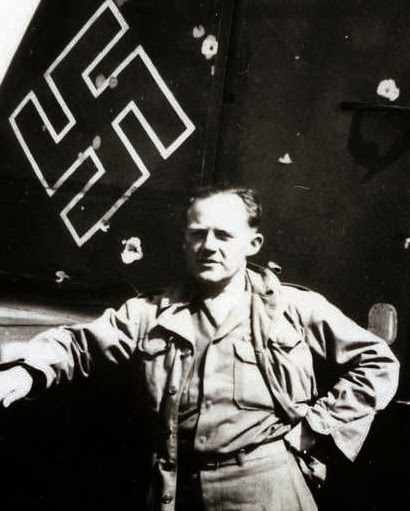
Germany, 1945
So his official story pops up again at Camp Gordon Georgia, standing at the Jewish USO of Camp Gordon, marrying Dora Moldawsky, a run-away from her family. It is May 1944 and he is only a few months away from shipping out to Europe. According to the story, he was too old by that point, six months shy of 39, to go to war. But because of the running away, four-year enlistment and incorrect birthdate, off he went. His new wife and family wrote letters, we are told, to get him discharged. He shouldn’t be there.

He shipped out in September 1944 and was in the middle of the end of the war actions in Germany.

Pine Creek Gorge, 1954 or '55
He returned home a year later, settled back into his hometown with the pharmacy, the family began. First son, me, then a second son. A brain tumor was discovered in 1958, he spent the last year and a half of  his life in a nearby VA hospital. He died in December 1964 at age 59 when I was 16.

That will be 50 years this December. I have come to know more about him in the past year, but it is all still ghostly, lost in the mists of the mid-20th Century. I have no way of knowing what part of me is from him, what from my mother who died three years before he did, and what is from my own experience and development without clear roots.


But every year, as Father's Day rolls around I do think of him. I have been blessed to be a father myself- for more than twice as many years as he was. I am saddened for both of us that we never knew each other when I was an adult. Perhaps things wouldn't have been good between us. That was a difficult and generation-dividing time.

We can't, of course, change the course of past history and in the end we only make our own history. For sixteen of my years he was there and today, my memories, tempered by the decades, are good.  A few weeks ago I posted a picture of Dad on Facebook and an old High School friend commented on how my dad had made him and his family feel welcomed and cared about. "He was a good man," I was told.

That is a good thing to know. I am grateful that I have that added to my memories of him. That my friend would have that memory 50 years later is good and even comforting.

Happy Father's Day, Dad. Thanks.

Wednesday, January 22, 2014

The Best Reason

I am just finishing Why We Write edited by Meredith Maran. It is an an interesting compilation from 20 successful writers about their craft. As a writer I was interested in the thought processes that go into different people's writing and style. As is to be expected there is little consensus since each person has their own style. Several things struck me, though, and even resonate.

1. They can't NOT write.

2. They've known this for a long time, even before they became "writers."

3. There's no successful short-cut or one style that will produce success.

4. Writing is work. Work you love to do and have to do, but still work.

5. If you want to be a writer, you have to write. (See #1)
I agree with these in my own less than "acclaimed writer" place. I have 34 years of journals and journal-like notebooks from all kinds of times and places in my life. They speak of the mountains of northern Pennsylvania, walking the streets of New York with a friend, 30-days in rehab, mission trips in various places.

They also speak of the day-to-day reflections of my life. I have always felt compelled to write.

Now that I am in semi-retirement I am going to attempt to make writing a part of my Third Career. I have the time, no full-time day job to worry about. I am not sorry that it has taken this long. It takes many of us a long time to grow young. I have also needed to fill all those other compulsions of my life, like helping people, counseling, ministry, etc.

So, for the next six-weeks I am going to focus on one particular set of writing. For the past six years I have been percolating a memoir and it's time to go back to those pages and pages in my journals where the initial writings took place. I am excited- and scared- of the process ahead. I will keep posting these wanderings here, but it is time to do "full-time" what I have been doing for so long already.

The best reason is always #1- I can't NOT write.

Saturday, August 09, 2008

Going "Home"

I watched the PBS (edited) broadcast of a remarkable 1969 documentary on Tuesday evening - Johnny Cash: The Man, His Music, His World. There were a number of moving scenes. Johnny and June singing Fever at a prison; Cash and Bob Dylan recording a duet; Johnny singing the

Ballad of Ira Hayes
(the native American who helped raise the flag on Iwo Jima but died an alcoholic) in front of a group of headdressed Indian chiefs. But one that interested me at this point in my life (and this past week as well) was when Johnny is back going through the sharecropper's shack where he grew up. He walked around the house, looking and commenting. He walked into the house and commented that the rooms seemed a lot smaller.

What struck me was the way I had been doing some of that the past few days with my 60th birthday. I had to drive up the main streets of town where I grew up commenting on what had changed- and what hadn't. I even had to drive around the corners where my boyhood home and my aunt's house were. "Gee, the streets seem smaller." "The back porch is still the same." "They moved the back door."

Is it some part of human memory that makes us desire to do that in some way or another when we move beyond those days? Is that a part of having a "home"; roots where we hope things will always be like they always were, especially for those of us who have moved away? Intriguing, to say the least, to watch Cash do at age 36 what I was doing at age 60.

Sunday, August 03, 2008

The Sixth Decade: 1998 - 2008

(Last in a series of life-reflections in the week before my 60th birthday.)
One sign that God may be calling is a certain restlessness, a certain dissatisfaction with things as they are. Other signs of God’s call may be a sense of longing, yearning, or wondering; a feeling of being at a crossroads; a sense that something is happening in one’s life, that one is wrestling with an issue or decision; a sense of being in a time of transition; or a series of circumstances that draw one into a specific issue.
---Source: Suzanne Farnham, et al, Listening Hearts
That quote has been even more real in the past decade than it was in any other decade. This was a decade of wrestling and transition I would not have believed possible this long after mid-life.
  • Elected to our Western District Board. I enter into the church politics for better and worse. Politics are politics, no matter where they occur. In the church we often just hide our politics behind some understanding of God's Will. At times that may be okay. At others it may be manipulation. It is often difficult to explain the difference. Friendships can be strained by circumstances or ideology.

  • Meeting and working with Bill Easum and Tom Bandy. Here I was opened to many ideas and directions. The biggest was the awareness that the stuff I was reading had real significance on the church. I became more and more aware that the purpose of the church is "to make disciples who make disciples who make disciples." I also became aware that so much of what we do in the church is almost totally unrelated to that purpose. Institutional survival underlies more of what we do than I had ever been able to see or admit.

  • The restlessness of the missional calling when the church has difficulty doing that began to creep in. I saw so many opportunities and too little time or effort to do them.
This was at the same time as
  • Our daughter went off to college and three months later

  • We left home in Watertown, WI, and moved to Chaska, MN, to a new call. As I said earlier in this series, you usually have to leave home in order to make the changes and growth that you need to make. After 15 years in Watertown we had settled in - at home. But life was calling us- and God is always in the midst of life. We moved. Talk about pain. Deep pain. Deep grief. And even after all the deaths in my past - or perhaps because of them - I do not do well with grief. Neither does Val. But we moved.

    Fortunately, in God's grace, God called us to Minnesota only 45 minutes from Betsy. We gave her space but our proximity allowed us to continue to enjoy her life and keep the contact of parent/child so it could grow into a true adult friendship.

  • Personality, spiritual, and other conflicts ended the ministry in Chaska. Unfortunately the move did not turn into the missional and church growing opportunity it appeared to be ahead of time. There were many things at work that are best left behind. It was difficult and devastating to us and to many. Yet, we never doubted God's call in the whole process. We may never understand the reasons or God's purposes. That has to be okay.
Family-wise...
  • I reconnected with my brother after years of minimal connection. One of the great things recovery gave me was the willingness and ability to make connections with my brother. There was not a big breaking apart. We just stopped connecting very often. I finally made a trip back to north central Pennsylvania after a 19 year absence. It was one of the highlights of this decade. It was also one of the real difficulties as less than a year later he calls and tells me his son is quite sick.

  • My brother's 26 year old son dies of cancer almost exactly a year after the reconnection. That is now almost 4 years ago now. In these past four years I believe that my brother and I have become friends in ways that we were never able to be. As I write this I have finished two days being with he and his wife, doing fun things, celebrating my 60th with them. I am grateful- very grateful.

  • Betsy thinks she has a call to ministry. It is not affirmed by situations and circumstances. So, instead, she finds a new and exciting direction for herself. It is interesting to watch her bloom!! It is also interesting to see how others feel she is somehow doing something inferior to church work.
Through and over and around it all...
  • I go on leave of absence to enter secular work as an alcohol and drug counselor. It started as a way to stay at the church with my wife and save the church money. It was also time and I knew it, to move in a new direction.

  • My wife spends an amazing 5 months directing our district conference and camp center and being renewed after the difficult ministry.

  • I realize that God has actually called me to a new ministry, a "secular" ministry as an alcohol and drug counselor. I came upon the realization one day that I was finally listening to God trying to convince me that the calling is not to the church but to God in service to people. That sometimes by truly living as a disciple one has no goal but to serve others.

  • We move to Rochester, MN, nearer Val's church and for me to work at the Mayo Addiction program. It was at that point that I realized that I was truly in a second career, not just some holding pattern until retirement. It was exciting and energizing and actually a whole lot of fun.
And, as of tomorrow, August 4, 2008, my 60th birthday,
  • I will be retired from the active ministry of the Moravian Church. Sooner or later retirement happens. I have been unofficially retired for several years. Not from ministry, and certainly not from God. But from the church-based ministry. By becoming retired though, I enter a new relationship with the church. I continue to work and have no plans on quitting working. When a person loves what they are doing why should they retire? Fortunately Mayo agrees with that general principle. I don't know what my next relationship with the church will be. I have just barely gotten through the new employee comfort level. I haven't had a whole lot of time to spend thinking about that. But I haven't left the church as such. I am seeking only to be faithful in the whole of my life.

  • Somehow or another I do feel that God knows that.

Saturday, August 02, 2008

The Fifth Decade: 1988 - 1998

(Fifth in a series of life-reflections in the week before my 60th birthday.)

It turns out that this is the first decade of my life since the first one where I spent the whole time in one place. This time it is in what I now consider my second home town, Watertown, WI. Today, I have no problem saying I'm from Wisconsin.

As I said yesterday I joked at my 40th birthday that I had done my 40 years in the wilderness. Now was the Promised Land. When thinking about entering the Promised Land I forgot about the Battle of Jericho that preceded it...

  • Just shy of 3 months after my 40th birthday I enter treatment for alcoholism. The Battle is waged as I discover- and admit- my active alcoholism. I wrote a letter to the congregation telling them what I was doing. Some felt I should prepare to move. It would be hard to continue to minister in this church after admitting I was an alcoholic. Fortunately the people of the church gave me the greatest gift- their ongoing support and care and love. We spent another 11 years serving in the same place.

  • Recovery starts and grows into a blossoming life and hope that I had never felt before. That recovery gave me back a lot- and in some ways, things I never had. Happiness, hope, renewed family, new friends. Most of all through the 12 Steps of AA I found a way of life that helped me live in new and exciting ways.

  • I start writing a yearly Christmas story, a tradition that will last 14 years.
Death returns in the form of AIDS...
  • DB, my second oldest friend dies in NYC, less than a year after I get sober.

  • WK, my oldest and best friend dies on Good Friday as I take the train home after staying with him for Holy Week. This is about 2 1/2 years into sobriety.

  • Recovery, a new way of life, keeps me in that pain instead of ignoring it and allows me to live in hope.
Life and ministry expands as perhaps this decade becomes one of the most fulfilling, exciting, and productive...
  • I earn my Doctor of Ministry from the Lutheran School of Theology at Chicago and

  • Become a Certified Alcohol and Drug Counselor five years into sobriety.

  • I "discover" the Boundary Waters Canoe Area Wilderness as a place of spirit and spirituality and, at the same time, rediscover the wilderness that Pine Creek had first introduced me to.

  • Work part-time as an alcohol and drug counselor at a local Watertown clinic.

  • I begin developing short-term mission work with youth and adults, a real passion.

  • I read the books, The Missional Church and Kicking Habits. They will soon lead my whole ministry in a new direction.

Friday, August 01, 2008

The Fourth Decade: 1978 - 1988

(Fourth in a series of life-reflections in the week before my 60th birthday.)

Joy and terror, hope and fear mark this decade. Perhaps that is how one prepares for mid-life. At least that's the way I did.

It began with
  • Self-confidence and feeling of competence in ministry as we settle into a fine ministry in York. I found my preaching voice thanks to the remarkable Fred Craddock. I fell in love with ministry.

  • We buy our cabin along Pine Creek back in my hometown area. My aunt used to tell me, "Once you get your feet wet in Pine Creek you will always come back."

  • Our daughter, Betsy, is born. At nearly nine years married, along came Betsy. Val had some problems in her early months but they settled down at about the fifth month. So began what today is over 2 1/2 decades (so far) of wonder and joy and hope and fear- parenthood.
Ministry becomes even more woven into our life together
  • We move to my 3rd pastorate in Watertown, WI, the beginning of a wonderful ministry, even though I was "never going to leave Pennsylvania". It was difficult and traumatic. Now we were really leaving everything we had ever known behind. You must finally do that in your 30s or you will never really do it, I feel. Fortunately God kicked us and we went. Reluctantly, but we went. The first four years, the last four of the decade, were a mix of good and bad, great and awful. Things seem great, but under it all is a restless uncertainty fed by a demon that would get exposed at the start of the next decade. (See below.)

  • Val hears the call to ministry and starts seminary. Excitement and fear for me on this one. She started seminary the same day our daughter started kindergarten. As this decade ended she had one year left.
But, alas,
  • AIDS was discovered- and an old friend has it. He was gay and had been living in New York City since the earl days of gay liberation and the Stonewall riots. He lived as if life would go on forever. He felt he had jumped off the wave before it crashed. He was wrong. I visited him a number of times at the ed of this decade. He prepared for death as he had lived- wide open.

  • The demon. My alcoholism began to eat into my life and soul- and I didn't even know it- and neither did anyone else, including Val. It had begun to work while we were still in York. I would go to our cabin and drink. I was an episodic drinker. I could go months without a drink. And then, with Val away- or me at a conference on my own- I would drink. With so much under it and feeding it it was a well hidden secret that was about to destroy absolutely everything. The episodes were getting closer and closer together.I had begun to think about finding ways to drink even with Val at home. It was not pretty, but I was completely oblivious.
It ended with my 40th birthday on which
  • I played my first ever trumpet solo with the community band at our weekly concert in the Park.

  • Val and the congregation held a surprise 40th birthday party in the park right after the concert.
Life looked great. I joked- finally- after 40 years in the wilderness I would enter the Promised Land.

Yes, but...

More on that tomorrow.

Thursday, July 31, 2008

The Third Decade: 1968 - 1978

(Third in a series of life-reflections in the week before my 60th birthday.)

As most people know, the third decade is where things begin to get settled out- adult plans, adult goals, the beginning of a career and marriage. Mine was no different. In fact, this may be one of the more "normal" decades of my six with only minimal unusual ups and downs.

I guess it can best be summed up as War, Marriage, and Ministry
  • Watching Chicago 1968 on TV. I remember being so angry at Mayor Daley and the establishment that I could hardly speak. It had a significant impact, on top of everything else that was soon to happen, that would lead me to a certain frustration(!) with the political process that didn't let up for about 40 years.

  • Draft Lottery and Conscientious Objection. #149. That meant that in 1970, when I graduated from college and lost my student deferment I would be drafted. They went to #190 that year. This was perhaps my first real wrestling match with my faith. I knew people who knew people who knew people that might have helped. Some thought about going to Canada. I had to be honest to myself.

    I applied for CO status as a pacifist which was not part of my former Baptist tradition. I came out the other end of the wrestling match feeling positive about myself. I was given the status and spent the next two years doing my alternative service, first at a home for the handicapped and then as a youth worker for the city of Bethlehem.

  • Protests. Ah, yes. The cornerstone of the late 60s. The Moratoriums in '69 and '70. The Invasion of Cambodia and the killings at Kent and Jackson States. Going to May Day in 1971- and turning around before it came to arrests. Involvement in draft and military counseling through the local peace agency. (Did I say my life was average? I guess maybe it wasn't as average as I thought.)

  • Atlantic City and Woodstock. The Atlantic City Pop Festival was two weeks before Woodstock and attracted over 100,000 people, my roommate, some friends, and myself among them. Throughout my college years I had the opportunity to see many great rock concerts including Cream. This was a great weekend. It was not Woodstock. But for those of us who were there it was a lot less messy, and was still in the culture.

There were more deaths...
  • Ruth, my Dad's sister and our guardian died a few months after I graduated from college. We never knew the circumstances but it was an auto accident caused either by a malfunction or her having a medical problem. That left my 19-year old brother and myself (at 22) on our own. He stayed living in the house. I stayed in Bethlehem where I was working.

  • GW, my college roommate. GW got sick with a rare cancer and died in the mid-'70s. My Dad's cousin's husband and her son-in-law also died in this decade. That was really the last for quite a few years.
A Life Together Starts
  • Meeting and Marrying Val. Yes, we met as part of the peace and protest group in Bethlehem. She was not as out in public about it as I was. That made her more effective of course.

  • Hurricane Agnes stranding us for days. We had gone to my hometown to help my brother clean up the house for sale. Along came this Tropical Storm that just wouldn't stop dropping the rain. The result was the 1,000 year flood. To see the river and Pine Creek rampage like that was a scary proposition. To have one of my brother's friends walk into gthe house carrying a dresser drawer and say, "This is all that's left" was humbling.

Ministry gets off the ground...
  • Hearing the call to Ministry. Now the call came- after I was doing my alternative service, not earlier when I could have a deferment. God's plans, not mine. Actually I had rejected the idea of ministry as a way out of the military. I guess that was the right choice. The call came at the Moravian Senior High Camp at Hope, NJ in August 1971. I had been invited by a friend to help him teach a course at camp on the church and war. That would probably not have happened had I sought an easier way a year earlier. God's ways of hooking you are as varied as the millennia.

  • A Trip to Israel- this one to get in touch with my Jewish roots in a real and deep way. In the summer between my middler and senior year in seminary my wife and I took this month-long trip to Israel. While there was a lot of Christian stuff there, I was finally connecting and beginning to understand my Jewish roots. It also helped us get to know each other better after a year of marriage.

  • My first congregation in Center Valley, outside Bethlehem, PA where I served one year as a student and then three years after being ordained in September 1974.

  • Cursillo saves my ministry. Most first ministries end up hitting some kind of wall after a couple years. I once described it as entering the ministry expecting the church I was serving to explode with excitement. After all, the only reason it happened before was that I hadn't been the pastor there before. Well, needless to say, it doesn't tend to happen that way very often.

    Meanwhile the Moravian Church was getting involved in the spiritual renewal movement, Cursillo, which I had introduced to the church my last year in seminary and then stopped being involved. Well, what goes around--- just as I was about to give up on ministry, not long after I stopped hitting my head into the wall and said to God, "Okay, God. It's your church. You do it." here comes Cursillo to push me into a new depth of faith and spirituality. The result was almost 30 more years in the parish!

  • Giving up on the hope of politics. And it all fell apart. Assassinations, Vietnam, Watergate, conservative Christian politics. I did not get interested in-depth again for another couple decades.

  • Moving to a new congregation in York, PA. I finally grew up. Val and I were on our own, away from Bethlehem putting life into practice. What a wonderful, caring supportive congregation to allow us to do that.
Thus ended thirty years. We were not yet parents, but we wanted to be. We both enjoyed what we were doing. (Val was being a pastor's wife and enjoying it and setting her own grounds for the future.) I was discovering my self and way of ministry. That would take a few more years to bloom a little more but we were enjoying ourselves. Just as it should be at 30.

Wednesday, July 30, 2008

The Second Decade: 1958-1968

(Second in a series of life-reflections in the week before my 60th birthday.)

I have a hunch that for the most part our second decade is the one that sets so much of our lives in motion. It is the time when we set out on the discovery of ourselves and our potential place in the world. For me, this was the decade where death became real- and even intimate...
  • Dad's brother, Uncle Carl. I was 11. Uncle Carl was neat. He worked for the Erie Lackawanna Railroad. We looked forward to seeing him. That's about all I know about him. He died suddenly in his sleep as far I remember. Again, we did not go to the funeral. We stayed with a neighbor. My 8-year old brother and I were felt, again, to be too young. The sadness of that was that two years later we had to attend our first funeral. Carl was 58.

  • Mom. I was 13. She went into the hospital in November to try to find out what was wrong. They operated, found colon cancer, and closed her up. There was nothing to do but wait. She was gone by mid-February. We went to the funeral and the three things I remember are
    1) I bought my first suit and tie.
    2) I didn't want them to close the casket, just in case.
    3) Carl's widow, Aunt Mabel, told me I shouldn't smile at people when I said "Thank you" for their comments and condolences.
    Mom was 48.

  • Dad's Father, Pop Pop. I was 15 and it was six days prior to JFK's assassination. He got sick, probably pneumonia, and died. He had been active, taking daily walks until a week or so before he got sick. He was 87 having been born in the centennial year of 1876.

  • Dad. He lived six and a half years after his brain surgery on my 10th birthday. The tumor was benign but slowly grew back, as they expected. He actually spent the last year and a half of his life in the Veteran's Hospital in Wilkes-Barre, Pa. It always seemed like an endless drive to go visit him. His sister Aunt Ruth had moved in with us when Mom got sick and she remained our guardian. Dad 59.
It was also the decade when spirituality and faith began first to seep and then pour into me and my pilgrimage truly began...
  • Bar Mitzvah on my 13th birthday. My mother was Jewish, of course. The war bride who probably shocked the home town more than just about anything else in those days. I had started Hebrew school when I was 11, I think. I would take the bus to Williamsport after school and then back home after class. There was something exciting about it. It was like finding a place. I didn't know much about it. Just learning Hebrew. We did not go to synagogue at all. Never. Until August 5, 1961 when I had my Bar Mitzvah and became a Child of the Law. I never went again until I was out of college and a Christian. Oddly, I remember the passage that the Rabbi used for my text and preached on:

    Man does not live by bread alone but by every word that comes from the mouth of God.

  • Becoming a Christian and being baptized a couple months before my 16th birthday. An even longer story, better told in detail in another place. The short version is that my friend Dallas and his family invited me to go to church with them. They had been asking for a while on and off. Finally I said yes. It was the last week of June 1963, about 17 months after Mom had died. I skipped the next week and then started again. It was a very independent Baptist church. I went forward and was baptized at the end of May 1964. I was now truly part of a community. I didn't feel different, an outsider, any more.

    God had finally broken through into my soul. Jewish and Christian. I don't use words like "completed" or "messianic Jew." They both are part of the great stream of faith that I jumped into with both feet and still flow with.
And naturally
  • A summer science program at Southern Illinois University and taking the train home by myself. It was between my 10th and 11th grades.
  • High School graduation
  • The first two years of college
  • Radio (listening, being a disk jockey and newsman, manager of the college radio station)
  • Playing trumpet in the band
  • Rock and roll
  • My first drink - and first drunk at the same time - at age 19
  • 1968- no words needed.
  • Kennedy, King, and Kennedy - with nothing more to add
  • And finally, the beginnings and escalation of Vietnam.
Death and spirituality. The second decade of this life. There developed an intimacy with both. As I write this and look at the list I am overwhelmed by how much happened in that 10 year period. Some of the things above are common to my generation of early Baby Boomers. Others were my unique path to walk. Put together they set a tone for my life that lasts to this day. Among these are:
  • The intimate awareness of death. Sometimes morbid and fearful, sometimes just a presence. The result has been an ability to minister in those difficult situations and not run in fear from them. Death is as real and present as life. As a result I absolutely insist on enjoying life. This life. As I have discovered over the 44 years since both my parents have died, life goes on. I will enjoy it- and make a difference while I am doing it.
  • The absolutely positive fact that God is real and present in my life. I do not live by bread alone. I have tried not to live by bread alone. I don't always hear or feel or taste those words that come from the mouth of God, but I know they are there even when I have ignored them and tried my own way. God is patient and will not leave me. Period.
  • Social justice and pacifism and the futility of war all came out in this period. They have not changed.
  • My love of music was born in this decade. It has never abated and only increased. (Yes, I am even listening to music from iTunes as I write this!)

Tuesday, July 29, 2008

The First Decade: 1948-1958

(First in a series of life-reflections in the week before my 60th birthday.)

The place: A small town in north central Pennsylvania. It is a basic middle-class community. In what may be more of an issue than I was ever aware of, the local pharmacist (Christian by background) came home from the war with a Jewish bride he met in Georgia. She was from Brooklyn, but like the pharmacist she had kind of run away from home, too. Oh, she was also eight years younger than he was. And at the end of WW II he was already 40!

I am sure that there was tension. (How's that for understatement.) I never knew it. But that basic rebelliousness they showed may be more important than just about anything else in my story. That and the edge of the wilderness of northern Pennsylvania where my Dad's family (both sides) had lived since the mid 1800s.

So, in 1948, four years into their marriage, he at age 43 and she at 35 had their first child, a boy, and they named him Barry. Why? Who knows. It's what I have been called ever since. So, in the midst of incredibly beautiful country, always a hint of poverty around the community, farming not too far away, "The Old Homestead" just up the road, and a family of Democrats amid strong Republican neighbors, the story began.

Beyond the obvious, you know learning to walk, talk and feed myself (which I don't remember,) there are these:
  • A plane trip to New York City on Allegheny Airlines (now US Air), with Mom getting sick. So we took the train home. We went for Passover with my Mom's family in Brooklyn. While in New York on that trip my brother and I were in the Peanut Gallery on the Howdy Doody Show. Every time I would look over at the monitor to see what I looked like I never saw myself- but there was always this one funny-looking, big-eared kid with his head turned.

    I do remember the Passover Seder dinner with all the grandkids. My brother was the youngest and I was just three years older. It is one of those primal memories, I think, informed as much by the pictures as anything else. But there is something truly moving, spiritually, about that.

  • Vacations as a family to Manhattan, Niagara Falls, Wildwood, NJ. Dad owned his own store and worked long hours. It was an old-fashioned drug store with a soda fountain until I was six or so. Because of his schedule- he was even open on Sunday mornings!- he seemed to value vacations. That's another thing I come by honestly.
  • My 6th Birthday party- a surprise at the park with the other kids at the summer recreation program followed one week later by...

  • Falling from the top of the "big kids" sliding board where I wasn't supposed to be and breaking my arm. I ended up in a body cast for six-weeks. I remember lying on the ground, in pain, and more afraid of what my mother would say. "Don't tell her," I whined. "I wasn't supposed to do that." The result was a week in the hospital. One fun thing was the little radio speaker thing that you could put under your pillow and listen without bothering the other kids. This may have been the beginning of a love affair with radio and music. Oddly, that hospital experience did not cause a fear of hospitals. I actually feel comfortable being in hospitals. Perhaps a precursor to my many years of visiting people in hospitals as a pastor and now working in a hospital environment.

  • The 1st hint of death with my Mom's father dying when I was 9. My mom went to the funeral by herself. Dad stayed home with us. We were deemed too young (9 and 6) to make the long trip to Brooklyn and to see death.
  • The 2nd hint of mortality when Dad had brain surgery in far away Philadelphia on my 10th birthday. They were doing exploratory surgery to see if there was a reason for his headaches, and perhaps other symptoms I never knew about. Mom was there with him. Neil and I were with our aunt and grandfather who lived just up the street. It turned out to be a tumor, non malignant. But the surgery left him partially paralyzed and set the stage for his retirement and disability a year later at age 54.
So it began. I never thought of it as a particularly unusual childhood. Fishing with Dad, vacations together, typical sibling difficulties. But nothing that I felt was out of the ordinary.

One thing about it was the community. Small towns, for better and worse, are interesting places. When they are in the rural areas, it is even more so. We couldn't get TV, for example, until cable TV showed up. That was when I was 6 or 7. But the people all knew about each other and even offered a kind of safe, warm cocoon that you could thrive inside if you wanted to. The extended family being only a few blocks away was also helpful.

It was a far different time. It seemed innocent, though I know now that it wasn't. It was just different. Simpler, perhaps. Fewer choices. But it was what I knew.

Monday, July 28, 2008

As Another Decade Comes to An End

I guess anyone who writes a daily blog about whatever comes to their mind has to have a certain amount of self-indulgence. For one who has been doing it for over 5 years and nearly 2,400 posts, and who for 30 years stood in a pulpit and told people what his interpretations of God's word were has to have more than the average self-indulgence (not to mention hubris and a bunch of other things.)

Well, as you are no doubt getting tired of hearing, I am now one week away from my 60th birthday. As a self-indulgent baby boomer I am taking the time to use this as a way of personal reflection. All of us are, for better or worse, the sum of all the events and years and experiences, the hopes and dreams and disasters of our lives. Then add to those the basic personality we seem to have been born with and the genetic material handed down across the generations. Finally mix all them in the stew pot of whatever culture and ethnic group, socio-economic class and favorite music- and you have you.

So, for those of you who might be interested I am going to review these 6 decades that are me. I don't think my life is any more interesting than yours or anyone else's. In many ways it is probably just old average. The ups and downs can be described in many different ways for each of us. The same ups and downs could turn into one person's road to pain and anger, while someone else uses it for good and hope.

Over the next six days, the last six days of my 6th decade I am going to review each of the decades. They will not be in depth, but rather in summary and a quick overview. I may try to pick out the more important or more interesting things from my perspective. I may try to analyze or reflect on then- and I may not. I don't know how it will go until it's over. At the end I may find nothing new- or I may be amazed at what I've missed.

In the end I have a hunch that it will be a kind of review of how I discovered God's will in my life. I may have told this before but our district president when I was in seminary was asked once to describe how he knew God's will. He simply said that he would walk through an open door and walk through it. When he looked back he would notice that it was God's will.

In AA I have heard it said that you discover God's will in two ways.

  • One is just to do the next right thing.
  • The other is when you hit a dead-end or a wall, turn and keep on going.
So I'll review some of those walls, dead-ends and open doors I've hit and walked through our around. From the view of a somewhat wiser, and definitely older guy maybe there will be visions of God's will in this pilgrimage into the post-modern world that I hope will open some doors for you.

Or not, since it is my story- and self-indulgence at work. At least I hope you get some enjoyment and insight.