Showing posts with label courage. Show all posts

Monday, June 10, 2019

Tuning Slide 4.46- Being Free #2

Weekly Reflections on Life and Music
If you keep doing what you’ve always done, you will keep getting what you’ve always gotten.
— Various

Last week I started a series based on a blog post at Planet of Success. It is about 10 powerful ways to free yourself if you are stuck. I took the concepts and riffed on them from my own experiences in the last 8-10 years to overcome self-defeating attitudes that kept me from changing and growing in my trumpet playing. Last week I looked at the first three:
1. Face your fears
2. Break your routine
3. Effect change, one step at a time

This week we take the next three and see where they can take us as we work to keep from staying stuck. Again, my thoughts are in italics.
4. Overcome the perception of impossibilities
✓ Feeling stuck in life … paralyzes us and diminishes our ability to see exciting new opportunities. Instead, we feel as if the options at hand are impossible to execute. If every solution you can think of seems impossible to accomplish, you’ll get even more stuck. … no progress can be made. nstead of getting trapped by these thinking patterns, try to explore your options… [T]ry to find the one solution that you like the most and commit to the decision.
It is not impossible to start a new career at least twice in one’s lifetime. Nor is it really too late to do it. I have seen many people over the years just kind of waste away into retirement- and spend many years moving toward it. It is not impossible to find new opportunities. As I have talked about with my trumpet playing, I was convinced that it would be impossible at my age (any age after about 40), to do anything about my shortcomings. Fortunately, I was wrong.
5. Be honest with yourself
✓ If we do want to break free from being stuck, it’s necessary to be honest with ourselves. Astonishingly, we almost always have the answer within ourselves. It might take some time to discover it, but it’s always there. The problem is that we do not act upon this knowledge. We prefer to keep this answer locked within ourselves.
Have the courage to at least think about the possible solution. It might be challenging to even consider acknowledging that you took a wrong path in life. But ultimately, it might prove to be better than suffering from this decision for the rest of your life.
Honesty. I have talked about this as part of the trio of honesty, openness, and willingness. The first honesty is to call BS on yourself when you say “I can’t do that!” or when we say “I don’t know what to do. It’s beyond me!” Neither is true. Because I had that moment of uncertainty at age 18, it does not mean I can’t do it now. Because I am trained in one area of life doesn’t mean I can’t get new training in my mid-40s or mid-60s for that matter. Admit that the biggest obstacle to getting where you want to go is YOU. That’s the first step of courage. The second is to say, “… and I don’t have to continue to block my own way!”
6. Change your perspective
✓ When we feel stuck in life, we most certainly do not have a good overview of the situation. Unfortunately, the feeling of being stuck in a rut can heavily affect our perception of life. It’s time to broaden your perspective!

▪ Stop walking the same path you’ve always chosen.
▪ Explore new perspectives by taking other paths.
▪ Ask yourself what your real goals are.
▪ Explore what you’re passionate about.
▪ Discover what it is that truly energizes you.
▪ Find your true purpose in life.
▪ Challenge yourself to have a vision for your life.

Discovering your vision and the pursuit of your passions can create a powerful drive. It can help you to liberate yourself from the vicious circle of being stuck.

That list above says more than I can absorb in a few moments. In essence, it replays that old cliche that if you keep doing the same things you will keep getting the same results. As long as I said I can’t change, that people my age can’t do that, someone with my history will fail, or I don’t know how that could happen- it won’t happen. Nothing will change if I don’t change. Nothing will improve if I don’t take the steps to make the change and improvement. That means looking at life from a whole new angle and finding out what I really want to see happen.

Remembering the first three things needed to get unstuck:
1. Face your fears
2. Break your routine
3. Effect change, one step at a time.

These were the prelude to everything else. I remember being asked to join a brass quintet, which I had never done in over 40 years of playing. (All three of those.) I remember deciding to get a trumpet teacher and then asking him. (All three of those.) I remember sitting with my teacher and him mentioning music camps and my then signing up for the Shell Lake Adult Big Band Workshop. (All three of those.) That’s when this week’s list came into play.

1. Things were no longer impossible. I did things I had never done before and began to see results, changes in my playing and increases in my skills.
2. I got honest with myself. I had been getting in my own way, but I also saw where I needed help in improvements. So I asked for help. My fears had been lessened, I had broken my routine of decades. I was taking it slowly, one issue at a time.
3. My perspective was changing. For one I began to see my third career in life included music. I was actually beginning to see myself as a “musician” and not having to excuse it away. Getting involved at Shell Lake with Mr. Baca’s trumpet workshop then gave these three items even more power and direction. I could see a vision, a movement, an honesty that was refreshing and exciting!

These first six things, interacting with each other and my new experiences, were life-changing on a surface level. That is where all change begins. We act our way into a new way of thinking, one small step or change or action at a time. After that, the changes get internalized, normalized. But that’s for next week.

Last week I asked you to take time this past week to find a fear that needed to be confronted or something in your routine that can be changed. Did you find a way to make a change? In the next week
  • begin to look at those from last week and how your perception is changing,
  • how you are no longer getting in your own way.
  • What are you still saying is impossible?
Take it deeper- and keep moving forward.

Monday, September 17, 2018

Tuning Slide 4.10- Mastery of Music #2: The High Road

Weekly Reflections on Life and Music

Success is not final, failure is not fatal:
it is the courage to continue that counts.
― Winston S. Churchill

A few weeks ago I posted the first in a series discussing the “pathways to true artistry” that Barry Green outlined in his book, The Mastery of Music, his follow-up to the groundbreaking Inner Game of Music. In each of them he looks at musicians and outlines a different pathway they embody. The first was “communication”- the silent rhythm as found in conductors and ensembles. For the second pathway he looks to the French horn and percussion for his ideas. They, he says, can teach us about

Courage: Choosing the High Road.

Music, Green tells us, has little (to no) tolerance for error. Unlike many sports where errors can win games (or lose them), music is far less flexible. Imagine if Doc Severinsen missed one of every 15 to 20 notes he played. It doesn’t sound like a lot, but we, the audience would get the feeling that it was time for him to retire. Every time we play in performance we get only one chance to get it right. We could come in early or late, loud or soft, crisp or mushy articulation, in one or out. All kinds of things can happen in the middle of the piece. Four measures before, we can’t call a time-out to make sure we are ready; we can’t ask for a do-over.

Green says it takes courage to face this performance after performance. He goes on to look at courage from the inside. Watching someone be “courageous” we may often think that they have no fear. In fact it looks like the opposite. In reality we are seeing fear that someone knows how to deal with. “Keep going,” the horn player reminds us as they play one of the trickier instruments. “Don’t stop,” says the percussionist who is almost always a soloist. This is, Green reminds us, “to go for it in spite of the fear of negative consequences should you fail.” That is “choosing the high road.”

That Green says is a “joyous choice.”

They “go for it” because of the “beauty of music and the joy of playing it.” Any musician who has played in a public performance knows that beauty and joy. Last week the director of the local community band arrived at rehearsal literally beaming. We were going to sight-read what he felt was one of the greatest wind band numbers- one that most of us have never played or even heard of. He was joyous that he could direct and we could play the piece. And no, it wasn’t a simple piece. But we played it- sight-reading the whole 15-minute piece.

Yes, it was a joy! Of course it didn’t take courage to do that in rehearsal. But it is in rehearsal that we learn the music and the beauty it has so we can play what it takes when it comes to the performance. Later in the same rehearsal we played another piece that was new to many of us. We got to the end and the three of us trumpets sitting together looked at each other. “That was hard,” one of us said with a smile. “Yes, but wow, was it fun!” another said. We all agreed.

The music goes on and the parts must be played! If we can’t deal with our fears and doubts we better decide to do something else. We will inevitably get stuck in that spot. I have told that story of my nearly 50 years of fear of a solo here before. It kept me stuck in many ways. It prevented me from taking a new leap into my musicality. I lacked the courage to fail. Again.

Let me be clear that the courage Green and I are talking about is not the courage to face those potentially life-altering events of ultimate success or failure. If I fail in a solo or play that F natural when it should be an F# the world, mine or anyone else’s is not going to fall apart. But courage is a very broad term that can have all kinds of subtle or explosive meanings. It takes my own courage to get through my fears. Even when it is “simply” playing the solo in the 2nd movement of Holst’s Second Suite.

When we come to those moments, Green calls it a fork in the road. (No Yogi Berra jokes.) One fork leads to the music in it’s beauty and power; the other leads to doubt, hesitation, or paralysis, says Green. So how do we move into the musical fork? He gives us four ways.

1. Be prepared. Practice- and then more practice- increases the familiarity with the music and reminds you that you are ready. Courage can often just be preparation. When you doubt you have the skills or haven’t prepared, Green reminds us, we are choosing to fail- to take the low road.

2. Don’t panic- keep focused. Stay with the music. Feel it, get its sense and rhythm and flow. Go with it. Know what you can do, not what you can’t.

3. Remind yourself of what brought you to this moment. Why do we do this crazy thing called music? Why do I take the time every day, day in and day out, to practice? Why did I get started in it in the first place? Play with that passion.

4. Believe in yourself. Self 2 can do this. Let it happen. When we have practiced and know the music, we can play with conviction and that will show in the music that comes out.

Channel your fear and courage. Take the adrenaline that pumps in the fear response and use it to the positive production of your music. It is extra energy that can be focused into heightened sense and increased awareness. The mindfulness that ensues will allow your self 1 to let go and trust self 2.

This is the courage to follow dreams. As we do this, we find that our soul will be enriched and skills will be strengthened that we can use to move the music into places we never thought we could go. In the end courage is not really overcoming fear, Green says, it is knowing that you are ready to give as honest a performance as possible.

And maybe even more!

~~~~~~~~~~~~~~~~~~~~~~~~~
Here is the piece that our director was excited about. It is Holst’s Moorside Suite. The third movement, The March, is incredible.

Monday, February 26, 2018

Waiting in Imagined Fear

It is not a new subject. We have been through this numerous times in the past 19 years since Columbine in 1999. After the latest school shooting in Florida I was taken back in my memory to the two early incidents that had an impact on me. Beyond those directly involved, we are seeing that many are being affected. For those who are not at the scene, I wondered, "What does imagined fear do to a soul?"

Columbine. April 1999.
It was nearing the end of my daughter's senior year in high school. Living in a smaller Wisconsin city where school was often the center of the community and my daughter being a senior the events in Columbine seemed way too real.

I thought about my daughter sitting in school, in a study hall in the commons area right inside door 1, the main entrance. I thought about members of the church who worked in or near the office, right across the commons or my best friend, one of the band directors down the hall. I thought of all the young people I knew, through our daughter, the church or community activities.

Then, within a couple days, there was a threat made to the school just as has happened across the country in the past two weeks. I knew that student as well.

The school made a couple of immediate decisions, including changing the location of graduation. It had been held outside at a local park for years. People would bring their lawn chairs and enjoy the wonders of spring along the river while the students marched in graduation. It was quite a celebration for the students and the community. Now it would be held in the school gym, more formal, but safer to protect. Some of the seniors protested but to no avail.

Red Lake Shooting. March 21, 2005
Six years later short a month I was in southern Minnesota working as a chemical health counselor in the local schools. A 16-year old on the Red Lake reservation in northern Minnesota took his grandfather's police weapon, killed his grandfather and grandfather's girlfriend then went to the school and continued the murders. He was wounded in a shootout with police and then committed suicide in a vacant classroom.

The shooter was only a year or two older than the students I worked most closely with, and had lived in our district for a short period of time. In the odd way of coincidences, I also knew his mother. My office was about fifty feet from the main entrance, the only unlocked door, of course, into the school. I often sat in there working with my office door open. The days after the shooting I became very aware of the proximity of that entrance and how quickly someone could get to my office. I vaguely remember having discussions with other staff, but we never really went into any detail that I can recall.

The students seemed naturally subdued for a few days. None of them ever mentioned to me that they knew the shooter when he was in our district, although they may have. All kinds of thoughts ran through everyone's minds I would guess. It's easy to become a sitting duck in many of the buildings in any school district.

I would call this "imagined fear." It is fear of the unknown that can easily come with an awareness of powerlessness, loss of control, the unplanned events that "can't happen here!"

Reaction as a pastor and counselor
I first thought of this after Columbine when social workers and others reflected some of their feelings on what had happened. They missed clues, they believed progress was happening with the two shooters when the youth were faking it. It was still a rare event in 1999 so even the best trained social workers didn't know what to look for. (By the way, in many ways they still don't. But that's another post.)

As a pastor in the community as well as an addictions counselor working with adolescents and a close friend of two guidance counselors in the school system, I wondered with them over coffee how we would know. We didn't have any answers, just as the counselors in Colorado didn't either.

In Minnesota I worked closely with the school counselors and staff. I was officially working for the county and was part of the school social work group. While the Red Lake incident did not have the larger impact of Columbine, we all shook our heads wondering what we miss on a regular basis. Since we all worked with severely "at-risk" youth we knew that just about any of our students could potentially break and cause such a disaster. It is not as easy to identify the future shooter as many would like to believe.

Rage, extreme anger, being bullied- these are all triggers and potential symptoms of school shooters. But these youth are also very, very good at masking it- sometimes by becoming bullies, sometimes by extreme introversion, sometimes by just being damn good actors. Every counselor or social worker in any school is painfully aware of this. It may be the nightmare for many that they miss the cues of suicidality or a shooter and the unthinkable happens. I have never had a shooter, but I know the pain of missed signs of suicide. I would guess the missed murderer is even worse.

Don't attack the counselor or social worker who misses it. Even though signs and the understanding of causes are clearer now than in 1999 or 2005, they are still variable. Plus, we don't know how many we DID prevent without ever knowing it was a possibility. There, I believe, we have most likely done more good than we will ever know.

Safety and Security Reflections
I was also aware then and still am in many ways of the impossibility of security and safety. Looking back at the four schools I worked with in Minnesota, they were all active places. At times of the day there were people entering and leaving the main entrance- people like myself, the social workers, shared teaching staff who traveled from school to school as needed; parents bringing forgotten papers to school or picking up a student for some appointment somewhere. Sure, having one main entrance to watch helps, but that does not prevent a mass shooting with multiple casualties.

An armed teacher would not be in the same position as an armed guard or patrol. The teacher is hopefully more focused on a day-to-day basis with teaching. They are working with some significant number of students on a regular basis. They are lecturing, proctoring, helping with homework, watching for misbehavior in their own classroom. If they are doing a good job as a teacher, they are not in a very good position to respond as quickly as they would need to if an event occurred near them.

It is already tough enough to be a good teacher. We can't also require them to be a good armed guard. Many don't want that job. I wouldn't. Improved security is important, of course. But we should probably expect that an armed guard at a main entrance to a school may well be the first casualty, not the last.

Students today
Malcolm Gladwell wrote the famous book The Tipping Point which essentially laid out that before any significant change occurs, there has to be the point where a critical mass of people say, "Enough!" For some reason, at least as I write this at the end of February 2018, we seem to have hit that point. Why the students of Parkland, FL, have reacted this way when others haven't to this extent will be something for social scientists to ponder somewhere down the road.

It is not that they have been fed by some left-wing, anti-gun conspiracy. It is not that they are more liberal than any of the students in the other places. They survived what their friends and teachers did not. Instead of survivors' guilt sending them into a dark frenzy of self-questioning, they shouted, "Enough."

When these students responded, so students in schools across the country were reminded that they, too, have been living in fear of such an attack. As a nation, since 9/11 we have all lived with such a fear of terrorists. The government in all kinds of overt as well as subtle ways, has been reminding us of that threat for seventeen years.

Maybe this last school shooting, an act of terror if not terrorism in the usual sense, was a tipping point to deal with those fears. Here is something that we might be able to do something about. More of us are getting killed by "shooters" than terrorists. Students in schools, worshipers in church, concert-goers having a party, workers in offices. Terror-inducing scenes.

People are tired of being afraid. People are sick of fear. People want to be able to do something that might have an impact on the culture of mass shootings we seem to be in the midst of. (That, it should be noted, is also why gun sales increase after each shooting.) Nothing will be 100% effective at stopping mass shootings. No one should ever believe it would. What the students of today are saying is that they are tired of being on the front lines of a war they never signed-up for. They want to have a say. They want to throw off the fear and do something.

Courage is not something that means we are fearless. Courage is, as an old, trite phrase used to say, is simply "fear that has said its prayers." What that means is that to act with courage is to know that there is strength in action, with confronting what is causing our fear. Courage is doing the next right thing to make a difference. There is a generation out there, a whole school generation since Columbine, that is now saying they want courage, not fear, to be their guiding principle.

We should listen and then be willing to truly sit down in dialogue to find out what is possible. We need to stop throwing ideology and patriotic misunderstandings at them. We need to support them and perhaps in so doing cast off our own fears.

Saturday, June 06, 2015

What Exactly is Courage?

Caitlyn Jenner has caused a firestorm by just doing what she has done. When others began telling of her "courage" to be so public with her actions, the push-back started. It made me ask myself the question at the top of this post.

What do we mean when we talk about courage?
Let me start with a personal story. Back in the late 80s I came to the awareness of being an alcoholic and I went into treatment. I was open about it, telling the members of my church in a letter to the congregation. People began to tell me that it took a lot of courage to do that. I would smile politely, say "Thank you" and then add that it wasn't courage, it was just something I had to do.

About eight months later I had the opportunity to get another person into treatment. I sat with he and some of his family for a couple hours talking about the problems of alcoholism and what life could be like if he got sober. He finally agreed and I took him to one of the local treatment centers. I remember saying to him as I prepared to leave, "It takes courage to do what you're doing." A few days later he responded to me that it wasn't courage, just something that had to be done.

At about the same time I was given one of those refrigerator magnet-type cards that had a simple quote on it:
Courage is fear that has said its prayers.
Yep. Courage IS doing what needs to be done in spite of fears and worries, consequences or possibilities.

The Google dictionary puts it this way:
  • the ability to do something that frightens one.
  • strength in the face of pain or grief;
  • synonyms: bravery, courageousness, pluck, pluckiness, valor, fearlessness, intrepidity, nerve, daring, audacity, boldness, grit, true grit, hardihood, heroism, gallantry;
Has it taken "courage" for Jenner to be open and honest? Sure- on one level. Those synonyms and the definition I am sure apply to her. Congratulations to her. It is good for her to have done this! Yes, she will profit from it, which is part of why she has done the PR stuff. It is a very well coordinated public relations campaign for her. Hey- if it works, go for it, because at one point it would have been an awful step to take, PR or not.

Is it a different type of courage than someone who has been battling cancer? Again, I have to answer "Yes." Battling a terminal illness is in its own category of courage. To face each day, to live with the terminal awareness, to not entirely give up takes a depth of courage and strength from within and without.

Courage comes in many different ways and is expressed by each individual in their own way. The key is, I believe, to express YOUR courage when you need to. I know that sounds like a wishy-washy kind of statement, but it recognizes that most of us do not face the BIG issues that require the deep expressions of courage. For some it's the courage to stand up to a bully or confront a co-worker or boss on sexual harassment. For a fireman it's to rush into a burning house to save someone (or their pet) and to another it might be taking that vacation hiking trip to confront one's inner demons. These many ways do not cheapen courage. They only show that courage is something we can access any day it's needed.

Courage is the ability to face one's demons and fears, those things that seek to pull us down or destroy us, and not give-in to them. It is being willing to reach for help and move forward.

Let's not play word games. Let's celebrate it as part of what makes the human spirit a place of wonder and awe.

Saturday, August 02, 2014

Heroes: Part 3- Women Heroes

When I started writing about my heroes, I listed a bunch of men. Well, here's the group of women who would make my list of Top Heroes. Their witnesses have been just as powerful to me as the men. (Listed alphabetically.)

  • Dorothy Day- Co-founder of the Catholic Worker Movement, she was a tireless advocate for the poor and social justice based firmly in her understanding of the faith. A confirmed pacifist, she often found herself in trouble with the established church and government.
  • Betty Ford- It took courage for a First Lady to admit to being an addict. Much of the progress we have made in reducing the stigma that chemical dependence has had is thanks to her.
  • Anne Frank- For one so young, Anne Frank is perhaps the hero of heroes. She was able to maintain hope and light in her life in spite of the horrific circumstances. This quote says it best: "Despite everything, I believe that people are really good at heart."
  • Helen Keller- A personal fight against her own disabilities make her another of those special heroes. An activist and outspoken author, she was the first deaf-blind person to get a Bachelor of Arts. When I think my problems keep me from succeeding she and Anne Frank humble me.
  • Mother Theresa- a human saint. She had many demons no one knew about but kept on moving forward in faith. Perhaps without her doubts she wouldn't have been so faithful. "If you can't feed a hundred people, then feed just one."
  • Rosa Parks- To take a seat on a bus and thereby start a revolution. It is not in the BIG things that we make a difference. Sometimes it is just sitting down in the right place.
  • Eleanor Roosevelt- Another First Lady who took stands of courage. She spoke out on racial issues, she held her own press conferences, she was more than just Franklin's spouse. She was Eleanor- and in many ways FDR was her spouse. An example of feminism before it existed. What a role model for anyone.
  • Theresa of Avila- A mystic with a heart open to God's grace, this 16th Century Spanish nun was a theologian, guide of the inner life, and instrumental in the Spanish renaissance.There is deep truth in her understanding: "I do not fear Satan half so much as I fear those who fear him."

Tuesday, May 13, 2014

Genius Hacks

Viral Nova posted 23 Genius Hacks for the brain the other day. Some of them were okay, but this one struck me:

18.) The physical effects of stress (increased breathing rate, heart rate etc.) mirror identically the physical effects of courage. So when you’re feeling stress from any situation immediately reframe it: your body is getting ready to do courage, it’s Not feeling stress.. A great example of cognitive reframing, researchers found that you do better when you appraise a stressful situation as a challenge, not a threat
Read more at Viral Nova
The idea in all of them was positioning, cognitive reframing, different ways to look at our own lives and the world around us. One of the many interesting things that science has been working on in recent years is how thinking and action can go together. Then, how acting differently can get you to think differently. Cognitive reframing, in spite of the fact that it is a "brain hack" is, in reality a new way of acting as much as it is a new way of thinking.

Which is why this one on courage and stress is so good.

Try it yourself sometime and see if it might work. No, I don't think it will necessarily make you super-brave or uber-courageous, but it will get you through some difficult times.

Friday, April 19, 2013

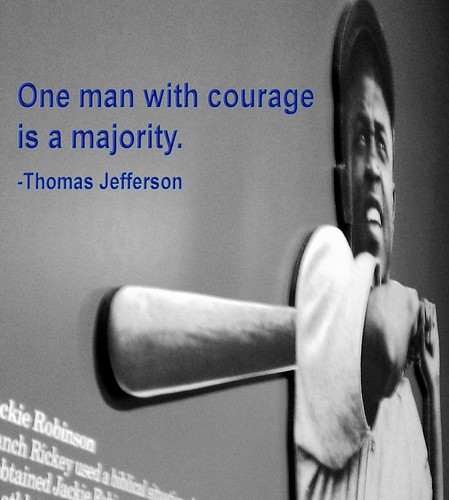
No Better Example

JackieCourage
Jackie Robinson
National Baseball Hall of Fame

Monday, April 15, 2013

Jackie Robinson Day

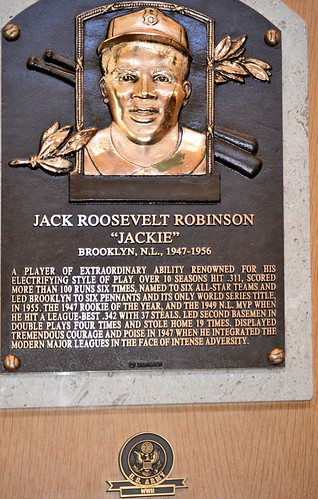
JackieR


April 15, 1947- # 42, Jackie Robinson, took the field for the Brooklyn Dodgers making history and changing America forever- for the better.


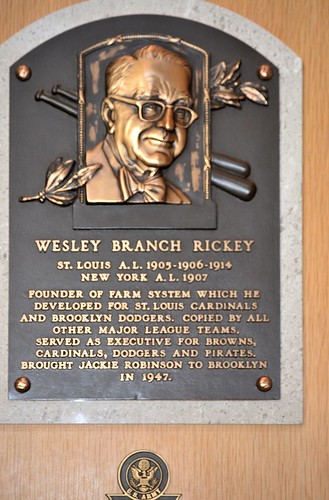
Mr. Rickey, executive of the Dodgers, fulfilled a lifelong dream to integrate baseball.

MrRickey


Courage
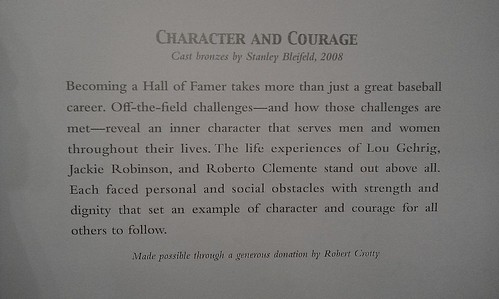
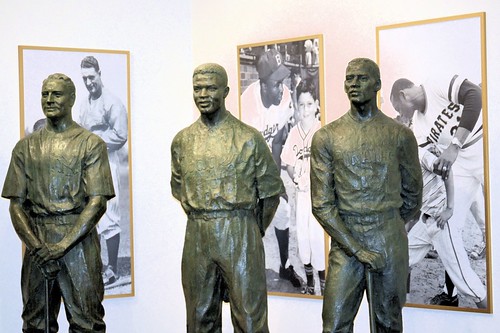
At the front entrance to the Baseball Hall of Fame in Cooperstown, NY is this plaque on character and courage. It honors three remarkable baseball players. On the left is Lou Gehrig. On the right, Roberto Clemente. In the center, Jackie Robinson.

Courage2