Showing posts with label culture. Show all posts

Monday, July 01, 2019

Tuning Slide 4.49- On Playing Together

Weekly Reflections on Life and Music
If I'm playing with a good band, I can last all night but a crappy, loud, out of tune band croaks my chops.
— Unknown

As that quote implies, the people we play with in our bands can make a big difference in how we play. While we may at times like to be the serious, top-shelf musician in our band, the truth is that such a position is not one that we truly want. In the long run, the best type of band to be in is one that is good and yet challenges us to be more than we have been. That begins with the idea of teamwork. In surfing the Internet I came across a number of articles that focus on this aspect of music and life. The first was from Engauge, a company in Great Britain that is in human resources and management consulting. The article, written by Vandy Massey was titled “Orchestras are a model for good teamwork”. There were seven elements in the list and they tell us a great deal about what we can learn in a band of any type that can then be applied to so many areas. As is my habit in these posts, the original material is in normal type and my comments are in italics.
◦ Knowledge – it’s important that everyone knows the repertoire. If not, there are bound to be hold-ups, mistakes or inconsistency as the wrong sheets of music are read, and confusion causes cacophony.
Another description for this is that knowledge keeps us all on the same page. That requires communication among the members of the team. Even for an orchestra, jazz band, or ensemble, it is more than just the repertoire, it is about the team environment and how we express that to each other. Often such communication needs to be a two-way circuit- each member needs to give helpful feedback to continue working on the same agenda.
◦ Resources – ensuring that everyone has all the equipment they need. Are the music stands in place, and is there enough seating, in the right order and at the correct distances from each other? It’s impossible to make sublime music without the right kit.
While this may not always apply to each of us individually, but resources are also part of the communication and knowledge system. Talk with each other; find the areas of uncertainty; make sure each member of the team is willing to do their own part on providing for the growth and betterment of the team.
◦ Culture – Is there a culture of participation or competition? Do all the musicians co-operate to ensure the right collection of instruments play at exactly the right moment at the perfect volume? Or are there some divas who make sure their sound is heard above all others – even when that’s not going to create the best overall experience for the audience
You can also call this the ambiance or environment of the group. Does the group feed you or drain you of energy. It is not about the individual, for example, it is about working together. If that is not a commonly accepted goal, it can be difficult. Sometimes groups have to work hard to fix a broken culture; other times the group just falls apart. With the right culture, built on the other things in this list, a group can grow and improve.
◦ Resilience – What happens if someone skips a beat? Do other members help carry the music? Or does blame culture mean that individuals are pilloried rather than supported.
If the team isn’t communicating and in agreement about the group’s purpose, it is hard to be resilient as a group. Group resilience is, as they say here, how do we respond when there is a mistake, someone makes a mistake or for some reason or another ends up in the wrong place at the wrong time? Positive and creative support allows the group to grow, to respond, to succeed.
◦ Commitment – Months of rehearsal and planning go into a performance. To make sure all the preparation pays off, every member must stay focused and committed to the last note.
If you are in a volunteer group, this can be the source of some of the greatest difficulties. The place of the group in a person’s priorities can get in the way of a commitment. While in any group there can be different levels of commitment, the focus of the group must remain important. Commitment means practicing the music and a willingness to make it the best music you can play. It means supporting the others in the team and being willing to work together.
◦ Sensitivity – Are individual members sensitive to and aware of the needs of the others? If they aren’t, there’s the potential for one person’s difficulties to diminish the overall listening experience. If everyone is aware and responsive, the conductor can adapt the sound at the flick of a baton.
If all I care about is my sound and my needs and my situation, the group will never make it, the teamwork will fall apart.
◦ Leadership – is the whole orchestra inspired and poised to entertain? Do they trust that their conductor will lead them through a flawless performance to rapturous applause?
Each of us is a leader to those around us, but a good group needs a team leader who can make a difference. In smaller ensembles we can learn “shared leadership,” but there is often one who leads if only by serving the whole team or helping set vision and direction. Is there one or sometimes two people in the group who have the ability to inspire you or others? How do YOU contribute to that leadership?

The last question I asked about your contribution to the leadership may be the central focus of the post. Be honest with yourself- are you a help or a hindrance? (Yes, any one of us can be a hindrance. Sometimes it is due to our own egos or just being in a bad mood.) Do you take the time to know the needs of the group and help provide them? Do you support the culture and positive environment of the group, helping it to be resilient? What is your commitment level and how sensitive are you to the other group members' needs? Put them together, how is your leadership helpful to the group and what can I do to continually improve?

Next rehearsal- take a moment to do this personal inventory and then build on it.

Monday, December 31, 2018

4.25- Tuning Slide: The Old and the New

Weekly Reflections on Life and Music

Music produces a kind of pleasure which human nature cannot do without.
— Confucius (500 BCE!)

Music has been around a very long time. (How’s that for an understatement?)
This appears to be borne out by the archaeological evidence. While the first hand axes and spears date back about 1.7 million years and 500,000 years respectively, the earliest known musical instruments are just 40,000 years old. (Link)
I love that phrase that the earliest known musical instruments are JUST 40,000 years old. Wikipedia tells me that this is in the Upper Paleolithic Era which is the third and last subdivision of the Paleolithic or Old Stone Age. The OLD stone age- as if the stone age wasn’t saying enough about how old it was! What were some of these old instruments? Flutes, of course. An easy instrument to make.
Music is found in every known culture, past and present, varying widely between times and ... It is probable that the first musical instrument was the human voice itself… A wood-lined pit contained a group of six flutes made from yew wood, between 30 and 50 cm long, tapered at one end, but without any finger holes. (Link)
Of course no one was writing any of this down for many, many millennia. But cuneiform tablets from Mesopotamia have been found which contain the Hurrian hymns, a series of hymns to the goddess Nikkal that date back 3,400 years.
“Hurrian Hymn No. 6” is considered the world's earliest melody, but the oldest musical composition to have survived in its entirety is a first century A.D. Greek tune known as the “Seikilos Epitaph.” The song was found engraved on an ancient marble column used to mark a woman's gravesite in Turkey. (Link)
We do know that there were musical instruments in Biblical times, but in these histories that is kind of late. The Psalms were hymns that were probably chanted and/or sung. Our favorite instrument is far older than the Biblical times.
In Denmark, by 2500 BCE an early form of the trumpet had been developed. This trumpet is what is now known as a "natural trumpet." It is valveless, and depends completely on manipulation of the lips to change pitch.

One of the most popular instruments today was created in 1500 BCE by the Hittites. …the guitar. This was a great step; the use of frets to change the pitch of a vibrating string would lead to later instruments such as the violin and harpsichord.

In 1000 CE Guido D'Arezzo made many improvements in music theory. He first improved and reworked standard notation to be more user-friendly by adding time signatures. Then he invented solfege. This is the vocal note scale: do, re, mi, fa, so, la ,ti, do. (Link)
So why all this?
First, some humility. Here we are about to start the 3rd decade of the 21st Century. It humbles me to think that what I and many of us are doing with music is part of a very long history. It is almost something that seems to come naturally, inbred, into the human race. If those ancients could make music that was, to them, inspiring and even “great”, who am I to think that I am something special?

Second, some continuity. Music is a long tradition. As a musician I am in that tradition, as small a part as I may play in it. So what? I am still part of it. So are you. Last week one of our local musicians/writers/journalists called for all the musicians of the Rochester, MN, area to gather for the third annual picture. There were about 75 or so of us. I could probably name another 45 or 50 who I know weren’t there. We were singers and instrumentalists, classical and pop, jazz and rock and country. As we were standing there getting the picture set up the Christmas song, The Little Drummer Boy, came over the sound system. Appropriate, of course, but we all started singing along. In harmony!

Third, the possibilities! Music is a varied tradition that can speak to any moment and any time. It moved the ancient Hittites as it moves us.

It does not matter how slowly you go so long as you do not stop.
— Confucius

What’s old can be new again? Perhaps it is better to say that in many ways the new is always built on the old. It can be the continuation, the growth, the evolution of the old.
At the end of a year there are many things that we look back on. We are grateful for some, with some never happened, and will forget 99% of the events. But they inform and form us into where we are today.

At the beginning of a year there are many things to look forward to. Most of them are unknown! Many things will happen in the next twelve months that we have no way of anticipating or even specifically planning for. Music will be there to become a soundtrack for our lives.

By three methods we may learn wisdom: First, by reflection, which is noblest; Second, by imitation, which is easiest; and third by experience, which is the bitterest.
― Confucius

◦ Music can turn us inward in reflection, the noble way of learning Confucius tells us.
◦ We imitate some of the greats of music in our learning process. I am not sure that in music that is as easy as Confucius thinks it is.
◦ Experience can be bitter, because we will not always succeed at what we try. We will make mistakes we wish we didn’t make. We will hopefully learn from that experience. Music is a building of experiences. Which is what we look forward to for the next 12 months.

Go- and put your life into it! It’s worth it- as it has been for millennia in every culture.

Wheresoever you go, go with all your heart.
— Confucius

Monday, November 20, 2017

Sad, Afraid, Speechless, Stunned, and Hopeful

Those words present the wide-range of feelings and reactions I continue to have over the news stories that never end. Tonight it was Charlie Rose. Last weekend it was Al Franken. Add that to Roy Moore, seemingly countless entertainment celebrities, legislators on all sides, even an NPR news executive. The biggest name continues to be Donald Trump, but he is not alone.

I admit to sadness, but no surprise at the Franken disclosure. Just when many of us liberals and progressives were beginning to get out of our Trump Funk (It only took a year!), we get knocked back by the awareness that this is not a liberal or conservative issue. We have tried to do that in the past, especially since many of the conservatives being accused have been "paragons of family values." (Liberals- being liberal- have always been accused of these kinds of immoral values.) But when it comes right down to today's news, it makes no difference.

Everyone seems to have clay feet! Which should not surprise anyone who is a person of faith or spirit. If we are honest, we would be the first to admit the awareness of what Paul says in Romans 7:

15 I do not understand what I do. For what I want to do I do not do, but what I hate I do. 16 And if I do what I do not want to do, I agree that the law is good. 17 As it is, it is no longer I myself who do it, but it is sin living in me. 18 For I know that good itself does not dwell in me, that is, in my sinful nature.[a] For I have the desire to do what is good, but I cannot carry it out. 19 For I do not do the good I want to do, but the evil I do not want to do—this I keep on doing. 20 Now if I do what I do not want to do, it is no longer I who do it, but it is sin living in me that does it. (NIV)
Unfortunately too often the religious right seems to forget that this applies to them as much as anyone else. They try to hide their human failings behind the righteous life they claim to live. That does not excuse it, however. The actions are still wrong. Period! End of discussion.

But this post isn't about that side of the issue. What has struck me most powerfully over these past few weeks since the Weinstein revelations became top news is the pace at which this has happened. Think about it. Before Weinstein things were normal. White male privilege was firmly entrenched from Hollywood to the White House to Alabama. Sexual harassment was the order of the day.

And then suddenly it wasn't.

A couple years ago we were amazed at how quickly opinion about, and acceptance of, same-gender marriage changed. It was almost like whiplash. One day it was wrong. And then suddenly it wasn't.

The same thing has just been happening from a different direction. This time it's women who are taking their power and running with it. They are not backing down. They are calling sexual abuse wrong! They are standing up to power, white male privileged power, and saying, "Enough!" They are advocating for change in some very basic issues in our society.

We are even hearing more about Bill Clinton and a little about the Clarence Thomas confirmation hearings. These were earlier skirmishes in what has become this major move forward. In other words, these are not just things that are happening now. FDR, Eisenhower, Kennedy were guilty of a number of things that we know about- and many that we don't. People are saying "No!"

The powers that be don't like it. Those who benefit by the system the way it is will fight back. They will build walls, figurative, metaphorical, and real, to keep others out. Some of the fights will be symbolic; others will be for real progress for real people. The fight over health care and the tax bill are examples of fights that will occur on many different fronts.

Perhaps this is a natural outcome of the Trump election. The dark underbelly of American culture and politics took the spotlight. Trump flaunted it, reveled in it, put it into 140 characters or less every day on Twitter. We could no longer pretend that it wasn't there. We began to realize that the system can perhaps best be described by the WW 2 acronym: SNAFU. Systems Normal, All Fucked Up. (Usually credited to the Marines. Not a surprise there.)

But it doesn't have to remain that way.

Resist. Move ahead. Become an ally. Speak up. Stand with the victims.

In spite of the stunned and fearful reactions of some, I actually find hope in the breaking down of this patriarchal system of abuse and worse. Maybe we will be able to make significant and world-changing movements.

I pray that it is so.

Wednesday, July 12, 2017

The Tuning Slide: 3.3- Spirituality of Music

Weekly Reflections on Life and Music

Music is the language of the spirit.
It opens the secret of life
bringing peace,
abolishing strife.
- Kahlil Gibran

We are in the last few weeks before this year’s Shell Lake Arts Center Trumpet Workshop. In late August I will start blogging about the themes and ideas that grow out of that, applying them to my practice and growth as a musician along with their applications to daily life. But before that, as we continue in the early part of this third year of The Tuning Slide, I want to take several weeks on some other topics that may also show up during the year ahead.

This week is the first of three posts taking a look at music from an angle that I have found more than important to me personally: Music as spiritual expression. There are as many different ways that this happens as there are listeners. Each of us also responds differently to a particular music or piece of music in different ways at different times. Our spiritual readiness and openness shifts as we grow and have other experiences.

The posts this week and next will look at the general topic of music and spirituality. The third post in three weeks will take a look at music as spiritual from the perspective of the musician. This whole idea of music and the spiritual may be one of the most basic links between life and music. What we experience in music may very well have an impact on how we live every day life in a deeper and more profound way than almost anything else we can talk about.

Since describing “spiritual” can be a whole lot like nailing Jello to a tree, I will start with a quick definition of what I mean when I talk about it. It has three parts:

a. Awareness of power and existence greater than one's self.
b. There is meaning, purpose, and direction in this greater scheme of things.
c. Positive, healthy connections with other people as part of a greater community.

We each may have different ways we describe these three parts of spirituality, but I would guess that most can agree with them, even if some may hesitate to use the word “spiritual.” I don’t want to get into a discussion of religious vs. spiritual or any of the other side issues that could bog us down.

I know many who use the word spiritual to describe the way some musicians play. Perhaps more than any other single individual, spiritual is often attached to John Coltrane. Or there may that moment in a song or solo that makes one get goosebumps or a chill up one’s spine. We then say that this is a spiritual moment. Whatever that may mean. But the three things I mentioned above can often be used to describe our experiences. Somehow we know that a piece of music makes us aware there is something greater than us, that there seems to be some sort of meaning or purpose there, and that we can connect with that as well as others.

It may be intuitive and beyond immediate description, but that is a spiritual experience.

As I was doing some research I came across a website (http://www.thescavenger.net/health-personal-development/self-growth/226-spiritual-significance-of-music-92345.html ) that had a good outline post on the topic. The quotes below are all mefrom that site. As I often do, I give you the quotes in bold and then I will riff on them as a way of thinking about music and the spiritual.

Music resonates within the human spirit. At the heart of humanity is a song of the soul. The spiritual significance of music can transcend communities, cultures, and creeds.

Quantum (and other branches of) physics have taught us that at the very center of all that is, our world vibrates. Some have found an early vibration of the original microwave background sound. Others have looked at the way the atoms and molecules vibrate in each of us. It isn’t too far-fetched to think that each of us has our own “vibration” that is unique since no one else has the exactly similar mix of atoms and elements. That may be a semi-scientific (or, to some, pseudo-scientific) answer to why music, sound vibrations in harmony, can be spiritual. It does seem to be at the heart of who we are.

Some of that may simply be repetition and communal connections (more on that below.) It may be the way a certain song, type of music, or musical progression brings back experiences that have moved us or touched us at some deep level. A particular lyrical passage may bring emotions to the front. Put those lyrics in a piece of music and it vibrates in harmony with us. Does it cause something in us to move in tandem with the music?

Music continues to inspire spiritual expression as sound reflects and affects faith and values. Beliefs and perceptions will transcend the very nature of music and lyrics.

Music, in some form, familiar or unusual can be found in most, if not all religious and spiritual movements. It may be as simple as the ringing of a gong to initiate or end a period of meditation or as complex as a Bach cantata. Or, on the other extreme, it may be the reaction against music in some historic traditions. But even in those there is an awareness that music can have an impact on the spiritual for better or worse.

In my particular religious tradition we have a history of brass choirs. A few weeks ago our concert band played a number that included one section that was directed for the brass to play together as a choir. I found myself responding to that passage from a deep, and even spiritual, place. That transcended the particular piece and took me to a good and peaceful place.

Amazing Grace, as an example, transcends even religion. Many non-believers respond in some deep way to its particular strains, even without the words. The number of instrumental variations of that hymn, its use in many settings- secular and spiritual- show that there is something deeply embedded in the Western traditions. Here’s a link to John Raymond and Real Feels doing a remarkable arrangement of Amazing Grace. Spiritual? At least in my book.


Which leads to the next point…

Our spirituality is an essential part of who we are, and it forms the framework of our world. Community, culture, and creed all offer insights into the connection between music and spirituality.

What is is that is deep within us? Why does music do this? Why do so many of us as musicians report feelings and emotional interactions with our music? Without getting out into some weird left-field ideas, I don’t think it is too far out to think that it is the vibrations of music in harmony that does it. We have common history and it can make a huge difference in what we respond to. Which brings us to one of the elements of that definition I started with:

Music cultivates community, as sound creates communication and unity…. Sound creates a spiritual connection between music-maker and music-lover.

I would add, a connection between music-lovers as well. That is community. They feed each other and give a common gathering place in the music itself. In my highly visual imagination I see the strands of music flowing from the musicians to the audience, around them, bringing them into the power of what the music is about. Not all of that could be called spiritual, of course. Certain music can send people into places that are not healthy. More on that next week as we go deeper to get in touch with spiritual.

With that introduction, let me ask you a few questions:
  • How would you define the spiritual in music?
  • When has it happened to you?
  • How do you know it was spiritual?
Add your thoughts in the comments on this post. I really want to hear from you and bring this virtual community into the dialogue.

~~~~~~~~~~~~~~~~~~~~~~~~~~~~~~~~~
A special note:

The copies of the 2nd Edition of The Tuning Slide book for the students at this year's Shell Lake Arts Center Trumpet Workshop have been ordered. They will again be free to the students! In order to help me defray the cost I have a Go Fund Me page where those who would like to can make a donation. Here is the link:

Go Fund Me for Tuning Slide books for students

Tuesday, December 27, 2016

Change the Paradigm and the Culture

We have been treated to another bunch of examples of sports people wanting to turn away from significant issues.

  • One team options a player because of a serious DWI, another team picks him up immediately.
  • Players on a college team boycott the team because a number of their colleagues were suspended for sexually inappropriate behavior. [Understatement!]
  • The coach of said team sides with the boycotting students citing "due process", even though the students clearly violated school and team policies, even if they weren't exactly illegal.
  • Last week a star of another college team tripped an opponent- the third such incident this year.
These are added to all the many ways the NFL and others like to look the other way, give an excuse,  or just plain tolerate bad, at times even illegal behavior. Somewhere, somehow, sometime we have to say "Enough! This BS has to stop! People need to take responsibility for their behaviors and their consequences.

Of course with the about-to-be-inaugurated administration we have seen more than a normal share of unwillingness to do that. This does not enhance our society or our country. The paradigm of winning at any cost needs to change- whether in sports or politics.

Wednesday, November 02, 2016

Día de Muertos


(Marigold is the traditional flower to honor the dead)

The multi-day holiday (Oct. 31 - Nov.2) focuses on gatherings of family and friends to pray for and remember friends and family members who have died, and help support their spiritual journey. In 2008 the tradition was inscribed in the Representative List of the Intangible Cultural Heritage of Humanity by UNESCO. -Wiki


Traditions connected with the holiday include building private altars called ofrendas, honoring the deceased using sugar skulls, marigolds, and the favorite foods and beverages of the departed, and visiting graves with these as gifts. Visitors also leave possessions of the deceased at the graves.

It is a good example of the way indigenous holidays have been adapted and interpreted into Christianity.

Personally, I find it a great way to remember family and friends no matter which tradition we may come from. All Saints' Day, Día de Muertos, or whatever you want to call it- take time to remember your ancestors and friends who have died.

One side note from the Wikipedia article cited earlier:
The holiday is sometimes called Día de los Muertos in English-speaking countries, a back-translation of its original name, Día de Muertos.
Credits:

Sunday, June 05, 2016

If Then Were Now (or Vice Versa?)

Muhammad Ali's death on Friday started me thinking and reminiscing. I remember the highlights and controversies of his career and life in the 60s. Starting out as Cassius Clay he became more radicalized as those 60s became more contentious. He became part of the Nation of Islam, changed his name, refused to be drafted, and had his championship revoked.

He was not as widely loved as it would seem from the eulogies these past couple of days. In fact, he was downright reviled in many quarters. His patriotism and commitment to the country were questioned. The sports biography/documentary, The Trials of Muhammad Ali, covered the legal battle to overturn his conviction for refusing to serve in the Vietnam War.

Watching the new reports and honors placed on him since he died made me think about how time changes things.

"A powerful, dangerous political force" the (LA Times) said in an editorial.

Yes. He challenged a racially-based political system. He turned away from the fame to stand for a point of justice. "Boxing is nothing," he said, "just satisfying to some bloodthirsty people. I’m no longer a Cassius Clay, a Negro from Kentucky. I belong to the world, the black world. This is more than money.”

A dangerous challenge, but done with a sense of peace about himself and about what he was working for. A boxer, known for fighting with his hands, calling for peace between people. A remarkable stand.

I haven't (yet) seen any posting or note denigrating Ali since he died. Oh, I am sure it's out there somewhere. Someone has or will write about his un-American stands, his turning to Islam, or whatever that will want to knock him out of the heights he rose to. If the events of his life from the 60s were happening today he would probably be more hated than he was then. Just being a Muslim would be enough to set outside the centers of American culture.

I hope there is a lesson in this for those who would point fingers, racially or religiously profile individuals, or strike out with prejudice toward those who may stand differently. Muhammad Ali was a political pioneer. He stood up and did what he felt he had to do. Don't let the fine eulogies hide his positively dangerous and revolutionary witness and life.

Thanks for your willingness and stand.

Rest in peace!

Wednesday, May 04, 2016

Tuning Slide: Meditating on Musicians and Music

Weekly Reflections on Life and Music
Without heroes, we're all plain people 
and don't know how far we can go.
-Bernard Malamud

I am going to take a side journey away from the trumpet alone on the Tuning Slide this week. A number of times over these weeks I have talked about who we listen to and who we surround ourselves with as important parts of our lives as musicians. As a result we often develop strong emotional connections with famous musicians we have never met.

I have spent a great deal of time in the past two weeks reflecting on the role of music and top musicians in my world. It was kicked off by the sudden death of the pop superstar, Prince. But it is something that has been raised countless times over the years whenever one of our great musicians dies. We have had our share already this year of the loss of these greats, Prince being the latest and, sadly, not the last.

We often call these people like Prince "icons." A definition of icon can be:
A person or thing regarded as a representative symbol of something
or
Someone who is venerated or idolized.
For better or worse, many of these musicians we uphold as heroes and icons are people we "idolize." Many of the "greats" do also inspire us and can lead us to greater things. As musicians we have the heroes of our own instruments that we love to emulate. I still get joy as I continue to work on Al Hirt's "Java" or play Herb Alpert's "Spanish Flea" in the big band. These spur me to play my best along with transcribing or just plain listening to some of the great solos of trumpet history.

Another piece of the musicians we hold as "icons" can be our part in the greater culture around us. These are the musicians who were the soundtrack for our lives at particular times and places. The most deeply ingrained are those whose music connects with strong and emotional memories. We "grew up" to that music. It is "our music." No one can ever take that away- it is imprinted in our memory. The way memory works, it is also directly linked to people, places, feelings. The opening vamp on the Four Tops "Reach Out I'll Be There" instantly transports me back to the radio station my freshman year at college. I can see it, smell it, react to is as if I were sitting there.

Which is why the death of a Prince, Merle Haggard, or David Bowie hits so close to home. The many ways people remember Prince are as much about ourselves as they are about Prince's musicianship, though naturally he wouldn't have had the cultural impact if he wasn't so talented.


This struck me when I stopped by Paisley Park in Chanhassen last week. One of the items left as a memorial was a baseball hat from an Iraq War veteran. Perhaps Prince's music carried him through his time in Iraq. Maybe it was the only way he remained connected with home and hope at difficult times. I don't know, but just seeing it there was a powerful spiritual moment, connecting this time and place with others. I was humbled by that.

Which brings me around to you and me- musicians ourselves. Someone reading this may one day be of the stature of an important musician impacting the greater culture. Most of us will not. We will play our music to keep our lives connected to this force we call music. It will be how we maintain our balance and discover new ways to express ourselves.

But- and this is important- we may never be "icons" but we will continue to have an impact on those for whom we play. Music, overall, is a spiritual language that connects us to our audiences. It is a conduit for getting in touch with something far greater than ourselves that is at the heart of human experience. No, I don't believe I am overstating this. We have all had it happen to us when listening to music- and when playing or performing music.

One of the big bands I play with regularly plays at senior living facilities in the area. The joy on people's faces is priceless. Seeing a person who barely moves, tap a foot ever so subtly to the beat is why it is important. Our band, at that moment, is as important to that person's life as Prince was to many other lives.

That is why we do what we do as musicians. We are, in countless and unknown ways, opening the window for the possibility of the spiritual entering our presence.

When speaking of religious icons a definition I remember from a TV series many years ago was
something or someone that opens a vision of God or the spiritual.
We can be that icon for others through our music. Music, of course, is not the only way this happens, but it is one of the ways we as musicians can participate in the expansion of the spiritual in the world. It is at that point that we move beyond ourselves into the flowing of that which is greater than us and sharing it around us.

I am honored and humbled to be able to do that.

Wednesday, May 20, 2015

Seen in Passing

Stopped at a gas/convenience store on our travels. I was standing at the register to pay and I saw a name from the 60s with the well-known corporate logo. It was the brand name "Zig Zag", famous for rolling papers to well, roll your own cigarettes. I knew they were still around, of course. But this particular sight surprised me. The logo and name was not on rolling papers.

Captain Zig-Zag was on liquid for e-cigarettes!

I remember hearing that some corporations have been ready to capitalize on legalizing marijuana for years. I don't know whether that is true or not, but at least this company jumped right in with a familiar name and logo when things began to change.

Tuesday, October 07, 2014

The Tipping Point

It would appear that yesterday's non-decision by the US Supreme Court may be the tipping point on same-gender marriage in the United States. Talk about a quick turn-around over a very short period of time! One activist commented on the news last evening that it is almost like whiplash!

Even four or five years ago, it would have been impossible to believe that such a sea-change would occur within such a time frame. yet it has. There was of course, the obvious cause of the Supreme Court finding that the Defense of Marriage Act was unconstitutional. That opened the door. But still- this fast?

I think the reasons have just as much to do with two things.

First, the speed at which information changes and doubles is amazing. More people are more aware more quickly than at any time in history. The 24/7 news cycle helps, but it is just as much the very existence of so much raw data available to more people. Over the past few years more people have become more aware of the arguments for- and against- the right to get married. The information showed that more people than had been thought to approve, did approve. More people learned that the discussion was no longer in the closets of America- it was on the Main Streets and offices and factories and in our church pews.

Which leads to the second thing that I think has happened. More people have come out of the closet and more people know more people who are openly gay. Guess what? They are neighbors, friends, co-workers and children. I may have told this story before, but it is worth repeating if I did. Sometime about 25 years ago I was at a church camp where we raised the issue of acceptance of gay young people. Those who opposed what some of us were saying would get angry at us when we raised stories of real people being hurt and pushed aside simply because they were gay. We were challenged not to make it a personal issue. We were talking about sin. Don't confuse the issue with real life people.

In these last 25 years more people are willing to see the gay people in their midst and discover that they are just like anybody else. What they want is the equality of marriage and to have their love recognized by the powers that be and the world in general.

Today there are now 30 states where same-gender marriage is legal. For today the argument is moot.

At last!

Sunday, August 17, 2014

A Remarkable Song's Ascent

It's about Biblical images of a shepherd King named David; it's a story of Samson and Delilah; it's a reflection on making love; it's a universal awareness that in the end there's nothing but standing before a Creator and singing.

Hallelujah.

Leonard Cohen wrote the original verses; John Cale sang the first variation; Jeff Buckley turned it into an anthem; Rufus Wainwright made it more playful; k d lang performed it at the Olympics and helped make it international.

It has been used for weddings, Yom Kippur services, movie and TV soundtracks and 9/11 reactions.

Hallelujah.

I just finished reading the book, The Holy or the Broken: Leonard Cohen, Jeff Buckley, and the Unlikely Ascent of "Hallelujah" by Alan Light. It tells the now 30-year journey of what has become an iconic song. Light traces the composer, Cohen, through his career and how this song, barely noticed for the first ten years of its existence slowly rose to the stature it has today.

It is a remarkable song that has a life of its own thanks in part to Cohen's own openness to change. The melody is simple, haunting and unforgettable. The first time one hears it, you think you've heard it before. It builds on its own familiarity and pulls you in. Light examines the song, the various verses added to it, it's use in the movie Shrek, American Idol and as the instrument for a resurgence and appreciation for Leonard Cohen, who as Light points out does the simple and radical thing of rhyming "what's it to you?" or "come to fool you" with "Hallelujah."

In the end for many, it may be the closing stanza of Cohen's original lyrics that speak of an attitude and a spirituality that we all seek to live. It is a holy or broken

Hallelujah!

I did my best, it wasn't much
I couldn't feel, so I tried to touch
I've told the truth, I didn't come to fool you
And even though it all went wrong
I'll stand before the Lord of Song
With nothing on my tongue but Hallelujah

Here is the now wise elder Cohen singing at the Montreal Jazz Festival in 2008.


Note: Go to You Tube and hear the other three remarkable interpretations by
John Cale
Jeff Buckley (life at Sin-e) and
Rufus Wainwright.
Each is unique and will bring out different emotions.

Wednesday, August 13, 2014

I Love Diversity

One of the fun things about living in a city like Rochester, MN, is that it is a highly diverse community. Thanks to a number of reasons there are lots of different ethnic groups here. It is not unusual to be sitting at one of my Caribou Coffee shops with people of different nationalities and languages. It keeps me aware of the incredible ways we are all different and yet all the same. Ever since I helped out on the Race Exhibit that the Science Museum of Minnesota developed when it was here in Rochester, I have been grateful for the ways we can share and live side-by-side here.

A couple weeks ago as Ramadan came to a close, Eid al-Fitr is the official name of the end, I happened to be downtown near the local Mosque. I parked across the street and did my errands. As I returned to my car, a gentleman I assume to be Muslim was walking along the sidewalk. He looked at me and broke into a big smile. No, he didn't know me. But he was excited about Eid al-Fitr and wanted to share it. He didn't speak English, but instead mimed that he was happy to be able to eat normally again- the fast was over. At first I was taken aback until I realized what he was doing. He smiled some more and expressed the joy of the end of the fast again. I smiled back and indicated I shared his joy for him.

That is what the wondrous picture of the United States is all about! The idea of a "melting pot" is a non-truth long ago disproved. While we do meld together in what we call "American" it is not a bland mixture of all kinds of different people from places far and wide. There is NOT this thing called "American." It is far more wondrous than that. It is a tapestry, a work of art that has been able to take all these different styles and ideas and personalities and ethnic backgrounds and make it into something of beauty, woven together with common desires for freedom and hope.

Which is why I get so upset at so many who think they have defined being a citizen of this country by a certain ethnic background. There was a time, and it is far less than a century ago, that the "true American" was a northern European. Oh- and Christian. Italians? Jews? Even some Spaniards? Chinese-no way. Japanese? Forget it.

Thank God we have these cross-currents to influence us. We have the ability to interact with people and cultures on a day-to-day basis. We are not diminished as a country by this. We are enriched. Perhaps we can even be a beacon of hope to a world still struggling with differences that lead to war.

As I have been sitting here writing there are some Egyptian-looking men speaking Arabic, some Muslim women wearing beautifully colorful clothing, an Asian-American studying for some exam, a guy with gray hair, young blondes, and others coming in and out.

What a beautiful place to live.

Wednesday, October 23, 2013

Six Weeks

For the past several months I have been posting periodically about the change in my life that will be starting in December. Six weeks from today will be the first day I will NOT have a "full-time" job since, well, I guess it's about 40 years now. On Wednesday December 4 I will switch to a part-time employee as I make the first step of a transition to "retirement" sometime in the next year.

Pieces of the reality of it have begun to settle in, especially as it is now in that 6-week range. I have been talking with my supervisor about clearing out my office space, taking books home, letting people take some of them, pulling the pictures from the walls. Within a few weeks I will no longer be one of the primary group counselors of the program we have been developing for the past 14 or so months.

Six weeks from today I will not have to get up and go to "work" five days a week. Just two, sometimes three as a supplemental.

Reality, even hoped for and planned for reality, can be scary.

Which is why I have been doing some thinking, planning, talking, praying, coaching. In the midst of this I have been led to a book, The Third Chapter: Passion, Risk, and Adventure in the 25 Years after 50 by Sara Lawrence-Lightfoot. In her research and interviewing she discovered the revolutionary cultural shift that has been taking place with those of us who used to be called "Senior Citizens" or, before that, the elderly. In the early years of my generation, the elderly DID include people my current age. The Golden Years were already looking tarnished for many. Come to age 65 and you were ready for the "Old Folks' Home."

Oh, how that has changed!

Even the first stage of this revolution, "Retirement Communities" where older people went to sit and play away their final years away from the distractions of young people (i.e. my generation). Oops. Gerontology is now outdated. We aren't riding into some Sun City Sunset. At least not in the ways many saw it 40 years ago. Yes, many of us are "retiring" from our careers, the jobs or callings that have given us pleasure as well as opportunity. But we want something different now.

We want to continue to be useful, but we want to discover new ways to use what we have been given. We want to continue to explore and dig, and relate and learn new things. We want to right wrongs we gave up working on. We want to leave a legacy while still learning new things. Life is too short to sit around the pool and sip lemonade. Sure we will do that, too. But there are books and stories to be written. There are pictures to take and videos to produce. There are bands to play in and music to be discovered. There are people to be mentor- and people still to mentor us in things we have been waiting for.

In short, life is still happening. Or, in the language we might have used 45 years ago-

Life is a-happenin', man.
No, it doesn't start in six weeks for me. It is just a continuation of a lifelong pursuit of life and all it can offer to me- and then to others.

As always, I'll keep you posted.

Saturday, May 11, 2013

Would I Have Had the Courage?

Earlier this week the Minnesota House passed the bill legalizing marriage equality. Probably within a few days the Minnesota Senate will do the same making Minnesota the 12th state to do so. I have been clear of my agreement of the bill and its ideas.

But I wonder if I would have been willing to do that if I were still in the active ministry?

What brough that to mind was that my current pastor at the Episcopal Church where we are now members, was on TV (as he has been before) expressing the acceptance of the bill and advicating marriage equality. He has been clear where he stands from the start last year when Minnesota defeated the anti-equality bill . There he was on TV on Thursday, in public, giving his opinion.

I am sure that I would not have been doing so. I am sure that I would have wanted to talk about it only with people who know my opinion already. I am sure that if someone in my church would have asked me where I stood I would have said my opinion but then hemmed and hawed with some statement about accepting, etc.

Of course, I haven't been in the church in almost 10 years now. Times, on this issue, have changed in our culture. But I was aware of how few pastors might have been making public statements on the issue. You know, we have to be able to minister to everyone and not offend anyone. Even if we believe they are wrong(?) But I am sure that in my desire to be liked and to be able to minister to everyone in my church, I would very likely have been less open than some.

On the same newscast was a pastor from a more conservative church who made it clear that their church was not going to go along with this cultural shift. Since the beginning of their church, he said, they have stuck with the Bible and scriptural values. He was not afraid of his views. He was certain of them and didn't care if people disagreed. He doesn't have the desire to minister to people who disagree with him unless they are willing to be open to changing their opinion. (My interpretation.)

Why is it that when we find that we disagree with what has been a more traditional opinion of theology and scripture that we hem and haw? We bow, if ever so slightly, to the tradition and lose sight of the fact that in many instances, (most instances, perhaps) those long-held interpretations are as culturally-based as the contemporary ones.

I have a sense that what we might be witnessing is similar to what was happening in American theology in the mid-1800s and again in the mid-1900s over issues of race. We missed the fact then that the Hebrew Bible (and therefore the under-pinnings of the Christian Scriptures) are tribal, a variation of the racial arguments. We may have difficulty today seeing how in any way you can justify human slavery and the de-humanizing of whole sections of the world population can be God's will.

I pray that the move we have been seeing in the past several years will prove to be as antiquated and irrational in 50 or 100 years. I pray that these steps can lead us to a deeper and more inclusive vision of who we are as human brothers and sisters. I pray, finally, that God's love can be seen and experienced as grace instead of law.

Monday, April 08, 2013

What a Strange Concept!

The ongoing debate over gay marriage has certainly hit a new level of discussion. I was listening to the public radio program On Being last evening and caught part of the discussion on the issue. Two things hit me.

First, in the discussion by a person formerly opposed to gay marriage, he made the point that here are these individuals who want IN to an institution that many mainstream Americans seem to want OUT of. And it is the institution that the anti-gay marriage people are trying to protect. What this amounts to, I realized as he talked, is a major cognitive dissonance when what we see and say and believe and want all come into some form of disagreement.

In essence he said that he realized that all the anti-gay marriage talk hadn't done anything to strengthen the institution. Marriage is in trouble, he implied, in spite of all the support it is supposedly getting. Why then are people trying to prevent those who WANT to get married from getting married?

Sidenote: I have been hearing how marriage is in such trouble for as long as I've been married (41 years). Maybe we are just better informed about it. Maybe more people feel free to leave truly bad marriages. Maybe we just are more willing to look around and see that the old institution of marriage was broken and we are in a time of moving it into a new way. I don't know, but it is not a new problem in 2013.

In that may well be the seeds of the change that has been occurring over the last few years. It is a massive change which, as the pundits have been telling us, is an almost unprecedented change in a short time. How does not allowing someone to get married keep marriage safe? So goes strange concept #1.

Second was the idea that most of the time when we are discussing this issue, we are leaving out one small factor. What is at the heart of marriage? What is it all about? Children? Commitment? Societal institutions under fire? Religion?

Nope.

In the end it is about love.

Whatever that means for the individuals, love is the underpinning of marriage. It is the force that brings two people together. And as it grows, it is the glue that surrounds the couple and keeps them going when the original love (or infatuation) begins to wear off. Love goes deeper and forms newer bonds within the relationship.

Love.

What another strange concept. The more we argue about the rights and wrongs of marriage (gay or straight) the more we lose sight of love. And the more we need to be reminded of it and how, in our current situation the government denies the right of love to be officially recognized in a rite of love.

May this strange concept of love not be denied. May it be allowed to blossom and bloom.

Monday, January 07, 2013

Vampires, Zombies and Other Assorted Curses

Watching the trailers at the movie theater yesterday, I was struck by three in a row that easily fit into the "horror" genre. They were all about one or another of those things in the title of this post. I have never been a fan of that genre, no matter how it's presented. Whether it's the Nightmare on Elm Street or Friday the 13th or even the Twilight series, vampires and the like aren't interesting to me. I understand the metaphoric role they can play, but somehow or another I don't find even that little bit of redeeming value in those movies.

Which is why I am surprised at my reading the Justin Cronin novels The Passage and now The Twelve. They are post-apocalyptic thrillers, science-fiction with (yes) a horror twist. They have zombies and vampires, but aren't called that. I was "tricked" into reading it by a glowing review from my daughter and have found the books every bit as good as she said. Like most good sci-fi or post-apocalypse novels, there is interesting character development, cultural criticism, and a sense of the ability of humans to both mess things up royally- and work to fix them up again.

In many such novels, these included, the apocalypse is a human invention gone crazy. Even the personal apocalypse of a Dr. Jekyll and Mr. Hyde or Frankenstein's Monster come from these all-too human tendencies. The popularity of such stories would indicate that we know this- and that most of us end up powerless over forces far beyond ourselves.

I don't know where Cronin's trilogy will take us. So far he has set up the basic story line in the first book, filled it in and, int he second book, set up the big final battle sure to come in book three. He has given us heroes and saints, monsters and sinners. They will clash and there will be blood. But somehow, in the midst of it, it appears to have some hope. Maybe that is what these books and movies are ultimately about, remembering hope.

Friday, April 13, 2012

Our Own Personal Jesus

With apologies to the great song by Depeche Mode and Johnny Cash, we do have our own personal understanding of Jesus- and it is most likely culturally based. LiveScience last week posted an article about how our overall American view of Jesus differs from the South Korean view. the money quote:

Americans are more likely to associate Jesus Christ with positive terms such as "love" and "amazement" compared with South Koreans, who are more likely to associate the founder of Christianity with words like "sacrifice," "blood" and "suffering." The results held true for both Christians and non-Christians in each culture, according to study researcher Shigehiro Oishi, a psychologist at the University of Virginia.
--Link

Perhaps the only ones to be surprised by this would be the fundamentalists who are quite sure, thank you, that their particular is THE ONLY correct one, even if no one else has ever seen it before. (Okay- we all do that. My apologies to the fundamentalists. Maybe.) Experience, culture, language can all seriously affect how we see and understand Jesus.

Last week, for example, in some national cultures, there were stories of people undergoing actual crucifixion-type rituals including being literally nailed to a cross- in order to fulfill cultural expectations of Good Friday. Many would frown on that and find it less that appropriate. yet the culture (or perhaps more so, sub-cultures) that do that see it as quite faithful to Jesus and the Gospel.

What I find interesting is that Live Science has found this out.

It's possible that these different views of Jesus arise from different conceptions of Christianity, Oishi wrote. South Korean culture is traditionally family-focused, with an emphasis on forgoing one's own needs for the needs of relatives. That could result in an emphasis on Jesus' sacrifices. Cultural factors determine an "ideal" personality, Eggleston told LiveScience, and that ideal could then be transferred onto Jesus, who was, after all, supposed to be the perfect model of humanity.

It's also possible that Americans simply view themselves as happier than South Koreans, so they project their own happiness onto Jesus, the researchers wrote.
--Link
If nothing else, this kind of thing helps me learn a little bit of humility when I think I have THE answers to who, what, and why about Jesus. I know so little. Even less than that, actually. And as I have said here before, I am not sure any God I, poor and powerless human, could describe and understand would be a God worth worshiping.

So here's Johnny Cash's amazing version of Personal Jesus.

Saturday, January 22, 2011

In the News....

The headline was another one of those eye-catchers:

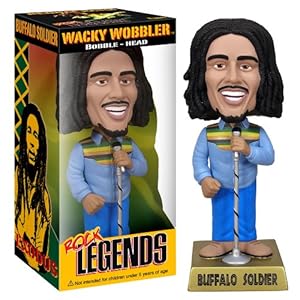
Bob Marley's family wins case over use of musician's image
One article I saw said that they wanted to keep his image from being a bobblehead doll.

Really? Bob Marley on a Bobblehead? So I Googled it and was I surprised what I found. On Amazon......

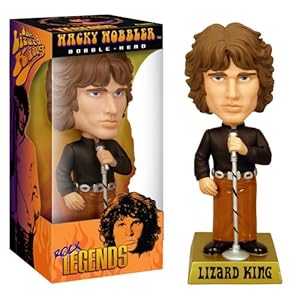
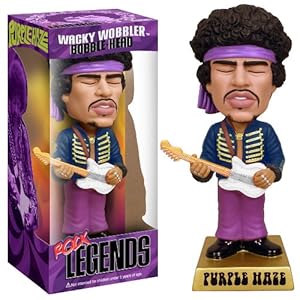
Marley is not alone in that category.


How about The Lizard King- Jim Morrison?


And Purple Haze Jimi Hendrix?


I have to admit that this particular aspect of "pop culture" took me back.  Especially the "Buffalo Soldier" aspect of the Marley bobblehead. That song is about exploitation of African-Americans and racism. Wikipedia says "the title and lyrics refer to the black U.S. cavalry regiments, known as "Buffalo Soldiers", that fought in the Indian Wars after 1866. Marley likened their fight to a fight for survival, and recasts it as a symbol of black resistance."


By the way, these bobbleheads are not for young children. Amazon posts:

WARNING:
CHOKING HAZARD -- Small parts. Not for children under 3 yrs.
Yes, and who knows, they might turn into radicals or revolutionaries or worse.

Las Vegas Review-Journal.

Sunday, November 01, 2009

You Can't Take It- But You Can Earn It

Since it is The Day of the Dead, I thought I would pass on the report from Forbes Magazine last week about the top earning dead celebrities.

Surprisingly, it is neither Michael Jackson nor Elvis.

It is Yves St. Laurent. Fashion wins out.

So does musical theater as the team of Richard Rodgers and Oscar Hammerstein is #2.

Michael Jackson is #3 with his one-time father-in-law, Elvis Presley at #4.

Then you have

  • Lord of the Rings author, J.R.R. Tolkien
  • Peanuts creator, Charles Schulz
  • Beatle John Lennon
  • Theodor Geisel, aka Dr. Seuss
  • Albert Einstein (that's a surprise) and
  • author Michael Crichton.

Tuesday, May 12, 2009

A Different Type of Culture War

The latest battle in the culture wars may just have started in Ohio...

Heritage Christian school had warned 17-year-old Tyler Frost that he would be suspended and prohibited from attending graduation if he went to the Saturday dance. The fundamentalist Baptist school in northwest Ohio forbids dancing, rock music and hand holding.
So what happened?

He went to the prom.

And the result:
Heritage principal Tim England said Frost will receive an "incomplete" on remaining assignments and will be banned from graduation ceremonies, but will receive his diploma after completing his finals.

Frost's father, Stephan Johnson, said the suspension is unfair and that he plans to sue the school.
When I became a Christian in 1963 I was a member of just such a church where these things were forbidden. But it wasn't a school so many of us still went ahead and danced and held hands anyway. It is 46 years later and the same issues are still rumbling around in the fundamentalist Baptist world.

In short, this is a culture war that has been around for a long, long time- well before even my experiences. It doesn't look like they have made much progress.