Showing posts with label Memories. Show all posts

Saturday, April 04, 2020

Buddy's War #57- At the End of March


    ▪    80th Armored Medical Battalion
    ▪    After Action Report: March 1945

Clearing Station Report

Personnel Casualties:
Killed: 0
Wounded: 1 officer, 2 enlisted men
Missing: 2 enlisted men
Reinforcements received: 1 officer, 34 enlisted men

And, as usual, what might be needed to make things better. This reflected the change that occurred in March when the 10th moved right out of Third Army territory into the Seventh Army,
~~~~~~~~~~~~~~~~~

On March 12 I posted a quote from the book Battalion Surgeon by the late Dr. William McConahey from Mayo Clinic. Captain McConahey was part of an infantry battalion surgeon medical corps from D-Day through the end of the war. I also discovered a lengthy interview from 2003 with McConahey online as part of the Library of Congress’s stories from the Veterans History Project. Here are some excerpts that helped me find out a little more about the situation Buddy was facing on a daily basis. This was life on the front lines of the war:
Well, they call you a battalion surgeon. I did no surgery, really. I was simply trying to save lives. They bring in the wounded to the Aid Station, first thing is to stop bleeding. And then give lots of morphine for pain. We used a lot of that, sometimes intravenously. And set fractures, and cleaned out the wounds, which were mess. Often they were filled full of dirt and debris and grass and torn uniforms. Cleaned them out good. Now we had no antibiotics in the days, except we had some sulfa powder. No penicillin. They had it back on base, in the hospital behind us, but we didn't have any. We'd sprinkle some sulfa in on the wound and put on a sterile dressing and pack it wide open and send them on back. We also gave tremendous amounts of blood plasma. We had no whole blood, but these were, we had cases of one bottle of sterile water packed under pressure and a bottle of blood plasma powder packed under vacuum. See, this was blood plasma with no red cells, but just dried protein part of the blood which gave the body and brought them back out of shock. They put these two bottles together with double ended needle and stuck the water bottle into the plasma bottle and in about 30 seconds you had a bottle of blood plasma. We put it intravenously and we gave that by the bucket full. We have hundreds and hundreds of those things in the Aid Station. And that would get them out of shock in a hurry and that's what saved lives time and again, was the blood plasma we had.

I had 32 men in my medical Aid Station and one officer, assistant battalion surgeon with me, another captain. Then these 32 enlisted men. Of those, 12 were company aid men. These guys lived up on the front lines with the company. [The aid men] would lie in the foxholes with the rifleman and they'd say "medic" and they'd run to the aid of the wounded and they would put on a doggone as good dressings I ever saw, lying on their bellies and the bullets going over their heads. How they did it, I don't know. Did quite a job. And then they would let us know in the Aid Station if there was some wounded up on the front line with walkie talkie radio we had. So I'd send up a litter squad, four men on a jeep, and a jeep driver, and he would take them as far as he could forward, then they would walk across the fields until they found the wounded man was. See, no helicopters then. So they'd put them on a litter, haul them back to the Aid Station and bring them back to me and we'd take care of them. So we had these twelve men on the front lines, eight litter bearers, two jeep drivers, and ten technicians to help me in the Aid Station. They would help clean wounds out, give plasma, all the rest, helped me a great deal in the Aid Station. That's what we had in our group.
Question: Now, how far were you from the actual fighting, in the Aid Station?
We'd try to find a house to get into, or a shed, or something, because you couldn't work out in the cold. … So we got as close as we could to the front lines so we weren't under actual fire. Maybe about a quarter a mile behind the front line, something like that. And then we would go to work and they would bring the wounded into us on the Aid Station there. And once they were in good shape, we put them in the ambulance and send them back to the Collecting Company, the next group behind us, which is about five miles back. And then they would look them over. If they were okay then, back to the Cleaning Company, ten miles to the rear, and that was almost a small hospital, with a couple of surgeons. They could do emergency surgery if they had to at that time.

[Note: This would explain why the location for Company C was almost always given at a distance behind the front. It is also important to remember that all of these were part of the company. I have no way of knowing at this point where Buddy was assigned. As a “surgical tech” I would guess it would have been in the Collecting or Clearing Company, but I am not sure.]

If they weren't badly wounded, they stayed in the Clearing Company for maybe a week or so, if they were back in good condition, send them back to the front. If they weren't, they would go on back then to an evacuation hospital or a field hospital, something behind maybe 30-40 miles to the rear and be taken care of there. And then, if even more badly wounded, they'd take them on back to England. And they might be there for a couple months, get them fixed up, then ship them back to the front, go back to duty. If they were badly hurt, send them on back home, sometimes, then too after that. 

[Note: Next comes the question perhaps most often asked of medics- did you carry a gun?]
Oh no.
Question: Or did your men carry guns? You had no protection, then, really.
No, we didn't carry guns because the Germans had signed what they called the Geneva Convention, in which they said they would not try to shoot at Aid people. So we all knew that and we had red crosses painted on our helmets on all the four sides. We had red crosses on our arms. Our jeeps carried red cross flags. I know that my life was saved many times by Germans not shooting at us. We didn't carry any weapons and they knew that. And often they had me in their sight, they wouldn't fire. It happened, I know, several times. I had been fired at, [?] one man took a shot at me and missed me by about four inches. That happened now and then, but usually they did not shoot at us. So we were safer to be without arms than to be carrying them.

[We] all were marked this way. Well, one time I just briefly mentioned this. I went behind lines by mistake one time. I was trying to find the Aid Station after I had gone back to check with the Collecting Company. I was coming back in the jeep and I missed a turn-off. I went back behind German lines by two miles, didn't know it. I came around a corner and down the road the German had a tank gun, pointing right at us, ready to fire the thing, the first tank or trunk that turned the corner. They didn't shoot. They saw the Red Cross flag on the jeep... they didn't shoot because we were medics... [and] all around us and the sides of us were little German soldiers digging foxholes, the guns right beside them. They looked up and wondered what was going on. Well, the driver jammed the jeep in reverse, went back up and around the corner and out of there, but they could have killed us, captured us, but they didn't, because they saw we were medical corps people.(Link)

As March ended, the 80th Medical and the 10th Armored were in the midst of their final month of combat. VE Day was less than 40 days away. Their movement over the next few weeks will get them in their final position, but also remind them of the ghastly evils that were everywhere to be found in this horrific war.


    •    Saturday, March 31, 1945
Got up at 9.30.  Went to the butcher shop. Baked. Had a letter from Buddy and Ruth. It was cool tonight.
Diary, Beula Keller Lehman

Wednesday, September 11, 2019

Buddy's War #29- The End of Peace


• August 31, 1944
Card saying Buddy was leaving. It is terrible
• September 1, 1944
Letter from Buddy and Dora. I am just sick
— Diary Entries, Beula Keller Lehman
I sit and stare at these entries and the ones to follow from late summer 1944. Over these past years of researching World War II and my Dad’s involvement, I have had some of the emotions that may have been a part of those days for my family members then. Having none of the letters they sent, and never having talked to any of them about it, all I can do is guess what it might have been like. The 75 years that have passed give the remembrances a glow that I am sure didn’t have at the time. Most images of World War II are either in black and white or that sepia tint of old pictures. Everything is frozen in time; each event is a unique moment in time. But they were connected- one flowed into the next. I have been discovering that for myself as I have gotten closer to today when peace, in whatever way Army training can be peace, was about to come to an end for the 10th Armored Division and their families at home.

• September 7, 1944
Canned pears. Sent some to Buddy. (Added later)- but he did not get them.
— Diary Entry, Beula Keller Lehman
We also live in a world that is so incredibly hyper-connected that it seems like ancient history to think about families who didn’t know what was happening to their loved ones. The Vietnam War was the first TV war. Even though it was delayed by a day or so, we could watch Walter Cronkite or Huntley and Brinkley bringing us the latest from halfway around the world. When the Iraq War started we all sat around the TV and watched the bombing of Baghdad live. Beula couldn’t do anything like that. So she just went on with her life. It was all she knew. Canning pears- and sending them to Buddy; putting money in an envelope for him to spend. Just normal and everyday behavior. Life was already disrupted. There are comments about getting ration cards or about gas rationing. Everything was uncertain and unknown. The best way to cope was to keep the feelings and fears as far below the surface as possible. To do that was to keep normal routines.

For Dora, only married four months, she celebrated her 31st birthday on September 10 as her new husband was boarding a troop carrier.

• September 8, 1944
Wrote to Buddy and sent him some money
— Diary Entry, Beula Keller Lehman
I have been surprised over these months and years of working on this story. It began as a way of honoring my Dad’s service and making some distant connection with a man I hardly knew. I discovered that many of the family stories and myths were true. At the same time, the diary entries hide as much as they reveal. I have been a pacifist for the past 50 years. I have wrestled with my interest in the war and how it was fought. I found myself intrigued as I dug into the stories. The events that were about to happen at this time 75 years ago changed my dad, I am sure. They changed who we were as a nation, first for the better, and then…?

In recent months I have also been challenged to figure out what these all mean for me. It is one thing to simply recreate a world that ceased to exist when the war ended. It is another entirely to discover what the personal impact of all this might have been - or has been - on me. How did this world-shattering war impact who and what I have become? I do not want to take anything away from the story I am attempting to recreate. It stands on its own. It is the story of Beula and her son, of my dad and my mom. It would be less than 20 years after these events that all those connections would be gone for me. All that would be left would be pictures and some words in diaries.

• September 12, 1944
Letter from Buddy and Dora. I think Buddy has left NY
— Diary Entry, Beula Keller Lehman

Wednesday, May 29, 2019

Buddy's War # 21 - The New Family


  •    May 10, 1944
A letter from Buddy and one from Dora and she sent me some pictures of Buddy. Wrote to Buddy and sent him a nice wedding present.
    •    May 13, 1944 [Day before Mother's Day]
Got a lovely pocketbook from Buddy and Dora.
    •    May 26, 1944
Letter from Dora w/picture of her and Buddy
— Diary Entries, Beula Keller Lehman
Separate letters from each of them and an obvious Mother’s Day gift from both. Over the two years he has been gone from home,Buddy appears to have been conscious of his mother and was a dutiful son with regular letters. Of course in those days it was a very common form of communication. Beula was writing letters to either Harold or Ruth at least three times per week. It cost money to make phone calls. A letter was 3 cents! (In 2019 money that is still only 43 cents! In spite of what we hear from time to time about the cost of letters, etc. They were- and remain- a very economical way to connect. ) It would appear that this has just become even more necessary than in the past. He would have been aware, I am sure, that his family is now in a state of shock over what has happened. Dora would have been just as aware from her side. Perhaps she understood the implications better than he did. Being aware of possible issues, she is no doubt trying to be a good daughter-in-law.

Beula seems to be accepting it- at least on the pages of her diary- and is  grateful. The two women will be facing some difficult separation ahead. Perhaps it was a good thing to make sure they were on good speaking terms. It is a new family for both of them.

Tuesday, May 14, 2019

Buddy's War #19 - Performing a Miracle


Before we get to the next months and the 10th being sent overseas, it is good to take a quick review of the US Army before the war began and the miracle performed in a short period. To say the strength of the US military was low would be an understatement. Politics, including isolationism, had to some extent tied the hands of President Roosevelt. Many hoped that the other European nations would take care of Hitler and Mussolini without US intervention. Roosevelt and others managed to finagle different ways of building readiness for what they felt was inevitable. It may only be through the lens of history that we can see that FDR and Churchill were correct and that Hitler’s advances were certainly one of the greatest threats to world peace and democracy that had ever been seen. It was a tightrope that they walked with finesse.

Even with that, however, in the months after Pearl Harbor, the United States was in the war but without a large and broad-based military. It was only the pre-Pearl Harbor draft which gave the foundation for what would become a huge fighting force. New armies and divisions were being created as long-range plans were developed and implemented in Washington for a war across both oceans and very far from home.


The 10th Armored Division was officially activated on July 15, 1942, at Fort Benning, Georgia. My dad’s 80th Armored Medical Battalion was an organic unit the 10th Armored- where the 10th went, the 80th went. When the 10th was created the new commander, Major General Paul Newgarden held a competition to give the unit a nickname. They took the name “The Tiger Division”. For the next year, Lester Nichols, author of the 10th Armored’s history, Impact, writes that the
training was especially rugged. There was the Tiger Camp with its night problems, forced marches, endurance tests, 'dry runs' and firing problems.
10th Armored Division, December 1942-  Fort Benning, Georgia
A division is somewhere between 10,000 and 15,000 soldiers. Fort Benning and the many training camps like it, became small cities providing more than just training. They also sought to provide entertainment, activities, sports, and more than enough “fun and games” to keep the troops occupied when they weren’t too tired from the training that Tiger Camp provided.

In late June 1943, the Division packed up and left Fort Benning for what has become known as the Tennessee Maneuvers. These maneuvers were at the heart and soul of turning the American Army into a world-class fighting force.
The Tennessee Maneuver Area was a training area in Middle Tennessee  selected because the terrain resembled France, Belgium and Germany. In June 1941, Major General George S. Patton conducted maneuvers with the 2nd Armored Division in the Manchester, Tennessee vicinity, where he soundly defeated the opposing forces, using large-scale armored fighting. These maneuvers led to the creation of the Tennessee Maneuver Area.

In June 1942, Governor Prentice Cooper, announced that nine counties would be used as a maneuver area by the Second Army, and was eventually expanded to twenty-one counties by the time of closure in 1944. Cumberland University, in Lebanon, Tennessee was the location of the Headquarters for the Army Ground Forces field problems, commonly known as the Tennessee Maneuvers. (Nashville was the principal trailhead.)

Between 1942 and 1944, in seven large scale training exercises, more than 850,000 soldiers were trained in the Tennessee Maneuver Area.

The 10 Armored was there with the 101st Airborne Division, the 80th Infantry Division and the 83rd Infantry Division through June, July, and August 1943. (--Link)
Between the wars, German officer Erwin Rommel, as a young military attache, had visited Nashville and Middle Tennessee to study and follow the cavalry campaigns of Confederate General Nathan Bedford Forrest to help him develop a pattern for the use of tank units as cavalry. This is part of what led General Patton to choose the area for his training in 1941.

Over the hills and valleys of twenty-one counties “Blue” and “Red” armies engaged in weekly strategic “problems,” with troops moved in and out according to a calendar of “phases” that lasted about four weeks apiece. In the military’s scenario Nashville was Cherbourg, without the bombing.

Maneuvers paused at noon on Thursday or Friday, when a light plane would fly over the mock battle lines, sounding a siren. Then thousands of soldiers would seek recreation in Nashville and the county seat towns. Facilities were limited, despite the best efforts of the U.S.O. and the American Red Cross; movie theaters and cafes were packed; drug store soda fountains were forced to shut down twice a day for cleanup. Each army PX was strained to the limit. Churches opened their doors and set up lounges; schools opened their gyms for weekend dances. The Grand Ole Opry had never drawn such crowds than during these months when Middle Tennessee hosted the army’s preparations for the eventual invasion of Normandy in 1944. (--Link)
According to Nichols the maneuvers themselves were

the scene of combat with chiggers, choking dust, sleepless nights, sore backs and aching feet. As always, the ‘enemy’ was constantly pursued. The battle umpires, too, were on hand to declare tank, track and truck ‘knocked out’ by a hidden ‘enemy’ anti-tank crew. (Impact!)
Other personal reports from other units indicated that the maneuvers were tough and often see as the toughest thing they ever did in the Army. Bob Wells who trained with the 100th Division through Tennessee Maneuvers wrote
In Tennessee we were as ‘in the field’ as we could be. When we slept it was in our pup tents, but each week for, as I remember, six weeks, we had problems Monday through Thursday. It was cold and wet, and I for one learned a lot about keeping myself together with no roof or facilities. (--Link)
Wells then records a poem written by and for the 35th Division vets. It begins:
The Tennessee Maneuvers
The devil was given permission one day,
to select a good place for the soldiers to play.
He looked around for a month or more wanting a place that would make them sore.

And, at last was delighted a country view
where the black walnut and the hickory grew, and vowed that Tennessee could not be beat
as a place for maneuvers in rain, snow, and sleet.

He scattered the rocks so the men could not sleep
and brought weather so cold it froze the sheep.
He then sent some rain, the bed rolls to soak
and a few cards and dice, so the men could stay broke.
And the final stanza
Now we’re on the last problem we’ve all done our part,
and at the end of this week the furloughs will start.
Then the men will go home with tall tales to tell
of the things that they did through this six weeks of hell.
— 35th Divisionaire. March 2008 Association Newsletter
The first week of September 1943 the 10th left Tennessee and settled at its new home, Camp Gordon near Augusta, Georgia. Here they would continue to train, grow and develop into a highly effective unit for the battles that lay ahead. Tiger Camp and lots of training continued.

By mid-May 1944, 75 years ago, training and planning were coming to an end. The war was waiting, and it appears as if they were ready. The US Military was working miracles and more were to come.

Saturday, May 04, 2019

Buddy's War # 18- What a Shock


    •   May 4, 1944
Buddy called at 9:45 from Georgia saying he was married on Wednesday [the previous day, May 3.] Well the shock was awful
- Diary entry, Beula Keller Lehman

It may be that the shock is simply that he married someone other than the one he had been dating for years. It may have sunk in that the “friend” grandma mentions speaking to in a phone call from Georgia 13 days earlier is now Mrs. Harold Lehman.

Here we meet Dora Moldawsky. Her parents, Sam and Anna, came to the United States from Eastern Europe, most likely the Ukraine. It was the early 1900s, probably around 1904 before the Soviet Union, but not before the pogroms. That is no doubt why they made the trip to the United States. How they entered is a piece of the myth. In those mists of childhood overhearing, I remember something about them posing as brother and sister, even though already married.  All genealogical research points to them already being married when they got here. It makes an interesting story. Legal, illegal, or semi-legal immigrants, they came through the golden door of Ellis Island in New York Harbor next to the uplifted lamp of the Statue of Liberty.

Sam and Anna had three children. Dora, the youngest, was born in 1913. I have some pictures of Sam from the 1940s- a tall, handsome man, tanned and well dressed. Anna was the typical Jewish, eastern European Bubbe, grandmother. Sometime in the late 40s or early 50s, Sam had a leg amputated. Family lore had it due to diabetes, but a cousin later discovered other possible causes.

They were observant, Orthodox Jews. They kept Kosher and Sabbath. When we visited, the strict separation of meat and milk, for example, was hard for my brother and me to understand. Mom was not observant back in the Gentile wilds of Pennsylvania, Orthodox, Conservative, or Reform. When we were in Brooklyn I don’t remember any time when anyone went to services on Friday evening or Saturday morning. It is quite likely that at least the men went, but, since Sam died when I was nine or ten, it wouldn’t have been unusual for us not to even notice what was happening.

Sometime in her late 20s, Dora did her version of running away from home. In 1940 according to that year’s census records, she was still in Brooklyn, working as a bookkeeper at a wholesale dress house. In some magical and mysterious unknown way by 1943 at age 30 she ended up in Augusta, Georgia. Different versions of the story claim she was working as a secretary or did accounting or was a club singer in Augusta. Maybe all three. What is clear is that while there she met a GI from Pennsylvania who was eight years older than she was. That adds a certain amount of rebelliousness to her character. It would take a great deal of what her family would call chutzpah for her to be on her own, in 1944, and then get married to a gentile! This was as “mixed” a marriage as any other in 1944.

Sam and Anna must have loved her, though, they did not disown her. Beula’s diaries mention Harold and Dora both going to New York to visit and then, after Buddy was deployed, Dora coming to spend time with his family in Pennsylvania. Later pictures show Sam and Anna visiting in Pennsylvania with my brother and me, their two youngest grandchildren.

What we have here is a story with a glimpse into a far-different time. We have Harold Lehman, a run-away gentile from Pennsylvania standing at the Jewish USO of Camp Gordon, Georgia, marrying Dora Moldawsky, a run-away from her Brooklyn family.

People have asked me what it was like to grow up Jewish in Gentile, Bible-belt, Pennsylvania. My immediate answer often was, “I have no idea.” My brother and I grew up culturally Gentiles. I was living in the midst of my family’s home area. As I have mentioned before we were the 7th or 8th generation from my family tree in the West Branch/Pine Creek Valley. And they were all culturally, if not actively practicing Christians. Christmas was a big holiday in our family with a tree and a midnight Christmas Eve/Day party where my brother and I were awakened. We went out to open our presents, delivered by Santa Claus, with family and Dad’s workers there.

I know there was an awareness in the community that our mother was Jewish and that therefore I was, in some way or another, Jewish. Before 1964 each school day started with a reading from the Bible, the Lord’s Prayer,* and the Pledge of Allegiance. When I became aware of such things, I noted that I was always given a passage from the Old Testament. Socially, and practically, though, I was far more Gentile than Jewish. That does not mean I wasn’t aware of “Jewishness.” It was just far more prevalent and obvious to me that I was part of a Pennsylvania native family. I have no idea how others in town felt.

Seventy-five years ago today none of this was on the table, at least in any way I can see. Knowing my family, I am sure there was a great deal of uncertainty, fear, perhaps even anger, at what Buddy had just done. I would guess they had some of the same stereotypes and prejudices, especially about New York City Jews, as were common in the day. Beula never mentioned in her diary that Buddy’s wife was Jewish. I have a hunch that, like many a mixed marriage today, the tension would have been incredible. It is May 1944 and he is only a few months away from shipping out to Europe. As if that wasn’t enough stress, they would have to get used to a new and very unfamiliar family member.

*Footnote: Many years later, living in the Midwest, I learned that in a number of places in the United States this daily Bible reading and reciting the Lord's Prayer was NOT the practice. I had a roomful of church members look at me like I was crazy and dreaming when I said that we did that each morning. The reason was simple- there were Christian groups in the community that were not allowed to pray with others, Christians or not.

Tuesday, April 23, 2019

Buddy's War # 17- A Hint of Something to Come


    •    April 21, 1944
At 6.45 in the evening Buddy called from Augusta and his friend was there and I talked to her.
- Diary entry, Beula Keller Lehman
This is the first mention in the diaries of Buddy’s friend. Did Beula know that she was more than just a “friend” and was she using the euphemism to ignore the implications? Dad was 38 years old, never married. His brother Carl, 42, the eldest, was to be married by the end of June to his very long-time girlfriend.  His sister Ruth, 40, the middle child, had been married about 10 years. Dad had a history of a long time girlfriend that I have mentioned in other posts, whose tires he reportedly slashed when angry.

For all practical purposes Buddy was a small-town boy He spent most of his life in his hometown along the banks of the West Branch of the Susquehanna River and the nearby Pine Creek in North Central Pennsylvania.

The West Branch rambles through the Allegheny Plateau, before heading east at Lock Haven. Forty or so miles later it breaks south at Muncy leaving the valley. It will join the North Branch a few miles further and form the main river to the Chesapeake Bay. The east flowing section is in a wide, fertile valley, the transition between the Appalachian Ridge and Valley Province (- Link) to the south and the Allegheny Plateau (- Link) to the north. For those 40 miles Bald Eagle Mountain (- Link) bounds the river and the valley. Powerful, tall and green, the mountain is the edge of the world from either direction.

Then there is Pine Creek (- Link). Don’t let its name fool you. One historian commented that it deserves the name river rather than creek. It can be a powerhouse of liquid- or a rock strewn stream. It runs eighty miles from its start beyond Ansonia. It flows through the Allegheny Plateau heading south having carved what is known as The Gorge or the Grand Canyon of Pennsylvania. It flows into the Susquehanna a few miles from my hometown, near the site where an ancient Elm stood for centuries until felled by Dutch Elm disease. Under that elm, the Tiadaghton Elm, on July 4, 1776, a group of illegal settlers known as the Fair Play Men signed a declaration of independence from England as the same thing was happening in Philadelphia. (- Link)

Pine Creek is the Tiadaghton- its native name. We were always told it was the largest creek in the world; the major tributary of the West Branch of the Susquehanna. Pine Creek is the wild place, the wilderness on which one’s life foundation can be built, a wilderness at the bottom of a majestic pine bounded gorge. Get your feet wet in Pine Creek, the saying went, and you will always return.

Both Dad’s parents grew up in the same area on neighboring homesteads. The town, and the whole valley from Williamsport to Lock Haven as well as up Pine Creek was filled with all kinds of distant- and not too distant relatives. Everyone knew everyone.  Nevertheless, as I said in post #2, I have little concrete information about his childhood and young adult years.

As a small-town boy, he did become familiar with the city when he went to pharmacy school in Philadelphia. But his feet had been in Pine Creek. After his graduation in 1928 he returned home to the West Branch Valley and lived with his parents in the house where he had spent much of his youth, worked at a local pharmacy that he and his father eventually purchased.

I am sure that it would not have been too much to assume that Dad was going to marry someone local.

All of this was now several years past when Beula got to talk to Buddy’s “friend” 75 years ago. When and how he met this friend is lost in family history. From information in Beula’s diary it appears that Dad was renting from a family in Augusta, about 9 miles from Camp Gordon and probably working in a hospital at least part time. Sixteen years later the family would stop in Augusta on a return trip from Florida and visit with a family who we were told was where Mom was living at the time. I can only guess that it may have been the same place. Who knows? Sometimes facts are not possible to discover.

What Beula and Bill or any of his siblings knew is pure, uneducated conjecture. Now, 75 years later we know where it was about to go.

Meanwhile,

◆ April 1944
◆ 75 Years Ago
    ◦    Adolf Eichmann and the Nazis offered the Hungarian rescue worker Joel Brand the "Blood for Goods" deal, proposing that one million Jews be allowed to leave Hungary for any Allied-occupied country except Palestine, in exchange for goods obtained outside of Hungary. The deal would never be made because the Allies believed it to be a trick and the British press slammed it as blackmail,
    ◦    A two-day meeting between Hitler and Benito Mussolini was held near Salzburg, and
    ◦    "It's Love-Love-Love" by Guy Lombardo and His Orchestra topped the Billboard singles charts.

Friday, April 19, 2019

Buddy's War # 16- Medical Training


◆ April 1944
◆ 75 Years Ago
Less than two months before the planned Allied invasion of France, American and British warplanes soften German defenses on the Normandy coast. (WW II timeline)
    Things will soon get far more hectic, surprising, and involved for my dad and his family. At this point 75 years ago it was all still in limbo. Through mid-April the only mention of Buddy this month in my grandmother’s diary was that she either received a letter from him or sent him one or a “box,” most likely of food. During this break in the action I have been researching the how and what of training for medics. I have found a number of helpful manuals and reports on the Internet. One is The Instructors’ Guide for Medical Department Mobilization, September 1942 and the other is part of the series on World War II history, this volume from 1974 on the Army Medical Department Medical Training in World War II. They give a clear picture of what the US Army Medical Department faced in the early years and how they developed the world class medical units that were indispensable. First, some background from the pre-war years as reported in the history.

    Training facilities of the U.S. Army Medical Department in 1939 reflected adaptation to peacetime medical requirements. From a World War I peak of over 340,000, the Medical Department’s strength had been reduced to a little over 11,500 officers and enlisted men by June 1939. … The five Medical Department field units that existed were either understrength or skeleton organizations; trained enlisted cadre could not have been provided in case of mobilization.
    Had the Medical Department been confronted with mobilization in the summer of 1939, the problems of creating a functioning organization capable of providing both routine health care and field medical support might have proved insurmountable. [Emphasis added.] The 2-year period that intervened provided an opportunity to adjust the program for the crisis that lay ahead. (Medical Training)

    Training that already existed was expanded slightly starting in 1939 after the start of the war in Europe when Germany’s invaded Poland. A report about the later development of replacement training centers on the website of the WW II US Medical Research Center clearly states the purpose:

The ultimate purpose of all Military Training is the assurance of Victory in war! An Army must be trained to do its job in the most effective manner if it is to reach victory with the least possible losses to the country. … Attached medical personnel and Medical Department units must be prepared to support the offensive spirit and actions of the Armed Forces. … Units must be trained to function effectively in any type of military operation. The well-trained medical unit will increase the offensive spirit by assuring combat personnel of adequate medical service at all times.

Medical personnel were therefore trained to be aggressive, resolute, and thoroughly capable…While the basis of initial training was the individual, the ultimate requirement was teamwork, from the smallest unit to the largest. (— Link)
    In order for that to happen, there was a basic program for medical personnel training. It appears that after the draft was begun in late 1940, the training looked something like this:
[E]nlisted men were to receive 13 weeks of basic training. [It] was divided into two phases: The first, a period of basic military training; and the second, a period of basic technical and tactical training. After 2 weeks of basic military training at the beginning of the cycle, the trainee was expected to be able to display and care for his uniform and equipment, to understand military courtesy, and to have acquired a fundamental knowledge of such basic military subjects as individual defense and march discipline.

The third to 13th weeks of the program were devoted to basic technical and tactical training. Training in basic military subjects continued, but after the second week of the cycle, the program stressed basic technical subjects that would prepare men either for specific duties or for further training at a medical unit or installation. During this period, men were also trained to march and execute tactical movements, to establish and operate battalion or regimental dispensaries, and to maneuver with the combat arms in the field….

Individuals qualified to be trained as technicians were selected at the end of the fourth, eighth, and 12th week of the cycle and sent to Medical Department special service schools or to enlisted technician schools for 8 to 12 weeks of technical training. (Quora)
    From other sources I have found that the Army earmarked medic candidates from the very first day they joined the Army. Sounds simple enough, but the truth of the matter is that in that time referred to as the period  of “Limited National Emergency”
Although there was extensive study and planning for the expansion of the Army Medical Department [during that period], little was actually done. …  The Army Medical Department was also handicapped by lack of funds to construct troop housing and classrooms at the training centers and to expand facilities at the technical and advanced technical training schools. The shortage of instructors at the training centers and technical schools was a chronic problem. Training equipment had to be improvised or simulated. Irregular arrivals and unscheduled transfers of trainees resulted in vast fluctuations in enrollments. (— Link)
    Looking at the 1942 Instructors’ Guide gives a decent outline of what the training was supposed to look like.

1) Basic Training- weeks one and two
The preliminary training of the individual enlisted man will be stressed. At the end of this period he should be able to wear properly, display, and care for his uniform and equipment; understand and correctly practice indoor and outdoor military courtesy; and have an applicatory knowledge of the essentials of all basic subjects prescribed in this program.
2) Technical Training- weeks 3-10
Emphasis is placed upon fundamental technical subjects which will fit him for actual practice or further training in a medical unit or installation. In addition to the technical subjects, specialist training, tactical and logistical training is begun. Fundamental technical subjects were covered such as establishment and operation of stations, collection and treatment of casualties in the field, the operation of regimental and battalion dispensaries; and the preparation for participation with the associated arms in field exercises and under combat conditions. 

3) Tactical Training- weeks 11-13
This period should be devoted largely to field and applicatory exercises. At the end of this period personnel intended for tactical medical units should be able to march and execute tactical movements with facility, establish and operate stations, collect and treat casualties in the field during day or night, operate battalion or regimental aid stations, and participate with the associated arms both in field exercises and under combat conditions.

4) Specialist Training- weeks 14-26
For a surgical technician this would include everything from nutrition and hygiene to ward management and air raid procedures. (Instructors' Manual)
    It appears that in the last quarter of 1941 the basic training portion was shortened to 11 weeks. But by then my dad would have already completed both basic and specialist training as outlined in the Manual.

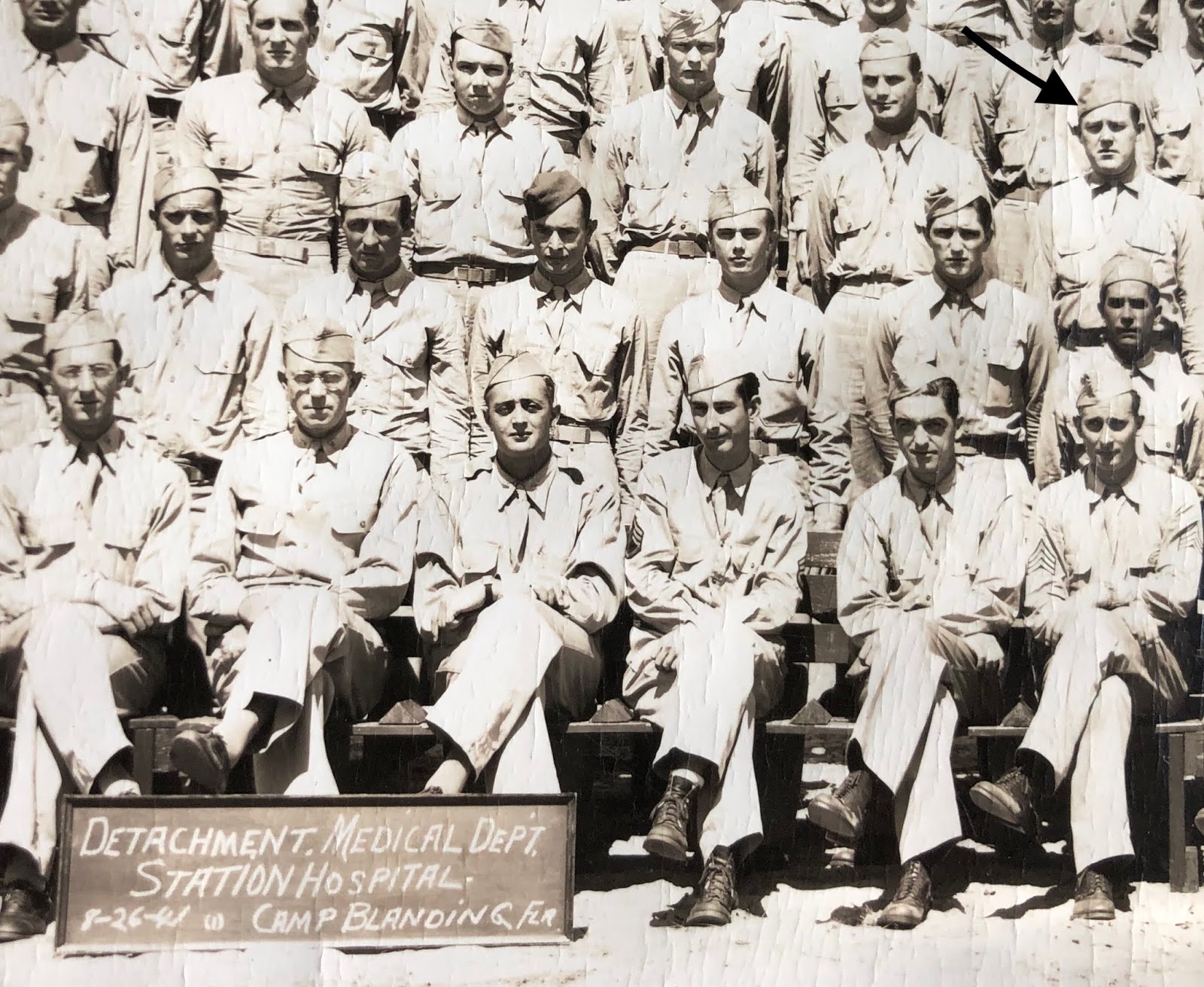
    My Dad was part of the initial mobilization in the two years of 1939-1941. As I talked about in an earlier post, he registered for the draft as required on the first day in October 1940. His enlistment date was January 13, 1941. I assume that because of his own civilian training as a pharmacist he went though both basic training and medical orientation as listed above. The one thing that supports that assumption is a picture I have of medics from the hospital at Camp Blanding, Florida in late August 1941, over seven months into his year.

Buddy in upper right corner (cropped)

As I have said elsewhere, I have no diary from my grandmother to confirm any information. So far I have hit dead ends on following him in that first period of service. If, as I assume, he was trained in his eventual specialty- surgical technician- this all would have taken him until mid-July 1941. Did he stay for further training or to develop skills? Camp Blanding is not listed as a medical training facility in anything I have found. Was he sent home early since the space was needed for increased training when the draft was extended in 1941?

    All I know for sure are the dates above, the picture from Camp Blanding, and that by January 1942 (perhaps earlier) he was home and remained at home until activated in August ’42 into the 80th Armored Medical Battalion. Now, in April 1944, he was a medic with the 10 Armored Division’s medical battalion, no doubt “enjoying” these last months before going overseas. D-Day was less than six weeks away and then everything would change.

Tuesday, April 05, 2016

What Hunter S. Thompson Missed in My Hometown

Back in January I had a post about the connection between my hometown, Jersey Shore, PA, and the original Gonzo Journalist, Hunter S. Thompson. He spent three weeks there in 1957 as a sports editor- his first job out of the Navy. To say he hated it would be an understatement, referring to them as a "nightmare people." (I was nine years old when Thompson lived a couple blocks up the street from my grandfather and worked at the newspaper office across the street from my Dad's pharmacy.) In a letter to a friend he had commented on many differences between Fort Walton, FL, and Jersey Shore, PA. One of these was:

There were innumerable bars in Fort Walton: there are two in Jersey Shore.
I am sure there were far more than two bars in my hometown in the late 1950s, especially if you counted the “hotel”, The Legion, the VFW, and the Elks and Moose clubs. Alcohol was not forbidden in Jersey Shore. It played a part in the area history as much as the Susquehanna River or the logging of Pine Creek. A local hero from the Prohibition Era was one Prince Farrington, arguably the greatest of American bootleggers. (Info from Lock Haven Express, 5/3/08)

Farrington, who died a year before Hunter S. Thompson arrived in town, was, to many, the Robin Hood of Central Pennsylvania. He purchased shoes and food for poor children, a roof for a local church and helped with mortgages for local families in danger of losing their homes. He is said to have hired every farmer within 50 miles of Williamsport to provide his supplies. He bought grain above market price, and then paid them more to store and hide the barrels. It’s said milkmen delivered jugs of Farrington’s product on their standard milk routes; most of the area’s law enforcement, regulatory and judicial staff were on his payroll. (LHE)

Originally from North Carolina he heard about the wonders of Central Pennsylvania from a fellow inmate during one of his youthful incarcerations. He was told of the clear and wonderful water in that part of the country. A perfect place to brew whiskey. It didn’t take long for Farrington and his family to move to the area. Loganton, in Clinton County, became home. His whiskey was considered better than the “big names” of the business. The story went that film star Roy Rogers once had a trainload of Farrington whiskey sent to Los Angeles for a Hollywood party, the barrel taps dipped in root beer to disguise the odor. It was so good that he continued to brew his own well into the early 1950s, long after Prohibition ended. After all, moonshine whiskey had no taxes on it.

The “last raid” on his stills came in 1946, but after posting bail he fled the state. He was eventually caught in Florida, served two years and released due to failing health. His daughter brought him back to Central Pennsylvania where he died in 1956. The family, it is reported, continued to make bootleg whiskey into the 1960s. (LHE) I guess Hunter S. Thompson didn’t hang around long enough to find them.

A few years later I could have helped. One of my teachers in high school was a relative of the Prince- and no one hid the fact. The legends of Prince Farrington, which was his real name, were never lost. It may even be that they have grown with time. His homestead is now an Inn along Main Street. In the 2008 article in the Lock Haven Express the good and bad of the story was recalled.
While Tammy Farrington [Prince’s great-niece] is proud of her family history, and the rogues that populate it, she says some of her relatives are a bit embarrassed by their association with one of the world’s most famous bootleggers.

And, she admits readily, there is a dark side to the family legend: Many of the Farrington clan developed serious drinking problems. In fact, she had her own past battles with alcohol.

But if the Prince Farrington legend lives on in the local imagination, it’s largely because of the folk hero’s genuine altruism, which kept food in the mouths and roofs over the heads of so many families.

One story that bears repeating involves his donation of $400 to replace the roof of a church in Sugar Valley. When parishioners finished the project at a cost of only $200, they tried to return the balance to Prince. He refused to take it, advising them to give the money to the church reverend.

The good reverend mulled over the offer from the millionaire bootlegger and finally decided to accept his largesse, saying, “God needs it more than Prince Farrington does.”
The Susquehanna Valley may have been too narrow for gonzo journalism, but it was a perfect place for bootlegging to thrive.

This was rural Pennsylvania in my formative years.

Monday, February 01, 2016

A 50-year Memory: Video for February

Three songs for four weeks in February 1966.
Pop and rock and sexy.

February 5 and 12 My Love - Petula Clark
February 19 Lightnin' Strikes - Lou Christie
February 26 These Boots Are Made For Walkin' - Nancy Sinatra

So let's go with Nancy....


Thursday, January 14, 2016

Before He Was Famous

Hunter S. Thompson was one of the off-beat characters of the late-20th Century. He started- and personified "Gonzo Journalism."

Gonzo journalism is a style of journalism that is written without claims of objectivity, often including the reporter as part of the story via a first-person narrative. The word "gonzo" is believed to have been first used in 1970 to describe an article by Hunter S. Thompson, who later popularized the style. It is an energetic first-person participatory writing style in which the author is a protagonist, and it draws its power from a combination of social critique and self-satire.
--Wikipedia
Over the past few years I came across some information that linked Thompson to my small, north central Pennsylvania home town. Last year when doing some research on some memoirs I discovered even more about that. Here is what I wrote at the time.

* * * * * * * * * * *
The world of the 1950s and early 1960s was, in small town America still the “old world”. The soldiers had come home, America was prosperous and lots of babies were being born. Jersey Shore, Pennsylvania, was as typical of that world as any other place. If you were looking for excitement and change, challenge and movement, this was not the place. The world of Central Pennsylvania was still as it had been for decades.

Perhaps no one expressed that better than future Gonzo journalist Hunter S. Thompson. In 1957, fresh out of the Air Force and looking to become a professional, Thompson found a job working as sports editor for the Jersey Shore Herald, a daily newspaper whose office was across the street from Lehman Pharmacy. He was 20 years old with no college degree. His resume said he had worked for the Command Courier, the newspaper of Eglin Air Force Base at Fort Walton Beach, Florida. He moved into an apartment four blocks from my grandfather’s house.

Jersey Shore, he discovered was not the (New) Jersey shore, as he had originally thought. He wrote a letter to a friend that clearly explained his no fear but a lot of loathing of Jersey Shore.
So you think Iceland is bad: ha! Let me tell you about north-central Pennsylvania.

There were three red lights in metropolitan Fort Walton: there are two in Jersey Shore, Pennsylvania. There were four laundry and dry cleaning establishments in Fort Walton: there are NONE in Jersey Shore. There were innumerable bars in Fort Walton: there are two in Jersey Shore. There were at least four good eating establishments in Fort Walton: there are but three small grills in Jersey Shore. There were women (whores, lesbians, and divorcees, if you must) in Fort Walton: the only women under forty in Jersey Shore go to high school. There were beaches and water and sand dunes and sea gulls and boats and bays in Fort Walton: there are mountains of coal dust, dirty old people, ancient wrecks of houses, and "True Confessions" magazines in Jersey Shore.

And now you're going to ask just what in the hell I'm doing in Jersey Shore, Pa. I know... and I'm ready with a quick answer I'm having a nightmare.
To say he was unhappy would be an understatement. But it’s not that he was unwelcome. On the Internet I found a scan of his press pass signed by the Chief of Police who I knew. Thompson even explains in his letter about what the people of the town thought.
These nightmare people think I’m a “nice young man” who’s come to settle in their community and make it a home. They call me “Mr. Thompson” and “sir” and insist that I attend the Lions’ Club meetings, become an Elk, and join a bowling team. They invite me to their homes for dinner and tell me that the only thing wrong with America is the fact that we’ve given all our money to foreigners.
He went on to briefly describe his work as sports editor. “Half of one entire page has to be local bowling scores – a goddamn list of people’s names…If a man really wanted to bury himself, I can think of no better place to do it than in Jersey Shore.”

Obviously the rural, small town America was not for Thompson. Staying in Jersey Shore was not an option. But the Hunter S. Thompson that Johnny Depp would one day portray on screen was at work. He left Jersey Shore after a few weeks, but only in a Hunter S. Thompson way. Here is a description from an online blog.
He had taken out a colleague’s daughter; the father was kind enough to allow the young couple access to his '49 Chevy. Sure enough Hunter got the man's prized possession stuck in the riverbed. The next day, the angry co-worker drove the car into work and Thompson said, “I knew heavy trouble was coming …I just got up, took my coat off the rack and went out the front door. Didn’t even collect my pay. Went straight to the apartment, loaded the car and drove to New York.
These “nightmare people” were, of course my relatives, neighbors and friends. “They” included me. During the time Thompson was in town the only thing I worried about was the tonsillectomy I had that November just before Thanksgiving. I want to defend my “nightmare people” but I am at a disadvantage. I knew nothing else but Jersey Shore and its seemingly ideal life. It was probably as quiet and dull as Thompson reports. At least on the surface. Later, the joke would be that the bus drivers on the intercity bus called Jersey Shore, "Jersey Whore". That or "The Peyton Place of the Susquehanna." Of that I have no personal knowledge.

Source of italicized information:
Outta the Way Blog
* * * * * * * * * * *

As always, I guess things depend on your own experiences and history.

Tuesday, December 01, 2015

A 50-year Memory: A Video for December

As November ended, The Supremes were supreme, ending a two-week run at #1:


On December 4, the Byrds landed and spent three weeks leading the charts with the Pete Seeger version of Ecclesiastes:

Saturday, September 12, 2015

Curing Boxes and Baggage

At first read, this is a heavy and complex piece of writing from artist Anne Truitt. Take a moment and ponder it.

Unless we are very, very careful, we doom each other by holding onto images of one another based on preconceptions that are in turn based on indifference to what is other than ourselves. This indifference can be, in its extreme, a form of murder and seems to me a rather common phenomenon. We claim autonomy for ourselves and forget that in so doing we can fall into the tyranny of defining other people as we would like them to be. By focusing on what we choose to acknowledge in them, we impose an insidious control on them. I notice that I have to pay careful attention in order to listen to others with an openness that allows them to be as they are, or as they think themselves to be. The shutters of my mind habitually flip open and click shut, and these little snaps form into patterns I arrange for myself. The opposite of this inattention is love, is the honoring of others in a way that grants them the grace of their own autonomy and allows mutual discovery.
--Brain Pickings
Here's the title of the piece on Brain Pickings that includes this phrase:
Compassion, Humility, and How to Cure Our Chronic Self-Righteousness
That leads me to see something very important in the passage that could easily be missed. It is about how each one of us can overcome the tendency to think more highly of ourselves than we ought to think, a tendency caused by an unwillingness to let go of the past and all the imperfect insights, self-centered interpretations, and putting other people into boxes that limit them while allowing us to be "different from" them.

Okay, that too is more complex than it has to be.

Each of us can tend to maintain our feelings about ourselves by not allowing others to grow and change. We hold on to the old ideas and keep our view of them based on the past.

Last weekend I visited a close high school friend that I haven't been with in person for nearly 45 years. While we have been friends on Facebook for several years, I am sure the images we had of each other were more than colored by our high school relationship. Most likely they were almost totally defined by that 50-year old experience.

We spent the weekend "catching up." It was a combination of reminiscing and letting each other know how we each became the people we are today over these last 50 years. By the end of the weekend the past was more truly the past. I can no longer see him through the eyes of an 18-year old looking at another 18-year old. Neither of us is the person we were then (Thanks be to God, at least as far as my life is concerned!)

Those old images that Truitt mentions above truly do doom us. They doom us to miss the great wonders of growing and changing as well as having the new experiences that keep us stuck in what we like to call "the good, old days," which they were not. They simply were.

This seems to be a time for me to make some of these old connections into new experiences. Tomorrow I will be preaching at the church I served from 1977 - 1984. I have not been there in 30 years. Many people are gone who were part of the church then. The "young people" are no longer young and their children are no longer the age of children. I will be an interesting experience to see the church and my experiences there from a new perspective.

Truitt called this other way of handling the past love. It is the opposite of the inattention that keeps stereotypes, old memories, and our own baggage from stunting our growth and relationships. We are far deeper, wider, and richer than the boxes we put ourselves and others in. I am looking forward to seeing what that means at the church and for me.

Last weekend helped set the tone for me to be able to do that.

Monday, August 03, 2015

This Week in History

Some notes of absolutely little interest, but potentially interesting?

1948- A 67-year memory:

1st - The U.S. Air Force Office of Special Investigations is founded.
3rd - Cleveland's Satchel Paige make his 1st start & goes 7 innings
3rd - FDR advisor Alger Hiss accused of being a "communist"
4th - 5 day Southern States filibuster succeeds in maintaining America's poll tax
5th - Cleveland Indians set club record for most double plays in a game (6)
6th - Bob Mathias, US, wins decathlon at London Olympics
6th - Fanny Blankers-Koen (Neth) is 1st woman to win 3 golds at Olympics
7th - Delfo Cabrera wins 11th Olympic marathon (2:34:51.6)
1965- A 50-year memory:
1st - Betsy Rawls wins LPGA Waterloo Golf Open
2nd - Morley Safer's sends 1st Vietnam report indicating we are losing
5th - Dave Marr wins PGA title
6th - 32nd NFL Chicago All-Star Game: Cleveland 24, All-Stars 16 (68,000)
6th - Beatles release "Help" album in UK
6th - Indian troops invade Pakistan
6th - US President Lyndon B. Johnson signs the Voting Rights Act prohibiting voting discrimination against minorities

Tuesday, July 14, 2015

# 6,000- In Memory of Another Pilgrim

Normally I would simply note the passing of post # 6,000 in the history of this blog which started over 12 years ago. But in the last couple weeks a fellow-pilgrim, friend, and very special person came to the end of his pilgrimage.

So I dedicate this post, number 6,000 of pilgrim wanderings for my friend, Ron, a true and dedicated pilgrim throughout his life.

We met about 45 years ago in the midst of our shared objections to the Vietnam War and our desire to help those who wanted peace. We spent the next years in our common interests. He and his wife gave me a place to learn a bit about what it means to mature and become yourself. He was almost exactly 10 years older than I was and became a role model and older brother.

We shared a common desire to grow and wrestle with our Christianity and what it means in these days to be a Christ-follower. We knew that this included standing up for what is right, caring for those who were the least and the lost, asking hard questions of ourselves, the government, and the churches. We learned and challenged each other to keep the faith and trust in the God who is the Creator.

His living room sanctuary was where I came to know another pilgrim who was soon to become my wife. We all worked together for peace as being something more than anti-war. It was a way of being and accepting, even in our human imperfections, the ways of God as the way of life.

He is also the impetus that got me into the Moravian Church and on the path that I have followed for these past 40+ years. God puts the right people in the right place at the right time. I was a young college graduate who had no idea what it meant to find his way in the world. He was present at the creation of what I have become and with his wife and mine helped me discover me.

It seems like a cliche to say that he was one of those people who is the "salt of the earth." Yet, in all the ways Jesus meant that phrase, that describes Ron. He was a "blue-collar" person who was able to relate to people on a deep and intuitive level, regardless of their place or standing. This included the gay co-worker (in 1971!), the kids at the local youth center that I directed for the city, returning Vietnam veterans- or this seminarian trying to be real.

It is appropriate that he died on July 4th. He was patriotic, again in the very best sense of the word. He wanted this country to live up to its ideals in the midst of a time when those principles were being torn to shreds, we felt, by the government itself. It will also be easy for me to remember his "Saint's Day", the day his pilgrimage found its answers and the reunion with his wife and others who have gone before us.

Rest in Peace, my dear friend. Thanks!!

An old American folk song made famous by Dave van Ronk, Bob Dylan and others speaks of my feelings these past months since I learned of his terminal situation. While it isn't about Ron, it is about all those friends who walk into our lives and will not leave us unchanged.


Sunday, June 21, 2015

Happy Father's Day

Since last Fathers Day I have been spending a lot of time with the memories of these three men.

  • I have walked into the history of the last year of World War II with my Dad and the 80th Medical Battalion/10th Armored Division in the Battle of the Bulge and the Race to the Rhine.
  • I have spent hours examining the world of Central Pennsylvania and the Susquehanna Valley that was my Grandfather Lehman's environment.
  • I have pored over census data and dug into the world of the new immigrants from Russia in the early 1900s that was my Grandfather Moldawsky's experience.

In doing so I have deepened my understanding and appreciation for all three of them.

Thanks!!!


Monday, May 18, 2015

It's Not Supposed to Change

I drove through my hometown today. It's been about six years since I last was there and this was just a passing through. We didn't have time this trip to stop and visit like we prefer doing. Over the past year or so I have been working on a memoir that, naturally, features my hometown. That means that I have spent a lot of time there - in my head and memory.

Imagine my shock today when the real town was there. The town that does not look like it did in 1965 (and earlier); the town that has been through changes and disasters as well as boom and bust. I drove down the street beside my childhood home. It's not the same. It was, as I remember it, a tree-lined street all the way down the next two blocks. Today there are none of those trees. All gone. "My" backyard is now not visible from the street as tall, narrow trees block the view and it looks like a fence was there. The building that was once a high school and then my junior high, looks a little worse for wear although it is now a shopping center.

The streets seemed smaller. The yards more compact. The neighborhoods closer together. There were newer homes next to older ones. There were falling down older homes and others that were well-kept. New businesses exist and some of the older ones are still there. What had been my Dad's store is gone, replaced in town by the big chain store.

No, it is not the place that was my hometown. That place was left behind a long, long time ago. At first I felt sad. But then I realized that even more recent places and memories exist only in the past. We can learn from them, build on them, but we cannot live there.

The town that was my hometown is now someone else's hometown. Over 45 years of high school students have gone through, including the children of family and friends. I am not part of that town and have not been for over 30 years.

That's okay! It was what it was, and for that I am grateful.

Thursday, April 23, 2015

Friday, November 28, 2014

I Would Agree

This came across NPR the other day:

Language Heard During Infancy, Then Lost, Leaves ‘Ghost’ Imprint on the Brain

MRI scans revealed that the adoptees showed the same brain activity as native speakers, despite no longer being able to understand and speak anything in the language.
Anecdotally I would agree in some minor way. I grew up in North Central Pennsylvania with a mother from Brooklyn who spoke Yiddish quite fluently, as did her family. I remember hearing a story that she didn't know English when she started school, although I am not sure that would be the case since she was the youngest of three children who, by the time she went to elementary school would have already been in 3rd and 4th grades.

In any case I know my mother and her family were fluent and, when we went to Brooklyn for visits, the language was freely used. I never was taught it or even given any hints about what any of the words meant. I have a hunch that this gave them the leg up on these two young kids with big ears. I do remember the phrasing and style of the words with that unique Brooklyn/Jewish lilt to it. I can still fall into that dialect quite easily. It is almost natural. That's the first bit of anecdotal evidence.

My mom died not long after I turned 13 and contact with the Brooklyn side of the family was lost. No more Yiddish.

When I was in high school I took German, which, as you may know is quite similar to Yiddish- Yiddish being a Germanic language of Eastern Europe that utilizes Hebrew letters. I did okay but never really studied like I should when I got to college. No anecdote here.

But somewhere around 10 years ago I was surfing around the Internet and came across a site that had some talks given by a Hasidic Rabbi in Yiddish. Just for the fun of it I clicked on it knowing I wouldn't know what he was saying, I just wondered. Hence, anecdote 2.

Well, it was clear it wasn't German, but I could have heard it anywhere and would have known it was Yiddish. No mistake. It had the accents and feel of the Yiddish that is buried somewhere in my most early memories. I have a hunch that my brain cells would have been lighting up like a Christmas tree (or Hanukkah candles, might be more appropriate!)

I know this doesn't prove anything. But it was such a deep moment transporting me back over five and a half decades to a time and place long gone.

The human brain is a truly remarkable organ. 

Sunday, October 05, 2014

Reading Diaries

As part of some of the writing I have been doing, my research (real research) has included reading my grandmother's diaries that I have available. I never knew my father's mother since she died about 7 months before I was born. Her diaries don't give me much information about her. In fact, most days what she has to say is quite normal. She usually writes about what time she got up, who she might have visited, who she wrote a letter to or who sent her one. Very seldom does the entry exceed three sentences. She is so good and short comments that she used the same book for 1944 and 1945.

But the years that I have diaries for are significant years: 1940, 1942, 1943, 1944, 1945.

World War II.

My dad was in that war. He went to training in Georgia where he met and married my mother, spent a year in Europe, was involved in the Battle of the Bulge and came home with his "war bride." Bits and pieces of family history as well as the world of the 1940s are there. In all those years she and others often went to "the show," which is the movies, of course. Only one is mentioned by name: Gone With the Wind. She talks about every family member going to see it and whether they liked it. (They all did.) Once in a while she comments about listening to FDR or baseball or football games on the radio. She mentions going to "the schoolhouse" to get her ration books along with the comings and goings of different family members.

The first time I read through these it was with a kind of detached interest. Then her words began to transport me back those 70+ years in a house that I knew intimately- it was my grandfather's house that had been in the family for around 60 years when my brother and I sold it in the early 70s. I know what the view is from the front window and what what the rooms contained. One of them was mine when I was home from college.

Then I could begin to sense the emotions in these brief comments. She was often lonesome and feeling poorly. At first it sounds like she is a sickly person, unable to do much. Then you read more closely- she is taking care of things. She does cooking and baking, painting and wallpapering. She goes downtown (about 8 blocks) and works in the yard. She visits friends to play cards, plays bingo and notes how many games she won, goes to the "democrat meeting" and "the club."

I realized that she was, as she said, lonesome, but she was not helpless. She was clearly a strong and independent woman. She had little choice at that point. Her husband, my grandfather, one year younger than her, was still working on the railroad and often away from home. He was in his mid- to late 60s, just like her. None of her three children were home most of the 40s and she was sick, although I haven't been able to find out what her issues were.

I can imagine her wandering around that big house on Allegheny St., keeping busy, wondering what was happening to her much-loved children. She was constantly writing letters and getting them. I have a hunch she probably also sat there by the big front window watching the people who walked by, knowing most, if not all of them, by name.

This is a whole new set of eyes for me to be seeing. I think I understand her daughter, my aunt who became my brother's and my guardian when our parents became ill and then died. And, perhaps if I can look a little more deeply, I will probably see more about myself as well.

As we get further into this year we will be having the 70th anniversary of the Battle of the Bulge of WW II. I am reading about it and trying to decipher what it might have been like for my dad, a medic, to be in that horrific time. Putting this all together is exciting for one who never knew my parents as an adult. As I reach my late 60s, well past the age either of my parents, these are interesting things to be learning.

Tuesday, September 16, 2014

For Fun- and Memories

This is, of course, a song from a very long time ago-- 1972, to be exact. Surfing around on You Tube the other evening I came across this video for the song. I don't remember seeing this video before (remember- I'm from a long time ago, too). Any way, even though we know that the song is an endless quoting of references to other songs in the 1959-1970 era, I like the way this video interprets it visually. Enjoy.


The "day the music died" is, of course, Feb.3, 1959, when Buddy Holly, Richie Valens and the Big Bopper were killed in Iowa in a plane crash. Here is a video that explains the verbal imagery of this classic song.