Showing posts with label World War 2. Show all posts

Wednesday, February 12, 2020

Buddy's War #47- The Hardest Job?


In a hard war theirs may have been the hardest job of all. But together with Army doctors and Army nurses, [the medics] worked something very close to a miracle in the European theater.
— Stephen Ambrose

Stephen Ambrose in his book, Citizen Soldiers gives a whole chapter to the medical corps, "Medics, Nurses, and Doctors" Buddy was a surgical tech, which I assume meant he was not at the front but behind it in the field surgical hospitals, the forerunners of the M.A.S.H units. Overall, though, the work of all the medics was almost that of miracle workers. Here are some of the reflections from Ambrose.
It wasn’t any different getting killed in World War II than in the Civil War, but if the shrapnel, bullet, or tree limb wounded a GI without killing him, his experience as a casualty was infinitely better. The medical team, from the medics in the field to the nurses and doctors in the tent-city hospitals, compiled a remarkable record. More than 8 percent of the soldiers who underwent emergency operations in a mobile field or evacuation hospital survived. Fewer than 4 percent of all patients admitted to a field hospital died. In the Civil War, it had been more like 50 percent.

Wonder drugs and advanced surgical techniques made the improvements possible, but it was people who had to get the wounded into a hospital before it was too late for the nurses and the drugs and surgeons to do their work. Those people were the medics. (P. 311)

At least to some degree, there were soldiers assigned to the medical units because of a desire to be non-combatants, often “conscientious objectors,” usually for religious reasons. While this was obviously not a common occurrence since the Army had clearly recruited for the medical corps, it still had an impact on some of the impressions of the troops concerning the medics. While Buddy was not, to the best of my awareness, not a conscientious objector, he may have had to face some of this prior to the war. As a trained pharmacist, though not doing that work, he no doubt was assigned to the medical corps for his training. Ambrose addresses this.
The medics had gone through the same training as any infantryman, except for weapons. In training camp, they had been segregated into their own barracks and kept away from the men they were learning to save, apparently for fear of contaminating the real soldiers. The rifle-carrying enlisted men and the medics developed little mutual camaraderie. One lieutenant confessed that he and his platoon “mildly despised” the men of the Medical Corps for being conscientious objectors. Their mere presence cast a moral shadow over what the infantrymen were training to do. The nascent medics were ridiculed, called such names as Pill Pusher, and the tourniquets and bandages they put on imagined wounds in field exercises were joked about. So was their only real work, treating blisters and the like.

But once in combat they were loved. “Overseas,” the medic Buddy Gianelloni recalled, “it became different. They called you Medic, and before you know it, it was Doc. I was nineteen at the time.”

On countless occasions when I have asked a veteran during an interview if he remembered any medics, the old man would say something like “Bravest man I ever saw. Let me tell you about him.. . .” (P. 312)
 Something I had not known was mentioned by Ambrose. As non-combatants, there were certain limitations beyond not carrying any firearms.
To preserve their non-combatant status under the Geneva Convention, the War Department did not give any medics combat pay (ten dollars extra a month) or the right to wear the Combat Infantryman Badge. This was bitterly resented. In some divisions, riflemen collected money from their own pay to give their medics the combat bonus. As for their right to wear the badge, five enlisted medics in the European Theater of Operations (ETO) were awarded the Medal of Honor, and hundreds won Silver or Bronze Stars. (P. 313)
 Overall it seems very clear that the army was bound and determined to keep their GIs alive, even if they weren’t going back to battle.
The remarkable rate of recovery for wounded GIs was based on mass production assembly-line practices. How well it worked, from the medic to the aid station to the field hospital to England, can be judged by the reaction of the men of the front line, who were almost certain to get caught up in the process, with their lives depending on it. As one lieutenant put it, “We were convinced the Army had a regulation against dying in an aid station.” (P. 321)
While Ambrose is referring to the doctors at the end of the chapter, I would guess that the attitude, training, and support of the other medical personnel were as critical to the mental health “treatment” on and near the front lines.
The doctors had to be shrinks as well as surgeons. Some of the patients— as many as 25 percent when the fighting was heavy—were uninjured physically but were babbling, crying, shaking, or stunned, unable to hear or talk. These were the combat exhaustion casualties. It was the doctors’ job to get as many as possible back to normal—and back to the lines—as soon as possible.

In the field hospitals, the American doctors treated the men as temporarily disabled soldiers rather than mental patients, normally categorizing them with the diagnosis “exhaustion.” For the sake of both prevention and cure, the doctors tried to treat such patients as close to the line as possible. Typically the doctors at battalion level kept the exhaustion cases at their aid stations for twenty-four hours of rest, often under sedation. The men got hot food and a change of clothing. For as many as three-quarters of the cases, that was sufficient, and the soldier went back to his foxhole.

Good company commanders already knew that to be the case. Captain Winters of the 101st commented that he learned during the Bulge “the miracle that would occur with a man about to crack if you could just get him out of his fox hole and back to the CP [command post] for a few hours. Hot food, hot drink, a chance to warm up—that’s what he needed to keep going.”

Men who needed more than a quick visit to the CP or battalion aid station were sent back to division medical facilities, where the division psychiatrist operated an “exhaustion center” that could hold patients for three days of treatment. The bulk of these men also returned to the line. Those who had not recovered went on to the neuropsychiatric wards of general hospitals for seven days of therapy and reconditioning. The extreme cases were air-evacuated to the States.

The system worked. Ninety of every hundred men diagnosed as exhaustion cases in the ETO were restored to some form of duty—usually on the line. As they had done with the men wounded by bullets and shrapnel, so the medics, nurses, and docs did for the exhausted casualties: under the worst possible circumstances, superb medical care. (pp. 329-330)
All quotes from-
"Medics, Nurses, and Doctors." Citizen Soldiers by Stephen Ambrose (also online at American Heritage as Medic!)

Tuesday, December 03, 2019

Buddy's War #39- End of the First Month


After Action Report
80th Armored Medical Battalion
10th Armored Division
1 Nov – 30 Nov 1944


There were 33 officers and 364 enlisted men. During the month one of the battalion was killed and five wounded. Five replacements were assigned. [Note: The member of the battalion who was killed was not in Company C. No death is noted in the company's morning reports.]

At all three clearing stations of the battalion in November 1944 there were:
    •    1962 admissions
    •    319 were returned to duty
    •    7 died in the stations
    •    1581 were transferred and
    •    55 remained in station on 30 Nov

The battalion commander had the following recommendations:
a. In some operations dissemination of information in regard to the tactical employment of the combat units did not reach this headquarters. Direct distribution of field orders and G-3 reports to the medical battalion would aid in the future employment of the supporting medical companies.

b. That all medical companies be employed in each action. ­ There is no useful purpose served by holding one entire company in reserve.

Fredrick D. Loomis
Captain, MAC.,
Battalion S-3

Looking at the daily admissions shows when the battalion's companies engaged in the heaviest battles. Again, from the 21st to the 29th, Company C was near the front.

Buddy and Company C were now back attached to the Reserve Combat Command (CC R). Located at Sierck-les-Bains, they were less than two miles from Division HQ at Apach and still only 12 or so miles west of the front!


Filling in some of the background on the medical battalions and companies:

The Army Medical Department's history describes Collecting Companies as:
...the forward echelon of the Division Medical Service. They were the connecting links in the chain of evacuation between Aid Stations and Division Clearing Stations. Their mission was to:

1) Remove evacuees from Infantry Regiment Aid Stations to Collecting Stations,
2) Prepare evacuees at the Collecting Stations for further evacuation, and
3) Transport evacuees by Ambulance from Collecting Stations to Division Clearing Stations.

Again, from the Army history:

The main task of the Clearing Company was to make decisions about what the next stage of treatment might be. This included such aspects as triage, sorting of casualties according to the nature and severity of their injuries, treatment- administering appropriate treatment to save lives, reduce suffering, and prevent permanent disability and determining which of the slightly wounded casualties could return to duty with their units.

(1) The medical detachment of the tank battalion moves in close support behind the tank companies, and directs its principal efforts at emergency treatment, either in vehicles or on the battlefield….

(3) [The] clearing stations reflect the characteristic high mobility of armor; they are organized and equipped with extremely mobile surgical trucks, and are capable of treating casualties in a short time after movement has ceased.
(pp. 1,2)
---------------
According to the manual for Armored Medical Battalions, they were in three parts:
(1) Division surgeon’s office. [Connected to the 10th Armored Division HQ]
(2) Medical detachments- provide first echelon medical service. [That is, they were at the front, near the battle.]
(3) Armored medical battalion- provides second echelon medical service. [They were behind the front lines, but, as can be see above, still well within battle distance. The greatest range of German artillery was about 18 miles, but they were often hampered by logistics and lack of ammunition.]
The manual continues with more specifics for the battalions:
Standing Operating Procedure
The armored division operates tactically in two or more combat commands… formed for a particular operation. Normally an armored medical company is included in each of the two combat commands and a part or all of the Third Company in the reserve command.

Medical units follow procedures best suited for the medical support of their individual unit. During combat, because of rapidly changing tactical situations, it may be found impractical to follow a predetermined plan. The employment of the medical detachments and the medical battalion is kept flexible and within control so that unforeseen tactical developments may be dealt with promptly.
(pp. 4-6)
A footnote to this history: What we are seeing in the development of this medical organization are the precursors of MASH units. (Wikipedia)
---------------------

Other unforeseen- or unplanned for issues always arose.
The most glaring example in these early months of the 80th Medical Battalion- and most of the medical groups in the area had nothing to do with battle.

It was trench foot.

Poor planning and a sense that the war might not last all that long now that the Allies were fully engaged led to one of the most surprising, unexpected medical concerns- trench foot. By all accounts, the fall-winter of 1944-45 was the coldest and wettest in years. Trench foot did as much damage to the Allies as the enemy due to its duration of disability and its tendency to recur. Inadequate winter supplies only added to the crisis. During November and December 1944 the total number of cases of cold injury on the Western Front was more than 23,000. This was the size of one and a half infantry divisions.

Gen. Omar Bradley Commanding General of the 12 Army Group wrote that this had seriously crippled the United States fighting strength in Europe. Medical officers estimated to Bradley that the majority who were evacuated from the front lines would never return to combat. At times this would reach as such as 38% of all hospital admissions to the 6 hospitals in the Paris area!  This obviously added to the burden at collecting companies like Company C and the 80 Medical Battalion! (Medical Department of the United States Army in World War II)


Saturday, November 02, 2019

Buddy's War #35- Entering the Battle


    ◆    75 Years Ago
    ◆    2 November 1944
The 10th Armored Division officially joined the front line forces.

The 10th Armored and attached troops have now been on the Cotentin Peninsula for a month. They have trained, planned, waited, and watched the weather. The troops were no less frustrated than Patton himself was. They were in Europe, but not yet in the war.

As October ended it became time to move.

The 80th Armored Medical Battalion, Company C, consisted of 18 officers and 104 enlisted men.

    ✓    Company C Morning Reports- Record of Events
    ✓    26 October- Departed bivouac area 2.1 mi NW of Quettehou [at] 0405. Traveled 127.2 mi via motor convoy to bivouac 1 mi east of Falaise arrived 1715. (MR)
[13 hours travel. 9.8 mph]
    ✓    27 October- Convoy left bivouac area 1 mi east Falaise [at] 0905. Traveled 74.7 mi to bivouac area 1/2 mi east of Damville. Closed bivouac 1830 (MR)
[9 1/2 hours travel. 7.9 mph]
      • Charles M. Province in the book Patton’s Third Army, reports that During this week the “10th Armored continued to move toward the XX Corps assembly area."
    ✓    28 October- Departed area 1/2 mi east of Damville at 0906. Motor convoy arrived at bivouac sire 1/2 mi west of Claye Souilly at 1725. Traveled 83.4 mi  (MR)
[8 1/2 hours travel. 9.9 mph. Co.C most likely passed around or through Paris on this day.]
    ✓    29 October- Departed area 1/2 mi west of Claye Souilly at 0907. Motor convoyed 69.2 mi to bivouac 1 1/2 mi east of Bar Le Duc. Closed bivouac 1632. (MR)
[7 1/2 hours travel. 9.2 mph]
    ✓    30 October- Left Bivouac vicinity of Ba Le Duc 0907. Traveled via motor convoy 98 mi. Billeted company in village of Lachaussee.  Arrived 1700. (MR)
[8 hours travel. 12.3 mph]
They have traveled 452 miles in 5 days, on the road for 46.5 hrs, with an average speed of 9.7 mph. Today that trip could be made in 8 1/2 hours (with tolls).

    ✓    31 October- Set up clearing station and evacuated patients. (MR)
They were assigned to the Reserve Combat Command (CC R) and were located 8 miles south of the 10th's Division HQ at Mars Le Tour and about 20 miles southwest of the fortress city of Metz where they would soon be engaged in their first battle.

They were bivouacked in an area that was unfortunately too small for movement. Then it rained and rained  providing a very muddy, but relatively quiet few days. Nichols in Impact says that it was perhaps the worst bivouac area of war for them. Their purpose was to assist XX Corps in the containment of enemy troops in preparation for the attack on Metz. They were to move around behind the forts and cut off the retreating enemy.


The 10th was to fall into line, one-by-one behind the 90th Infantry then move through providing support and cover. From all that was reported, it was not particularly  good geography (or weather) for the tanks, but the 10th managed and found its place.


This was part of what Province in Patton's Third Army says was the continuing practice of rotating and regrouping Third Army units in contact with the Germans. It had two purposes. One was to give as much rest as possible to those troops in extended contact with the Germans for the greatest amount of time. The other was to keep the enemy guessing as to the plans of the Third Army.

When November and time for the battle around Metz came, the XX Corps (part of the Third Army) under General Walton H. Walker had a total of 30 infantry battalions, 500 tanks, and more than 700 guns. Their  plan had two phases. One was to destroy all German forces around Metz and then to switch the advance to the northeast to catch the enemy as they pulled out of Metz.


On November 2, 1944, the 10th was pulled into place and had their first awareness of combat. It was a generally quiet area and not much else was to happen for the next two weeks, but the enemy had been engaged for the first time.

War was now a reality.


Wednesday, October 02, 2019

Buddy's War #32- Battalion Preparations


    •    October 2, 1944
1st Letter from Buddy. He arrived in France all OK. Said he had a nice trip going over. Dora called and said she received a letter also
— Diary entry, Beula Keller Lehman
In general, as applied to infantry units,
The Medical Battalion was a Divisional medical unit developed to furnish medical support for the Infantry Division. Its primary mission was to organize and conduct the necessary evacuation and medical care for casualties of the Division. Because of the high mobility of the Division, the installations of the Medical Battalion had to be of a more temporary nature and possess increased readiness and ability to maintain contact with the different units of the Division. The Medical Battalion was thus charged with the evacuation of ALL casualties from the Infantry Battalion and Regimental Aid Stations. If for any reason, casualties could not be gathered at the Aid Stations, the Collecting Companies would remove casualties directly from the field.
 The Medical Battalion was organized as a kind of ‘miniature’ medical organization in order to maintain the best operative coordination of all the existing facilities and to give flexibility to a possible expansion of the medical service when necessary. It always accompanied the Division in the field! (Link)
 Armored medical battalions were training slightly differently in light of armored movements being different from infantry. They also looked at other special issues, such as extricating the wounded from tanks! There was a unique field manual for the armored medical battalions. The schematic shows the idealized view of how they were to be set up.

(P. 2; Armored Med Units Field Manual 1944)

Like the infantry battalions, the armored battalions needed to be ready to move at quick notice. The Armored Medical Units Field Manual, 1944 has specifics about how and what to do in advancing or “retrograde” movements.  It also gives these details about the general organization of the companies of the medical battalions:

  The armored medical battalion is a flexible, highly mobile unit capable of accompanying combat elements of the armored division. It is composed of a headquarters and headquarters company and three identical medical companies.

21. FUNDAMENTALS OF EMPLOYMENT, a. The medical battalion provides second echelon medical service by the collection, treatment, clearing, and evacuation of the sick and wounded of the division. It is self-contained administratively and technically, having its own maintenance, administrative, and supply organization.

b. Flexibility of the medical battalion is always maintained. The battalion is organized to be responsive to any demand made upon it for reinforcement or support. It can function as a unit, or its several major components may be broken down into lesser elements to support tactical groupings. In combat, usually one medical company supports each combat command. (p. 25)
 Undoubtedly they had received a great deal of training on this in the States prior to leaving. Here they bivouacked and most likely learned the ins and outs. It had to become second nature, I am sure, to be able to do what was needed in difficult and dangerous circumstances. This was all preparation time. After they had set up the bivouac in the rain on 23 September, the morning reports through 25 October simply say:

✓    24 September 1944- 25 October
  ✓    Company C Morning Report
Field duties at bivouac site. (MR)

Meanwhile, since the 10th/80th had arrived in the European theater:

    ◆    75 Years Ago
    ◆    25 September 1944
Operation Market Garden ended. It had begun on 17 September when Allied paratroopers landed in the Netherlands and Germany. They did not cross the Rhine and ended with an Allied defeat.

    ◆    27 September 1944
The Battle of Metz began. It would stall and then not be finished until Patton, the Third Army, and the 10th Armored joined later in the fall.

A piece of family “lore” comes to mind as I work on these early days in Europe. My aunt, Buddy’s sister, Ruth, told me a number of times that the family believed that when he went overseas he was actually too old for the deployment into battle. In October 1944 he was actually about a month shy of 39 years old. It is important to also remember that Buddy had lied about his age when he first enlisted in 1940, saying he was a year younger than he was. As far as the army was concerned, as he bivouacked in France he was not even 38 yet. I was told that Dora and the family tried in vain through letter writing to get him discharged prior to his deployment. They were told by one of his superiors, however, that he wasn’t going to let a medic as good as Buddy be discharged.

Whether he was too old, should have been there or not, Europe was where he was- a medical corpsman with Patton’s Third Army and the 10th Armored Division about to be part of the last seven months of the war in Europe. In pictures that I have of that era, he almost stands out like someone who shouldn’t be there. He is clearly older than most of the guys around him. He is an elder among his band of brothers.

Wednesday, September 11, 2019

Buddy's War #29- The End of Peace


• August 31, 1944
Card saying Buddy was leaving. It is terrible
• September 1, 1944
Letter from Buddy and Dora. I am just sick
— Diary Entries, Beula Keller Lehman
I sit and stare at these entries and the ones to follow from late summer 1944. Over these past years of researching World War II and my Dad’s involvement, I have had some of the emotions that may have been a part of those days for my family members then. Having none of the letters they sent, and never having talked to any of them about it, all I can do is guess what it might have been like. The 75 years that have passed give the remembrances a glow that I am sure didn’t have at the time. Most images of World War II are either in black and white or that sepia tint of old pictures. Everything is frozen in time; each event is a unique moment in time. But they were connected- one flowed into the next. I have been discovering that for myself as I have gotten closer to today when peace, in whatever way Army training can be peace, was about to come to an end for the 10th Armored Division and their families at home.

• September 7, 1944
Canned pears. Sent some to Buddy. (Added later)- but he did not get them.
— Diary Entry, Beula Keller Lehman
We also live in a world that is so incredibly hyper-connected that it seems like ancient history to think about families who didn’t know what was happening to their loved ones. The Vietnam War was the first TV war. Even though it was delayed by a day or so, we could watch Walter Cronkite or Huntley and Brinkley bringing us the latest from halfway around the world. When the Iraq War started we all sat around the TV and watched the bombing of Baghdad live. Beula couldn’t do anything like that. So she just went on with her life. It was all she knew. Canning pears- and sending them to Buddy; putting money in an envelope for him to spend. Just normal and everyday behavior. Life was already disrupted. There are comments about getting ration cards or about gas rationing. Everything was uncertain and unknown. The best way to cope was to keep the feelings and fears as far below the surface as possible. To do that was to keep normal routines.

For Dora, only married four months, she celebrated her 31st birthday on September 10 as her new husband was boarding a troop carrier.

• September 8, 1944
Wrote to Buddy and sent him some money
— Diary Entry, Beula Keller Lehman
I have been surprised over these months and years of working on this story. It began as a way of honoring my Dad’s service and making some distant connection with a man I hardly knew. I discovered that many of the family stories and myths were true. At the same time, the diary entries hide as much as they reveal. I have been a pacifist for the past 50 years. I have wrestled with my interest in the war and how it was fought. I found myself intrigued as I dug into the stories. The events that were about to happen at this time 75 years ago changed my dad, I am sure. They changed who we were as a nation, first for the better, and then…?

In recent months I have also been challenged to figure out what these all mean for me. It is one thing to simply recreate a world that ceased to exist when the war ended. It is another entirely to discover what the personal impact of all this might have been - or has been - on me. How did this world-shattering war impact who and what I have become? I do not want to take anything away from the story I am attempting to recreate. It stands on its own. It is the story of Beula and her son, of my dad and my mom. It would be less than 20 years after these events that all those connections would be gone for me. All that would be left would be pictures and some words in diaries.

• September 12, 1944
Letter from Buddy and Dora. I think Buddy has left NY
— Diary Entry, Beula Keller Lehman

Sunday, September 01, 2019

Buddy's War #28- Arrival at Camp Shanks


    ◆    75 Years Ago
    ◆    1 September 1944
Arrived Camp Shanks, NY, 1430 via rail from Camp Gordon, GA for permanent change… Distance traveled 384 miles. Discipline excellent. (MR)
~~~~~~~~~~~~~~~~~~~~~
Through the next year there will be many references and quotes from the daily Morning Report of Company C, 80th Armored Medical Battalion, Buddy’s unit. The screenshot here is from two days ahead in October. The top locates the company and then lists any changes in personnel followed occasionally by a record of some events. The bottom section is an accounting of numbers of personnel in each of the categories, officers first, then enlisted men. Different units had slightly different styles of morning report forms, though they were all for the same general purpose.

Jennifer Holik at the WWII Research & Writing Center has a couple of good articles explaining both their use in the military during World War II and their value for researchers.
Company Morning Reports
A Morning Report was created each day outlining events of the prior day for the events of a Company. …Morning
Reports listed many details about the company which include:
    ◆    The location of the company for the date of the report.
    ◆    Strength of the unit in numbers of men
    ◆    Details of those entering and leaving the company
    ◆    Names of those declared AWOL, Missing In Action, Killed In Action, or wounded.
    ◆    The reports also provided information on the day’s events. Some clerks reported weather conditions, in addition to the usual information on where the unit was fighting, and other enemy encounters.

The companies were required to report numbers of men at each meal, which provided information to the Army, who then was able to provide food and appropriate supplies for the soldiers. These numbers also alerted headquarters when the ranks were depleted and replacements were needed. (-Link)

I have been able to obtain the Morning Reports for Co. C for the entire time in Europe beginning with today, 1 September 1944. They have given me invaluable information on where my Dad’s company was every day and, when appropriate, a record of events. Whenever I use one of the reports I will note it with (MR).

Wednesday, August 21, 2019

Buddy's War #27- Almost Ready


    ◆    75 Years Ago
    ◆    6 June - 21 August 1944
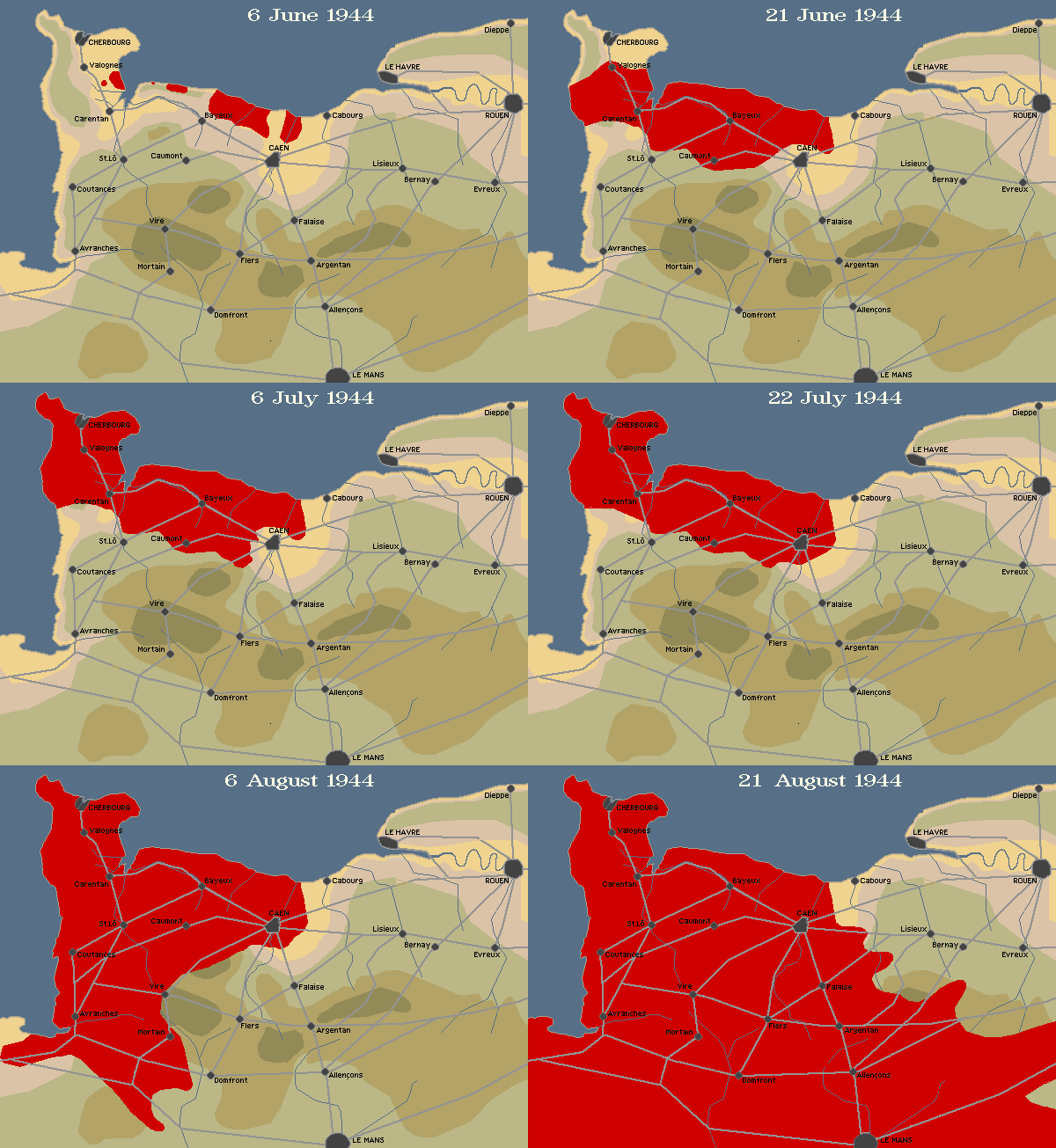
D-Day to D-Day+76: Allies moving south and east across France after D-Day.
The Normandy landings were the first successful opposed landings across the English Channel in over eight centuries. They were costly in terms of men, but the defeat inflicted on the Germans was one of the largest of the war. Strategically, the campaign led to the loss of the German position in most of France and the secure establishment of a new major front. In larger context the Normandy landings helped the Soviets on the Eastern Front, who were facing the bulk of the German forces and, to a certain extent, contributed to the shortening of the conflict there. (-Link)

It was not a smooth and easy invasion. In fact, through the month of June and most of July, the Allies made very little progress. They needed a breakthrough- a breakout from the Normandy peninsula and get moving across France. It came from July 25-31 in Operation Cobra.

Operation Cobra was the codename for an offensive launched by the First United States Army (Lieutenant General Omar Bradley) seven weeks after the D-Day landings, during the Normandy Campaign of World War II. The intention was to… break through the German defenses that were penning in his troops… (-Link)

As seems to be the story of the invasion and much of what would happen over the next months, the operation was delayed at first- by the weather. When it did begin on 25 July, it proved as decisive as Bradley and the Allies hoped. Within the next few days, the Allied forces managed what has since been referred to as their “breakout. “

The immediate aftermath was the ability to expand the forces and put further plans into action.
At noon on 1 August, the U.S. Third Army was activated under the command of Lieutenant General George S. Patton. Lieutenant General Courtney Hodges assumed command of the First Army and Bradley was promoted to the overall command of both armies, named the U.S. 12th Army Group. Patton wrote a poem containing the words, 
So let us do real fighting, boring in and gouging, biting.
Let's take a chance now that we have the ball.
Let's forget those fine firm bases in the dreary shell raked spaces.
Let's shoot the works and win! Yes, win it all! (-Link)

The U.S. advance following Cobra was extraordinarily rapid. Patton and the Third Army were hell-bent for leather rush across France as can be seen below. This is an animated series of maps showing

An incredible series of maps from June 6 - August 21, 1944. About 10 weeks into the invasion. It is interesting to note that the Allies were relatively slow until the very beginning of August, then they seem to explode across France. Click on map if it is not moving. (-Link)

Animated maps, 6 June to 21 August
Three days after the final series of maps above, the "Battle of Paris" ended with Allied troops liberating the French capital.

The 10th Armored Division, one of the key elements of Patton’s plan for the Third Army, was now at Camp Shanks, NY, waiting to board a ship. Within three weeks they will be heading east among the first divisions to travel directly from the United States to the mainland of Europe.

Tuesday, August 06, 2019

Buddy's War #26- Movement Begins


    ◆    75 Years Ago
    ◆    July 31, 1944

The 10th Armored Division left Camp Gordon for Camp Shanks, NY, point of embarkation
With six-weeks left until embarkation, the 10th Armored Division, along with Buddy’s 80th Armored Medical Battalion, left Georgia. The training was done; Tiger Camp was closed; they were ready to become active participants.

Orangeburg, NY, 19 miles north of New York City, was home to Camp Shanks, known as "Last Stop USA," the largest World War II Army embarkation camp. 1.3 million US service personnel en route to Europe were processed at a sprawling camp that covered most of the town. On the western shore of the future site of the Tappan Zee Bridge. (— Link)

Memorial at the site of Camp Shanks
The area was served by two railroad lines; it also had quick access to piers on the Hudson River which could handle large military ships, so troops could get in from bases across the country and then back out to New York — and on to Africa and Europe.

As only the Army can, 17,000 workers were mobilized to transform Orangetown’s farms into a city of nearly 50,000; the base included Quonset hut barracks, headquarters buildings, stores, chapels, a theater, a laundry, a bakery, and a hospital. “In three months, they built more than 2,500 buildings,” says Donnellan. “You can’t put a deck on your house in three months now.”

Named after the general who commanded New Jersey’s Camp Merritt during World War I, Camp Shanks opened in January 1943. Here soldiers would be “staged” — inspected for proper equipment and supplies and made ready for deployment. “After being trained all over the country, they came here to make sure their rifles worked, that they had the proper boots, then they got their orders and were put into units,” Donnellan says. There were seven staging areas, including one for the Women’s Army Corps — and one for African Americans. The military was still segregated, Donnellan says, and blacks were at times treated worse than prisoners of war, who also were housed at the camp. “The WAC area was near the POWs, but the blacks were kept all the way across the camp,” he says. (— Link)
Shanks was part of the New  York Port of Embarkation (NYPOE).

The NYPOE was the largest of eight Port of Embarkation commands, the second largest being the San Francisco Port of Embarkation and the second largest on the East Coast being Hampton Roads Port of Embarkation. By the end of the war 3,172,778 passengers, counting 475 embarked at the Philadelphia cargo port, and 37,799,955 measurement tons of cargo had passed through the New York port itself with 5,893,199 tons of cargo having passed through its cargo sub-port at Philadelphia—about 44% of all troops and 34% of all cargo passing through army ports of embarkation. (-- Link)

How does one prepare for going overseas to war? Or more to the point, in the midst of what may be an unprecedented expansion of overseas troops, how does the Army prepare so many people in such a short time? In 1943 as the Army was putting the finishing touches on its post-Pearl Harbor buildup, the Medical Field Services school in Carlisle, PA, published a thirty-page pamphlet for officers on what to do before leaving for war. Most of it was what you would expect with the possibility that the reader wouldn’t make it home.

The introduction began:
Personal affairs of your family become personal problems only when they remain unsettled. Over here, you have the time and facilities; over there, you may not.
The Table of Contents
    I.    Wills
    II.    Powers of Attorney
    III.    Survivorship Bank Accounts
    IV.    Class E Allotments
    V.    National Service Life Insurance
    VI.    Certification of Officers
    VII.    Designation of a Beneficiary
    VIII.    Clothing & Equipment for Overseas Duty
    IX.    Pensions
    X.    Checklist for Personal Identification

It told you what the Army would provide (gas mask, tent, tent pole, canteen, etc.) and what you would need to provide (belt, shirt, soap, socks, towels, etc). And then gave a postscript of the things they might wish they had when they got overseas.
The pamphlet concluded with a one-page summary and well-wishes.

    ◆    75 Years Ago
    ◆    August 4, 1944


Military ID issued to Harold K. Lehman


Thursday, July 25, 2019

Buddy's War- A Pause to Remember


    ◆    75 years ago this week
    ◆    July 23-25, 1944

Soviet troops liberated the first of the concentration camps- Majdanek in Poland.
In Guns at Last Light, the third book of his amazing trilogy on World War II, Rick Atkinson says that at this point, the war came to have a "vivid moral structure." As the Allies were moving toward Paris, the Soviet troops in Poland had arrived at the Majdanek camp. A New York Times reporter said, "I have just seen the most terrible place on the face of the earth." (Atkinson, p. 183ff)

He had no idea that he had only seen the tiniest glimpse into a horror that we still have difficulty putting into perspective. The full horror that would be unveiled in the winter and spring of 1945 still stuns and paralyzes the imagination.

Monday, July 15, 2019

Buddy's War # 25 - Popular Culture Interlude


◆ 75 Years Ago
◆ July 15, 1944
#1 on the Billboard Top 100:
"I’ll Be Seeing You"- Bing Crosby with John Scott Trotter and His Orchestra


The home front in World War II was as much involved in the war as could be possible. From the World War II Museum website:
World War II touched virtually every part of American life, even things so simple as the food people ate, the films they watched, and the music they listened to. The war, especially the effort of the Allies to win it, was the subject of songs, movies, comic books, novels, artwork, comedy routines—every conceivable form of entertainment and culture. … World War II and the popular culture of that era are interconnected; the story of one cannot be fully told without the story of the other.
By this time in the war people also relied on popular culture to both inspire and help them forget, at least for a moment or two, what was going on overseas. Happy songs, songs of longing, songs of hope, songs of sadness were all part of the music scene when people went to buy records. For 1944, here were the top songs on the Billboard charts ranked by the number of weeks they were #1.

Top Songs of 1944 (by weeks at #1)
1. Swinging’ on a Star- Bing Crosby (9 weeks)
2. Bésame Mucho - Jimmy Dorsey (7 weeks)
3. My Heart Tells Me- Glen Gray (5 weeks)
3. I Love You- Bing Crosby (5 weeks)
3. You Always Hurt the One You Love- Mills Brothers (5 weeks)
6. Paper Doll- Mills Brothers (4 weeks)
6. I’ll Get By- Harry James (4 weeks)
6. I’ll Be Seeing You- Bing Crosby (4 weeks)
6. I’ll Walk Alone- Dinah Shore (4 weeks)
10. It’s Love, Love, Love- Guy Lombardo (2 weeks)
10. I’m Making Believe- Ink Spots/Ella Fitzgerald (2 weeks)

The Jukebox at restaurants and bars had a different set. Sometimes they were still being played a year after released. Sometimes they were songs that didn’t sell as many records, but people would drop their coin into the jukebox to hear it. Two of the biggies in 1944 bring to mind an image of people standing around a jukebox and laughing, singing, and dancing to these two.

On the Jukebox
"G. I. Jive"- Louis Jordan


"(There'll Be a) Hot Time in the Town of Berlin (When the Yanks Go Marching In)"- Bing Crosby and the Andrews Sisters with Vic Schoen and His Orchestra


But radio was the source of more than just music alone. It was the TV of its day. The top radio shows of 1944 show the normal mix of comedy, music, variety, plays, and even sit-com.

Radio
Bob Hope
Fibber McGee and Molly
Lux Radio Theatre
Walter Winchell
Bing Crosby
Edgar Bergen and Charlie McCarthy
Jack Benny
Abbot and Costello

Entertainment was the diversion many needed. And it was provided.

◆    75 Years Ago    
◆    July 1944
In mid-July, the Allies disembarked nearly 1,500,000 soldiers in Normandy, a total of 36 divisions, as well as 300,000 vehicles. 54,000 tons of material are landed each day on the beaches of Utah and Omaha, as well as at Arromanches, where the artificial harbor operated 24 hours a day. -Link

Friday, June 28, 2019

Buddy's War #24- Meeting the Family


    •    June 26, 1944
Harold called from Wmsport. Ruth and I went to Antes Fort to get him. Carl and Mabel for supper then went to Mabel's.

    •    June 28, 1944
Went to the wedding. Carl and Mabel looked grand. Went to the Dutch Inn for lunch. It is awful hot. Carl and Mabel left for a trip. Ruth, Dora, and Buddy went out for the evening.
— Diary Entries, Beula Keller Lehman

Harold brings his new wife home about six weeks after they got married. It is now three weeks after D-Day and the war is moving on. Dora gets to meet the family for the first time at the wedding of Dad’s older brother, Carl. Carl and his wife Mabel have been together for a while, as indicated by Grandma’s diary. Carl is almost 43, Mabel is 42. He works for the Erie Railroad in the Hornell, NY, shops and regularly commutes by train or bus. She is a language teacher in the Lock Haven schools. Carl pops into the picture of Beula’s life, stays a moment, and then heads to Lock Haven to be with Mabel. They return, pass through, and he’s gone again. This life never changed. She kept teaching; he kept working for the railroad.

Harold and Dora attend the wedding then spend the evening out with Harold’s sister. In 1933 Ruth was the first of the siblings to be married. We hear very little in the diaries of her husband, Fred Parker. By 1944 they were living in Bethlehem, PA, working for Bethlehem Steel which had bought out the Williamsport Wire Rope Company.

It is a quick visit for Buddy and Dora. On July 1, four days after the wedding, Buddy and Dora are headed out.

It will be Buddy’s last visit home before he enters the war.

    •    July 1, 1944
Packed a lunch for Buddy and Dora. Took them to Wmsport. They left at11.15. Came home and went to bed for it was so lonesome.
— Diary Entry, Beula Keller Lehman

◆    June 26, 1944
◆    75 Years Ago
Cherbourg is liberated by American troops. In less than 90 days, Buddy’s troop ship will land in Europe at Cherbourg.

Wednesday, June 19, 2019

Buddy's War # 23- Mixed Marriages


Back in post #18, I mentioned my parents mixed marriage. In the late 1960s I had a conversation with a Jewish cashier in a local music store in Bethlehem, PA. We were talking about the increase in mixed-race marriages. The cashier, probably in her early- to mid- 40s expressed a certain discomfort and disagreement with that. Being Harold and Dora’s son I mentioned to her that my parents were a mixed marriage- a Christian and a Jew. She had no comeback, but I have a hunch that she wasn’t all that pleased with it, yet it caused her to pause.

I decided to do a little digging into mixed marriages, specifically mixed-faith marriages. One paper I found from Brandeis University talked about endogamy- the custom of marrying only within the limits of a local community, clan, or tribe. While there were periods of ups and downs over the years in the United States, the rate of mixed Jewish/non-Jewish marriages was quite low. In New York City in 1910, just about the time my grandparents became citizens of the United States, the rate of Jews marrying non-Jews was only about 1.2%! A few years later in Cincinnati in 1917 it was still only 4.5%. By 1950, not much had changed. Only 4% of Jewish marriages were to non-Jews. (Compare this to a Catholic-non-Catholic rate of 27%.) By 1957 the Jewish/non-Jewish marriage rate was still at 7%.

The reasons are many for this. Religious stereotypes and anti-Semitism played a major role in keeping the groups apart. Many communities, Jewish and non-Jewish, were often more homogeneous than they have become in the years since. For Jews, the centuries-old prejudices, pogroms, and ghettos, with the Holocaust in World War II being the most recent, were a huge deterrent to inter-marriage. Adding to that was an undercurrent of fear that if the Jewish people assimilated, it was a move into oblivion. While the Holocaust, like the Spanish Inquisition in the 15th and 16th Centuries, showed only too painfully that assimilation was helpless against genocide, it felt like assimilation was also, in and of itself, dangerous.

As recently as 1970 the intermarriage rate for Jews was still only 17%; that has changed in the past 50 years. Today the Pew Research Institute estimates that overall 58% of Jewish marriages have a non-Jewish spouse. That number is impacted by the religiousness of the Jewish spouse- only 2% of Orthodox Jewish marriages are mixed marriages even though overall the times have really changed.

That 2% number also highlights for me the incredible move my parents made 75 years ago! Even today, only 2% of marriages like theirs would be mixed. The greater society may have come to accept and participate in such marriages, my mom’s community would have great difficulty with it. In 1944 it would have been scandalous! In both Brooklyn, NY, and Jersey Shore, PA.

I was clueless about it all until I went away to school and met a number of Jewish students and learned more and more about the centuries of anti-Semitism. By that time both of them had died and I had become a Christian. I had little understanding of my Jewish heritage- that would come later. But even in those early years of my own exploration, I knew that Harold and Dora were rebels. The “status quo” was something to go against. Both, as youngest children from quite close and closed communities, decided that whatever they found in each other was worth the challenge.

Seventy-five years ago the Pennsylvania family had not yet met Dora. That was soon to change as the final summer of preparation was nearing its end.

◆ June 1944
◆ 75 Years ago
13 June- Germany launches a V1 Flying Bomb attack on England, in Hitler's view a kind of revenge for the invasion. He believes in Germany's victory with this "secret weapon." The V-1 attacks will continue through June with horrifying losses.
19-20 June- The Battle of the Philippine Sea takes place. The United States Fifth Fleet wins a decisive naval battle over the Imperial Japanese Navy near the Mariana Islands.

Thursday, June 06, 2019

Buddy's War # 22- D-Day


◆    June 6, 1944
◆    75 Years Ago Today
D-Day as Operation Overlord was executed- the largest naval invasion in history.
Your task will not be an easy one. Your enemy is well trained, well equipped and battle hardened. He will fight savagely.

But this is the year 1944! Much has happened since the Nazi triumphs of 1940-41. The United Nations have inflicted upon the Germans great defeats, in open battle, man-to-man. Our air offensive has seriously reduced their strength in the air and their capacity to wage war on the ground. Our Home Fronts have given us an overwhelming superiority in weapons and munitions of war, and placed at our disposal great reserves of trained fighting men.
 
The tide has turned! The free men of the world are marching together to Victory!

I have full confidence in your courage and devotion to duty and skill in battle. We will accept nothing less than full Victory!

Good luck! And let us beseech the blessing of Almighty God upon this great and noble undertaking.

― Dwight D. Eisenhower

The Normandy Invasion consisted of
    ▪    5,333 Allied ships and landing craft embarking nearly
    ▪    175,000 men. The British and Canadians put
    ▪    75,215 troops ashore, and the Americans
    ▪    57,500, for a total of
    ▪    132,715, of whom about
    ▪    3,400 were killed or missing.

Our sons, pride of our nation, this day have set upon a mighty endeavor, a struggle to preserve our Republic, our religion, and our civilization, and to set free a suffering humanity.
― Franklin D. Roosevelt
American personnel in Britain included
    ▪    1,931,885 land,
    ▪    659,554 air, and
    ▪    285,000 naval—a total of
    ▪    2,876,439 officers and men housed in
    ▪    1,108 bases and camps.
The waiting for history to be made was the most difficult. I spent much time in prayer. Being cooped up made it worse. Like everyone else, I was seasick and the stench of vomit permeated our craft.
— Pvt Clair Galdonik, 359th Infantry Regiment, U.S. 90th Division
According to Smithsonian.com
When Allied troops stormed the beaches of Normandy... most Americans slept—news of the invasion wouldn't reach the United States shores until 3:32 a.m. EST, when General Eisenhower's Order of the Day, a message recorded for the troops going into the invasion, was read over American radio stations. President Roosevelt himself wasn't briefed of the invasion's status until a mere 30 minutes before the American public found out. (-Link)
At the end of the first day, 156,000 Allied troops had come ashore at Normandy. It was the first successful opposed landing across the English Channel in eight centuries.


In Georgia, my Dad and the troops watched with interest. A successful invasion would mean they were that much closer to heading for Europe.  No one probably wanted to think about what it would mean if it weren’t successful. The Battle of Normandy lasted into mid-July.

It was successful.

About six weeks ago I was sitting outside enjoying a calm peaceful evening when I was struck by the contrast and similarities to what might have been happening 75 years ago. Since I have been absorbed by World War II for a number of years now, I realized that my writing and exploration of the war was about to get more intense.  Out of nowhere came the thought, “War is coming!” The war in 1944 was in full swing, of course. The Pacific War had begun to turn in the Allies favor and the African and Italian campaigns were quite successful. The Soviet Union had overcome the eastern front and was heading west. But the big event was yet to come. The invasion of Europe, code-named Operation Overlord, was well along in the planning stages and tension was great.

I know the outcome these seventy-five years later. But since part of my self-appointed task has been to follow my dad in the war, I also know that what I am seeing and feeling is more anticipation of what I will discover about Dad (Buddy), the world of 1944-45, and ultimately about myself. There have been a number of turning points in Buddy’s War so far from his running away from home in 1940 to activation into the 80th Armored Medical Battalion; from being part of the now famous 10th Armored Division to marrying my mother. D-Day meant the time was getting short.


"D-Day Statistics: Normandy Invasion By the Numbers" History on the Net © 2000-2019, Salem Media.

Wednesday, May 29, 2019

Buddy's War # 21 - The New Family


  •    May 10, 1944
A letter from Buddy and one from Dora and she sent me some pictures of Buddy. Wrote to Buddy and sent him a nice wedding present.
    •    May 13, 1944 [Day before Mother's Day]
Got a lovely pocketbook from Buddy and Dora.
    •    May 26, 1944
Letter from Dora w/picture of her and Buddy
— Diary Entries, Beula Keller Lehman
Separate letters from each of them and an obvious Mother’s Day gift from both. Over the two years he has been gone from home,Buddy appears to have been conscious of his mother and was a dutiful son with regular letters. Of course in those days it was a very common form of communication. Beula was writing letters to either Harold or Ruth at least three times per week. It cost money to make phone calls. A letter was 3 cents! (In 2019 money that is still only 43 cents! In spite of what we hear from time to time about the cost of letters, etc. They were- and remain- a very economical way to connect. ) It would appear that this has just become even more necessary than in the past. He would have been aware, I am sure, that his family is now in a state of shock over what has happened. Dora would have been just as aware from her side. Perhaps she understood the implications better than he did. Being aware of possible issues, she is no doubt trying to be a good daughter-in-law.

Beula seems to be accepting it- at least on the pages of her diary- and is  grateful. The two women will be facing some difficult separation ahead. Perhaps it was a good thing to make sure they were on good speaking terms. It is a new family for both of them.

Monday, May 27, 2019

Buddy's War #20- Interlude- Memorial Day


    ◆    75 Years Ago
    ◆    Memorial Day 1944


In 1944 Memorial Day was celebrated on May 30 as it had been for decades. (It became a Monday holiday in 1970.) It must have been a solemn day as many had already died- and everyone knew it would only get worse. It was only 8 days before D-Day.

Memorial Day (or Decoration Day) was, and is, a time to remember those who died in war. It was begun, as we know it today, after the Civil War and slowly was accepted across both north and south. It was the day to go to the cemetery and decorate the graves of the lost soldiers. It was a day to remember.

But in the midst of World War II, it was also a very real reminder of the cost the country was in the midst of paying. There was a debt being built that might live for many more decades and may never be able to be fully repaid.

John L. Sullivan was a Navy lieutenant during World War II. For Memorial Day 1944 he wrote this essay. The New York Times printed it on May 31, 1982, with the headline: “Memorial Day 1944: Looking Beyond Victory”. As I pause in my remembering thoughts of World War II, grateful that my Dad lived through the war, the essay is a haunting reminder across these past 75 years.

It began:
Recurrent in all our tributes to those who fall in battle is a dominant resolve that their sacrifice somehow shall bear fruit. How, we do not know, except in terms of generalities, even platitudes, about a bright new world which shall rise out of the desolation of war. This is our answer, and the only answer we have, to the wanton waste of blood and treasure which is the essence of war.

He continues:
For Victory alone is inconclusive. It decides the conflict, it ends the war, but of itself it settles no problems, establishes no principles. It is purely negative, for it brings us back where we started, and it was not for this that our comrades died.

His clear-eyed awareness of what was happening around him in the Pacific that year was filled with the pain of what he himself had no doubt witnessed. He knew that war doesn’t solve anything. It only, hopefully, sets the stage for something important and better. Victory is not the purpose of all this he says. Peace it the eventual purpose. But peace is not just the end of or the absence of war. It is the action of building a different and better world in the absence of conflict.

He concludes:
We are taking the first objective of this war, which is Victory. But our sights must be lifted higher. Beyond Victory lies Peace. Will it be the kind of Peace those men had in mind? It is for us to answer that question, all of us. If we answer it well and faithfully, if our voices and ideals help to make the Peace just as our weapons help to make the Victory, then in the years to come, years untroubled by the march of armies, we shall be able to say, in truth, that we have kept faith with those who died. We can do no less, and we can do no more.(-Link)

As Lincoln had said at Gettysburg almost 80 years earlier, it is for us the living to dedicate ourselves to the cause for which they gave their last full measure. It is for the living to build the peace. The war cannot do that. World War II did not do that. But it gave a place for that to happen.

Which is why I have been writing this blog and doing this research. It is about my Dad and his journey in war, but it is also about what happened as a result of that war- and how we may be losing the peace that built a different world. We may be losing the compassion that came at the end of the war to rebuild the countries of our enemies. We may be forgetting that these soldiers on one level or another believed that they were there to build a better world. Very few of them would have put it that way, of course. But to “keep the world safe for democracy” can be such a goal.

Today is another Memorial Day today. It is now 74 years since World War II ended. It did not end war. There are many more graves of many more young men and women in all corners of the world as well as in cemeteries around the United States. Maybe we can raise our voices and live our ideals in order to “make the Peace just as our weapons help to make the Victory.” It is in these actions of ours that our debt for their sacrifice will be redeemed.

Tuesday, May 14, 2019

Buddy's War #19 - Performing a Miracle


Before we get to the next months and the 10th being sent overseas, it is good to take a quick review of the US Army before the war began and the miracle performed in a short period. To say the strength of the US military was low would be an understatement. Politics, including isolationism, had to some extent tied the hands of President Roosevelt. Many hoped that the other European nations would take care of Hitler and Mussolini without US intervention. Roosevelt and others managed to finagle different ways of building readiness for what they felt was inevitable. It may only be through the lens of history that we can see that FDR and Churchill were correct and that Hitler’s advances were certainly one of the greatest threats to world peace and democracy that had ever been seen. It was a tightrope that they walked with finesse.

Even with that, however, in the months after Pearl Harbor, the United States was in the war but without a large and broad-based military. It was only the pre-Pearl Harbor draft which gave the foundation for what would become a huge fighting force. New armies and divisions were being created as long-range plans were developed and implemented in Washington for a war across both oceans and very far from home.


The 10th Armored Division was officially activated on July 15, 1942, at Fort Benning, Georgia. My dad’s 80th Armored Medical Battalion was an organic unit the 10th Armored- where the 10th went, the 80th went. When the 10th was created the new commander, Major General Paul Newgarden held a competition to give the unit a nickname. They took the name “The Tiger Division”. For the next year, Lester Nichols, author of the 10th Armored’s history, Impact, writes that the
training was especially rugged. There was the Tiger Camp with its night problems, forced marches, endurance tests, 'dry runs' and firing problems.
10th Armored Division, December 1942-  Fort Benning, Georgia
A division is somewhere between 10,000 and 15,000 soldiers. Fort Benning and the many training camps like it, became small cities providing more than just training. They also sought to provide entertainment, activities, sports, and more than enough “fun and games” to keep the troops occupied when they weren’t too tired from the training that Tiger Camp provided.

In late June 1943, the Division packed up and left Fort Benning for what has become known as the Tennessee Maneuvers. These maneuvers were at the heart and soul of turning the American Army into a world-class fighting force.
The Tennessee Maneuver Area was a training area in Middle Tennessee  selected because the terrain resembled France, Belgium and Germany. In June 1941, Major General George S. Patton conducted maneuvers with the 2nd Armored Division in the Manchester, Tennessee vicinity, where he soundly defeated the opposing forces, using large-scale armored fighting. These maneuvers led to the creation of the Tennessee Maneuver Area.

In June 1942, Governor Prentice Cooper, announced that nine counties would be used as a maneuver area by the Second Army, and was eventually expanded to twenty-one counties by the time of closure in 1944. Cumberland University, in Lebanon, Tennessee was the location of the Headquarters for the Army Ground Forces field problems, commonly known as the Tennessee Maneuvers. (Nashville was the principal trailhead.)

Between 1942 and 1944, in seven large scale training exercises, more than 850,000 soldiers were trained in the Tennessee Maneuver Area.

The 10 Armored was there with the 101st Airborne Division, the 80th Infantry Division and the 83rd Infantry Division through June, July, and August 1943. (--Link)
Between the wars, German officer Erwin Rommel, as a young military attache, had visited Nashville and Middle Tennessee to study and follow the cavalry campaigns of Confederate General Nathan Bedford Forrest to help him develop a pattern for the use of tank units as cavalry. This is part of what led General Patton to choose the area for his training in 1941.

Over the hills and valleys of twenty-one counties “Blue” and “Red” armies engaged in weekly strategic “problems,” with troops moved in and out according to a calendar of “phases” that lasted about four weeks apiece. In the military’s scenario Nashville was Cherbourg, without the bombing.

Maneuvers paused at noon on Thursday or Friday, when a light plane would fly over the mock battle lines, sounding a siren. Then thousands of soldiers would seek recreation in Nashville and the county seat towns. Facilities were limited, despite the best efforts of the U.S.O. and the American Red Cross; movie theaters and cafes were packed; drug store soda fountains were forced to shut down twice a day for cleanup. Each army PX was strained to the limit. Churches opened their doors and set up lounges; schools opened their gyms for weekend dances. The Grand Ole Opry had never drawn such crowds than during these months when Middle Tennessee hosted the army’s preparations for the eventual invasion of Normandy in 1944. (--Link)
According to Nichols the maneuvers themselves were

the scene of combat with chiggers, choking dust, sleepless nights, sore backs and aching feet. As always, the ‘enemy’ was constantly pursued. The battle umpires, too, were on hand to declare tank, track and truck ‘knocked out’ by a hidden ‘enemy’ anti-tank crew. (Impact!)
Other personal reports from other units indicated that the maneuvers were tough and often see as the toughest thing they ever did in the Army. Bob Wells who trained with the 100th Division through Tennessee Maneuvers wrote
In Tennessee we were as ‘in the field’ as we could be. When we slept it was in our pup tents, but each week for, as I remember, six weeks, we had problems Monday through Thursday. It was cold and wet, and I for one learned a lot about keeping myself together with no roof or facilities. (--Link)
Wells then records a poem written by and for the 35th Division vets. It begins:
The Tennessee Maneuvers
The devil was given permission one day,
to select a good place for the soldiers to play.
He looked around for a month or more wanting a place that would make them sore.

And, at last was delighted a country view
where the black walnut and the hickory grew, and vowed that Tennessee could not be beat
as a place for maneuvers in rain, snow, and sleet.

He scattered the rocks so the men could not sleep
and brought weather so cold it froze the sheep.
He then sent some rain, the bed rolls to soak
and a few cards and dice, so the men could stay broke.
And the final stanza
Now we’re on the last problem we’ve all done our part,
and at the end of this week the furloughs will start.
Then the men will go home with tall tales to tell
of the things that they did through this six weeks of hell.
35th Divisionaire. March 2008 Association Newsletter
The first week of September 1943 the 10th left Tennessee and settled at its new home, Camp Gordon near Augusta, Georgia. Here they would continue to train, grow and develop into a highly effective unit for the battles that lay ahead. Tiger Camp and lots of training continued.

By mid-May 1944, 75 years ago, training and planning were coming to an end. The war was waiting, and it appears as if they were ready. The US Military was working miracles and more were to come.

Saturday, May 04, 2019

Buddy's War # 18- What a Shock


    •   May 4, 1944
Buddy called at 9:45 from Georgia saying he was married on Wednesday [the previous day, May 3.] Well the shock was awful
- Diary entry, Beula Keller Lehman

It may be that the shock is simply that he married someone other than the one he had been dating for years. It may have sunk in that the “friend” grandma mentions speaking to in a phone call from Georgia 13 days earlier is now Mrs. Harold Lehman.

Here we meet Dora Moldawsky. Her parents, Sam and Anna, came to the United States from Eastern Europe, most likely the Ukraine. It was the early 1900s, probably around 1904 before the Soviet Union, but not before the pogroms. That is no doubt why they made the trip to the United States. How they entered is a piece of the myth. In those mists of childhood overhearing, I remember something about them posing as brother and sister, even though already married.  All genealogical research points to them already being married when they got here. It makes an interesting story. Legal, illegal, or semi-legal immigrants, they came through the golden door of Ellis Island in New York Harbor next to the uplifted lamp of the Statue of Liberty.

Sam and Anna had three children. Dora, the youngest, was born in 1913. I have some pictures of Sam from the 1940s- a tall, handsome man, tanned and well dressed. Anna was the typical Jewish, eastern European Bubbe, grandmother. Sometime in the late 40s or early 50s, Sam had a leg amputated. Family lore had it due to diabetes, but a cousin later discovered other possible causes.

They were observant, Orthodox Jews. They kept Kosher and Sabbath. When we visited, the strict separation of meat and milk, for example, was hard for my brother and me to understand. Mom was not observant back in the Gentile wilds of Pennsylvania, Orthodox, Conservative, or Reform. When we were in Brooklyn I don’t remember any time when anyone went to services on Friday evening or Saturday morning. It is quite likely that at least the men went, but, since Sam died when I was nine or ten, it wouldn’t have been unusual for us not to even notice what was happening.

Sometime in her late 20s, Dora did her version of running away from home. In 1940 according to that year’s census records, she was still in Brooklyn, working as a bookkeeper at a wholesale dress house. In some magical and mysterious unknown way by 1943 at age 30 she ended up in Augusta, Georgia. Different versions of the story claim she was working as a secretary or did accounting or was a club singer in Augusta. Maybe all three. What is clear is that while there she met a GI from Pennsylvania who was eight years older than she was. That adds a certain amount of rebelliousness to her character. It would take a great deal of what her family would call chutzpah for her to be on her own, in 1944, and then get married to a gentile! This was as “mixed” a marriage as any other in 1944.

Sam and Anna must have loved her, though, they did not disown her. Beula’s diaries mention Harold and Dora both going to New York to visit and then, after Buddy was deployed, Dora coming to spend time with his family in Pennsylvania. Later pictures show Sam and Anna visiting in Pennsylvania with my brother and me, their two youngest grandchildren.

What we have here is a story with a glimpse into a far-different time. We have Harold Lehman, a run-away gentile from Pennsylvania standing at the Jewish USO of Camp Gordon, Georgia, marrying Dora Moldawsky, a run-away from her Brooklyn family.

People have asked me what it was like to grow up Jewish in Gentile, Bible-belt, Pennsylvania. My immediate answer often was, “I have no idea.” My brother and I grew up culturally Gentiles. I was living in the midst of my family’s home area. As I have mentioned before we were the 7th or 8th generation from my family tree in the West Branch/Pine Creek Valley. And they were all culturally, if not actively practicing Christians. Christmas was a big holiday in our family with a tree and a midnight Christmas Eve/Day party where my brother and I were awakened. We went out to open our presents, delivered by Santa Claus, with family and Dad’s workers there.

I know there was an awareness in the community that our mother was Jewish and that therefore I was, in some way or another, Jewish. Before 1964 each school day started with a reading from the Bible, the Lord’s Prayer,* and the Pledge of Allegiance. When I became aware of such things, I noted that I was always given a passage from the Old Testament. Socially, and practically, though, I was far more Gentile than Jewish. That does not mean I wasn’t aware of “Jewishness.” It was just far more prevalent and obvious to me that I was part of a Pennsylvania native family. I have no idea how others in town felt.

Seventy-five years ago today none of this was on the table, at least in any way I can see. Knowing my family, I am sure there was a great deal of uncertainty, fear, perhaps even anger, at what Buddy had just done. I would guess they had some of the same stereotypes and prejudices, especially about New York City Jews, as were common in the day. Beula never mentioned in her diary that Buddy’s wife was Jewish. I have a hunch that, like many a mixed marriage today, the tension would have been incredible. It is May 1944 and he is only a few months away from shipping out to Europe. As if that wasn’t enough stress, they would have to get used to a new and very unfamiliar family member.

*Footnote: Many years later, living in the Midwest, I learned that in a number of places in the United States this daily Bible reading and reciting the Lord's Prayer was NOT the practice. I had a roomful of church members look at me like I was crazy and dreaming when I said that we did that each morning. The reason was simple- there were Christian groups in the community that were not allowed to pray with others, Christians or not.