Showing posts with label medics. Show all posts

Saturday, April 04, 2020

Buddy's War #57- At the End of March


    ▪    80th Armored Medical Battalion
    ▪    After Action Report: March 1945

Clearing Station Report

Personnel Casualties:
Killed: 0
Wounded: 1 officer, 2 enlisted men
Missing: 2 enlisted men
Reinforcements received: 1 officer, 34 enlisted men

And, as usual, what might be needed to make things better. This reflected the change that occurred in March when the 10th moved right out of Third Army territory into the Seventh Army,
~~~~~~~~~~~~~~~~~

On March 12 I posted a quote from the book Battalion Surgeon by the late Dr. William McConahey from Mayo Clinic. Captain McConahey was part of an infantry battalion surgeon medical corps from D-Day through the end of the war. I also discovered a lengthy interview from 2003 with McConahey online as part of the Library of Congress’s stories from the Veterans History Project. Here are some excerpts that helped me find out a little more about the situation Buddy was facing on a daily basis. This was life on the front lines of the war:
Well, they call you a battalion surgeon. I did no surgery, really. I was simply trying to save lives. They bring in the wounded to the Aid Station, first thing is to stop bleeding. And then give lots of morphine for pain. We used a lot of that, sometimes intravenously. And set fractures, and cleaned out the wounds, which were mess. Often they were filled full of dirt and debris and grass and torn uniforms. Cleaned them out good. Now we had no antibiotics in the days, except we had some sulfa powder. No penicillin. They had it back on base, in the hospital behind us, but we didn't have any. We'd sprinkle some sulfa in on the wound and put on a sterile dressing and pack it wide open and send them on back. We also gave tremendous amounts of blood plasma. We had no whole blood, but these were, we had cases of one bottle of sterile water packed under pressure and a bottle of blood plasma powder packed under vacuum. See, this was blood plasma with no red cells, but just dried protein part of the blood which gave the body and brought them back out of shock. They put these two bottles together with double ended needle and stuck the water bottle into the plasma bottle and in about 30 seconds you had a bottle of blood plasma. We put it intravenously and we gave that by the bucket full. We have hundreds and hundreds of those things in the Aid Station. And that would get them out of shock in a hurry and that's what saved lives time and again, was the blood plasma we had.

I had 32 men in my medical Aid Station and one officer, assistant battalion surgeon with me, another captain. Then these 32 enlisted men. Of those, 12 were company aid men. These guys lived up on the front lines with the company. [The aid men] would lie in the foxholes with the rifleman and they'd say "medic" and they'd run to the aid of the wounded and they would put on a doggone as good dressings I ever saw, lying on their bellies and the bullets going over their heads. How they did it, I don't know. Did quite a job. And then they would let us know in the Aid Station if there was some wounded up on the front line with walkie talkie radio we had. So I'd send up a litter squad, four men on a jeep, and a jeep driver, and he would take them as far as he could forward, then they would walk across the fields until they found the wounded man was. See, no helicopters then. So they'd put them on a litter, haul them back to the Aid Station and bring them back to me and we'd take care of them. So we had these twelve men on the front lines, eight litter bearers, two jeep drivers, and ten technicians to help me in the Aid Station. They would help clean wounds out, give plasma, all the rest, helped me a great deal in the Aid Station. That's what we had in our group.
Question: Now, how far were you from the actual fighting, in the Aid Station?
We'd try to find a house to get into, or a shed, or something, because you couldn't work out in the cold. … So we got as close as we could to the front lines so we weren't under actual fire. Maybe about a quarter a mile behind the front line, something like that. And then we would go to work and they would bring the wounded into us on the Aid Station there. And once they were in good shape, we put them in the ambulance and send them back to the Collecting Company, the next group behind us, which is about five miles back. And then they would look them over. If they were okay then, back to the Cleaning Company, ten miles to the rear, and that was almost a small hospital, with a couple of surgeons. They could do emergency surgery if they had to at that time.

[Note: This would explain why the location for Company C was almost always given at a distance behind the front. It is also important to remember that all of these were part of the company. I have no way of knowing at this point where Buddy was assigned. As a “surgical tech” I would guess it would have been in the Collecting or Clearing Company, but I am not sure.]

If they weren't badly wounded, they stayed in the Clearing Company for maybe a week or so, if they were back in good condition, send them back to the front. If they weren't, they would go on back then to an evacuation hospital or a field hospital, something behind maybe 30-40 miles to the rear and be taken care of there. And then, if even more badly wounded, they'd take them on back to England. And they might be there for a couple months, get them fixed up, then ship them back to the front, go back to duty. If they were badly hurt, send them on back home, sometimes, then too after that. 

[Note: Next comes the question perhaps most often asked of medics- did you carry a gun?]
Oh no.
Question: Or did your men carry guns? You had no protection, then, really.
No, we didn't carry guns because the Germans had signed what they called the Geneva Convention, in which they said they would not try to shoot at Aid people. So we all knew that and we had red crosses painted on our helmets on all the four sides. We had red crosses on our arms. Our jeeps carried red cross flags. I know that my life was saved many times by Germans not shooting at us. We didn't carry any weapons and they knew that. And often they had me in their sight, they wouldn't fire. It happened, I know, several times. I had been fired at, [?] one man took a shot at me and missed me by about four inches. That happened now and then, but usually they did not shoot at us. So we were safer to be without arms than to be carrying them.

[We] all were marked this way. Well, one time I just briefly mentioned this. I went behind lines by mistake one time. I was trying to find the Aid Station after I had gone back to check with the Collecting Company. I was coming back in the jeep and I missed a turn-off. I went back behind German lines by two miles, didn't know it. I came around a corner and down the road the German had a tank gun, pointing right at us, ready to fire the thing, the first tank or trunk that turned the corner. They didn't shoot. They saw the Red Cross flag on the jeep... they didn't shoot because we were medics... [and] all around us and the sides of us were little German soldiers digging foxholes, the guns right beside them. They looked up and wondered what was going on. Well, the driver jammed the jeep in reverse, went back up and around the corner and out of there, but they could have killed us, captured us, but they didn't, because they saw we were medical corps people.(Link)

As March ended, the 80th Medical and the 10th Armored were in the midst of their final month of combat. VE Day was less than 40 days away. Their movement over the next few weeks will get them in their final position, but also remind them of the ghastly evils that were everywhere to be found in this horrific war.


    •    Saturday, March 31, 1945
Got up at 9.30.  Went to the butcher shop. Baked. Had a letter from Buddy and Ruth. It was cool tonight.
Diary, Beula Keller Lehman

Monday, March 16, 2020

Buddy's War #55- A Brief Respite and More Background


    •    Friday, March 16
Got up at 11. Did not feel so good. Wrote to Buddy.
Diary, Beula Keller Lehman
75 years ago today, the 10th Armored/80th Medical finished a four-day break in the city of Trier. In the two weeks prior to the break they had, as pointed out in earlier posts, cleared the Saar-Moselle Triangle, captured Trier, crossed the Moselle and did some clearing up toward Wittlich and Bullay. According to Nichols in Impact, they took the opportunity to do some sightseeing in Trier, the oldest city in Germany of the old Roman Coliseum and other ancient remains.

The Tenth was about to go on a long trip. In the next six days, they will travel 83 miles and then over 100 more by the end of the month. In these movements, the 80th Armored Medical Battalion will change its organizational movement to match the original plans set out in the manual for Armored Medical Battalions. No doubt this aided in the work of the clearing station of the company. With the more rapid movement of armored units as compared to infantry units, they needed to make sure the patients in the clearing station were moved appropriately. To do that Company C would often move in two sections as we will see from here through the end of the war.


As shown in this screenshot of the 1944 Armored Medical Units Field Manual flexibility and mobility were essential. As will happen for the rest of March and all of April this will be the story of the 80th as the 10th Armored’s organic medical battalion. The battalion medical companies were referred to as “second echelon” treatment, i.e. not front line treatment. The Field Manual describes them this way.
    ✓    24. MEDICAL COMPANY. For details of organization, see T/O 8-77. The armored medical battalion includes three medical companies organized and equipped to be self- contained. The primary function of the medical company is to assure prompt and continuous evacuation of forward medical units, and to render medical care to casualties evacuated. Each medical company consists of a headquarters, a collecting platoon, and a clearing platoon.
In reading through the daily Morning Reports for Company C, my Dad’s company, there has not been any indication of three sections as listed above. I am sure there must have been some breakdown, especially considering there was a surgical team since my Dad’s duty was surgical tech. Whenever they would move, the Morning Report would almost always indicate that the “clearing station” was set up and then the troops billeted.

    ✓    Collecting platoon
(1) This platoon consists of a platoon headquarters and two identical collecting sections. The platoon headquarters is equipped with a radio-liaison vehicle included in the group medical net (FM). It is capable of contacting all division medical units within range,
(2) This vehicle formally operates forward from the clearing platoon, contacting the aid stations and controlling and directing the ambulances of the medical company to battalion aid stations and casualty collecting points in the forward areas.
(3) Ambulances of the collecting sections operate forward from the clearing station to evacuate battalion aid stations and casualty collecting points established by the medical detachments.
Sidenote: there is a good memoir of a radio technician, Wire As a Weapon: Observations of a lineman with the 150th Armored Signal company laying wire from 10th Armored Division Headquarters to the forward units in 1944-45. (If you Google it, you will get lots of articles about the weapon a garrote wire for killing.) 

    ✓    Clearing Platoon
Functions and operation. ( a ) This platoon is the nucleus of second echelon medical service in combat. The clearing station does not attempt surgical procedures better performed by specialized units of supporting medical elements. Its primary purpose is to perform emergency surgery, including amputation, to combat shock, to administer blood and plasma transfusions, tetanus toxoid, apply splints, and check dressings.
The clearing stations employed mobile surgical trucks. According to the Army Medical Department History:
“Mobile Surgical Trucks” were truck-mounted ‘mobile’ operating rooms designed for temporary expansion of busy and overcrowded Hospitals! These units provided additional and self-sustained two-table operating rooms which could be utilized for all types of surgery. No additional burden was put on the Hospital, since the truck possessed its own autoclaves, surgical instruments, lighting, gloves, dressings, and linen. It must be noted that the Truck itself was only a means of transportation, while the ‘special’ Tent (carried in the trailer, together with the necessary power supply) provided with the Truck acted as the actual operating room.
The Truck, 2 ½-Ton, 6 x 6, GMC, CCKW-352 (short wheelbase); 353 type (long wheelbase), aka “deuce-and-a-half” the US Army’s workhorse, was one of the best vehicles suited for this purpose. manufactured by the General Motors Truck and Coach Division of the Yellow Truck and Coach Manufacturing Company


Illustration of a Surgical Truck and Tent, as introduced by the 47th Armored Medical Battalion.


One of the two Mobile Surgical Trucks of C Company, 78th Armd Med Bn, 8th Armd Div, ready to accept casualties. Wounded German PWs on litters are waiting for treatment.


Partial display of basic equipment of two Mobile Surgical Trucks, set up in the appropriate Tent

Again, from the Field Manual:
Each surgical unit contains an operating table with operating lights, cabinets for supplies, instruments and sterile dressings, hot water heater with boiler, a supply of cold water, a sterilizing unit and facilities for ventilation and heating. Electric power is furnished by a gasoline-operated generator. Each surgical unit includes a specially constructed blackout tent to provide additional space for the treatment of casualties. One surgical unit has in addition the necessary items of equipment to treat gas casualties. In the event of an enemy gas attack, this unit operates for the emergency treatment of systemic symptoms incident to toxic gases and the emergency treatment of chemical burns. It is equipped to perform essential decontamination of personnel and equipment. (Field Manual)
As I mentioned above, part of the reason we will see in the coming weeks for the splitting of the clearing station into platoons or sections (both words are used to describe them in the morning reports) is for the efficiency of collecting and clearing the wounded. The Field Manual makes sure this is covered.

    ✓    EVACUATION OF CLEARING STATION BY SUPPORTING MEDICAL ECHELON.
An essential for the proper functioning of the clearing station is the ability to move on short notice. This capability is dependent upon whether the accumulated casualties are being promptly and continuously cleared from the clearing station by corps or army medical units. Constant liaison by the supporting medical unit is necessary to insure prompt evacuation of the clearing station. Liaison is established and maintained by the supporting medical unit charged with the evacuation of the medical company. (Field Manual)
One other note during this brief break from the war from reading the Morning Reports:

When someone either joins the company or is transferred to another company, in most instances they indicate their race.  Race is almost always listed as “W”. This one was different:

    ✓    Company C Morning Report
    ✓    13 March 1945
Manygoats, Raymond Pvt. Reasgd and jd 13 Mar 45 from… HQ 53rd Reinforcement BN, 17th Reinforcement depot. MOS 303. Semi-skilled. Race Amer Indian. (MR)
MOS 303 was the duty code for "hospital orderly."

And on the homefront:

75 years Ago Today
March 16, 1945:
President Roosevelt said at a news conference that as a matter of decency, Americans would have to tighten their belts so food could be shipped to war-ravaged countries to keep people from starving. (Link)


Thursday, March 12, 2020

Buddy's War #54- Beyond Trier


    •    Thursday March 8
Got up at 10. Felt bad so I am not doing anything. Received a letter from Ruth. Wrote to  her. It is a spring day.
Diary, Beula Keller Lehman
The 10th Armored and Company C of the 80th Medical Battalion remained at Trier from 2 March through 15 March. It was a clean-up time around and northeast of Trier. Originally, Nichols tells us, the plan was that the 10th just clear the Saar-Moselle Triangle. Their efficiency and speed achieving that goal led to the capture of Trier as well. That then was to be the end of the mission until the actions of Col. Richardson’s Task Force captured the Romer Bridge. Again the combat operation was extended to crossing the Moselle and heading north to Wittlich.


8 March 1945- After capturing Trier two Tiger forces crossed the Moselle and were within six miles of Wittlich, 20 miles north of Trier.

10 March 1945- Task Force Cherry entered the city and kept moving another 12 miles toward Bullay to seize the bridge there. They were not to be successful as the Germans had already destroyed it.

12 March 1945- The mission ended and TF Cherry rejoined the rest of the 10th in Trier.

At the same time, CC B and CC R drove the Germans back just a few miles north of Trier at Ehrang. Unfortunately, work on repairing the bridgehead at Ehrang was slowed allowing the Germans to mount a specific attack on the infantry battalion and the battalion’s captain was killed among heavy casualties. A Task Force of CC R managed to cross the river and pushed the Germans from the hills on the high ground overlooking the town of Schweich.

Schweich was declared an “open city”. The Germans, according to Nichols, told the Division in a message that the town was
“undefended and sheltered 3,000 wounded Germans.” But when Task Force Chamberlain entered Schweich, they fond a devastating array of 88s, [88mm German anti-tank and anti-aircraft gun, perhaps the best overall and most feared of the German arsenal] mined streets, and instead of 3,000 wounded- they found but two German casualties. Nettled by the big lie, the tankers quickly seized Schweich. Shortly afterward, the acerbic Germans rained a steady stream of shells into that “open city”… resulting in heavy Tiger casualties there as the bombardment took its toll.
11 March- after two days of fighting the TF had neutralized the German threat and they returned to Trier.

By March 12 the Division was back together in Trier. They were resting in preparation for the move toward the Rhine.

Co C was assigned in support of CC B during this time. Looking at the battalion’s end of March After Action Report, the capture of Trier and the move toward Ehrang and Wittlich are reflected in the admissions to the three clearing stations. Between 1 March and 9 March over 1,300 admissions are listed, an average of 145/day. The numbers drop beginning on 10 march with less than half that- 615 admissions, 56/day- through 20 March.

    •    Sunday March 12
Got up at 10. Changed the beds. Washed some. It is a rainy day.
Diary, Beula Keller Lehman
Reflections
In following my dad, Buddy, through the war I have also read a number of books by others who were in similar situations in World War II. One was the book Battalion Surgeon by the late Dr. William McConahey from Mayo Clinic. Captain McConahey was part of an infantry battalion surgeon medical corps from D-Day through the end of the war. I will be quoting him again later, but this particular quote from the preface of his book struck me at this point.
My horizon was quite limited. The war fought in division, corps, and army headquarters, where personal danger and discomfort were slight, was one of maps and lines and pins and shifting troops here and there- more like a fascinating game of chess. But the war I saw was one of mud and discomfort and suffering and death and terror and destruction.
I have the advantage of books and the Internet to put these stories in some semblance of order. As I read I can find out what happened when and in what order. Even in Nichols’ somewhat over-hyped prose, it all sounds clear and directed. I also know the end of the story. Through it all, though, I keep looking for ways to describe what my dad was going through. This quote does it as well as any. I am sure that the “mud and discomfort and suffering and death and terror and destruction” McConahey describes were real for Dad. Perhaps the transformation in him that war must exact on one’s soul, was why he may have been “Buddy” to his mother, but he was no longer simply a mother’s son.

We are now just shy of 8 weeks until the end of the war in Europe. There is still more of the chaos and destruction to come.

Wednesday, February 12, 2020

Buddy's War #47- The Hardest Job?


In a hard war theirs may have been the hardest job of all. But together with Army doctors and Army nurses, [the medics] worked something very close to a miracle in the European theater.
— Stephen Ambrose

Stephen Ambrose in his book, Citizen Soldiers gives a whole chapter to the medical corps, "Medics, Nurses, and Doctors" Buddy was a surgical tech, which I assume meant he was not at the front but behind it in the field surgical hospitals, the forerunners of the M.A.S.H units. Overall, though, the work of all the medics was almost that of miracle workers. Here are some of the reflections from Ambrose.
It wasn’t any different getting killed in World War II than in the Civil War, but if the shrapnel, bullet, or tree limb wounded a GI without killing him, his experience as a casualty was infinitely better. The medical team, from the medics in the field to the nurses and doctors in the tent-city hospitals, compiled a remarkable record. More than 8 percent of the soldiers who underwent emergency operations in a mobile field or evacuation hospital survived. Fewer than 4 percent of all patients admitted to a field hospital died. In the Civil War, it had been more like 50 percent.

Wonder drugs and advanced surgical techniques made the improvements possible, but it was people who had to get the wounded into a hospital before it was too late for the nurses and the drugs and surgeons to do their work. Those people were the medics. (P. 311)

At least to some degree, there were soldiers assigned to the medical units because of a desire to be non-combatants, often “conscientious objectors,” usually for religious reasons. While this was obviously not a common occurrence since the Army had clearly recruited for the medical corps, it still had an impact on some of the impressions of the troops concerning the medics. While Buddy was not, to the best of my awareness, not a conscientious objector, he may have had to face some of this prior to the war. As a trained pharmacist, though not doing that work, he no doubt was assigned to the medical corps for his training. Ambrose addresses this.
The medics had gone through the same training as any infantryman, except for weapons. In training camp, they had been segregated into their own barracks and kept away from the men they were learning to save, apparently for fear of contaminating the real soldiers. The rifle-carrying enlisted men and the medics developed little mutual camaraderie. One lieutenant confessed that he and his platoon “mildly despised” the men of the Medical Corps for being conscientious objectors. Their mere presence cast a moral shadow over what the infantrymen were training to do. The nascent medics were ridiculed, called such names as Pill Pusher, and the tourniquets and bandages they put on imagined wounds in field exercises were joked about. So was their only real work, treating blisters and the like.

But once in combat they were loved. “Overseas,” the medic Buddy Gianelloni recalled, “it became different. They called you Medic, and before you know it, it was Doc. I was nineteen at the time.”

On countless occasions when I have asked a veteran during an interview if he remembered any medics, the old man would say something like “Bravest man I ever saw. Let me tell you about him.. . .” (P. 312)
 Something I had not known was mentioned by Ambrose. As non-combatants, there were certain limitations beyond not carrying any firearms.
To preserve their non-combatant status under the Geneva Convention, the War Department did not give any medics combat pay (ten dollars extra a month) or the right to wear the Combat Infantryman Badge. This was bitterly resented. In some divisions, riflemen collected money from their own pay to give their medics the combat bonus. As for their right to wear the badge, five enlisted medics in the European Theater of Operations (ETO) were awarded the Medal of Honor, and hundreds won Silver or Bronze Stars. (P. 313)
 Overall it seems very clear that the army was bound and determined to keep their GIs alive, even if they weren’t going back to battle.
The remarkable rate of recovery for wounded GIs was based on mass production assembly-line practices. How well it worked, from the medic to the aid station to the field hospital to England, can be judged by the reaction of the men of the front line, who were almost certain to get caught up in the process, with their lives depending on it. As one lieutenant put it, “We were convinced the Army had a regulation against dying in an aid station.” (P. 321)
While Ambrose is referring to the doctors at the end of the chapter, I would guess that the attitude, training, and support of the other medical personnel were as critical to the mental health “treatment” on and near the front lines.
The doctors had to be shrinks as well as surgeons. Some of the patients— as many as 25 percent when the fighting was heavy—were uninjured physically but were babbling, crying, shaking, or stunned, unable to hear or talk. These were the combat exhaustion casualties. It was the doctors’ job to get as many as possible back to normal—and back to the lines—as soon as possible.

In the field hospitals, the American doctors treated the men as temporarily disabled soldiers rather than mental patients, normally categorizing them with the diagnosis “exhaustion.” For the sake of both prevention and cure, the doctors tried to treat such patients as close to the line as possible. Typically the doctors at battalion level kept the exhaustion cases at their aid stations for twenty-four hours of rest, often under sedation. The men got hot food and a change of clothing. For as many as three-quarters of the cases, that was sufficient, and the soldier went back to his foxhole.

Good company commanders already knew that to be the case. Captain Winters of the 101st commented that he learned during the Bulge “the miracle that would occur with a man about to crack if you could just get him out of his fox hole and back to the CP [command post] for a few hours. Hot food, hot drink, a chance to warm up—that’s what he needed to keep going.”

Men who needed more than a quick visit to the CP or battalion aid station were sent back to division medical facilities, where the division psychiatrist operated an “exhaustion center” that could hold patients for three days of treatment. The bulk of these men also returned to the line. Those who had not recovered went on to the neuropsychiatric wards of general hospitals for seven days of therapy and reconditioning. The extreme cases were air-evacuated to the States.

The system worked. Ninety of every hundred men diagnosed as exhaustion cases in the ETO were restored to some form of duty—usually on the line. As they had done with the men wounded by bullets and shrapnel, so the medics, nurses, and docs did for the exhausted casualties: under the worst possible circumstances, superb medical care. (pp. 329-330)
All quotes from-
"Medics, Nurses, and Doctors." Citizen Soldiers by Stephen Ambrose (also online at American Heritage as Medic!)

Tuesday, May 14, 2019

Buddy's War #19 - Performing a Miracle


Before we get to the next months and the 10th being sent overseas, it is good to take a quick review of the US Army before the war began and the miracle performed in a short period. To say the strength of the US military was low would be an understatement. Politics, including isolationism, had to some extent tied the hands of President Roosevelt. Many hoped that the other European nations would take care of Hitler and Mussolini without US intervention. Roosevelt and others managed to finagle different ways of building readiness for what they felt was inevitable. It may only be through the lens of history that we can see that FDR and Churchill were correct and that Hitler’s advances were certainly one of the greatest threats to world peace and democracy that had ever been seen. It was a tightrope that they walked with finesse.

Even with that, however, in the months after Pearl Harbor, the United States was in the war but without a large and broad-based military. It was only the pre-Pearl Harbor draft which gave the foundation for what would become a huge fighting force. New armies and divisions were being created as long-range plans were developed and implemented in Washington for a war across both oceans and very far from home.


The 10th Armored Division was officially activated on July 15, 1942, at Fort Benning, Georgia. My dad’s 80th Armored Medical Battalion was an organic unit the 10th Armored- where the 10th went, the 80th went. When the 10th was created the new commander, Major General Paul Newgarden held a competition to give the unit a nickname. They took the name “The Tiger Division”. For the next year, Lester Nichols, author of the 10th Armored’s history, Impact, writes that the
training was especially rugged. There was the Tiger Camp with its night problems, forced marches, endurance tests, 'dry runs' and firing problems.
10th Armored Division, December 1942-  Fort Benning, Georgia
A division is somewhere between 10,000 and 15,000 soldiers. Fort Benning and the many training camps like it, became small cities providing more than just training. They also sought to provide entertainment, activities, sports, and more than enough “fun and games” to keep the troops occupied when they weren’t too tired from the training that Tiger Camp provided.

In late June 1943, the Division packed up and left Fort Benning for what has become known as the Tennessee Maneuvers. These maneuvers were at the heart and soul of turning the American Army into a world-class fighting force.
The Tennessee Maneuver Area was a training area in Middle Tennessee  selected because the terrain resembled France, Belgium and Germany. In June 1941, Major General George S. Patton conducted maneuvers with the 2nd Armored Division in the Manchester, Tennessee vicinity, where he soundly defeated the opposing forces, using large-scale armored fighting. These maneuvers led to the creation of the Tennessee Maneuver Area.

In June 1942, Governor Prentice Cooper, announced that nine counties would be used as a maneuver area by the Second Army, and was eventually expanded to twenty-one counties by the time of closure in 1944. Cumberland University, in Lebanon, Tennessee was the location of the Headquarters for the Army Ground Forces field problems, commonly known as the Tennessee Maneuvers. (Nashville was the principal trailhead.)

Between 1942 and 1944, in seven large scale training exercises, more than 850,000 soldiers were trained in the Tennessee Maneuver Area.

The 10 Armored was there with the 101st Airborne Division, the 80th Infantry Division and the 83rd Infantry Division through June, July, and August 1943. (--Link)
Between the wars, German officer Erwin Rommel, as a young military attache, had visited Nashville and Middle Tennessee to study and follow the cavalry campaigns of Confederate General Nathan Bedford Forrest to help him develop a pattern for the use of tank units as cavalry. This is part of what led General Patton to choose the area for his training in 1941.

Over the hills and valleys of twenty-one counties “Blue” and “Red” armies engaged in weekly strategic “problems,” with troops moved in and out according to a calendar of “phases” that lasted about four weeks apiece. In the military’s scenario Nashville was Cherbourg, without the bombing.

Maneuvers paused at noon on Thursday or Friday, when a light plane would fly over the mock battle lines, sounding a siren. Then thousands of soldiers would seek recreation in Nashville and the county seat towns. Facilities were limited, despite the best efforts of the U.S.O. and the American Red Cross; movie theaters and cafes were packed; drug store soda fountains were forced to shut down twice a day for cleanup. Each army PX was strained to the limit. Churches opened their doors and set up lounges; schools opened their gyms for weekend dances. The Grand Ole Opry had never drawn such crowds than during these months when Middle Tennessee hosted the army’s preparations for the eventual invasion of Normandy in 1944. (--Link)
According to Nichols the maneuvers themselves were

the scene of combat with chiggers, choking dust, sleepless nights, sore backs and aching feet. As always, the ‘enemy’ was constantly pursued. The battle umpires, too, were on hand to declare tank, track and truck ‘knocked out’ by a hidden ‘enemy’ anti-tank crew. (Impact!)
Other personal reports from other units indicated that the maneuvers were tough and often see as the toughest thing they ever did in the Army. Bob Wells who trained with the 100th Division through Tennessee Maneuvers wrote
In Tennessee we were as ‘in the field’ as we could be. When we slept it was in our pup tents, but each week for, as I remember, six weeks, we had problems Monday through Thursday. It was cold and wet, and I for one learned a lot about keeping myself together with no roof or facilities. (--Link)
Wells then records a poem written by and for the 35th Division vets. It begins:
The Tennessee Maneuvers
The devil was given permission one day,
to select a good place for the soldiers to play.
He looked around for a month or more wanting a place that would make them sore.

And, at last was delighted a country view
where the black walnut and the hickory grew, and vowed that Tennessee could not be beat
as a place for maneuvers in rain, snow, and sleet.

He scattered the rocks so the men could not sleep
and brought weather so cold it froze the sheep.
He then sent some rain, the bed rolls to soak
and a few cards and dice, so the men could stay broke.
And the final stanza
Now we’re on the last problem we’ve all done our part,
and at the end of this week the furloughs will start.
Then the men will go home with tall tales to tell
of the things that they did through this six weeks of hell.
— 35th Divisionaire. March 2008 Association Newsletter
The first week of September 1943 the 10th left Tennessee and settled at its new home, Camp Gordon near Augusta, Georgia. Here they would continue to train, grow and develop into a highly effective unit for the battles that lay ahead. Tiger Camp and lots of training continued.

By mid-May 1944, 75 years ago, training and planning were coming to an end. The war was waiting, and it appears as if they were ready. The US Military was working miracles and more were to come.

Friday, April 19, 2019

Buddy's War # 16- Medical Training


◆ April 1944
◆ 75 Years Ago
Less than two months before the planned Allied invasion of France, American and British warplanes soften German defenses on the Normandy coast. (WW II timeline)
    Things will soon get far more hectic, surprising, and involved for my dad and his family. At this point 75 years ago it was all still in limbo. Through mid-April the only mention of Buddy this month in my grandmother’s diary was that she either received a letter from him or sent him one or a “box,” most likely of food. During this break in the action I have been researching the how and what of training for medics. I have found a number of helpful manuals and reports on the Internet. One is The Instructors’ Guide for Medical Department Mobilization, September 1942 and the other is part of the series on World War II history, this volume from 1974 on the Army Medical Department Medical Training in World War II. They give a clear picture of what the US Army Medical Department faced in the early years and how they developed the world class medical units that were indispensable. First, some background from the pre-war years as reported in the history.

    Training facilities of the U.S. Army Medical Department in 1939 reflected adaptation to peacetime medical requirements. From a World War I peak of over 340,000, the Medical Department’s strength had been reduced to a little over 11,500 officers and enlisted men by June 1939. … The five Medical Department field units that existed were either understrength or skeleton organizations; trained enlisted cadre could not have been provided in case of mobilization.
    Had the Medical Department been confronted with mobilization in the summer of 1939, the problems of creating a functioning organization capable of providing both routine health care and field medical support might have proved insurmountable. [Emphasis added.] The 2-year period that intervened provided an opportunity to adjust the program for the crisis that lay ahead. (Medical Training)

    Training that already existed was expanded slightly starting in 1939 after the start of the war in Europe when Germany’s invaded Poland. A report about the later development of replacement training centers on the website of the WW II US Medical Research Center clearly states the purpose:

The ultimate purpose of all Military Training is the assurance of Victory in war! An Army must be trained to do its job in the most effective manner if it is to reach victory with the least possible losses to the country. … Attached medical personnel and Medical Department units must be prepared to support the offensive spirit and actions of the Armed Forces. … Units must be trained to function effectively in any type of military operation. The well-trained medical unit will increase the offensive spirit by assuring combat personnel of adequate medical service at all times.

Medical personnel were therefore trained to be aggressive, resolute, and thoroughly capable…While the basis of initial training was the individual, the ultimate requirement was teamwork, from the smallest unit to the largest. (— Link)
    In order for that to happen, there was a basic program for medical personnel training. It appears that after the draft was begun in late 1940, the training looked something like this:
[E]nlisted men were to receive 13 weeks of basic training. [It] was divided into two phases: The first, a period of basic military training; and the second, a period of basic technical and tactical training. After 2 weeks of basic military training at the beginning of the cycle, the trainee was expected to be able to display and care for his uniform and equipment, to understand military courtesy, and to have acquired a fundamental knowledge of such basic military subjects as individual defense and march discipline.

The third to 13th weeks of the program were devoted to basic technical and tactical training. Training in basic military subjects continued, but after the second week of the cycle, the program stressed basic technical subjects that would prepare men either for specific duties or for further training at a medical unit or installation. During this period, men were also trained to march and execute tactical movements, to establish and operate battalion or regimental dispensaries, and to maneuver with the combat arms in the field….

Individuals qualified to be trained as technicians were selected at the end of the fourth, eighth, and 12th week of the cycle and sent to Medical Department special service schools or to enlisted technician schools for 8 to 12 weeks of technical training. (Quora)
    From other sources I have found that the Army earmarked medic candidates from the very first day they joined the Army. Sounds simple enough, but the truth of the matter is that in that time referred to as the period  of “Limited National Emergency”
Although there was extensive study and planning for the expansion of the Army Medical Department [during that period], little was actually done. …  The Army Medical Department was also handicapped by lack of funds to construct troop housing and classrooms at the training centers and to expand facilities at the technical and advanced technical training schools. The shortage of instructors at the training centers and technical schools was a chronic problem. Training equipment had to be improvised or simulated. Irregular arrivals and unscheduled transfers of trainees resulted in vast fluctuations in enrollments. (— Link)
    Looking at the 1942 Instructors’ Guide gives a decent outline of what the training was supposed to look like.

1) Basic Training- weeks one and two
The preliminary training of the individual enlisted man will be stressed. At the end of this period he should be able to wear properly, display, and care for his uniform and equipment; understand and correctly practice indoor and outdoor military courtesy; and have an applicatory knowledge of the essentials of all basic subjects prescribed in this program.
2) Technical Training- weeks 3-10
Emphasis is placed upon fundamental technical subjects which will fit him for actual practice or further training in a medical unit or installation. In addition to the technical subjects, specialist training, tactical and logistical training is begun. Fundamental technical subjects were covered such as establishment and operation of stations, collection and treatment of casualties in the field, the operation of regimental and battalion dispensaries; and the preparation for participation with the associated arms in field exercises and under combat conditions. 

3) Tactical Training- weeks 11-13
This period should be devoted largely to field and applicatory exercises. At the end of this period personnel intended for tactical medical units should be able to march and execute tactical movements with facility, establish and operate stations, collect and treat casualties in the field during day or night, operate battalion or regimental aid stations, and participate with the associated arms both in field exercises and under combat conditions.

4) Specialist Training- weeks 14-26
For a surgical technician this would include everything from nutrition and hygiene to ward management and air raid procedures. (Instructors' Manual)
    It appears that in the last quarter of 1941 the basic training portion was shortened to 11 weeks. But by then my dad would have already completed both basic and specialist training as outlined in the Manual.

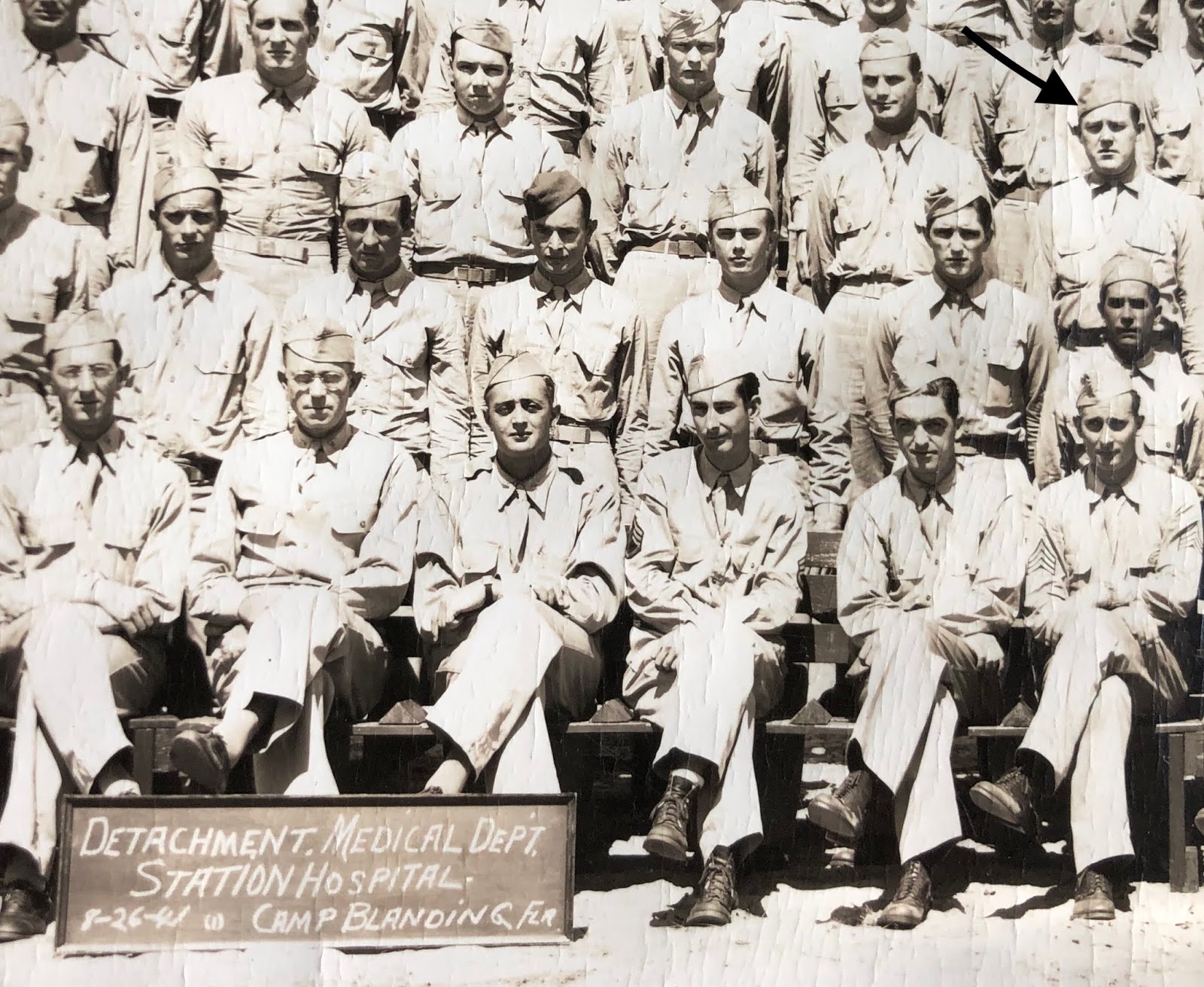
    My Dad was part of the initial mobilization in the two years of 1939-1941. As I talked about in an earlier post, he registered for the draft as required on the first day in October 1940. His enlistment date was January 13, 1941. I assume that because of his own civilian training as a pharmacist he went though both basic training and medical orientation as listed above. The one thing that supports that assumption is a picture I have of medics from the hospital at Camp Blanding, Florida in late August 1941, over seven months into his year.

Buddy in upper right corner (cropped)

As I have said elsewhere, I have no diary from my grandmother to confirm any information. So far I have hit dead ends on following him in that first period of service. If, as I assume, he was trained in his eventual specialty- surgical technician- this all would have taken him until mid-July 1941. Did he stay for further training or to develop skills? Camp Blanding is not listed as a medical training facility in anything I have found. Was he sent home early since the space was needed for increased training when the draft was extended in 1941?

    All I know for sure are the dates above, the picture from Camp Blanding, and that by January 1942 (perhaps earlier) he was home and remained at home until activated in August ’42 into the 80th Armored Medical Battalion. Now, in April 1944, he was a medic with the 10 Armored Division’s medical battalion, no doubt “enjoying” these last months before going overseas. D-Day was less than six weeks away and then everything would change.

Thursday, April 18, 2019

Buddy's War # 15 January - March 1944: The Greater War


While my dad, with the 10th Armored Division and 80th Medical Battalion continued training, there was a great deal of activity elsewhere. In the first 3 months of 1944, 75 years ago, some actions in the greater war:

January 1944
◦ 16: General Dwight D. Eisenhower arrived in London, returning from a week of rest and planning in Washington, D. C., and assumed command of the European Theater by General Orders No. 4. His new title was Commanding General, U.S. Forces, European Theater of Operations.

◦ 20: The Royal Air Force drops 2,300 tons of bombs on Berlin,
     and   The U.S. Army 36th Infantry Division, in Italy, attempts to cross the Gari River but suffers heavy losses.

◦ 22: Allies begin Operation Shingle, the landing at Anzio, Italy, commanded by American Major General John P. Lucas. The Allies hope to break the stalemate in south Italy, but they are unable to break out of the beachhead and the line holds until late May. The minesweeper USS Portent commanded by Lt. H.C. Plummer, hit a mine and sank southeast of Anzio, Italy.

◦ 27: The Siege of Leningrad ended after 872 days, as Soviet forces finally forced the Germans to withdraw. Some 2 million died, mostly of starvation and disease.

February 1944
◦ 1: U.S. Marines mop up on Roi and Namur in the northern part of the Kwajalein atoll in the Marshall Islands.

◦ 2: The Narva front near the east border of Estonia is formed between the Soviet and German forces.

◦ 3: American planes bomb Eniwetok in the Marshalls, later to be a major B-29 base.

◦ 4: Kwajalein, the world's largest atoll and a major Japanese naval base, is secured.

◦ 5: The American Navy bombards the Kuril Islands, northernmost in the Japanese homelands.

◦ 8: The plan for the invasion of France, Operation Overlord, is confirmed.

◦ 17: American Marines land on Eniwetok.

◦ 18: The light cruiser HMS Penelope is torpedoed and sunk off the coast of Anzio with a loss of 415 crew,
    and    American naval air raid takes place on the Truk islands, a major Japanese naval base, but they will be one of the bypassed fortresses of the Japanese outer defense ring.

◦ 19: Leipzig, Germany is bombed for two straight nights. This marks the beginning of a "Big Week" bombing campaign against German industrial cities by Allied bombers.

◦ 26: The "Big Week" bombing campaign comes to a successful conclusion; the American P-51 Mustang fighter with its long range proves invaluable in protecting American bombers over Germany.

March 1944
◦ 3: German forces around Anzio, having failed to drive the Allies from the beachhead, go over to a defensive posture.

◦ 6: The Allies receive intelligence that the Japanese may be about to attack Western Australia, causing them to greatly bolster defenses there. When no attack comes, forces return to their regular stations on the 20th.

◦ 16: United States XI Corps arrives in Pacific Theater.

◦ 17: Heavy bombing of Vienna, Austria.

◆ March 20, 1944
◆ 75 Years Ago Today
The Royal Air Force drops 2,300 tons of bombs on Berlin.
The U.S. Army 36th Infantry Division, in Italy, attempts to cross the Gari River but suffers heavy losses.

◦ 24: Heavy bombings of German cities at various strategic locations last for 24 hours.
-- Wikipedia


Wednesday, March 13, 2019

Buddy's War: #14- A Year of Change Begins


    •    January 6 , 1944
Had a letter from Buddy and a picture of the meds in his division. Gee it is good.
- Diary entry, Beula Keller Lehman
Note: Picture is cropped. Buddy is in center front.
We are now in the middle of March. Not much of consequence has happened with the 10th Armored so far this year. They are still in Georgia training and training and then more training. My grandmother’s diary is very brief and understated, as always. There’s not much about what my dad has been up to. Beula mentioned letters about every third day. Usually all she says is that she got a letter or that she sent one.

What was Buddy doing? What was the role of a medic in training? He has been with the 80th Armored Medical Battalion of the 10th Armored Division virtually since the beginning. He was also not a “new” recruit or trainee, having had his original training following the draft in 1941 prior to Pearl Harbor. I am continuing to research medic training, but I would think that by this point he was well-trained and as ready as it was possible to be after over 18 months on active duty. (If anyone has any stories or information from family or friends about this, please let me know!)

Two other diary entries give a brief and tantalizing glimpse at what might have been happening. The first:

    •    February 1, 1944
Buddy may get a furlough. wants to go to NY. Sent him $100.
- Diary entry, Beula Keller Lehman

Why is Dad going to New York instead of home on furlough?  There is no hint in the diaries so far that he has been dating anyone or that he was interested in anything except the military. It is a more than educated guess that this diary entry hints at something that will make a huge difference in coming months.

The second entry, 75 years ago last week gives a slight glimpse at what might have also been taking up his time.

    •    March 10, 1944
Letter from Buddy. He said he is working in a big hospital in Augusta
- Diary entry, Beula Keller Lehman
Was this common? Remembering that he was not a new recruit, was he as trained in the duties of a medic as he needed to be and could go off-base? Or, and perhaps more likely, this was part of the training. From later information I have found that in Europe he was a surgical tech. His own profession in civilian life was as a pharmacist. It is very possible that they had him working in a civilian hospital to learn that aspect of the medic’s role. It even appears that he may not have been living on base. In the back of Beula’s diary is a listing of  his general’s name (Wm. H.H. Morris- commander of the 10th at the time), a phone number, and “the name of the people he rents from.”

This whole section highlights what for me has been my biggest regret in doing these posts- that I have come to this interest too late for many things to be found. It is only after I began this that I learned of 10th Armored reunions, now ended as even the youngest surviving veterans would be in his early 90s today. It is exciting to do the research I have been working on, but the many missing links are tantalizing and make me sad.

As far as the 10th:
 Checking in on the Tiger’s Tale monthly newspaper for the Division at “Camp Gordon”:

The February headline was that the division’s “Bond Drive Goes Over Quota.” The original goal was to sell $50,000 worth of US savings bonds. As of the middle of February they had raised $55,500. That is almost $800,000 in 2019 dollars! The top unit was the 11th Tank Battalion which bought over 10% of that at just over $7,000. Dad’s 80th Armored Medical Battalion was 11th on the list with just over $2,000 purchased. At that time an enlisted man’s pay started at $50/month and went as high as $138/month (between $700 and $1900 in current dollars.)

US Savings bonds were the government’s way of borrowing from civilians with the promise to pay them back. On February 1, 1935 legislation was signed that allowed the Department of the Treasury to issue savings bonds. In April 1941 they became known as Defensive Bonds to finance World War II.
After the attack on Pearl Harbor, Defensive Bonds were informally known as War Savings Bonds. US Savings Stamps in denominations of 10¢, 25¢, 50¢, $1 and $5 featuring a Minuteman statue design were also sold to be accumulated over time in collection booklets which when filled could be exchanged to purchase interest bearing Series E bonds. All the revenue coming in from the bonds went directly to support the war.  -- Wikipedia
(When i was an elementary school student in the 1950s, Savings Bonds were still popular. There was still the feeling of a patriotic and civil responsibility to bring in your dimes, quarters,  or even dollars to purchase the stamps. They are still available, sold only online and have different restrictions.)


An interesting story on page 2 in March told of two underage soldiers being discharged. The older of the two was just six months shy of his enrollment-eligible age of 18. He couldn’t “see why age has anything to do with the qualifications for being a soldier.” He had faked his mother’s name on his application- and she is the one who turned him in. He hoped to convince her to sign permission now. The younger one was only 15 years old and turned himself in since he was afraid of the consequences of falsifying his age.

Also in March we hear of two members of the Division who had previously fought in the Spanish Civil War- both on the Republican side, also known as the Loyalists, against Franco and his Nationalists.

There’s “gossip” of events in different battalions and companies and lots of news about sports and activities.  There was
    •    Basketball championships,
    •    Ping-pong, volleyball, wrestling,
    •    Boxing, polo, bowling,
    •    Rifle team and plans for the summer.

When you think about the task of keeping 10 - 15,000 troops occupied, especially in off-duty hours, this all makes a lot of sense.

And one little piece of trivia I saw:
The fresh milk for the division comes all the way from St. Paul, Minnesota.”
In a front page column in February, the General reviewed the high standards for the Division, his own take for the troops on the standards set by the Army. These were called “Preparation  for  Oversea  Movement  of  Individual  Replacements"("POR"). As the General wrote:
If you are POR qualified you are fit to fight and rarin’ to go; you are physically hard and tough; you can drive a tank all day and take the bumps; you can run, jump, hit the dirt and you can take advantage of cover to get up on your German or Jap enemy, surprise him with blade or bullet.
But the reality of war was also included in being POR Qualified. The General continued:
…your identification tags are correct and your wear them, your clothing and equipment are properly marked, well cared for and you are proud of them; you are protected from disease by inoculations against small-pox, typhoid and tetanus, taken within the past six months. You have provided your dependents with insurance and allotments; you don’t know where you’re going but you do know what you’re going to do when you get there; you are confident and ready.
D-Day was less than 90 days away, though no one yet knew the timing. The 10th Armored was less that six-months from leaving. For the 10th, a lot was still ahead. For Buddy and family, changes were on the way.

Monday, January 07, 2019

Buddy's War: Interlude


Over the past few months I have posted the first of the series following my dad in World War II. The next two years will be the remembrances of the 75th Anniversary of the big actions and winning of that war in 1944 and 1945. My dad was a medic in the 80th Armored Medical Battalion, an organic part of the famed 10th Armored Division. My goal up to this point was to catch up to the calendar dates to match the 75-year anniversary. I have given some background and some of the family history.

These will continue as I move forward. I also  hope to fill in some of the gaps in the earlier story. Since I have been following some of the entries in my  grandmother's diary, that left one whole year out, 1941- there was no diary. I am hopeful at finding some more information about his training and plans that year before Pearl Harbor. If nothing else I am digging into the training and activities. the Army was involved in.

I will also try to fill in some of the earlier information on the formation and training of the 10th Armored Division. It was officially activated in July of 1942 and my dad arrived with them in August. They had two full years of training until the fall of 1944 when they left for Europe. I will be filling in some of the background and activities during those two years as we move into the early part of this new year.

My main goal, though is to go through these next 22 months of World War II with my dad and his band of brothers.

I have set up a separate blog for Buddy's War, but will continue to cross-post all the entries here as well.

As has been the case before, here is what was happening 75 years ago this week in 1944 in World War II:

January 4: The United States launches operations behind Axis lines, delivering weapons and supplies to anti-Nazi partisans in France, Italy, and the Low Countries.

January 7: In preparation for the invasion of France, Allied planes drop airborne operatives into the occupied country to help train their partisans in guerrilla tactics to support regular troops.

January 9: Winston Churchill meets with Free French leader Charles de Gaulle to discuss the role the Free French will play in the Allied invasion of France.

Monday, December 31, 2018

Buddy's War: #13 New Year's Eve 1943

This is part of a series that over two years will follow the story of my father in World War II 75 years ago. I did this five years ago in the series Following the 10th Armored, but I have been doing more research and expanding the ideas. The beginning posts will set the stage for the events of 1944 and 1945 when he was in Europe as part of the 10th Armored Division's 80th Armored Medical Battalion.
~`~`~`~`~`~`~`~`~`~`~`
◆ December 31, 1943
New Year’s Eve
75 Years Ago Today…
Hitler delivered a New Year's message to the German people admitting… that 1944 "will make heavy demands on all Germans. This vast war will approach a crisis this year. We have every confidence that we will survive." British Deputy Prime Minister Clement Attlee broadcast a New Year's Eve message of his own to the people of the United Kingdom. Attlee declared that the "hour of reckoning has come" for the Nazis but urged the British people not to be complacent, stating: "We do know that in 1944 the war will blaze up into greater intensity than ever before, and that we must be prepared to face heavier casualties.
~~~~~~~~
I hope next year will bring peace for everybody. Hope we all stay well.
— Diary entry, Beula Keller Lehman

Thursday, December 20, 2018

Buddy's War: #12- Christmas 1943

This is part of a series that over two years will follow the story of my father in World War II 75 years ago. I did this five years ago in the series Following the 10th Armored, but I have been doing more research and expanding the ideas. The beginning posts will set the stage for the events of 1944 and 1945 when he was in Europe as part of the 10th Armored Division's 80th Armored Medical Battalion.
~`~`~`~`~`~`~`~`~`~`~`
◆ Seventy-five years ago this week
◆ December 18, 1943
Heinrich Himmler ordered new rules for arrest and deportation of Jews in Germany, revoking most previous exemptions for Jews who had married Gentiles. Most Jewish spouses were ordered deported to the nominally Jewish city of Theresienstadt in January, rather than immediately to concentration camps.
On the homefront, the Williamsport Sun-Gazette reported ongoing war news from both Europe and the Pacific and updated a railroad “strike” possibility from the non-operating union, including word that the government was considering taking over the railroads. Behind the headlines it was a Christmas season.

Beula sent Buddy a box on the 20th and did some sewing on the 21st.

They trimmed the Christmas tree on the 22nd and did some baking and cleaning on the 23rd.

On Christmas Eve and Christmas Day, Ruth and Fred and Carl and Mabel came around. She reported it was “awful cold.”

Letters came and went from Buddy still in Georgia.

A war-time Christmas.

Wednesday, December 05, 2018

Buddy's War: #11- In the Greater War

This is part of a series that over two years will follow the story of my father in World War II 75 years ago. I did this five years ago in the series Following the 10th Armored, but I have been doing more research and expanding the ideas. The beginning posts will set the stage for the events of 1944 and 1945 when he was in Europe as part of the 10th Armored Division's 80th Armored Medical Battalion.
~`~`~`~`~`~`~`~`~`~`~`

In dealing with my father’s story of involvement in World War II, I don’t want to overlook the fact that during this time there was a lot of war happening. In 1943 the Eastern Front collapsed on the Germans, fighting was fierce in the Pacific, and Italy and Africa were centers of heavy warfare. The Germans continued their “Final Solution” when they were able. While many of the troops destined for Europe in 1944 were still in training, the war was as active as it had been. Here are some of the notable events of 1943: (Link)

◆ January 14, 1943
The Casablanca Conference between the U.S. and Britain begins. Roosevelt and Churchill agree that Germany must surrender unconditionally, and plan the Allied invasion of Sicily.

◆ January 31, 1943
Over 90,000 German troops at Stalingrad surrender to the Soviets. It is a significant turning point in the war against Germany.

◆ February 8, 1943
U.S. troops complete the capture of Guadalcanal from the Japanese .

◆ April 19, 1943
The Warsaw Ghetto Uprising begins after German troops attempt to deport the ghetto's last surviving Jews. About 750 Jews fought back the Germans for almost a month.

◆ May 11, 1943
The Trident Conference between the U.S. and Britain begins. Roosevelt and Churchill decide to delay the Allied invasion of France and in its place plan the Allied invasion of Italy. In Alaska, U.S. troops land on Attu in the Aleutian islands to retake it from the Japanese .

◆ May 12, 1943
Axis forces in North Africa surrender.

◆ May 16, 1943
German troops crush the last resistance of the Warsaw Ghetto Uprising and kill thousands of Jews. The rest are sent to the Treblinka concentration camp to die.

◆ July 10, 1943
Over 160,000 Allied troops land in Sicily, beginning Operation Husky.

◆ July 25, 1943
Benito Mussolini's fascist government is overthrown in Italy. The new Italian government begins peace talks.

◆ August 15, 1943
U.S. troops retake Kiska island in the Aleutians.

◆ August 17, 1943
Operation Husky, the Allied invasion of Sicily, is successfully concluded when American troops take Messina.

◆ September 3, 1943
British troops land on mainland Italy, beginning the Allied campaign in Italy. American troops land six days later. The new Italian government formally surrenders.

◆ September 10, 1943
German troops occupy Rome. Mussolini soon declares himself the head of a new fascist Italian government in German-occupied northern Italy.

◆ October 13, 1943
Italy declares war on Germany.

◆ November 20, 1943
U.S. Army troops land on Makin island in the Gilberts. The next day, U.S. Marines land on Tarawa. Within four days, both islands were secured, but at the cost of thousands of casualties.

◆ November 8, 1943
The Teheran Conference between the U.S., Britain, and the USSR begins. Roosevelt, Churchill, and Stalin meet together for the first time.

◆ December 1, 1943
The Teheran Conference between the U.S., Britain, and the USSR is successfully concluded. Roosevelt, Churchill, and Stalin agree that the Western Allies would invade France in June 1944 and that when it began the USSR would launch a new offensive from the east.
◆ December 5, 1943
◆ Seventy-five years ago today.
The Allies began Operation Crossbow in an all-out effort to stop Germany's V-1 rocket program. The first launch sites targeted were near Ligescourt, France, where U.S. Army Air Force B-26 bombers made an unsuccessful attempt to put a dent in the program. (Link)
◆ December 24, 1943
Dwight Eisenhower is named supreme commander of Allied Expeditionary Forces.

(Link)

Wednesday, November 28, 2018

Buddy's War: #10- Building an Army

This is part of a series that over two years will follow the story of my father in World War II 75 years ago. I did this five years ago in the series Following the 10th Armored, but I have been doing more research and expanding the ideas. The beginning posts will set the stage for the events of 1944 and 1945 when he was in Europe as part of the 10th Armored Division's 80th Armored Medical Battalion.
~`~`~`~`~`~`~`~`~`~`~`

◆ November 28, 1943
◆ Seventy-five years ago today:

The Tehran Conference was held. President Roosevelt and Prime Minister Churchill met with Soviet leader Joseph Stalin met in Iran to discuss war strategy.
~~~~~~~~~~~~~~~~~~~

In the early 1940s the United States faced a seemingly daunting task. Build a world-class military from next to nothing. Beginning with the first “peace time draft” at the end of 1940 and then expanding almost exponentially after Pearl Harbor in December 1941, the US Armed Forces underwent a transformation perhaps unprecedented in history. From top to bottom the military needed to become an unbeatable force. The reason was simple and now, almost 80 years later, almost overlooked. By Pearl Harbor, the United States was all that stood between world peace and the demolition of everything Western Civilization stood for! One of those who answered the call in 1941 was a surgeon names Brendan Phibbs. Over 45 years later he wrote a memoir of the time, The Other Side of Time: A Combat Surgeon in World War II. I came across it in my research this past summer and was blown away by its power. It was another piece of information about what my Dad was facing. In the early chapters of the book he reflects on the world at the beginning of World War II.
It’s hard today to remember the glow that bathed our armed forces as the country hitched up its weapons for the Second World War. It was a springtime, a virginal encounter when a generation distracted and sometimes desperate could turn happy and relieved to the ancient simple virtues…. Because sometime during the twenties and thirties the United States Army had disappeared. While the rest of the world rumbled and flamed through a tortured decade, [Old pictures of the US Army] certainly didn’t seem any match for the well-drilled hordes that thumped and banged their way across the newsreel screens, flaunting the terrors of Germany, Russia, Italy, and Japan…. Out of the radiant past came the army we have forgotten.
Help was needed. The pictures from Europe and the Pacific were horrendous. How could the United States compete with that kind of military power that was at once brutal, overwhelming, and in control of a great deal of the world?
Maybe we should never use total black or clear white to symbolize the capering of the human animal, but in 1942 we … knew we were marching out against the closest approximation of total darkness the planet had ever known.

We were a reenactment of American history, from Louisburg to Chateau-Thierry, a levee en masse around a skeleton of barely competent professional soldiers, when somehow, always, the carpenters and salesmen and tavern keepers and foundry workers got themselves sorted into ranks, most of them to become adequate and some of them to become heroes…. It was going to be our army, we were prepared to love it, and I suppose we would have felt even more strongly if we had known what we really were: the last American crusade, an army marching out with the cheers and blessings of a whole people, to save our country and the world from black, unrelieved villainy.

We were marching out to become the last people’s army in the history of the United States of America.
— Brendan Phibbs, The Other Side of Time: A Combat Surgeon in World War II. 1987.

As we move into 2019 (and 1944) I will expand on some of the ways the United States accomplished this miraculous task. To the point of this series I also did some digging into the needs for medical personnel as well as training the medics in combat. On Quora I found some of the history of the process:
The Army, on the other hand, primarily managed their combat medic training pipeline by earmarking medic candidates from the very first day they joined the Army. Medics went through a combined basic training, infantry class, and medics school, taught continuously for the student. Prior to the war, Army Medic training (combined with basic training) was 13 weeks. In the 4th quarter of 1941, the Army truncated the school to 11 weeks. Since 1942 saw the enlistment of millions & millions of men, Army Basic/Medic school was cut to just eight weeks for ten months. November and December 1942 saw the program extended back to 11 weeks; May to August 1943 increased the class to 12 weeks. From August 1943 to war's end, combined basic training/medic school stabilized at 17 weeks. Whatever curriculum was cut short, was picked-up by field training detachments after the apprentice medic arrived at his first duty station. (-Link)
From a U.S. Army history of the growth of the medical corps in World War II came this information:
Despite the country’s desire to avoid involvement in another European war, the US Army had been gradually expanding in the years before Pearl Harbor, from 191,450 troops when Hitler invaded Poland in September 1939 to about 1.5 million when the Japanese attacked on December 7, 1941. The National Guard had been mobilized in 1940, the same year Congress approved a peacetime draft. Guard units faced several obstacles, however. Industry was not producing enough military equipment, and troops had to train with limited quantities of outdated items. Medical training itself was a bottleneck; for instance, not enough brick-and-mortar hospitals existed to provide full training for all newly enlisted men, and courses had to be shortened to ensure at least some hands-on training for all enlistees. (-Link)
In short, there was a lot going on in those years- and by the end of 1943 U.S. Military personnel were fighting and dying in many areas.

They had only just begun.

Sunday, November 25, 2018

Buddy's War: #9- Thanksgiving 1943

This is part of a series that over two years will follow the story of my father in World War II 75 years ago. I did this five years ago in the series Following the 10th Armored, but I have been doing more research and expanding the ideas. The beginning posts will set the stage for the events of 1944 and 1945 when he was in Europe as part of the 10th Armored Division's 80th Armored Medical Battalion.
~`~`~`~`~`~`~`~`~`~`~`
◆    November 25, 1943
Thanksgiving Day
75 Years Ago Today…

My dad had been home for around 10 days on furlough. It was time to head back to Georgia and Camp Gordon. Grandma’s diary simply records that she got up at 8:00 (early for her), got dinner, and then “took Buddy to the station at 2-.”

By 6:00 both Carl and Ruth were also gone.
Such was Thanksgiving 1943.

Meanwhile in Georgia:
The troops that were not on furlough over Thanksgiving had their own feasts. Since they had formed in 1942, the 10th Armored Division, the Tiger Division, had produced a newspaper:

From Vol II, No. 11 on Dad’s birthday, they had the following information about the upcoming Thanksgiving:

"Next Thursday is Thanksgiving, traditionally a holiday that ranks as a day for good eating, good fellowship and general celebration. The Tiger Division should have a typical Thanksgiving holiday. Turkey dinner in the mess halls. Two Tiger grid teams will clash on the post gridiron in what promises to be a fast-moving, hard-fought contest.
Sometime during the day every Tier might well stop for a few minutes to consider why he, personally, should feel thankful on Thanksgiving Day 1943. Here are a few reasons we can think of: We are part of the greatest Army in the world, preparing to fight for the greatest country in the world; our forces on the fighting fronts are everywhere surging ahead; on the home front, production is ever on the increase and there is no longer any doubt that we shall have the planes, ships, and tanks necessary to destroy the enemy;… there is plenty to be grateful about… So lets consider ourselves very lucky, and enjoy the day— and then, the next day, go on about the business of winning the war so we can return home and have our old-fashioned Thanksgivings."