Road Trip '07 - Day 8
Wind Cave
This cave had an easy tour that we felt we could handle. You can't visit the Black Hills and not do one of these caves. While Jewel Cave is BIG, Wind Cave is just big! Actually, it is the fourth largest in the world (3rd largest in the US) and perhaps the one of the most complex. To get a bigger picture, just click on the picture here. It has a rich heritage. In the Lakota spiritual tradition it is the place where Buffalo was born. One of the workers at the store pointed out on the map pictured above that if you look at it in the right way, you can make a stylized image of a bison out of it. The head is up in the upper right corner, it has a "beard" and the leg comes off the bottom. There are about 125 miles of caverns explored so far. And that winds around over and above different passages in only one square mile!
According to the website, Wind Cave was regarded as sacred by American Indians, so cave exploration did not begin until 1881, when the entrance was noticed by two brothers, Jesse and Tom Bingham. They heard a loud whistling noise, which led them to a small hole in the ground, the cave's only natural opening. The whistling noise was the powerful wind that either comes from or goes into the cave through that opening. This is caused by the differences in air pressure between the cave and the surrounding above ground countryside. As the weather changes the "wind" provides equilibrium between pressure gradients. When a high pressure area moves into the area, the wind blows into the cave where there is lower pressure, and vice versa. There are a couple quite unique aspects of Wind Cave. One is these box formations. These calcite formations were what was left when the limestone around them was eroded away by water. Today Wind Cave is a "dry cave" where there is no water. It is also about 300 million years old making it one of the oldest in the world. (The Black Hills are also among the oldest mountains in the world, so it makes sense.)
The other famous formations are these "popcorn" formations. These are simply what's left as tiny bits of ground water seep into the cave and evaporate. It takes centuries for these to grow. One of the scientific puzzles of Wind Cave is the lack of stalactites and stalagmites. The popcorn and the flowstone (below) are the major forms.
 The exploration of passages is going on all the time. With all the winding and turning that the passages take, it is no surprise that there is far, far more to see.
 Humans do leave their mark. In older days they had the practice of signing their names to the walls. This one was from 8/17/82 - oh, yes, that's 1882.
<><><><><><><><><><><><><><><><><><><><><><><>
Mammoth Site
From Wind Cave we headed south to Hot Springs a little down the road on the southern edge of the Black Hills. Just outside of town is one of the most interesting digs around. It is known as the Mammoth Site Museum of Hot Springs. It is at an old sink hole that many, many years ago became a watering hole for mammoths. But they also tended to get stuck in it and covered with mud and preserved. Well, at least their bones were.
 A developer was going to build houses here but began to dig up bones. He contacted a university and eventually the rich treasure of mammoth remains was discovered. From what they can determine, the depth of the hole and its contents is probably 60 or more feet. In the picture above the fence at the top is the original ground level. They have gone down about 20 feet so far.
Those green arrow are pointing at places along the strata where there are mammoth footprints. They see them from the side as a dip in the strata. In the lower center of the above is part of a mammoth skull located where it was found. Below is a closer look: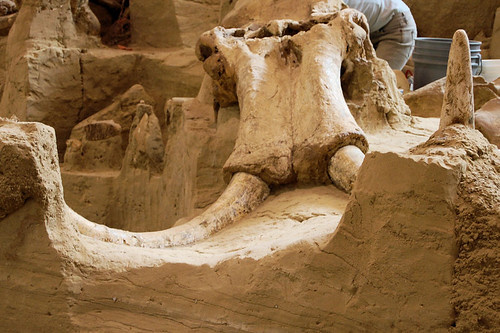
This is on the other side of the building- enclosed for year round tourist visits and for protection of the site. They only dig for about six-weeks a year, usually volunteers from organizations like Earth Watch. They uncover enough to keep the scientists busy the rest of the year. In the lower right of the picture is what is considered the most complete single mammoth skeleton ever uncovered. It angles from right center to bottom center. Here's a close-up. The pelvis, for example is just about the lower center of the picture. You can tell the size in comparison the workers in the above picture.
<><><><><><><><><><><><><><><><><><><><><><><>
Custer State Park (4)


Actually these two bison pictures were taken in the morning on the way to Wind Cave. This old straggler was all by himself walking across the plain. It was an irresistible picture. Notice, too, the prairie dog hole toward the right in both pictures. You can tell it by the dirt around it. And yes, there is a prairie dog poking his head out.


Antelope and turkey are around, too.

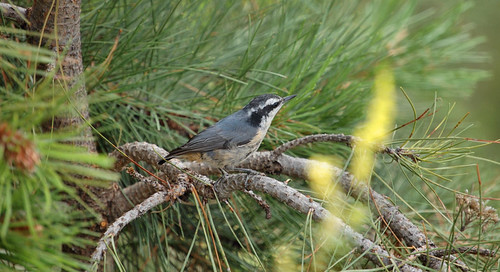
And, on top of the mountain this little old bird decided to show up and let me take his picture.
What mountain? Well, the one with this great lookout. It's the Mount Coolidge Fire tower and sits at about 6,032' above sea level. It has an incredible 360 degree vista from the Badlands in the east to all directions of the Black Hills.

This view looking down to the east shows the slow, slow way that nature rebuilds from fires. One of the worst fires to hit the area was in July 1988. Below you can see the still relatively barren mountains and hills. But they are recovering. After all, many of the plants are adapted for a fire environment.

Then off to the west and then the southwest- the two rock carvings can barely be seen. If they didn't have a map there pointing it out, I wouldn't have known where to take the pictures. Mt. Rushmore (right) stands out better than Crazy Horse (left) because of the different type of rock. In fact, the only way I could be sure it was Crazy Horse was by zooming in with Paint Shop Pro and changing some of the contrast levels. The comparison does show the immensity of the Crazy Horse carving, though. They are both about 11 miles from the spot where we were.

<><><><><><><><><><><><><><><><><><><><><><><>
Coming to a Close
So the stay in Hill City is just about at an end. Oh, I have a lot more to say- and we have a two-day trip home. This has been an amazing journey. I have some thoughts yet about sacred ground- something we have seen a lot of. I may even say something yet about not eating in chain restaurants or, amazingly, not turning on the radio/CD player in the car even once. One last night to rest in Hill City, then hitting the road east.
Miles today: 104 (Total: 1274 )


No comments:
Post a Comment