Showing posts with label technology. Show all posts

Tuesday, September 13, 2016

How Did We Know Which Way to Go?

Coming up out of the New York City subway can be very disorienting. Which way is what? How do I get to where I want to be?

Even more to the point- how did we ever manage before GPS and Smartphones with Google Maps?

I was thinking this the other week when I spent a day in NYC with a friend. Then he- a mere young thirty-something- asked me that very question. "How did anyone ever get around the city before these things?"

My admittedly smart alack answer was- "An m. a. p."

But he was right. Smartphones and related technology have made it easier to get around a place like NYC. Need to know what subways go where? Google it. How about the bus schedule back out of Port Authority? Google it? Need an Uber ride? Use the Smartphone app.

People in those prehistoric days probably did have a better understanding of where to go in their home areas. They probably had a map in their head that helped simply because they followed the same routes on a regular basis. Tourists? Well they had to figure it out.

I have seen some thoughts that the use of Google Maps, Siri, etc. have made us too dependent on the technology. We don't know how to read maps like we used to. But it has allowed us to travel new routes, in new places, even in our home towns.

Somehow or another we managed. We are adaptable.

And often got lost.

Thursday, November 13, 2014

A Scary Book

Just finished reading A Deadly Wandering by Matt Richtel. It is the story of the dangers of texting, cell phone use, and driving. It is told around the death of two rocket scientists in Utah as another driver was texting and forced their car into the fatal accident.

Back when I first got my driver's license in the mid to late 60s, my aunt was adamant about not having a radio in the car. She felt that having a radio in the car was inviting disaster. This was in the days before FM radio was popular so the radio she was talking about was the old AM type. I prevailed. Now, 50 years later, to have a only a radio in the car would be silly- and maybe not even possible.

But I am afraid my aunt was on the right track. Matt Richtel's well-researched and -written book presents the incredible dangers our modern technology has added to what, in reality has always been a very dangerous activity- driving a car. In separate sets of chapters Richtel tells the story of Reggie Shaw, the driver whose inattention caused the action; the neuroscientists who are studying the ways the brain has been overwhelmed by the increasing information flood; the prosecutors search for justice; Terryl, a victim's advocate who takes hold of the case and won't let go; and families and lawmakers.

Reggie, an everyday kind of kid is 19 when the accident happens, becomes an "everyman" for all of us. His story could at any moment become our story as we wrestle with the distraction of cell phones and texting. The scientists and their families could also become any one of us, victims of someone else's distraction. It is not as far-fetched as many of us might think. One statistic that sent shivers up my spine was that just talking on a cell-phone while driving makes us 4 times as likely to be in an accident and texting makes us 6 times as likely. That is equal to- and worse than- drunk driving, the ultimate no-no. These are not numbers pulled out of a hat. These come from years of research on the brain's ability to think when distracted.

In spite what many of us think we cannot multi-task! We just cannot! What we call multi-tasking is just the brain switching between one activity or another. We cannot pay attention to two things at the same time. One will suffer. In that inability is the great danger of texting and driving. The research is very clear. It is amazingly dangerous. And people do a variation on it all the time. Sometimes it is just changing the dial on the radio. I had a friend who lost his wife and daughter in that kind of distracted accident. Sometimes it is looking at the GPS or trying to program the GPS while driving. It might be wondering what the weather is up ahead there where the darker clouds are so the availability of the local radar on the smartphone comes into play.

The problem lies in the fact that we have a brain that evolved for a different type of lifestyle.We also have a brain that wants to respond to certain stimuli- such as the vibration or beep of a text arriving on our phone. We have to answer it; we have to always on the ready for the important information. It actually sets our dopamine system into action- which only reinforces the need to answer the text the next time.

These are oversimplifications of the science, but it is good science. Our ability to evolve into a way of better handling this flood of information is much too slow. Just because we are more comfortable with it does not mean that our brains have changed enough in just a very, very few years to cope.

Reggie spent a couple years after the accident not believing he was texting at the time or that he was even being inattentive. It was only when he heard the science that his several years of worry, wondering, fear and guilt came crashing in. Richtel does what any good Pulitzer Prize-winning journalist would do- he builds the story so we can feel what is happening. He demonizes no one. He gives the hint in the book's sub-title and Prologue that this is going to turn  out in a hopeful way. Redemption is at the heart of the story.

I am not sure Reggie is just an everyday guy. I hope he is representative of more of us than not. I hope I could have the courage in the end to do the right thing. His open and fearless testimony led the Utah legislature to pass an anti-texting law just when it was about to die in committee.

The book has scared me- about my own behavior in the car. I do not text, but the phone can have me tied to its buzz or beep. Even with a Bluetooth connection for phone calls, I am not sure I should be doing much of that. The ease at which something happens, the speed- in brain-time as well as clock-time- at which accidents can happen is chilling.

May we all pay attention!

~~~~~~~~~~~~~~~~~~~~~~~~

At first the phone companies were fighting the changes in the law that make  texting and driving illegal. They got on board knowing that it was good business not to have your customers dying or being killed. But they also were willing to put their money behind it. AT&T had it's "It Can Wait" campaign. Reggie has been an important part of that.

Here, as part of AT&T's campaign, is Reggie telling his story.


Werner Herzog produced documentary on texting and driving. Reggie's story is the final part of the movie.


Reggie Shaw's Web page

Sunday, November 13, 2011

You Can Never Keep Up

...or...

technology keeps at least a jump ahead of what I buy.

Sitting in the local Barnes and Noble last evening looking at the new Nook Tablet I realized it is impossible for we everyday people to keep up with things.

I got my Nook Color for Father's Day. That was June. Only five months ago. It is not a tablet, but has some tablet/computer features.

Now there's the Nook Tablet. For the same price I paid for the Nook Color JUST FIVE MONTHS AGO.

Sorry to yell like that but my pioneering spirit, my early adopter status is continually threatened by such events.

But I guess there's nothing to do about it. No, I am not getting a Nook Tablet. But I will look with a certain amount of jealousy at it- and try not to be too covetous.

Friday, June 24, 2011

Amazing!

A digital camera that will store enough information that will allow you to change the center of focus AFTER you have taken the picture?

A company called Lytro is saying they have just that- and that it will be a revolution in photography. They say it will be commercially available by the end of the year.

See what I mean when I say amazing?

No more out-of-focus shots because the auto-focus just won't lock in on the right little part of the scene. Just go to the post-production and re-focus.

The breakthrough is a different type of sensor that captures what are known as light fields — basically, all the light that is moving in all directions in the view of the camera. That offers several advantages over traditional photography, the most revolutionary of which is that photos no longer need to be focused before they are taken.
--AllThingsD

I have no idea what that means technically, but it sounds exciting as well as the claim that it will be competitively priced.

What will they think of next?

Link to story on All Things D

That link has some pictures that demonstrate the technique.

And here is one of the pictures. Go ahead and play with it. You will agree with me.


Link to Lytro.

Tuesday, October 12, 2010

Life in the 21st Century

Here I sit in Minnesota at my computer. I have two windows open. The one I am writing this post in and a live feed from Terra, a Latin American TV channel from Chile showing what is happening at the mine as they get ready to start bringing up the 33 trapped miners.

From the day they found the miners alive and then lowered a TV camera down until today we have been kept informed. Now, at 9:17 CT the rescuer is in the pod and ready to be lowered.

Wow. There he goes. And as the President told him the luck of the world goes with him.

9:35 - The capsule and the rescuer has arrived in the mine. Smiles, cheers, hugs.

It is amazing, I say again and again. The ways we have been able to communicate and connect the world. It wasn't all that long ago that we would have not been able to see this until film or tape was transmitted or transported. Yet today we can watch it live on a computer screen.

9:50 The first miner, Florencio Ávalos, is in the capsule. His family has gone to the rescue area to greet him.

9:54 He is coming to the surface, the pulley moves, the capsule begins a slow ascent with the flag of Chile there to be seen.

Now, watching the wheel turn, the cable pulling the capsule with Florencio to the surface. The family stands expectantly after 69 days separated. Life will certainly be different for all of them. That wheel turning will be a recurring memory of this rescue.

I am grateful that the TV commentator has given a lot of quiet time just to absorb what is happening.

10:10 They have pulled the pulley mechanism up. The moment is close. The son stands with his eyes wide. Applause. He is there! Tears and hugs and cheers.

What a moment. It may be these moments of connection that someday may help us all see how interconnected we are- or can be.

10:19- El Presidente Sebastián Piñera acaba de escribir en su Twitter: "Que emocion! Que felicidad! Que orgullo de ser Chileno! Y que gratitud con Dios!"Twitter feed from the Chilean president expressing the emotion, joy and pride of the Chilean people. And gratitude to God.

10:26 The capsule starts down again. It will be many hours- more than a day- before all the men are back and then the rescuers who have gone down with the capsule. It is quite a humbling time. I know I could not do what the miners do.

*********************************************

Over at BoingBoing, Xeni Jardin had this to say, live blogging like I was:
I can't imagine what it's like for the trapped miners, but man, what must be going on in the mind of the paramedics/rescuers they're sending down into the mine? What kind of strength must someone have to enter that tiny rescue shaft to drop half a mile down towards the center of Earth?
There is much work to do, but for tonight, the hope is real and, perhaps resurrection is not too strong a word.

Tuesday, March 10, 2009

Change is Changing

Last week I posted on how technology and information have brought about endless change. I also noted how fast change has been occurring. One of you posted an obvious reason for some of that- there are a lot more people today than there ever have been. That's why iPod and Facebook exploded. There were more people available to get hooked.

At any rate, the idea of such rapid change is still incredible. Its impact on how we live and work and play has been nothing short of amazing. I hinted that I hadn't even thought about the church in the midst of all that.

That wasn't quite true. I have thought about it many times in the past decade or so since I first heard of the doubling of information and technology rate. I also thought about it in other ways even longer ago that that.

I remember when we went to Disney World with our daughter in 1991. We did the ride inside that big geodesic globe which was essentially about the history of technology and communications, etc. The ride, as I best remember it today, made the point that the "old" spoken word and story telling by oral transmission was, naturally an early way of communicating. Now we have all these electronic marvels. (Even in 1991 the marvels were there.)

As the ride came to an end I remember that my wife (and co-pastor) turned to me and simply said:

We are dinosaurs.
Which I agreed with. Sort of. The idea of standing in a pulpit Sunday after Sunday, year in and year out, expounding in some form or another on an ancient text in a purely oral format did sound like antiquity. It was little changed in basic form since, well, since the church started.

Over the past 18 years a lot has changed- and preaching continues. We may use Powerpoint or video projectors but most of the time "the message" is still presented much like it always has been. We have moved into a "new" era, what has been called a "post-modern" era, moving beyond the supposed certainties and style of modernity. Things aren't supposed to be as "black and white" or "either-or" like they used to be. "Permanent" truths have been challenged.

But the oral tradition has remained the same- and even grown. Thanks to TV and movies the post-moderns are a story-telling generation. They can retell the most complex movie plot or throw movie quotes back and forth. Good storytellers- whether preachers, screenwriters or movie directors- are still doing what we have always done.

So why does the church membership remain overall stagnant? Why have the mainline, historic denominations which offer a sense of "roots" declined? Why has most of the "growth" in Western Christianity been transfer growth?

Oh I wish I knew.

Ten years ago I had all the answers. The answers were right.

But I wasn't.

At least it doesn't look like it. The changes in the church are among the most difficult to see, predict, or even analyze. I wish I had some of my own notes about the church from 25 years ago and what the experts were saying at that time. As I think back on it, one of the most insightful was Lyle Schaller. Schaller was The Leadership Guru of the church. He had a way of observing and naming trends he was seeing. Yet I do not remember Schaller being a "futurist" in saying that this, that, or the other thing was going to be the way of the future. As I think more about it today his was a fluid vision of the church. I think he knew better than most that to predict the ways of the church was to be on the same page as weather forecasting. Anything beyond the proverbial 36-hour forecast would be worthless.

Church change- lasting change- also takes place at a snail's pace, even in this day and age. There is a natural "conservative" tendency in such a large and diverse system as the church. There is a constant tension of the new and the old, a give and take between generations, the natural rhythms that life and death bring.

All of which is to say that change in the church is unpredictable. But then the whole premise of the book The Black Swan is that Big Change is almost always the result of unpredictable occurrences. The socio-cultural changes that will come from the current economic situation are beyond what we can even guess today. We can only think the way we have always thought- even when those ways don't work or got us into the situation in the first place.

So it goes in the church. But the important part is to be open to the possibility of change. God is at work. There is no doubt about that. But I for one don't have clue 1 anymore what that means in my day to day life, let alone the future of the church. Sure I have my opinions, but so do we all.

In the end my guess is we will all be surprised at what really happens.

Thursday, March 05, 2009

Time Isn't What It Used to Be


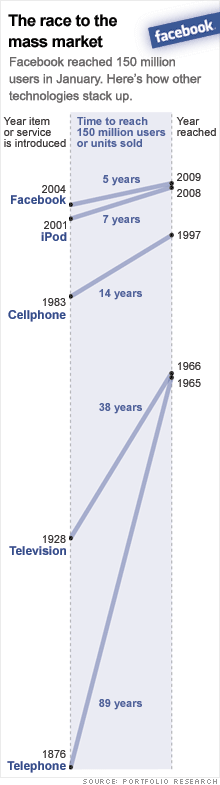
Bob Carlton at The Corner posted the chart at left from The Trend Watch. It shows the length of time it took some technologies to reach the 150 million user mark. Facebook did it in 5 years compared to the telephone which took 89 years.

Take another look at that and you will also see that a mere decade ago, 10 years, neither iPod nor Facebook were even on our radar screens. Today they are two of the most ubiquitous technologies around. What took decades in the past now happens in almost an instant.

I remember a few years ago that people were talking about information doubling every 18 months to two years. Some of that was based on the famous "Moore's Law" which according to Wikipedia,

describes a long-term trend in the history of computing hardware. Since the invention of the integrated circuit in 1958, the number of transistors that can be placed inexpensively on an integrated circuit has increased exponentially, doubling approximately every two years. The trend was first observed by Intel co-founder Gordon E. Moore in a 1965 paper. It has continued for almost half of a century and is not expected to stop for another decade at least and perhaps much longer.
Applying that idea to information it was said that we have more and more information to deal with more quickly. The graph at left also seems to indicate that we have more and more ways to access that information more and more quickly.

So in many ways it appears as if the arrow of time is still moving in only one direction but we are moving a lot faster than we used to. Change is now normal. Lack of change is, well, not normal. We are seeing things develop and disappear more rapidly than ever before. Just because we did it that way 10 years ago (let alone 50 years ago) doesn't mean we will be doing it that way as soon as next week.

I'm not sure where all this leads me today. A week after surgery I am grateful for the speed of change in medicine. In 1958 I had my tonsils removed. They used ether. I stayed in the hospital 24 hours and was in bed at home for a week. A doctor couldn't believe that they actually used ether.

In 1979 my wife had the same surgery I just had. She was in the hospital a week, wasn't allowed in a car (other than to go home) for six-weeks and was told to lie down and not move a lot for the first few weeks. They had me out of bed less than 12-hours post-surgery and home within 30 hours post-surgery. I am already allowed to drive now since I am not on any narcotics. "Walk," they told me. "Walk as much as you can."

So the chart is a framework for a lot of things, not just technologies. Are there dangers? You bet. The ease of lack of privacy is one. So is the ever widening gap between the haves and have-nots; the industrialized nations and the yet-to-be-industrialized nations. We may be overwhelmed by a lot of this change if we do not also maintain our soul. (And I haven't even gone to the impact on the church.)

Having said all that, it is still good to pick up a book and read. Just for fun. Like the sci-fi novel I am working on now about what happens when bio-nano-technology can build new people or rebuild old ones in a time after a cosmic power surge has knocked out technology as we know it today.

Ironic, huh?

Saturday, October 18, 2008

Unbelievable

It is the 21st Century As I write this I am watching an old sit-com while the words "We are experiencing technical difficulties" runs across the screen.

In other words the top of the 1st inning is almost over and TBS has been running old shows to cover the dead air. They don't even have their sports people on giving us information. This appears to be MAJOR technical difficulties.

To not be able to get information from St.Pete to Atlanta is unbelievable.

7:19: Now the top of the inning is over. Still no TBS game.

7:25 At least their putting the score on the super- and there's nothing on their website.

Tuesday, September 02, 2008

HighTech Touch

I saw an item on the news the other night about the increase of young children with cell phones. One of the parents commented that they want the phone for their child so they can stay in touch. We have reached an interesting time when we want and expect to be able to have instant connections with whoever we want to be in touch with. It is hard to go anyplace where there aren't people on cell phones, answering cell phones, dialing on cell phones, texting on cell phones.

Back in 1982 just as the possibility of computers and the household use of high tech was beginning to be a possibility, John Naisbitt wrote a book called Megatrends. In it he proposed that as we become more and more high tech we are going to need more and more high touch in our lives. The "coldness" of high tech would push us into that need of the personal and the warmth of relationships.

Keeping connections is what cell phones have become about. We are hungry for relationships. Or more to the point, we are created, I am sure, to be in relationship with others. We are not meant to be lone creatures. We live and react in community. But the overwhelming high tech around us can make us feel disconnected. Hence the popularity of cell phones, even to the point of people giving up land lines.

But every now and then I run into someone who will still say, "But I don't want to be that available all the time." No one says you have to answer the phone every time in rings. But you can answer the phone when you want to talk to someone.

Several years ago, when my daughter went to Spain to stay for a school year, the most difficult part for me was those hours she was on the plane heading there. She was out of touch with us for the first time in her life. Completely out of touch. As soon as she landed, she called us to let us know she was safe. Today we take that ability to touch for granted. Thirty-eight years ago I went to Europe for the summer. My aunt- my guardian- had no idea I arrived safely until she got a post card from me a week to 10 days later.

Yes, our high-tech world has given us the need for high touch. And much to our surprise it is the very technology that gave us the need that can also help provide it.

Friday, May 09, 2008

Technological Miracles

An amazing headline today:

Data from Columbia disk drives survived the shuttle accident
The headline is only partly true. In reality the drive was sent to a company called Kroll Ontrack in the western Minneapolis suburbs. The engineer there, Jon Edwards, managed to work his miracle on some of the data. Much of the data on other drives was lost due to the incredible heat that not only melted parts but also demagnetized them.

This news doesn't entirely surprise me, especially with Kroll Ontrack. Last fall I put my CD of pictures from our 2002 trip to Spain in the drive- and got an error message. Something somewhere on the CD was messed up and all those great and wonderful once-in-a-lifetime pictures seemed lost forever.

Then I found a business card on a bulletin board at a local coffee shop. It was for a sales person for Kroll Ontrack. To make the story short I called, took the CD in, paid a pretty good fee and Voila! there were my pictures again. All of them. It isn't cheap. These kind of guys get paid well for their magic. But I'm not sure how important the data from Columbia is, but my pictures were, to me, priceless.