Showing posts with label Veterans. Show all posts

Thursday, September 28, 2017

Just as Great a Generation

For any one of a number of reasons I have not been watching the Ken Burns/PBS series on Vietnam. I may very well catch it later in bits and pieces, but its very presence on TV has got me to thinking (again!) about that divisive and nation-changing time. So much of what appears to divide us today has its roots in that era.

I am not a veteran of that, or any, war. I did not serve in the Armed Forces. I was a conscientious objector and did my alternative service from 1970 1972. I was, and still am, a pacifist. I am the son of a WW II veteran who served as a non-combatant- medic- with the 10th Armored Division at, among other battles, the Battle of the Bulge. I still get chills when I play- or hear- the Star Spangled Banner. I remove my hat when the flag passes. I am patriotic and proud to be an American.

And, no, this is NOT another post about the NFL and such protests. This is about Vietnam and Vietnam-era vets who have never received the care and support they deserve for what they did. They didn't get it in Vietnam from the "powers-that-be", from any of the Presidents they served for, and many have consistently mis-understood them and the war they fought in.

A number of years ago Tom Brokaw gave the World War 2 military members the title of "The Greatest Generation." They were remarkable in what they did. I have done considerable study on my Dad's service and see what  those incredible men and women did in, I believe, literally saving western civilization, democracy, and life as we know it.

But it is time to see that the Vietnam Era Veterans are just as great a generation.

The ones I knew then and have come to know since were caught in the middle of some of the greatest difficulties an armed forces can endure- split leadership, poor leadership, poor assumptions, poor political understanding, corrupt governments they were sent to give support to, then undermined, again, by their own military and political leaders lack of willingness to admit an error. Robert McNamara finally admitted in the documentary Fog of War in 2003 that the war was an error. Sorry, sir, that was 40 years too late for the men and women whose names are on that wall in Washington, D.C.

Many of them knew it at that time. They were the ones on the ground seeing the insanity and facing an enemy that was often invisible and had far greater numbers than the Pentagon was willing to accept as reality. Too many leaders were still living in the warm glow of World War 2 while ignoring important lessons from the Korean War. We destroyed North Korea at that time, what some wanted us to do with North Vietnam, and still were unable to bring the war to a peaceful conclusion. We never saw it coming in Vietnam.

But, again, the troops on the ground knew it. They fought, and fought hard, even with that knowledge. Many knew it to be a losing battle with atrocities and the "fog of war" keeping things even worse than we saw on TV. They fought as hard as the World War 2 vets in a completely different type of war. They were brave and scared to death at the same time. As any soldier in any war would be. Many came home wounded in soul and took many years to heal. Some never have.

I hope they are being recognized today. They never received the "Welcome home!" they deserved. We should have embraced them and listened to their stories without judging or calling them names. Many of them joined the protests against the war; many did not. All were heroes.

Maybe the current Ken Burns series will cast some new light on that war and those who served. Maybe we can set aside our preconceptions and leftover animosities to come together and say "Thank you!" to them for what they did. Maybe we can have a dialogue about service and patriotism and leadership that we have long ignored having.

Maybe we can turn a corner in the political divisiveness and insanity that we have been experiencing and finally move on before the Vietnam-era generation is gone, and with them lessons we have yet to learn.


Friday, May 27, 2016

Remembering Why It Is Memorial Day

General Orders No. 11, Washington, D.C., May 5, 1868:

The 30th day of May, 1868, is designated for the purpose of strewing with flowers or otherwise decorating the graves of comrades who died in defense of their country during the late rebellion, and whose bodies now lie in almost every city, village, and hamlet church-yard in the land. In this observance no form of ceremony is prescribed, but posts and comrades will in their own way arrange such fitting services and testimonials of respect as circumstances may permit.
From an opinion piece in the Washington Post by a veteran:
It’s not Veterans Day. It’s not military appreciation day. Don’t thank me for my service. Please don’t thank me for my service. It’s take the time to pay homage to the men and women who died while wearing the cloth of this nation you’re so freely enjoying today, day.
-Link to Washington Post
Stop and remember this weekend.
It's not about summer and barbecues.

Tuesday, March 01, 2016

Another 50-year Memory: Vietnam

Earlier, when I got ready to post the video for the month from 50 years ago, my senior year in high school, I discovered that the song that dominated the American airwaves for five solid weeks in March and April of 1966 was the Vietnam War song, Ballad of the Green Berets. It is one of those songs that brings back deep and powerful emotions.

In 1966 the anti-war movement was hardly more than a relatively few people. Most of us were still living in the World War II vision of victory and the unbeatable power of the American military. Barry Sadler's song conjured all those positive emotions. It was, after all, only 20 years after World War II and many of us were the GI's children.

On the other hand it was a song of praise to and even worship of war. Wrapped in  the honor of the "brave men of the Green Berets" was, unfortunately, words that glorified war and death. My Dad had died about 18 months earlier, but I wonder if he, a veteran of the Battle of the Bulge, would have felt that way?

Those two conflicting emotions were- and still are- real in the American psyche. They may even be basic emotional responses in the human psyche.

Underlying the conflicting emotions was also the uncertain political leadership, a deep and fatal misunderstanding of the root causes underlying the war, and a reliance on a style of war that was becoming outdated. Even Defense Secretary McNamara many years too late acknowledged the "fog" of the Vietnam War. The result, as we well know, was a disaster. We turned on ourselves and the men and women in the service. We vilified returning servicemen as if they were to blame for the problem when all they did was answer the call to military service.

Even if we did not participate directly in that vilification, as a nation it may have been among our darkest hours.

Times have changed in many ways. More people now understand that disagreement with war policy does not mean disagreement or hatred of those sent to serve. More people are recognizing the devastating effects of any war and seeking ways to help and support those who are adversely impacted by it. We are welcoming veterans home and thanking them for their service.

I also believe our Vietnam veterans are hopefully getting their long-deserved due. I have noticed that Vietnam vets are more willing to talk publicly today about their service without wondering who is going to condemn them for something that wasn't their fault.

Yesterday we were having lunch in an out-of-the-way restaurant. There was only one other couple present. The gentleman was a Vietnam-era Navy veteran. He was talking to the young server about his experiences and what he did in the war. He was not on the ground in Vietnam, but served aboard an aircraft carrier off the Vietnamese coast. As I listened to his story, we were only a couple tables apart, I was glad he now felt able to talk openly about it.

This is a far cry from some of my vet friends between 1969 and 1972. Even those who were involved in groups like Vietnam Veterans Against the War, as vocal as they were, would often be cautious about who they talked to about their experiences. Over these 40 years I have sat with a number who wanted to talk more about it and make their own amends to themselves.

Even given all that, I cannot post Barry Sadler's song. There are on You Tube videos that honor vets of other wars with pictures set to Sadler's song. While I applaud the support of these troops, Sadler's words are still too divisive and difficult, describing a time that is now past.

Plus we need to do something more positive as the vets of my generation are aging.

  • My heart still sinks every time I see a Vietnam Veteran.
  • For what we as a nation put them through,
  • For the way they were treated,
  • For the loss of so many young men!
To all Vietnam veterans, and troops from all the wars, I thank you for your willingness to do what you have done. May the day come when we (or someone) can look back and be glad when no one has to fight in war.

Thursday, November 19, 2015

Following the 10th- Personal Reflections

This is the final part of a series following my father's 10th Armored Division in World War II seventy years ago. He was a medic with the 80th Medical Battalion assigned to the 10th Armored, part of Patton’s Third Army.


Today, November 19, 2015 is the 110th anniversary of my Dad's birth. Seventy years ago today, on his 40th birthday, he was settling back down in his hometown in Pennsylvania after years of uncertainty with World War II, training for War and the 11 months overseas with the 80th Medical Battalion/10th Armored Division.

He was now back at the pharmacy he owned. His wife of 18 months was with him. She was, I am sure, a stranger in a strange land, being a 32-year old Jewish woman from Brooklyn now in the (mostly Christian) wilds of North Central Pennsylvania.

Less than three years later in August 1948 their first child would be born eight months after Dad's mother died. Another three years and a second son would come along. Time would move quickly and unforgivingly for Harold and Dora.
  • August 1958 Dad would have brain tumor surgery
  • November 1959 he would sell the pharmacy
  • November 1961 Mom would discover she had colon cancer
  • February 1962, she would be gone.
  • Summer 1963 Dad would move to a Veterans' Hospital
  • December 1964, two weeks after his 59th birthday, he, too, would be gone at which point I was 16-years old.
I never had what could be called a "close" relationship with either of them. There wasn't time for a lot of memories to be built. Whatever memories were there were also sublimated in the grief and trauma of losing them both while still a teenager. Much of what I know about Dad is in bits and pieces. Until the past several years his war service was an uncertain bunch of seemingly disconnected facts and rumors.

I then opened my grandmother's diary for the first time. (Hard to believe, I know.) I soon began to discover a few more bits and pieces that actually corroborated the facts and rumors. I began to put a timeline together and do more research.
  • Yes, he "ran away" from home and got himself drafted
  • Yes, he was at Camp Gordon, Georgia with the 80th Medical Battalion/10th Armored Division where he met and married my mother
  • Yes, he was at the Battle of the Bulge
Thus I began to read more about the work of the 10th Armored including the campaign by campaign history- Impact: The Battle Story of George S. Patton's Spearhead Tenth Armored Division in Europe in World War II by Lester M. Nichols. I did more research on the Internet and decided I would do this blog series following Dad's journey in the war.

I come now to the end. This will be the last post in the series. Seventy years ago war was over. There's nothing else to report on the battles seen and wounded cared for. World War II as I said in a previous post remains the paradigm of a "good war." It was truly a world war with staggering casualties everywhere. It did truly save western democracy as we know it. It also began the breakdown between races when the Black American troops came home to find they were less accepted at home than in Europe.

Through these intervening seventy years much has changed. I myself am a product of the aftermath of World War II and then of Vietnam, causing a major shift in so many things American. The divisions raised in that war coinciding with the Civil Rights Movement and then Watergate are the precursors of much of the division we see active today. These posts were not meant to compare that time with this. Maybe we should. I don't know.

What I learned was subtle and perception changing.
  • This past 4th of July I realized that my deep and emotionally positive responses to the military songs and Sousa marches are to a great extent based in my Dad's war. I play "the caissons" as much in his honor as any other reason. The others remain symbols of the victory of World War II.  
  • I can see now in pictures I have seen dozens of times, in Dad's eyes, that far-away soul that has seen more than he ever wanted to. If his unit was part of the liberation of a Nazi Concentration Camp as seems to be the case, the inhumanity he witnessed would be forever etched in that soul.
  •  In other pictures of Dad with his comrades in the medical unit, there is a sense of brotherhood that Steven Ambrose wrote about so movingly in his World War II books like Band of Brothers. Whether it is standing outside a beer hall/restaurant or beside a Nazi war plane, there is a confidence that comes from having done something so awful, yet so important - and succeeded. And they did it together.
  • I have a better awareness now of why my Dad never wanted to talk about it. A medic involved in that winter hell of the Bulge would be a classic definition of PTSD, a word unknown at the time. Since all the other "rumors" I collected seem to be true, the stories of nightmares and not being willing to talk would probably also be true. As would his hair-trigger anger which was most likely made worse by the "startle-effect" common to PTSD.
  • Knowing how many from my hometown went to war in the 1940s I also have a better understanding of the world I grew up in. We were all surrounded by veterans. Most of us in my class were children of those vets. I am sure that colored more than just the patriotism that was bred into us. It also produced many fathers who had difficulty relating to anyone but their comrades at the local VFW or American Legion. Vietnam later brought the addition of drug abuse. WW II had its alcoholism I am sure.
    • I, personally, have been a pacifist my entire adult life. This isn't the place to go into the details of what that means and how that can- and does- fit together with my lifelong patriotism. I noted to a friend the irony of a pacifist following the end of World War II so closely. He commented back that it gives me the opportunity to again see why I believe what I do about war. 
    • He was right on target. I am as much a pacifist as I ever was. War is always an evil, even when it does good or even when it is necessary. We must never forget that. Perhaps because my Dad was already in his mid-30s when he got drafted and sent to war, it was not the self-defining vision late-teens and early-twenties would experience. The "glory" of war was forever tarnished for him in the snow and ice of the Ardennes. I remember a vague statement to that effect from his sister, my aunt, who took over the role of mother and father when they were gone. In the midst of her patriotism she indicated that some way or another, her brother had forever changed.
    • Since my Dad was a non-combatant, a medic, I learned from this vicarious family connection to the War that there are many ways to serve without having to carry arms. Being a non-combatant, even a pacifist, does not mean that one is a coward. There a many ways to stand up for one's beliefs and serve the country. My Dad did that. I never looked at him that way before.
    • I am proud of him and glad I did this. I met a side of my Dad that I never knew- and would probably have never known. To live that hell, then come back to his hometown roots and pick up where he left off, must have been a whirlwind of emotions. I don't know if he survived it or whether that all played into his own death before age 60. Losing his 48-year old wife after less than 20 years of marriage played into that as well, I am sure. 
    • In the end I am humbled by my Dad's service and the service of his many comrades. It was not what he wanted to be doing- none of them wanted that. But they went and did it. Many of them would say that they simply went and did what they had to do, then came home and tried to forget it. We cannot forget; we must not forget. There is a lesson of the greatness of the American spirit in their story- spirit, and courage, and humility.


      I am honored to be your son, Dad.

      Happy Birthday.

      Thanks for your service and dedication.

      Wednesday, November 11, 2015

      Following the 10th- Keeping the Book Open- the Son of a Veteran

      This is part of a series following my father's 10th Armored Division in World War II seventy years ago. He was a medic with the 80th Medical Battalion assigned to the 10th Armored, part of Patton’s Third Army.


      For the past year I have been following my Dad's 10th Armored Division in the last year of World War II. I have done research and learned things that I never knew. In this next to last post in the series, I decided to think about this whole process from the viewpoint of being a son of a World War II veteran.

      Today is Veterans' Day. For me it has always been a special day of remembrance. They have been called "The Greatest Generation" and their war has defined "good war" (if there is such a thing) for the past 70 years, at least two generations. The first half of the 40s became, for my generation, a "magic" time. It was World War II! We grew up with war stories, war movies, war memorials built. We celebrated the great victory well into the early 60s. Korea was a blip on the road of history. World War II was the big war, the war of our fathers.

      They weren't the greatest generation to us, not as it has come to be used in recent years. They were the heroes who went and did what needed to be done and paid a great price for it. From the vantage point of the 21st Century, this is well two-thirds of a century ago. But for me, they are recent events. The war ended but three years before I was born.

      Our lives were impacted in many silent ways by the returning vets. In small towns across the country these veterans were well-known, special people. Yet many, as in my Dad's case, kept it all bottled in. To question it, to raise any concerns was unpatriotic. We never thought about it. We never asked about what he, and so many others, suffered in their silent nightmares? What was it like to relive the Battle of the Bulge from a medical battalion? The horrors he must have seen are beyond the ability of anyone to imagine.

      By the time I was old enough to think about these and ask the questions both he and my mother were gone. It was the mid-60s  and the times were changing. It is only in recent years, with the advent of the Internet that I have been able to trace the stories I never heard directly. In so doing I opened a book I didn't know existed. I found a way to be an observer from a distant place and see pictures of my Dad in new ways. I have posted some of them here over the past year.


      I look at them differently today. I had been told that he would often have nightmares about the war in those days before it was known as PTSD. I can understand a little more about it today. Being a medic in such a horrifying place as the Battle of the Bulge would produce many traumas. I am sure he tried to return to "normal" but must have found it difficult. I remember his anger and wonder today how much of that might have been made worse by the memories. I also know and have been told that he was a caring person. He gave prescriptions on "credit" that had eventually to be written off when he sold the store but 14 years after the war ended.

      In the health care of the 50s and 60s, my Dad was also cared for by the VA. He spent the last 16 or so months of his life in the chronic, nursing-type ward at the VA hospital in Wilkes-Barre. His brain tumor prevented him from taking care of himself. The VA did that for him and for us- his family. We received veterans' benefits and college support. The whole atmosphere, the ambiance of World War II was a unique and caring response. At least that is how I saw it as a recipient of the care and support.

      His generation is passing away. According to the National World War II Museum "there are approximately only 855,070 veterans remaining of the 16 million who served our nation in World War II." That means there are only about 5% of the Vets still around. Nearly 500 of them die each day.

      My Dad was among the older vets of his era, almost 39 when he arrived in Europe in 1944. He died 51 years ago, not yet even 60. But the youngest vets are now at least in their mid-80s. My generation is older than most of them were when I was a teenager. We are losing that intimate contact with an important piece of our American heritage and democracy. They fought a war in which there was to us a clear example of evil spreading across the world. Hitler and the Axis powers were terrifying, even to many sitting in the relatively safe borders of North America. In what may have been one of the more selfless acts in world history, 16 million Americans went to fight for the world's safety and security. They believed, a with a great degree of certainty that if they didn't, the world would not be safe for any of us in this country or for freedom and democracy. But they went and through grit and courage, fear and sheer force of will were victorious.

      And then they helped rebuild their former enemies.

      Perhaps when history is written in another 75 to 100 years this will stand out as the greatest moment in American history.

      I have always known this at some level. One cannot grow up on the World War II movies and documentaries, books and stories without being aware of that. It is real today whenever I hear the marches of the different military branches. "When the Caissons Go Rolling Along (U.S. Army Field Artillery March)" still moves me.

      This must be an open book for generations to come. These WW II vets set a standard that is not easy to match but their willingness to serve remains the archetype.

      On this Veterans' Day, 70 years after the end of World War II, I will pause and give thanks for my Dad's service and for his generation that gave us an incredible model to follow in serving. There are many things to remember, but this is one we forget at our own peril.

      (Below is my video for Veterans' Day 2015 in Memory and Honor of my Dad and the Vets of our American history.)


      Veterans' Day 2015

      On the 11th hour of the 11th day of the 11th month...
      the "war to end all wars" ended. Sadly it wasn't the end. 
      It was but a beginning of what would be a bloody century.
      After my last year of following my dad in his war across Europe in World War II, I put this video together in memory and honor of all who have served. Thank you for your service.

      Tuesday, November 11, 2014

      Veteran's Day 2014

      It began as a way of remembering the end of World War I. That was supposed to be the "war to end all wars." I remember my aunt saying every year about the 11th hour of the 11th day of the 11th month. It was still Armistice Day in her mind. 

      As bad as WW I was, it did not end all wars. The politics and reactions to the Germans and the war only set up the conditions for the next, and far worse, one. World War II was the epitome of total war across 90% of the world's population- and many of us as we became the children of that war's veterans.

      If you have been following along with my posts on my Dad and the 10th Armored Division in 1944 you know I have been digging around in the war that was raging unmercifully 70 years ago. I realized I knew very little about many things connected to the war. For most of my generation World War II was both reality and fantasy. The reality was seen in the people we loved, even if we couldn't name it.

      The fantasy was in some of the war movies that made it look "easy" in a difficult way. John Wayne was the quintessential war hero. Then there was The Guns of Navarone that pictured the ingenuity of Americans or Bridge on the River Kwai that began to show the awful ambiguities of  that war and any war. Two World War II heroes were elected president in a row- Eisenhower who led the troops and John F. Kennedy who was nearly lost in it.

      The Longest Day, still with the somewhat easier picture of the war, did come along and change that view as we saw the re-enactment of D-Day. Saving Private Ryan turned our minds to the trauma our soldiers experienced in that invasion.

      The current movie, Fury, is an extraordinary film that does not in any way, shape, or form sugar coat the experience of the armored divisions in WW II. It is intense, bloody, and frightening- as I am sure war is. It is also poignant. I am sure the movie is not anywhere near as intense, frightening and moving as the real experience was.

      But reading about and following along with the 10th Armored and Tec 5 (Corporal) Harold Lehman, has given it more depth, more horror, more truth. Especially the truth of the need to be a "band of brothers" and the incredible fortitude that last year of the war must have needed. I am not  yet to the winter of 1944-45 when things got worse, very much worse for awhile.

      So this year, even more than usual, I remember my Dad and his band of brothers, especially the medics like him who were "non-combatants" but were just as heavily involved in the horror as anyone else. I will never know my Dad's specific stories, the things he saw that kept him awake at night and perhaps ate away at him in ways that I can't imagine.

      I remember him as well as the veterans of the wars since from Korea through Vietnam and the Gulf Wars into Afghanistan. I pray for their comfort, relief if needed from the traumas they faced, and a sense of having done what they were called to do.

      And above all else, I pray that we can stop learning war and learn ways of peace as a world-wide experience.


      Monday, October 27, 2014

      Following the 10th Armored Division (3) - Medical Battalions

      This is part three of a series that, over the next year, will follow my father's 10th Armored Division in World War II seventy years ago. While we are still in the time before they entered battle, let me give you some of the back story of the division, this time by looking at the medical battalions in World War II.


      To start, there are a number of good websites out there about medics and medical detachments in history. One is the WW 2 US Medical Research Center where a lot of my information comes from.

      Here is a chart from the site showing the basic organization of a medical battalion, infantry division. As you can see, the battalion consisted of about 500 men. The same basic set-up was used in the armored divisions as well.

      The MEDICAL BATTALION, Infantry Division consisted of:
      • 1 Battalion Headquarters
      • 3 Collecting Companies (usually designated Company A, B, and C)
      • 1 Clearing Company (usually designated Company D)
      Battalion Headquarters established the Battalion's Command Post and was an agency of command and control. This was to be located in vicinity of the Clearing Station, which was the focal point of the Division medical support. HQ consisted of the Commanding Officer, the Executive Officer, Training Officer, and the Adjutant Personnel Officer. Another Officer in charge of Intelligence was later (1944) added and usually delegated as a Liaison Officer at Division Headquarters. The attached Chaplain was usually present at the Clearing Station.

      ~ ~ ~ ~ ~ ~ ~ ~ ~ ~ ~

      Collecting Companies were the forward echelon of the Division Medical Service. They were the connecting links in the chain of evacuation between Infantry Aid Stations and Division Clearing Stations. Their mission was to:
      • Remove evacuees from Infantry Regiment Aid Stations to Collecting Stations
      • Prepare evacuees at the Collecting Stations for further evacuation
      • Transport evacuees by Ambulance from Collecting Stations to Division Clearing Stations
      The major functions of the Collecting Companies were fourfold:
      • Contact -- to establish and maintain contact with the Medical Detachments of combat troops
      • Treat -- to establish and operate a Collecting Station, administering the treatment necessary to return minor casualties to their units, or to prepare more seriously injured casualties for further evacuation to the rear
      • Evacuate -- to relieve the Medical Detachments of casualties, moving these to the Clearing Station, or returning them to duty
      • Transport -- to transport casualties to the Clearing Station
      ~ ~ ~ ~ ~ ~ ~ ~ ~ ~ ~

      The Clearing Company of the Medical Battalion operated Clearing Stations as necessary for the sorting and treatment of patients evacuated by the Collecting Companies. Patients were prepared at the Clearing Stations for further evacuation to the rear.

      Primary functions of the Clearing Company included:
      • Reception -- receiving casualties brought into the Clearing Station by Ambulance of the Collecting Companies
      • Triage -- sorting of casualties according to the nature and severity of their injuries
      • Treatment -- administering appropriate treatment to save lives, reduce suffering, and prevent permanent disability
      • Care and Shelter -- providing temporary care and shelter of casualties until their physical condition permitted further evacuation
      • Slightly Injured -- returning slightly wounded casualties to duty with their units
      • Records -- preparing appropriate medical records for the patients
      • Dispensary -- operating and running a Dispensary for treatment of personnel of the Medical Battalion when the Division was not engaged in combat
      • Guard -- performing Interior Guard Duty for the Medical Battalion, sharing this duty with the Collecting Companies
      The distribution of personnel was (1942 data) as follows :
      • 6 Captains, 
      • 6 First Lieutenants, 
      • 13 Non-commissioned Officers, 
      • 23 Technicians, and
      • 84 other Enlisted Men.
      Prior to D-Day, June 1944 European Theater (ETO) medical personnel totaled 132,705, of whom 62,000 were with combat forces and the rest with the Services of Supply (S.O.S.) By March 1945 the number had increased to 245,387 men.

      ~ ~ ~ ~ ~ ~ ~ ~ ~ ~ ~
      Geneva Convention compliant ID Card from WW II

      At About.com, is this part of an answer about medics in World War 2:
      World War 2 medics carried no weapons. Under the existing conventions of war they were not supposed to be fired upon, but depending on the enemy this convention was not always adhered to. And of course some enemy weapons (bombs, artillery and mortar shells, land mines) were incapable of discrimination. Toward the end of World War 2 the helicopter was used as an airborne ambulance to evacuate the wounded to a field hospital, but mostly the medic was on his own, administering what aid he was able with the limited medical supplies he carried. Some procedures were based on expediency, such as allowing a badly wounded soldier to die in order to concentrate on saving another who had a better chance of survival. ...All in all, being a medic is World War 2 was not a pleasant job.
      It is noted in some accounts that, at first, some soldiers resented the medics during training in the states. They were non-combatants and, as such, seen as less "macho." That changed once they all got into battle. There is this found on one of the medical history websites:
      As stated by Stephen Ambrose, "It was the universal opinion of the frontline infantry that the medics were the bravest of all".
      ~ ~ ~ ~ ~ ~ ~ ~ ~ ~ ~
      From a page on combat medics:
      During the war, such drugs as sulfa (sulfanilamide) and penicillin were discovered as well as advanced surgical techniques, effectively contributing to the survival rate. A wounded soldier, if treated within the first hour, had an 85 percent chance of survival. Contributing to that survival rate was the speed with which the combat medic on the frontline attended to his patient. At the war's beginning the medics were often ridiculed, sometimes being called "pill pushers," or worse. In combat, however, that attitude drastically changed as they gained respect from all ranks. When a soldier cried out "Medic!" there was no hesitation, and they were eventually referred to as "Doc."

      Medics did whatever was necessary to stabilize the wounded soldier, lessen his pain and get him to a forward aid station. The station lay within a distance of 300 to 1,000 yards of the front line where there was a sergeant and four litter-bearers. Once the wounded soldier was attended to, the "litter team" arrived to carry him to the main aid station or field hospital, today known as the M.A.S.H. unit, one to three miles behind the line. The physician on duty attended to the soldier's wounds and, if necessary, ordered transportation to the nearest general hospital for further treatment.
      ~ ~ ~ ~ ~ ~ ~ ~ ~ ~ ~

      Portion of 10th Armored Medics at Camp Gordon, GA

      My first reaction to reading this was utter amazement. I have always been conscious of the incredible logistics it took to go to war in Europe in the 1940s. The basic movement of so many troops across the Atlantic Ocean (and into the Pacific as well) is obvious. But the scope is nothing short of overwhelming, mind-boggling and just about any other word you can find to describe its immensity.

      All told, 16.1 million American troops served in World War II; over 1.9 billion people were engaged from all nations on both sides world-wide. Staggering numbers!!! Even breaking it down to the Division level it is still staggering- a Division consisted of about 15,000 troops. 91 divisions were mobilized during the war: 68 infantry divisions, 1 mountain division, 16 armored divisions, 5 airborne divisions, and 2 cavalry divisions.

      Still another insight- serving the 15,000 troops of the 10th Armored Division, there was a medical battalion of about 500. The work must have been everything from horrific to boring depending on what was happening. The level of what we today call PTSD for all these troops must have been as staggering as the numbers themselves.

      With this kind of background, then, I humbly attempt to follow the 10th Armored with my Dad, a Tec 5, in 1944-45. I will never know his story specifically, but I honor all who like him did what they needed to do.

      Here's a version of a documentary on WW 2 medics:

      Monday, November 11, 2013

      Veterans' Day 2013

      Thanks!


      Monday, November 12, 2012

      For Veterans' Day (2)


      I am not sure how I learned this from my veteran father. Perhaps it was as much by his silence and pain from his experiences as a medic in World War II as part of Patton's forces. I do know it was strongly imprinted somehow or another that the world would be a better place if we didn't have to keep making soldiers go to war.


      For my Monday quote today, then, in honor of "Red" and all veterans, here is one from another vet, the late General Omar Bradley:

      The world has achieved brilliance without wisdom, power without conscience. Ours is a world of nuclear giants and ethical infants. We know more about war that we know about peace, more about killing that we know about living.
      --General Omar Bradley

      I found the following on a website, To Bend Light, Prayers from a Jewish Heart. It expresses in prayerful poetry (or poetic prayerfulness) the greatest wishes for this or any Veterans' Day.

      The Last Soldier
      When the last soldier passes on,
      When armies are disbanded and militias discharged,
      When weapons are abandoned and armor discarded,
      Your mission will, at last, be over.

      For you know the soldier’s secret.
      Yours was not a mission of war
      Nor a mission of ruin.
      Yours was not a mission of destruction
      Nor a mission of death.
      Your mission was safety, security, protection.
      Your mission was honor, loyalty, service.
      Your mission was to end violence, tyranny, despair.

      When the last soldier passes on,
      When the uniforms are retired and the final grave filled,
      We will remember all who served and sacrificed for our nation.

      Until then G-d of Old,
      Watch over our soldiers and our veterans.
      Renew their courage.
      Rebuild their strength.
      Heal their wounds.
      Bind their hearts with Your steadfast love.
      Remember them,
      Bless them,
      Sustain them,
      And give them peace.
      © 2011 Alden Solovy and www.tobendlight.com. All rights reserved
      --Link.

      Sunday, November 11, 2012

      Veterans' Day 2012


      Friday, November 11, 2011

      11-11-11

      For Red who was in this war, and for veterans of all ages who did what they felt was the right thing to do.

      This is your day.

      Thursday, November 11, 2010

      Veterans' Day


      Here is one whose name and face are not unknown to me. Slightly older than "The Greatest Generation" (he would be 105 in a week), he was sent to Europe anyway. This was his ID card, issued, interestingly, exactly four years before my birthday.


      Purple mountain majesty as a view from his final resting place only 20 years after the ID picture.  That was a long time gone, now. But I remember to say thanks today.

      Wednesday, November 11, 2009

      In Memory for Veteran's Day


      A War Reality

      From TED.com, Filmmaker Deborah Scranton talks about and shows clips from her documentary The War Tapes, which puts cameras in the hands of soldiers fighting in Iraq. Powerful!

      Tuesday, November 11, 2008

      A Reason for Gratitude

      Flag
      Today is Veteran's Day.

      A quote I found in a book I just finished reading seems more than appropriate. The quote itself is from Robert Moton who was the president of the Tuskegee Institute and a son of slaves. He was a speaker in May 1922 when the Lincoln Memorial was dedicated. Andrew Ferguson quotes from his speech at the dedication at the end of his book, Land of Lincoln.

      Ferguson reports that Moton said that the greatest of Lincoln's achievements was not that he "saved the Union" but that it was a particular kind of Union he saved, one dedicated to a proposition. Moton said:

      When the last veteran has stacked his arms, when only the memory of high courage and deep devotion remains, at such time the united voice of grateful posterity will say: The claim of greatness for Abraham Lincoln lies in this, that amid doubt and distrust, against the counsel of chosen advisers, in the hour of the Nation's greatest peril, he put his trust in God and spoke the word that gave freedom to a race and vindicated the honor of a Nation conceived in liberty and dedicated to the proposition that all men are created equal.
      Today, one week after the election of Barack Obama as our 44th President, that proposition rings forth in newer and greater ways that I am sure Lincoln could ever have imagined. It is not just Lincoln or even the Union soldiers of the Civil War that have helped make that a reality. It is all veterans.

      Ferguson had this to say in his next to last paragraph.
      If Lincoln had failed, the country would have ceased to exist. The founders would have lost their bet that ordinary people could govern themselves, and the principle they were betting on- that all men were created equal- would have slipped into darkness, and no one can say when it might have been revived.
      Thank God the darkness has been pushed back even further.

      Honoring the Veterans

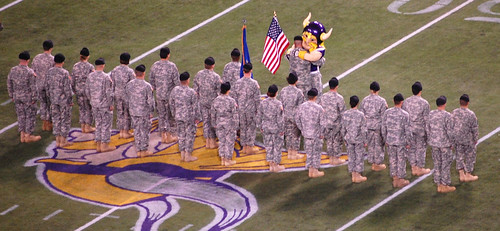
      Honoring Vets Packers-Vikings 11/09/08


      At the Packer-Viking game on Sunday they honored a group of returning Veterans from Minnesota. I honor them today.